BeyondNISQ

77 posts

BeyondNISQ banner
BeyondNISQ

BeyondNISQ

@BeyondNISQ

I came for the Signal, but stayed for the Noise. "If you think you understand quantum mechanics, you don't understand quantum mechanics." -Richard Feynman

Katılım Haziran 2025
64 Takip Edilen374 Takipçiler
BeyondNISQ
BeyondNISQ@BeyondNISQ·
Yes-- while this has drawn some scrutiny from the quantum community, it has sent shockwaves through the cyber security community. Whether it is this new Jesse-Victor-Gharabaghi Algorithm, or another innovation, the fact that innovation comes at you fast and from anywhere, an has game changing impacts should scare anyone into running towards PQC, fast.
English
0
0
3
53
BeyondNISQ
BeyondNISQ@BeyondNISQ·
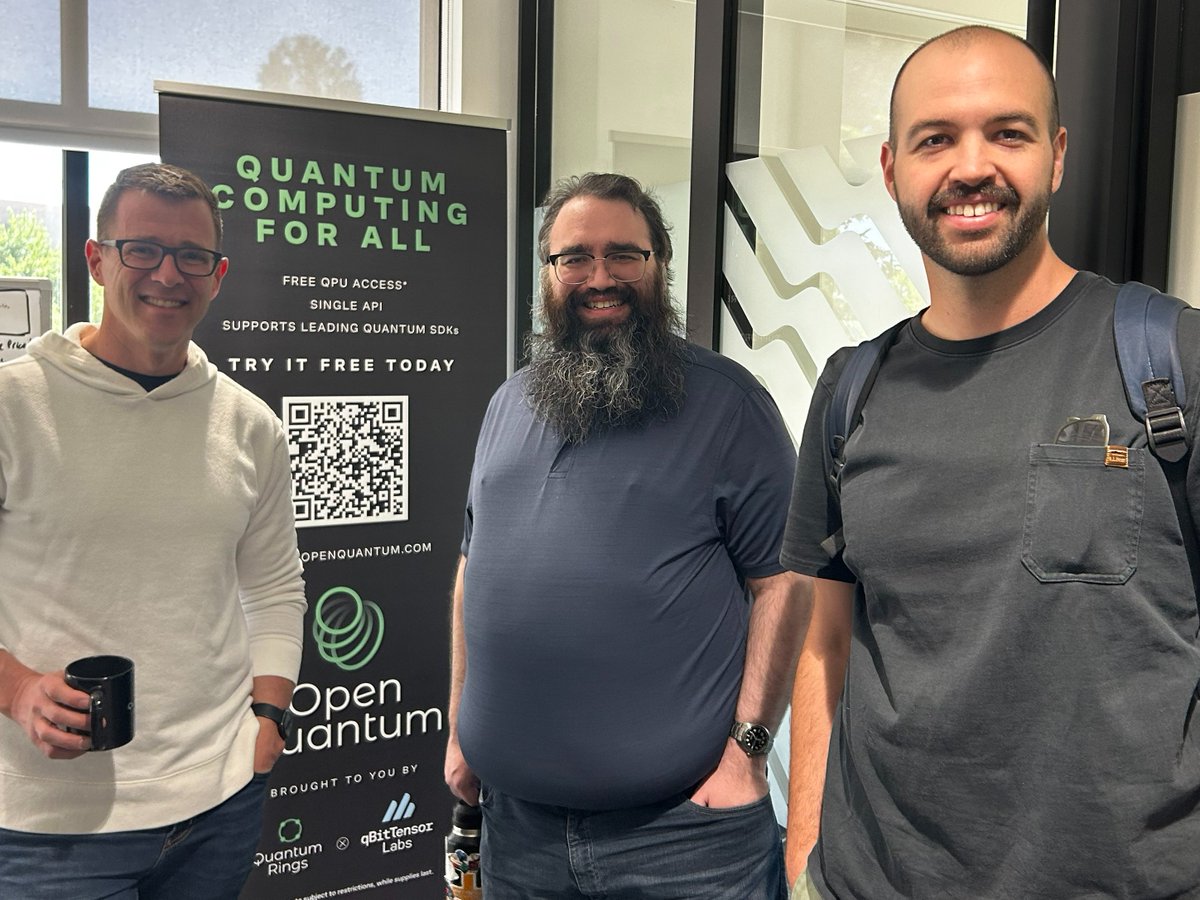
It was great to spend the weekend with the Hackers, the industry sponsors, and the facilitators. Always inspired by what small teams of passionate people can do in a short period of time.
qBitTensor Labs@qBitTensorLabs

Witness hundreds of students from across the world contributing to @OpenQuantum_ as they compete to solve the Quantum Rings Challenge in the 2026 @MIT #iQuHACK event. Won't be long before quantum gigabrains like these are competing for massive payouts on #SN63...

English
1
0
5
212
BeyondNISQ
BeyondNISQ@BeyondNISQ·
Could this be true? @IcebergQuantum just claimed that instead of ~1M physical qubits, RSA 2048 can now be broken with ~100k physical qubits using their LDPC codes. "As a concrete demonstration, Pinnacle shows how breaking RSA-2048 — long considered to require millions of physical qubits — could be achieved with fewer than one hundred thousand" finance.yahoo.com/news/iceberg-q… While we still have a long way to go to 100k qubits, we seems to be getting about a 10x reduction each year, while quantum computers rapidly grow. Don't Panic, Do Prepare.
English
0
5
10
2.4K
BeyondNISQ
BeyondNISQ@BeyondNISQ·
Anyone from the Bittensor ecosystem making the trip out to Colorado for @EthereumDenver? My team is bouncing around the idea of setting up a casual open coffee hour near the venue during the conference, and I wanted to see if anyone would be interested.
English
2
4
11
687
BeyondNISQ
BeyondNISQ@BeyondNISQ·
JB is probably right here. Two questions where I’d love community input: 1 - Timing — With the broader crypto market on fire (and the ripple effects on Bittensor, etc), is now the right moment to do a tour? Or will it land on deaf ears given everything else going on? 2 - Selection — We want long-term investors who truly see the value in quantum—not speculators. (Speculators burned us in TAO flow: short-term hype, long-term pain.) With that in mind, which shows/podcasts/conferences should we prioritize? Appreciate any thoughts!
JB Rings@dTAO_Dad

@qBitTensorLabs Podcast tour updating the Bittensor community soon plz! @BeyondNISQ

English
6
4
12
2.7K
BeyondNISQ
BeyondNISQ@BeyondNISQ·
@qBitTensorLabs If they don't give him back soon, we are doomed! j/k. Thanks for representing the team Ryan.
English
0
0
8
118
qBitTensor Labs
qBitTensor Labs@qBitTensorLabs·
🚨 BREAKING NEWS: ShorShot (Ryan) has been taken in by the FBI! 🚨 Last week Ryan visited the FBI Denver headquarters where he represented Quantum Rings at the Protecting Quantum Summit. Ryan joined the leading quantum companies from across the front-range, to dive deep into the threat landscape for quantum companies. No surprise: the FBI is advising quantum companies to watch out for incoming threats from bad actors who want to get their grubby hands on leading quantum tech. 🫡
qBitTensor Labs tweet mediaqBitTensor Labs tweet media
English
5
2
36
949
qBitTensor Labs
qBitTensor Labs@qBitTensorLabs·
The intersection of Crypto & Quantum – That’s the lane we are in. Believer or skeptic, quantum is coming and will fundamentally impact cryptocurrency. The big question? When do you think quantum breaks crypto? ~ < 5 years ~ 5-10 years ~ 10+ years #QuantumComputing #NextWave #BreakingBTC
qBitTensor Labs tweet media
BeyondNISQ@BeyondNISQ

Well researched and written but not exactly "succinct" @SuccinctJT :-) I want to take a moment to highlight that this is substantially grounded in a single snapshot of where the technology sits today. To give a fair assessment of cryptographic risk accurately, however, snapshots are insufficient. Trends matter, and current trends do suggest a non-trivial chance of a materially more aggressive trajectory than your write-up implies. Innovation Reducing the Required Resources A concrete example is Craig Gidney’s May 2025 paper, “How to factor 2048-bit RSA integers with less than a million noisy qubits.” Under explicit error-correction and architectural assumptions, Gidney shows that a machine with <1 million noisy physical qubits could, in principle, factor RSA-2048 in under a week. For context, this single paper reduced prior resource estimates by more than an order of magnitude, from ~20 million qubits (Gidney–Ekerå 2019) to ~1 million. This is not speculative hype; it is grounded in published fault-tolerant resource modeling, improvements in modular arithmetic, and optimized magic-state management. ArXiv: arxiv.org/abs/2505.15917 Innovation Driving High Quality Logical Qubits On the hardware side, IonQ’s publicly disclosed roadmap now projects fault-tolerant logical qubit counts far beyond trivial scales. According to their 2025–2026 technical disclosures, IonQ targets: ~8,000 logical qubits by 2029 ~80,000 logical qubits by 2030, with very low logical error rates If logical qubits are treated as the relevant, error-corrected computational resource (which you may say is optimistic, and I may agree) then multi-thousand logical-qubit systems within this decade directly challenge the assumption that CRQCs are inherently decades away, even without assuming further algorithmic breakthroughs beyond Gidney’s work. Putting it Together The relevant question, then, is not whether a CRQC exists today, but whether it could plausibly emerge on an accelerated timeline driven by algorithmic innovation and aggressive engineering roadmaps. Taken together, the 2025 resource reductions and public industry plans make it increasingly plausible that conventional public-key cryptography could be threatened before the end of this decade, and likely within the next. In your concluding lines you note: "I won’t argue that a cryptographically relevant quantum computer in five years is literally impossible, only highly unlikely." I agree with this assessment. However, from a traditional risk-mitigation perspective, outcomes that are low probability but high impact cannot be dismissed. For cryptographic systems underpinning critical infrastructure, financial markets, and national security, the appropriate posture is not prediction, but preparedness. This argues for measured, proactive transitions to quantum-resilient cryptography rather than reactive responses once timelines become uncomfortably clear. I should note that your analysis of how Bitcoin is (and is not) vulnerable, and your core distinctions between encryption, signatures, and HNDL risk, are strong and people should be aware of these distinctions.

English
3
3
28
1.3K
BeyondNISQ
BeyondNISQ@BeyondNISQ·
Well researched and written but not exactly "succinct" @SuccinctJT :-) I want to take a moment to highlight that this is substantially grounded in a single snapshot of where the technology sits today. To give a fair assessment of cryptographic risk accurately, however, snapshots are insufficient. Trends matter, and current trends do suggest a non-trivial chance of a materially more aggressive trajectory than your write-up implies. Innovation Reducing the Required Resources A concrete example is Craig Gidney’s May 2025 paper, “How to factor 2048-bit RSA integers with less than a million noisy qubits.” Under explicit error-correction and architectural assumptions, Gidney shows that a machine with <1 million noisy physical qubits could, in principle, factor RSA-2048 in under a week. For context, this single paper reduced prior resource estimates by more than an order of magnitude, from ~20 million qubits (Gidney–Ekerå 2019) to ~1 million. This is not speculative hype; it is grounded in published fault-tolerant resource modeling, improvements in modular arithmetic, and optimized magic-state management. ArXiv: arxiv.org/abs/2505.15917 Innovation Driving High Quality Logical Qubits On the hardware side, IonQ’s publicly disclosed roadmap now projects fault-tolerant logical qubit counts far beyond trivial scales. According to their 2025–2026 technical disclosures, IonQ targets: ~8,000 logical qubits by 2029 ~80,000 logical qubits by 2030, with very low logical error rates If logical qubits are treated as the relevant, error-corrected computational resource (which you may say is optimistic, and I may agree) then multi-thousand logical-qubit systems within this decade directly challenge the assumption that CRQCs are inherently decades away, even without assuming further algorithmic breakthroughs beyond Gidney’s work. Putting it Together The relevant question, then, is not whether a CRQC exists today, but whether it could plausibly emerge on an accelerated timeline driven by algorithmic innovation and aggressive engineering roadmaps. Taken together, the 2025 resource reductions and public industry plans make it increasingly plausible that conventional public-key cryptography could be threatened before the end of this decade, and likely within the next. In your concluding lines you note: "I won’t argue that a cryptographically relevant quantum computer in five years is literally impossible, only highly unlikely." I agree with this assessment. However, from a traditional risk-mitigation perspective, outcomes that are low probability but high impact cannot be dismissed. For cryptographic systems underpinning critical infrastructure, financial markets, and national security, the appropriate posture is not prediction, but preparedness. This argues for measured, proactive transitions to quantum-resilient cryptography rather than reactive responses once timelines become uncomfortably clear. I should note that your analysis of how Bitcoin is (and is not) vulnerable, and your core distinctions between encryption, signatures, and HNDL risk, are strong and people should be aware of these distinctions.
English
0
5
15
1.8K
BeyondNISQ retweetledi
The Quantum Insider
The Quantum Insider@QuantumDaily·
New data from The Quantum Insider shows a clear shift. Quantum is moving out of labs and into the real world. Countries and companies are now installing hardware, building networks and scaling facilities. thequantuminsider.com/2025/12/02/ins…
The Quantum Insider tweet media
English
3
4
26
2.6K
BeyondNISQ
BeyondNISQ@BeyondNISQ·
We are getting ready to open up beta access to free quantum compute to the next major wave of users on @OpenQuantum_ If you haven't pre-registered yet, get registered at openquantum.com in the next few hours, and you might still make the next wave of users ;-)
BeyondNISQ tweet media
English
1
15
43
2.5K
BeyondNISQ
BeyondNISQ@BeyondNISQ·
"Maybe Satoshi left his wallet as a reward for the first of to build a good enough quantum computer" Scott Aaronson 02-Dec-2025
English
1
4
22
1.3K
BeyondNISQ retweetledi
StarkWare (Privacy) 🥷
StarkWare (Privacy) 🥷@StarkWareLtd·
Will quantum computing kill Bitcoin? @EliBenSasson & Prof. Scott Aaronson, one of the world’s leading quantum computing experts, are hosting a special webinar to explore how quantum breakthroughs could reshape the crypto landscape. December 2nd, 2:30 PM UTC. RSVP required 👇
StarkWare (Privacy) 🥷 tweet media
English
27
33
152
42.3K
BeyondNISQ
BeyondNISQ@BeyondNISQ·
@coinbureau Agreed-- though 2029 is more likely if current QPU roadmaps are to be believed. ...If you're a skeptic: 2035
English
0
1
7
192
Coin Bureau
Coin Bureau@coinbureau·
🚨VITALIK: QUANTUM COMPUTERS COULD BREAK ETHEREUM AND BITCOIN BY 2028. He warned that quantum computing could break the elliptic curve cryptography securing Ethereum and Bitcoin within four years.
Coin Bureau tweet mediaCoin Bureau tweet mediaCoin Bureau tweet media
English
1K
762
4.8K
1.7M
BeyondNISQ
BeyondNISQ@BeyondNISQ·
Last week Google's quietly dropped this gem with the potential to wildly accelerate the timeline to quantum advantage in optimizations. Optimization has always been quantum computing's biggest opportunities, but also had the longest road to scale. The traditional approached like QAOA have insane resource requirements to beat classical methods at scale, and has been mired skepticism about a potential speed up. This discovery has the potential to change all that. Decoded Quantum Interferometry reframes certain optimization problems as decoding, with the potential to tackle bigger problems on nearer-term hardware. If it holds weight and scales, then the top quantum use case has a much more reasonable timeline. Kudos to the team on this breakthrough. I can't wait to see it in action.
Google Quantum AI@GoogleQuantumAI

Recently published in @Nature, Decoded Quantum Interferometry (DQI), a new quantum algorithm achieving exponential speedup on select optimization problems. Learn more → goo.gle/43v6Nsa

English
0
6
18
1.6K