Bjoern Gehrmann

7.8K posts

Bjoern Gehrmann banner
Bjoern Gehrmann

Bjoern Gehrmann

@BjoernGehrmann

Economist (PhD, @humboldtuni) & Mediator (MAS, @ETH). Evidence-based Foreign Policy. Personal #EconTwitter account; (re-)tweets ≠ endorsements

Berlin & Sion VS Katılım Ağustos 2011
1.4K Takip Edilen973 Takipçiler
Sabitlenmiş Tweet
Bjoern Gehrmann
Bjoern Gehrmann@BjoernGehrmann·
„The efforts of men are utilized in two different ways: they are directed to the production or transformation of economic goods, or else to the appropriation of goods produced by others.“ - Vilfredo Pareto
English
0
1
10
0
Bjoern Gehrmann
Bjoern Gehrmann@BjoernGehrmann·
@policytensor @dov_levin The key to peace is China. The US has disciplined Israel in 2024 re Lebanon, via the Hochstein mediation when Biden withheld key weapons deliveries for the Gaza campaign.
English
0
0
1
56
Policy Tensor
Policy Tensor@policytensor·
Specifically, I think China may have already guaranteed weapons supply to ensure that Iran will not be disarmed by the aggressors. This is bc I don’t see how the US and Israel can reassure Iran that it will not be attacked again. The meeting itself seems confirmation. For the Israeli case. I suspect that Hamas is not up for debate for the Israelis. Or the West Bank.
English
1
0
1
186
Policy Tensor
Policy Tensor@policytensor·
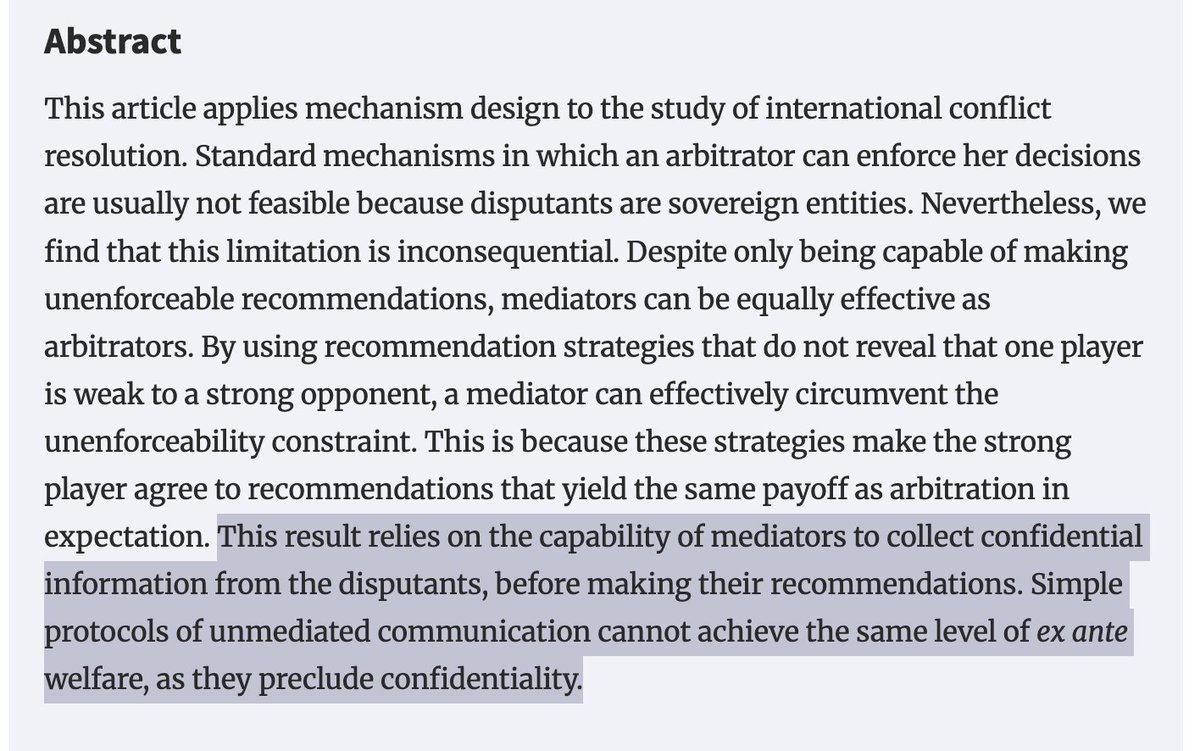
Thank you, @BjoernGehrmann! Look at the abstract. The result requires trust between both sides and the mediator. Can Pakistan pull this off? Do you think they have enough trust with the Chinese and the Americans, @dov_levin?
Policy Tensor tweet media
Bjoern Gehrmann@BjoernGehrmann

Take a look at this: academic.oup.com/restud/article… „mediators can be equally effective as arbitrators. By using recommendation strategies that do not reveal that one player is weak to a strong opponent, a mediator can effectively circumvent the unenforceability constraint.“

English
2
1
12
4.4K
Bjoern Gehrmann
Bjoern Gehrmann@BjoernGehrmann·
…and this one: journals.uchicago.edu/doi/abs/10.108… „We study a model in which […] a form of third-party mediation inspired by work of Myerson effectively brokers peace in emerged disputes and also minimizes equilibrium militarization.“
English
0
1
6
578
Bjoern Gehrmann
Bjoern Gehrmann@BjoernGehrmann·
Take a look at this: academic.oup.com/restud/article… „mediators can be equally effective as arbitrators. By using recommendation strategies that do not reveal that one player is weak to a strong opponent, a mediator can effectively circumvent the unenforceability constraint.“
Policy Tensor@policytensor

One question that I haven’t seen explored is mechanism design for two sided negotiations. Isn’t there a tidy way to repurpose auction theory? Like: both sides submit sealed bids to Pakistan repeatedly until we have a solution?

English
1
0
5
4.8K
Bjoern Gehrmann retweetledi
Hanno Lustig
Hanno Lustig@HannoLustig·
Back in the 1960s, Robert Triffin predicted that the Bretton-Woods arrangement would be short-lived. To keep the world supplied with enough dollars, the US would have to keep running balance of payment deficits, ultimately leading investors to question the gold backing of all those dollars being recycled abroad. He was proven right within a decade. This time around, the same questions are being asked about the backing of US Treasurys. The Safe Assets that weren't. open.substack.com/pub/thetwocent…
Hanno Lustig tweet media
English
14
117
598
47.1K
Bjoern Gehrmann retweetledi
Rudi Bachmann
Rudi Bachmann@BachmannRudi·
Ja. Einverstanden. Ich plädiere schon lange dafür, mit den bestehenden Steuerarten in Deutschland ein Art progressive Konsumsteuer zu erzeugen.
Mike Ryko 🚴🏻‍♂️🚴🏻‍♂️@mikeryko1

@BachmannRudi @social_sth @liberal_dvh @haucap Stimme ich zu. Der Teil mit den. Verteilungsfragen ist trotzdem richtig. Warum sollen z.B. immer weiter Einkommen belastet werden, statt Vermögen zu belasten. Klar, Vermögensbesteuerung hat negative Effekte auf Investitionen usw. Höhere Einkommensteuer haben aber auch neg Effekte

Deutsch
3
2
18
6K
Bjoern Gehrmann
Bjoern Gehrmann@BjoernGehrmann·
Democratic legitimacy, anyone?
Balaji@balajis

POLITICAL BILLIONAIRES The clip below is a good encapsulation of what modern China is by Eric X. Li, who’s one of the most thoughtful Chinese nationalists. I appreciate his description, because the Internet is the exact opposite. Because on the Internet, capital (in the form of Bitcoin, and more generally smart contracts) really does stand above any given state. The negative way of framing this emerging reality is that Internet capitalists are now above national governments. The positive way of framing it is: anyone can become an Internet capitalist, and there is now truly global rule-of-code that no state can easily abrogate. Moreover, individuals can’t have their digital rights revoked even by powerful states. As for whether it’s bad if “billionaires” have influence over the government…the reality is that political leaders control many billions in assets. For example, a city like SF with ~$16B in annual budget and 11 supervisors plus a mayor essentially has 12 political billionaires. Each of these political billionaires allocates $1B+ per year in cash, on average. This is orders of magnitude more than a typical tech billionaire allocates. That’s because tech billionaires might have $1B in net worth but perhaps only $10-50M liquid. So: market billionaires actually have far less in the way of financial resources than political billionaires. A market billionaire might allocate perhaps $100M over the course of their lifetime, whereas a political billionaire will allocate $1B+ in a single year. This is a >100X differential. Now, yes, it’s true that political billionaires have less for personal consumption than market billionaires do, but that is (almost by definition) societally unimportant. A political billionaire spending a billion on government worker salaries does a lot more to steer the world than a pair of fancy shoes. One might also argue that political budgets are less discretionary than market budgets, and I’d agree, but the sheer scale of public budgets makes up for it. Even if only 1% of a $16B city budget is discretionary, that’s $160M in discretionary cash per year. Anyway, the point is that anyone in control of a giant public budget is already in full billionaire mode. They are allocating billions in capital, so they are political billionaires. You are going to have billionaire-run government in this sense no matter what.

English
0
0
0
107
Bjoern Gehrmann retweetledi
Moritz Kuhn
Moritz Kuhn@kuhnmo·
Wichtig ist, dass die Rohdaten für die Wissenschaft gut zugänglich sind, so dass die wir mit den Daten arbeiten und Statistiken zur Armut und ihrer Entwicklung erstellen können. Die Wissenschaft braucht dafür kein Statistisches Bundesamt. Die Vorwürfe sind unbegründet! 1/2m
Martyna Linartas@martyna_lin

Es ist ein nicht akzeptabler Eingriff in die wissenschaftliche Freiheit: Das Statistische Bundesamt nutzt eine umstrittene, neue Methode und schon wird die #Armut mal eben um mehr als 1 Million Menschen geringer. Dagegen haben wir Beschwerde eingereicht. zeit.de/gesellschaft/2…


Deutsch
2
4
27
4.4K
Bjoern Gehrmann retweetledi
Nassim Nicholas Taleb
Nassim Nicholas Taleb@nntaleb·
A noble person is kind to a stranger he will never meet again, when nobody is watching, & when he has nothing to gain. The rest is self-promotion, social climbing, or profit seeking.
English
173
1.7K
10.8K
406.4K
Bjoern Gehrmann retweetledi
Luis Garicano 🇪🇺🇺🇦
I love all the micro policies of Milei. Rent liberalization and bonfire of regulation works as expected. But I agree in being worried about the macro side. While fiscal deficits are gone, the peso is increasingly overvalued (eg. Big Mac index), the current account is flipping to a deficit in 2025. Looks unsustainable.
Brad Setser@Brad_Setser

The bond market, at least parts of it, still pay attention to the balance of payments "Milei remains unable to tap international dollar markets. One reason investors ... is [Argentina's] failure to rebuild its foreign currency reserves." 1/

English
11
19
113
33.8K
Bjoern Gehrmann
Bjoern Gehrmann@BjoernGehrmann·
What about killer acquisitions? @florianederer
Balaji@balajis

Strongly disagree. (1) The actual reform would be to make IPOs easier, by essentially eliminating Sarbox. And we'll actually get that reform... but only via crypto, because all companies will become cryptoequities. However, that means they'll list on Internet capital markets and crypto exchanges, rather than NYSE/NASDAQ. (2) See how the number of US public companies has crashed since the early 2000s? Then, ten years later, the number of Internet coins started soaring. The big picture is that we're just sunsetting US capital markets in favor of Internet capital markets. (3) Now, let's talk about why random government interference with voluntary capitalist transactions is so bad. (a) First, bigcos (invisibly) reduce already rare M&A activity, because they need to budget for a global fight with regulators just to get a deal done. (b) Next, bigcos are forced into baroque deal structures, like the recent Character, Scale, Inflection, Adept, Covariant, and Windsurf deals, which can cause drama for everyone. (c) And, bigcos are forced to fight to the death with startups rather than surrender to them by acquiring them. In practice this often means political skullduggery. (d) Finally, bigcos put far less of their profits into exits, which in turns results in less money for tech startups. After all, a big M&A is a big surrender for a bigco, as they'd prefer not to capitulate to a startup by buying them. So: that means less M&A, more complexity, more politics, and less money. That's like every dysfunctional socialist country, where businesses need to use political connections simply to get a deal done. To be clear: of course I understand the hostility towards Big Tech, which did after all censor millions. But regulations in general strengthen bigcos by making it so complex and expensive to do things that startups can't compete (or, in this case, get acquired). Finally: the Elizabeth Warren/Lina Khan faction of statists generally haven't founded businesses and certainly don't want to advance technology. Their actual policy goal was to kill tech and stop us from getting to Mars. Sometimes they're explicit about it; see poster below. The only edit you'd make is that they were building an anti-tech army, and that army was (for now) defeated on the battlefield of ideas.

English
0
0
1
315
Bjoern Gehrmann retweetledi
Luis Garicano 🇪🇺🇺🇦
Turnberry ends the free trading world that made Europe rich. For decades, we profited from free trade while America paid for our security. Now the bill has come due. 15% tariffs, $750B energy purchases, $600B investments—for nothing in return. My take: siliconcontinent.com/publish/post/1…
English
13
19
90
28.3K
Bjoern Gehrmann retweetledi
Luis Garicano 🇪🇺🇺🇦
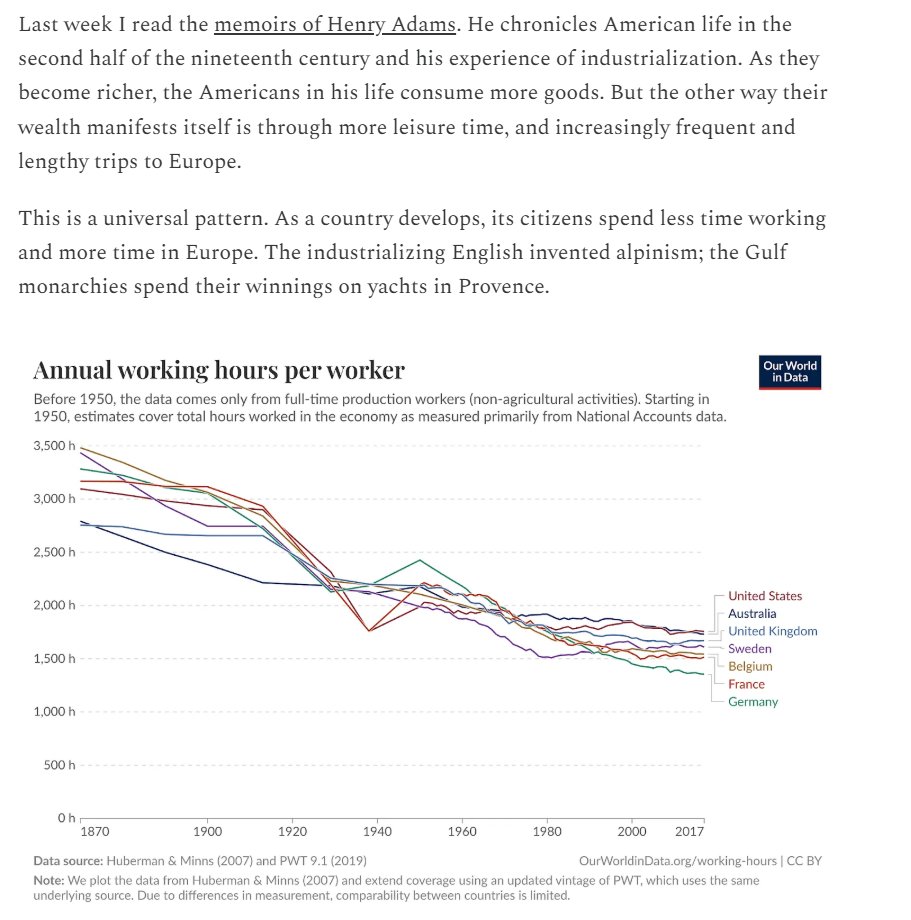
Europe may struggle to automate its own economy. But if it remains the world's preferred leisure destination, it can capture gains from everyone else's automation. @pietergaricano explores the other side of Baumol in Silicon Continent. 🧵 1/9
Luis Garicano 🇪🇺🇺🇦 tweet media
English
2
34
128
23.9K
Bjoern Gehrmann retweetledi
Moritz Kuhn
Moritz Kuhn@kuhnmo·
Guter Kommentar zur Arbeitsweise des öffentlichen Dienstes in Deutschland: Deutschland, eine Juristenrepublik faz.net/einspruch/juri…
Deutsch
0
6
17
856
Bjoern Gehrmann retweetledi
Lars Christensen
Lars Christensen@MaMoMVPY·
That is not what the market is pricing - if that was the case then the dollar would not be significantly weaker and the US Stock market significantly lower relative to Europe. This is an increasing US risk premium.
Robin Brooks@robin_j_brooks

Never in the last 20 years has there ever been such a massive divergence in long-term real interest rates between the US (blue) and Euro zone (black). Markets price continued stagnation in the Euro zone versus continued growth outperformance in the US. I think that's right...

English
3
7
45
16.8K
Bjoern Gehrmann retweetledi
Lorenz Kueng
Lorenz Kueng@LorenzKueng·
Health Impacts of Federal Pandemic Aid to State and Local Governments "The researchers estimate that each additional $1,000 in federal aid per state resident led to 38 fewer deaths per 100,000 residents from all causes over the 2020–2022 period." nber.org/papers/w33699 1/n
English
1
4
6
1.4K