

Brahmareddy
2.6K posts

Brahmareddy
@BrahmaWritings
Data Engineer | Building & researching Data, AI & ML | Sharing real experiences | USA 🇮🇳🇺🇸
United States Katılım Şubat 2019
145 Takip Edilen274 Takipçiler
@vemuruadi Exactly, identify key drivers, predict outcomes, and keep refining the decision loop continuously.
English

@BrahmaWritings So core 2 todos for analytics are once we define decision objective are - understand driving factors and then simulate/predict the factors. N repeat.
English
Every company collects data.Every company collects data. Very few use it to make better decisions.
The gap between dashboards and decisions is the most expensive problem nobody talks about.
English
@vemuruadi Hmmm, Adi. it is important to define the decision clearly, use data to understand what drives it, predict what will happen, and keep improving it over time.
English
@BrahmaWritings Can we frame a decision as: Objective, working on inputs, driving a workflow with some factors?
So what are analytics todos on this decision?
English
@praveenTweets @UberEng The best experience would be if I could simply ask Siri to book an Uber ride or place an Uber Eats order, and the entire process completes smoothly without any extra manual steps.
English

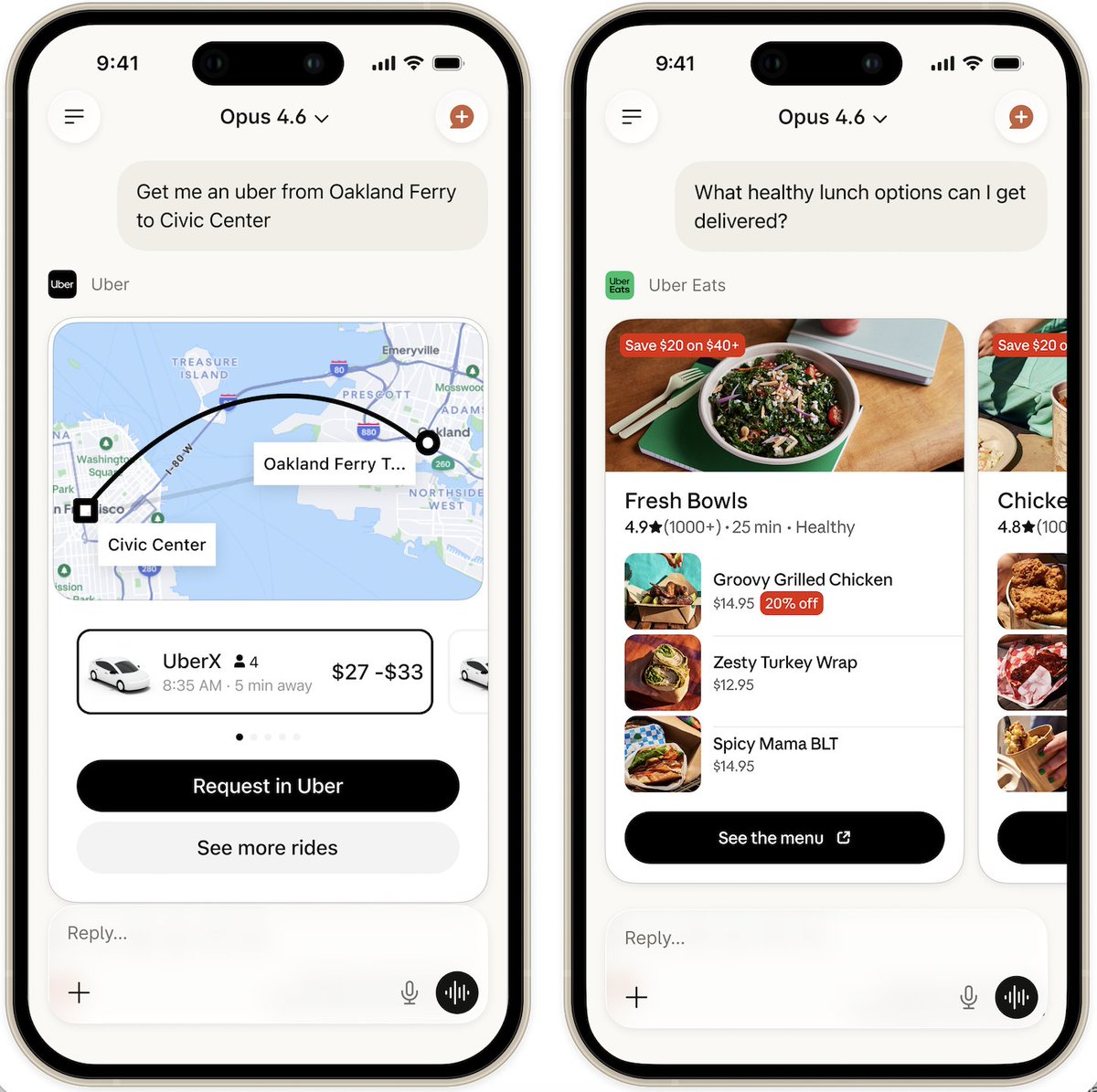
Excited to bring Uber & Uber Eats into Claude! Browse restaurants, check fare ranges, see ETAs, and complete trips or orders seamlessly.
A strong example of AI simplifying everyday use. Great team effort to make it fast, reliable, and intuitive. 🚀 @UberEng
English
The strength of American tech is simple: the world uses it every single day.
English
Today, 75% of all new code at @Google is generated by AI and approved by engineers, up from 50% just last fall.
We are now entering a truly agentic era, where engineers orchestrate autonomous digital task forces, deploy agents with intent, and deliver results at an entirely new level.
English
@sundarpichai Hmm, TPU's are potential and they are underrated.
English

TPU 8t, optimized for training and TPU 8i, optimized for inference.
Looking good!

English
Google Cloud has incredible momentum: our models now process 16B+ tokens /min via direct API use by our customers (up from 10B last quarter).
This week at Cloud Next we’re sharing an extraordinary range of new partnerships and innovations, including our new Gemini Enterprise Agent Platform, the new mission control to build, scale, govern, and optimize agents. We’re also launching our 8th-gen TPUs to take on the most demanding agentic workloads.
Congratulations to our @GoogleCloud team, and a huge thanks to our partners who are building the future with us.
GIF
English
We are living through a moment when advances in science, medicine, and artificial intelligence are accelerating at an unprecedented pace.
English
Excited for @databricks @Data_AI_Summit 2026. Strong themes, practical sessions, and a great chance to learn where Data + AI is really heading. June 15 to 18 will be worth watching closely.
English
AI will move fast, but clear data thinking will still be the skill that separates noise from real value.
English
The warehouse vs. lakehouse debate is dead.
The REAL question in 2026:
Can your data platform serve both humans AND AI agents safely?
That's where Unity Catalog, governed metadata, and Lakebase come in.
The future belongs to engineers who think in systems, not scripts.
English
In 2024, you wrote ETL jobs.
In 2025, you reviewed AI-generated ETL jobs.
In 2026, you're designing guardrails for agents that write, test, AND deploy their own pipelines.
The engineers who thrive?
They're learning:
→ Evaluation-Driven Development (EDD)
→ Context engineering for LLMs
→ Agent orchestration patterns
English
80% of new databases on Databricks are now launched by AI agents, not humans. Let that sink in.
The role of a Data Engineer is shifting from "pipeline builder" to "system architect + AI supervisor."
Here's what this means for your career 🧵👇
English

You have no experience.
You’ve never started a company.
You’ve never had a full time job.
Nike is going to kill you.
You’re a kid.
You don’t have technical skills.
You shouldn’t build hardware.
Apple is going to kill you.
You can’t build hardware.
You can’t measure heart rate non-invasively.
Athletes don’t care about recovery.
Under Armour is going to kill you.
It won’t be accurate.
You don’t listen.
You’re an ineffective leader.
You can’t recruit great talent.
You’re going to have to pay every athlete.
You can’t measure sleep non-invasively.
It’s too expensive to research.
Athletes are a small market.
The product costs too much to make.
The product costs too much to sell.
Your valuation is too high.
Consumers aren’t going to want it.
Hardware is too hard.
You should measure steps.
Fitbit is going to kill you.
You can’t build a marketing engine.
You can’t raise enough money.
You need a real CEO.
Google is going to kill you.
You can’t be a subscription.
You can’t build a brand.
You can’t do consumer in Boston.
Your valuation is too high.
You shouldn’t make accessories.
You shouldn’t make apparel.
Lululemon is going to kill you.
You can’t predict Covid.
Stay in your niche.
You are going to run out of money.
You can’t build a health platform.
Amazon is going to kill you.
You can’t measure blood pressure.
You can’t get medical approvals.
The market is too small.
You don’t understand AI.
The market is too competitive.
It won’t work internationally.
The supply chain is too complicated.
You can’t build an AI.
You can’t raise enough money.
It’s too competitive.
Healthcare isn’t going to want it.
…
Just keep going ✌️

English
Hmm, tried this preview couple of months back. This is a big shift.
Maps is no longer just navigation. It’s becoming an AI layer between people and the physical economy.
As a data engineer, what stands out is the scale. Real-time context, 300M businesses, 500M reviews, live traffic signals, all filtered per user. That’s serious data orchestration.
The opportunity is huge.
But so is the responsibility.
When algorithms decide visibility for millions of local businesses, transparency and fairness matter more than ever.
English

Google just dropped AI agents into the planet's biggest application, Google Map.
Launched today across the United States and India.
This fundamentally positions an AI model as the primary gatekeeper between everyday consumers and the local economy.
Users can ask complex questions like how to find a phone charging spot without waiting in a long line.
Before this update, the app required exact names or basic categories to find places. Now, the system understands the context of a full sentence and cross-references it with a database of over 300M businesses and 500M user reviews. It filters these massive datasets in real time based on personal search history to present a custom itinerary.
This is a massive shift because a single algorithm now actively decides which local shops get seen by 2B users.
It essentially turns a neutral map into an active recommendation engine that could dictate the financial success of physical stores.
📌 Whats new
So the old Google Maps just gave you a flat map with a basic blue line and a voice telling you to turn right in 500 feet.
This meant you often had to guess exactly which lane you needed to be in or what the upcoming intersection actually looked like in the real world.
The new update introduces Immersive Navigation, which uses AI to completely change what you see on your screen while driving.
It constantly analyzes fresh Street View imagery to build a vivid 3D view of the exact buildings, overpasses, and terrain right outside your car window.
Instead of just a basic blue line, the screen now highlights the actual lanes, crosswalks, and traffic lights ahead of you.
This helps you perfectly prepare for a tricky lane change or a confusing highway merge way before you actually get there.
The voice guidance also sounds much more natural now, acting like a passenger who tells you to go past the current exit and take the next one.
It even processes over 5M traffic updates every second to clearly explain why an alternate route might take longer but have less traffic.
When you finally reach your destination, the map will specifically highlight the front door of the building and point out the closest parking spots.
This entire upgrade takes the stressful guesswork out of driving because your phone screen finally matches the physical layout of the road.
It is incredibly helpful to have a navigation system that actually shows you the physical reality of the road, though relying so heavily on real-time 3D rendering might drain your phone battery much faster.
Google@Google
Today @GoogleMaps is getting its biggest upgrade in over a decade. By combining our Gemini models with a deep understanding of the world, Maps now unlocks entirely new possibilities for how you navigate and explore. Here’s what you need to know 🧵
English