

Fee Developer
5.7K posts
Fee Developer
@Brian7270
Real Estate Development Futures Options
Florida Katılım Ağustos 2012
1.4K Takip Edilen378 Takipçiler

The series finale of Iran has finally kicked off. Looks like a lot of action ahead. Thank God. The writers should be fired for that stupid negotiation arc that wasted our time for like 7 episodes.
I see trailers for Cuba already dropping. Looks like a limited series, maybe 3 episodes. But should be interesting and action filled.
Honestly it seems like the studio is setting the stage for a China franchise, maybe a trilogy with Russia and North Korea, but all connected. Kind of like the marvel universe but with enemies of Western civilization.
English
Fee Developer retweetledi

Spirit Airlines died tonight at the hands of the socialist crusader, Elizabeth Warren
She must be so proud to add another casket to her achievements.
Tonight at 3am, Spirit turns off the lights. 14,000 jobs gone. 30+ smaller airports lose service.
JetBlue offered $3.8 BILLION in cash to buy Spirit in 2022. Shareholders, flight attendants union, literally everyone voted yes.
The combined company would have held 9% of the US market against a Big 4 that already owned 80%.
For anyone who understands numbers: 9% isn’t a monopoly against 80%.
Warren said no.
She wrote letters. She pressured Buttigieg. Biden’s DOJ sued. A federal judge killed the deal in January 2024.
Her argument: the merger would cost consumers $1 billion a year.
Now look at her collateral damage she dusts under the rug.
510 pilots gone in the months after. 1,800 flight attendants furloughed in December.
14,000 jobs in 2023. 7,500 last week. Zero tonight.
And that’s just the people in Spirit uniforms.
Catering goes. Fuel guys go. Baggage crews, gate agents, airport coffee shops, hotels and rental cars in 70 cities Spirit flew to. Every airline job carries 3 more on its back.
40,000 people out of work because of one woman’s moronic crusade against the market.
And the math ain’t mathing.
Spirit abandoned 90 routes during the death spiral. Fares on those routes are up 14% on average. Oakland to Newark: $135 to $288. Fort Myers to San Juan: $92 to $219. Kansas City to Newark up 66%.
That’s reality. Not some BS number from a “study.”
So @SenWarren tell me how this saves the consumer money?
Cheap carriers in a market drop fares 21% across the board. Southwest did this in the 90s and saved Americans $68 BILLION over 20 years.
Warren killed it. That’s what moronic politicians led by socialism do.
Then with her own blind arrogance, she tweeted Spirit’s collapse is “a Biden win for flyers.”
A win.
14,000 people are reading termination letters tonight.
And she’s taking credit.
This is socialism in 2026.
A senator who’s never made payroll thinks she knows how to run a market better than the people who own and work in the company.
She saved you a billion on imaginary paper.
She cost you ten times that in real life.
She didn’t protect consumers from anything.
14,000+ will go from working to welfare.
She will make sure to blame billionaires, hardworking tax payers, AI, capitalism and whatever monster they will make up tomorrow hiding under your bed.
Higher taxes. Fewer jobs. More expensive everything.
She called it a win. I hope you enjoy winning.
English
Fee Developer retweetledi

@vladtenev So when do we get conditional orders? Until then it’s a crypto app for me.
English

Fee Developer retweetledi

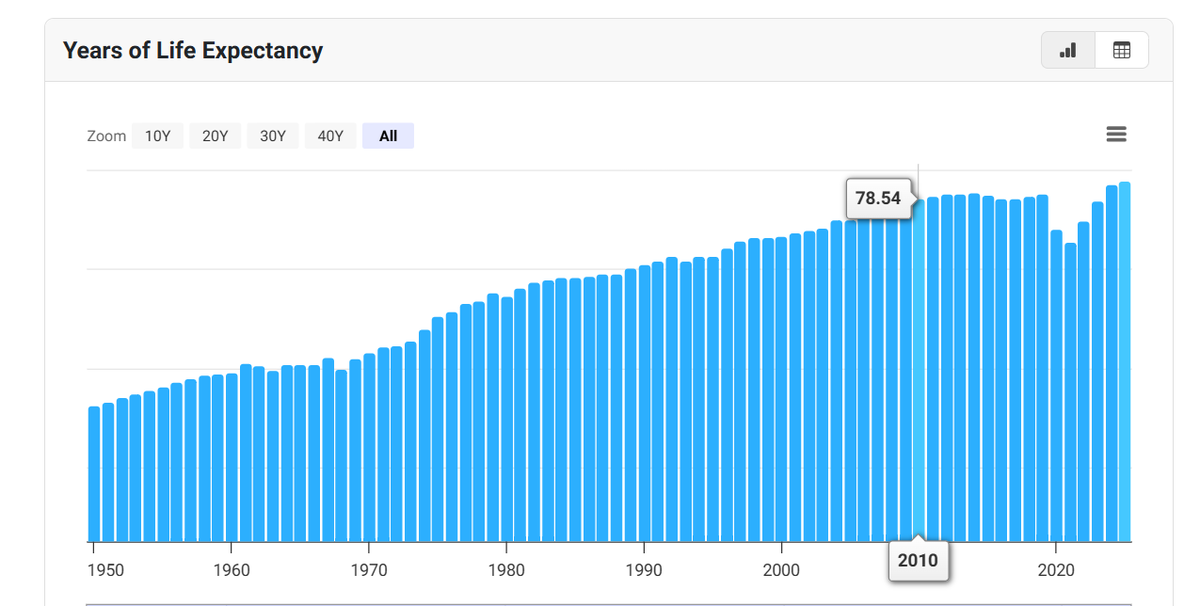
Two charts that tell you all you will ever need to know about the failure of Obamacare.
It was passed in 2010, the very year American life expectancy began to stagnate. Since then, the US has fallen ever further behind other rich countries. Yet our medical spending has doubled.

English
Fee Developer retweetledi
Yesterday I argued race-based districts inflame segregation but I think the deeper question is one nobody in the civil-rights establishment wants asked.
What did those guaranteed seats actually deliver during the past 60 years in Chicago, Baltimore, St. Louis, Memphis, Detroit, Philadelphia, and Cleveland?
The same cities, decade after decade, anchored by the safest minority Democratic seats in the country.
Look at the schools, the murder rates, the median household wealth of the constituents those seats were designed to protect. Look at how many of those incumbents have ever faced a serious primary, let alone a competitive general.
The seats were always safe, unlike the neighborhoods they represented.
A guaranteed seat with no competition produces a representative with no incentive to deliver anything beyond the performative grievance that the district expects.
The strongest argument for what the Court did this week is not legal but ethical: that the people those districts were drawn to "protect" have the least to show for 60 years of protection.
John Tillman@JohnMTillman
Today's Supreme Court decision on race-based redistricting is bigger than people even realize. I've watched this play out for two decades, mostly in Chicago. The argument for race-based districts was always that they protect minority representation. What they've actually done is inflame segregation, and not just for voters but also for the elected officials. When, say, ~90% of one racial category dominates a legislative district, the lawmaker representing it is incentivized against interacting with the world beyond it. They don't have to find common ground because there is simply no coalition to build. Alienation is a requirement of the job. Now imagine a Chicago aldermanic map drawn for compactness rather than identity: a 65/20/15 district. You literally would not be able to win a seat on city council by pandering to one single group. You'd actually have to go talk to people about how they actually live and things they care about: schools, safety, jobs, taxes. Working-class voters of every background want roughly the same things. Identity-based districts function to paper over that. But a blended district would necessitate it. The superficial grievance model of left-wing politics relies on the existence of racially sorted districts. Today's ruling makes that sorting harder. That's what matters here.
English

I'm holding calls on a penny stock I think has massive squeeze potential. Let's see if you can guess it
1) It was popular 5-7 years ago
2) The company is god awful
3) Hasn't held above the 200sma since 2021
(If you're a subscriber, don't ruin it for everyone)
English

@cantonmeow But that's how a rising wedge looks like, we don't want that.
English

$TSLA feels like it wants to do what it wants to do, but it's just hugging a rising 20 month SMA support because it's forming higher highs and higher lows to get the base loaded.

English
I guess they just showed incredible restraint with the first attacks.
The Hormuz Letter@HormuzLetter
BREAKING: A source close to Ghalibaf says US/Israeli force concentration around Iran "has reached maximum level," warning that the US will launch "an intensive surprise attack via strategic bombers and aircraft carriers targeting energy facilities," with Iran ready to respond "immediately and with excessive force using weapons that exceed expectations," targeting Israel and oil reserves in the Gulf.
English

Every dip gets bought until it doesn't
All of a sudden, the wicks stop forming and $spx is 300pts lower while you're caught with your dick in your hand and worthless calls
That's how tops are formed
English
@InvestorsLive when trump says same shit every week yet one week it is ignored and we pump and the next it is the cause for a dump, that's not trump doing it
English

If you think about it, basically what we just saw on $CAR Trump has been doing with $SPY Lol
English
@RanjYousif @unusual_whales No kidding, these posts tilt me so hard
English

@unusual_whales Survivorship bias has a name and it's '4700% gain.' Nobody's posting the guys who lit $9 on fire on the same strike yesterday.
English

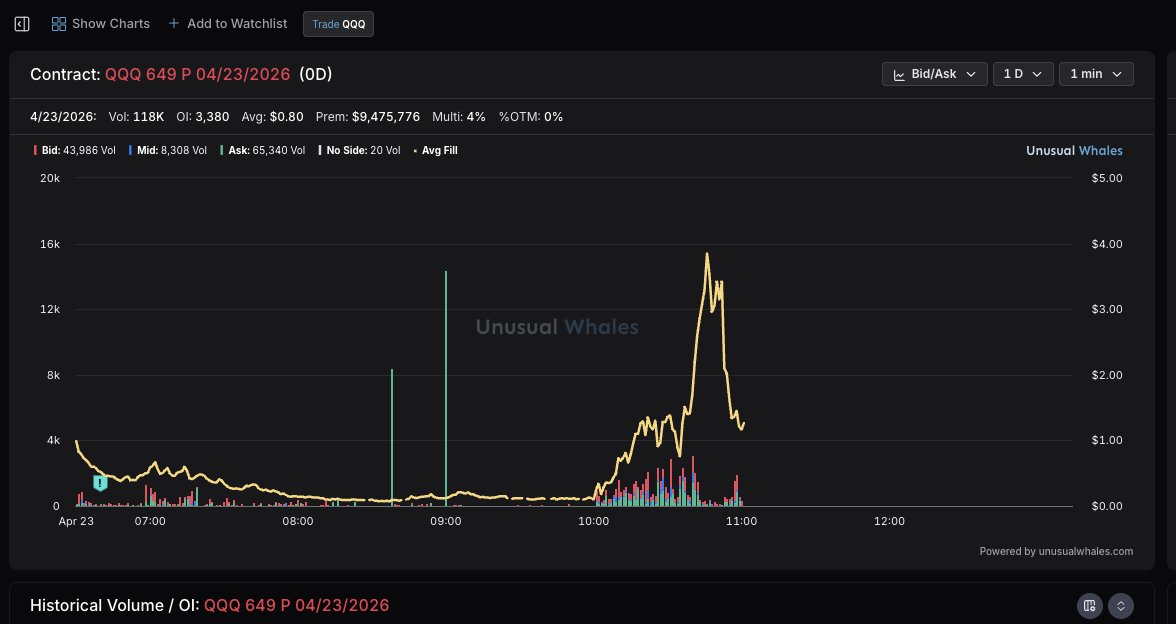
BREAKING: Look at this.
$QQQ 649 0 DTE puts opened at .09 and .12 turning a HUGE intraday return.
A high of 4.33 currently for a 4700% gain.
Someone always knows.
English
@simon_ree @PauloMacro So is the theory that some insider who is not with Iran knew Iran would say this?
English

@BITCOINFUNDMGR Yeah but you had big confidence 3 weeks ago and shorts were smoked.
English

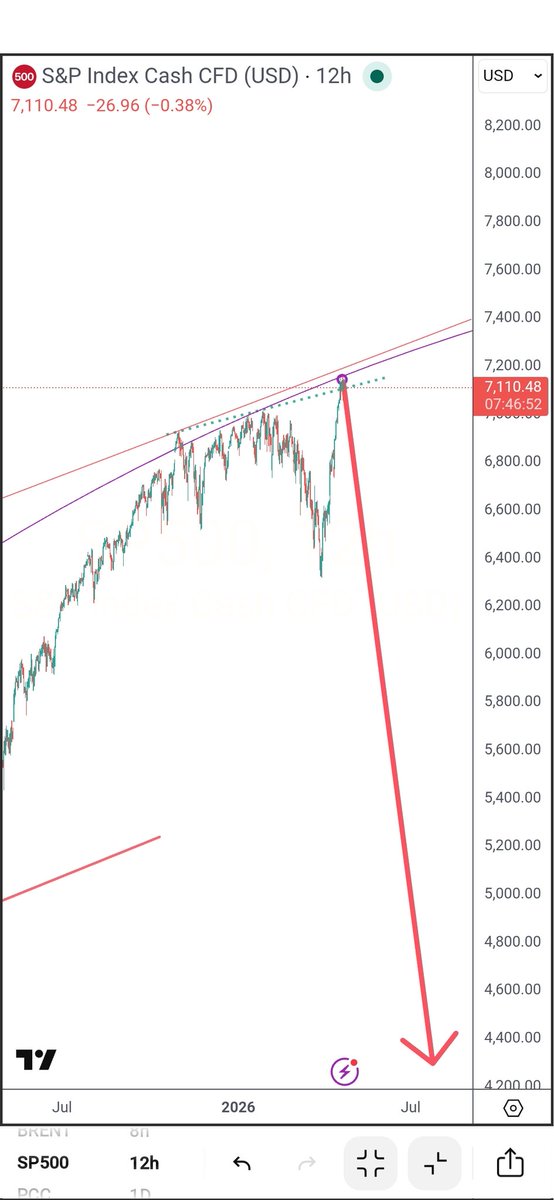
I have high confidence that this is what's happening next. The stock market is designed to transfer wealth from the masses to the elite. Begin transfer.

English
@DiveBomb321 we were in distribution ahead of the war/energy moves
English

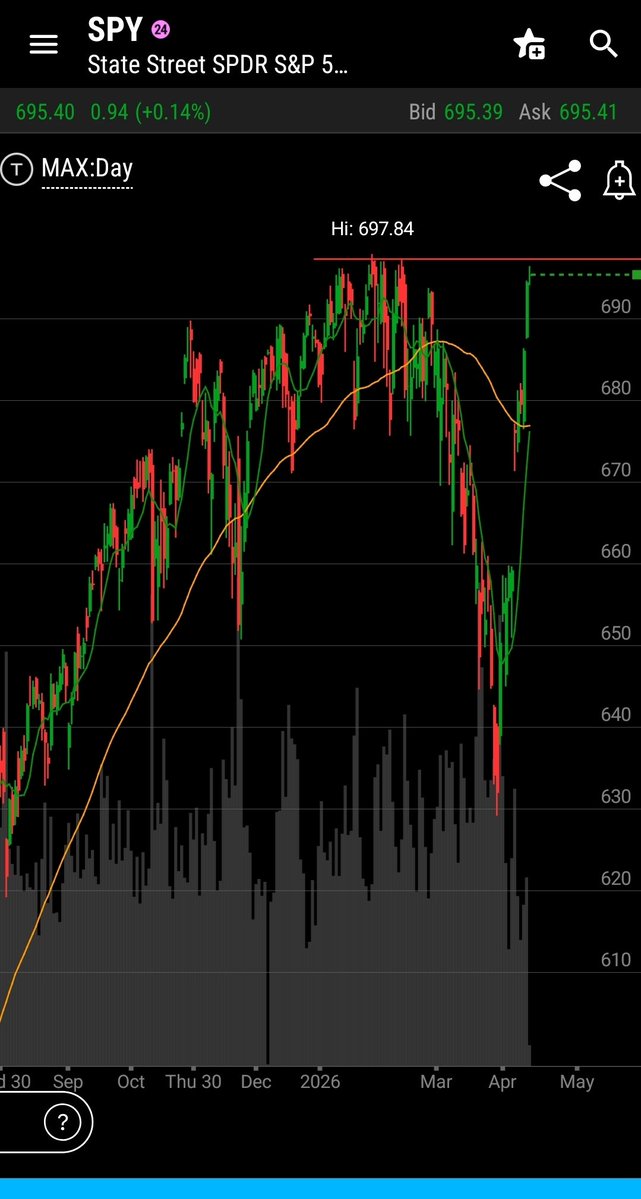
$spy so you are telling me it took months to grind up to this high in the first place and we went down because of the war and the looming energy crisis and the war isn't over and the looming energy crisis is worse and we shot back up in two weeks. That's some bullshit. 😂
English
Fee Developer retweetledi

INSANE VIDEO!!
Triggered Protesters STALK Innocent Puppet!
English
Fee Developer retweetledi

nationalreview.com/magazine/2026/…
Cui bono?
Hard to imagine a film with a more deceptive title, or a more disastrous legacy than this one. An Inconvenient Truth scared the hell out of millions of people. It predicted all kinds of climate-related catastrophes and polluted the minds of concerned citizens in countries all over the world with apocalyptic levels of fear and misunderstanding. It led to countless policies and regulations that wasted trillions of dollars, vilified the fossil fuel industry, and in the process, doomed millions of poor countries to another generation of “energy-poverty,” which is of course, no different than “poverty-poverty.” It gave us Greta Thunberg, and countless other misinformed activists who chained themselves to bridges, glued themselves to roads, and threw paint on priceless works of art in their misguided attempts to save the planet. It also won two Academy Awards and made Al Gore a very rich man.
It seems obvious today that climate change is real, but that its impact on the planet has been wildly and irresponsibly overstated, primarily by people who have prospered from scaring us. It’s an old grift, but it always works, and I’m happy to share the attached article - an unsparing but very fair analysis of Al Gore's movie 20 years after it became the most profitable and influential environmental documentary ever produced.
I thought the same thing last month when Paul Ehrlich died, and people finally began to acknowledge the false catastrophism that made him famous, thanks his bestselling horror story, The Population Bomb. It too, scared the hell out millions of people and caused a level of economic and psychological damage that’s simply incalculable. It also made Paul Ehrlich a rich man.
Among other things, Ehrlich predicted that, by 1980, the average American lifespan would decline to just 42 years. “Most of the people who are going to die in the greatest cataclysm in the history of man have already been born,” Ehrlich wrote in 1969. “The death rate will increase until at least 100-200 million people per year will be starving to death during the next ten years,” he declared the following year. By 1971, Ehrlich was willing to “take even money that England will not exist in the year 2000.” Roughly 100 to 200 million people, he assumed, would die of starvation between 1980 and 1989 in what he deemed “the Great Die-Off.”
Paul Ehrlich was a distinguished evolutionary biologist who spent most of his career at Stanford University. He was also a highly respected environmentalist with all the proper credentials, and a media darling. (Johnny Carson alone had him on over a dozen times.) The Population Bomb was read by millions of people and reprinted no less than 20 times, making it one of the most consequential environmental books of the 20th century. And, just like An Inconvenient Truth, it was complete and total fiction.
Opportunists like Gore and Ehrlich have always been with us and always will be. The most charitable thing we can say about them today is that they were wrong, but I’m not feeling charitable these days. I’m looking instead for the next grifter who wants to prosper by scaring me about the coming apocalypse, in whatever form it might take. And I’m asking myself a simple question, famously posed by Cicero a long time ago. “Cui bono?”
Who benefits?
It’s well and fine to caution America about the odds of another pandemic, or the impact of AI, or the effect of processed foods, or the addictive qualities of social media, or in my case, the consequences of failing to close our ever-widening skills gap. (It won't be the end of the world, simply the end of America.) But if those warnings come with Oscars and bestsellers and large piles of money, remember Cicero’s question. And heed the answer...
PS. Here's the article, if the link doesn't get you there...
Two decades have passed since Al Gore’s movie An Inconvenient Truth hit theaters, in May 2006, catapulting climate change into the global spotlight. The film, with its dramatic visuals and dire warnings, transformed the issue from a niche ecological concern into a front-page crisis. World leaders in rich countries began labeling it an “existential threat,” and it dominated international agendas. Gore’s message especially resonated with the elites who travel by private jet to attend global conferences, and it inspired a generation of influencers, activists, and policymakers.
As we approach the film’s 20th anniversary, it’s a time to reflect on not just its impact but its accuracy. The film’s predictions of escalating catastrophes have largely failed to materialize, its policy prescriptions have fallen short, and the $16 trillion currently spent in pursuit of its vision has delivered scant benefits. An Inconvenient Truth encapsulates the past two decades of climate debate: heavy on emotion and costs, light on evidence and benefits.
Let’s start with the film’s core narrative: that climate change is driving ever-worsening disasters. Gore painted a picture of a world besieged by floods, droughts, storms, and wildfires, with humanity on the brink.
The data tells a different story. Over the past century, as the global population quadrupled, deaths from climate-related disasters have plummeted. In the 1920s, an average of nearly half a million people died annually from such events. Today, that number is under 10,000 — a decline of more than 97 percent. This isn’t because disasters have vanished. It’s because wealthier, more resilient societies have adapted through better infrastructure, early warnings, and disaster management. Richer, smarter societies have made us dramatically safer, proving that adaptation and resilience work far better than alarmists suggest.
Gore’s movie famously warned of vanishing polar bears, using poignant computer-generated images to suggest they were drowning because of melting ice. Again, reality is starkly different: Polar bear populations have increased from around 12,000 in the 1960s to more than 26,000 today, according to the best available evidence, including from the Polar Bear Specialist Group under the International Union for Conservation of Nature. The primary historical threat was overhunting, not climate change. While future warming poses risks, the apocalyptic narrative is undermined by the data.
Hurricanes were another bogeyman. The film notably claimed that we would see more frequent and stronger storms; its poster cunningly showed a hurricane coming out of a smokestack. But global data from satellites actually show a slight decline in hurricane frequency since 1980. While Al Gore blamed Hurricane Katrina on climate change, just one year later, the U.S. began an unprecedentedly long streak of eleven years without major hurricane landfall. Indeed, the longest reliable data series for landfalling hurricanes in the U.S. has shown a decline since the year 1900, and major hurricanes are about as frequent as they were in the past. When adjusted for more people and more houses, the damages from U.S. hurricanes have declined, not increased.
Wildfires follow a similar pattern. Media hype suggests a planet ablaze, but global burned area has decreased by 25 percent since 2001, according to NASA data. Each year, the reduction spares from the flames an area larger than Texas and California combined.
In the U.S., while recent years have seen large fires, the 1930s Dust Bowl was five times worse. Fires are down everywhere else in the satellite era: They’re trending lower in Australia, Europe, and South America; Asia hit its third-lowest annual burned area, and Africa (the biggest burner by far) posted its all-time low in 2025. North America’s woes to a large extent stem from mismanagement: We’ve skipped the prescribed burns that lower long-term fire risk; a century of this fire suppression has built up undergrowth fuel and created tinderboxes. Yet this is spun as “climate change,” not policy failure.
Even CO2 emissions from wildfires are plummeting. The year 2025 saw the lowest-ever-recorded emissions in the satellite era, down 3 gigatons from early-2000s levels — equivalent to wiping out the annual emissions of Brazil and Indonesia combined. This undercuts the core argument that rising global temperatures are supercharging fires and feedback loops of carbon release.
This decline isn’t new; it’s a century-long pattern driven by human adaptation. People hate fires, so we prevent them. In the early 1900s, nearly 4 percent of global land burned yearly — two Indias’ worth. Today, it’s nearly halved, to 2.2 percent, sparing almost one India ablaze annually. Better land management, farming practices, and fire suppression have tamed blazes worldwide.
Air pollution from fires follows suit. Globally, reduced burning means cleaner air. The risk of death from fire-related pollution has dropped significantly, likely saving tens of thousands of lives yearly, especially among vulnerable infants.
Global fires are dramatically down, with lower emissions, pollution, and intensity — all facts that challenge the alarmism. In the wake of Gore’s film, media and activists have worked overtime to amplify every weather event as “unprecedented,” but the evidence shows that humanity is safer than ever from climate disasters. Climate change is real, but its impacts on extreme weather are dramatically overstated.
Now consider the policy fallout. Gore’s call to action spurred trillions of dollars in spending to reduce emissions. Yet global fossil-fuel emissions have set records nearly every year since 2006, and they again set a record in 2025. Fossil fuels still dominate because countries want cheap and reliable power.
In 2006, the world got 82.6 percent of its total energy (not just electricity) from fossil fuels, according to the International Energy Agency. Annual fossil-fuel consumption rose 26 percent between then and 2023, the last year with global data. Even though renewables had also grown spectacularly, the world was still overwhelmingly dependent on fossil fuels delivering 81.1 percent of global energy. On current trends, it will take until the year 2708 to reach zero.
Gore explicitly claimed that the solutions to climate change were already at hand — especially solar and wind. Implementing these technologies swiftly and decisively, he said, required only sufficient political will from especially rich nations. This missed the fact that solar and wind are still not cheap and that much of the non-rich world has leaned even more into fossil fuels.
Although solar and wind technologies have become dramatically cheaper in recent years, they remain fundamentally intermittent: They generate power only when the sun shines or the wind blows, not satisfying demand around the clock. Modern societies require reliable, 24/7 electricity, which means any heavy reliance on renewables necessitates substantial backup systems — typically fossil-fuel plants (like natural gas) that can ramp up quickly to fill the gaps during extended periods of low generation. People think that batteries can play a large role, but almost everywhere, we have battery backup for just tens of minutes, whereas weeks or months would be needed — which would entail a prohibitive cost.
The result is that citizens and economies end up paying nearly twice. While we save on fossil-fuel costs, we have to pay once for the renewables themselves (including their installation, grid integration, and subsidies) and again for the reliable backup infrastructure that will keep the lights on.
Studies examining real-world grids in places such as China, Germany, and Texas show that, after properly accounting for these backup costs, the true all-in price of solar and wind power often turns out to be significantly higher than claimed — sometimes twice as expensive as coal, and many times more than fossil fuels when reliability is factored in.
We’re constantly bombarded with the narrative that solar and wind are the cheapest energy sources around — an idea that Gore did much to sell. But look at the real-world data: As nations ramp up their share of these intermittent renewables, electricity prices soar. Countries such as Denmark and Germany, for instance, get more than 40 percent of their power from solar and wind, but they face electricity costs double or triple those in China or the U.S., which use these renewables far less.
And it turns out that even China, which is often rumored to be going green, is really overwhelmingly fossil-fuel-based. The solar panels and wind turbines China sells the rest of the world are mostly made with fossil fuels.
An Inconvenient Truth’s naïve framing — that we already possess affordable, scalable solutions and merely lack the resolve to deploy them — ignored these practical engineering and economic realities.
Estimates vary, but climate policies since 2006 have cost more than $16 trillion globally, including subsidies, regulations, and infrastructure. In the U.S. alone, the Inflation Reduction Act poured hundreds of billions into green tech. Yet emissions climb because the rich world’s efforts ignore the developing world’s realities. Here’s the crux: An Inconvenient Truth focused on what rich countries should do: cut emissions drastically. But rich nations (OECD countries) will account for only about 13 percent of remaining 21st-century emissions. Emerging giants including China, India, and Africa drive the rest. Even if all rich countries achieved net-zero by mid-century, it would avert less than 0.2 degrees Fahrenheit of warming by 2100, using the U.N. climate panel’s own model. That’s negligible.
This missing sense of proportion from Al Gore continues to stoke climate agitation, with activists happily glueing themselves to roads and vandalizing paintings in the U.S. and Europe, blaming Western countries for not reducing their carbon footprint enough. Meanwhile, the agitators ignore the real elephants in the room.
As other global challenges — poverty, disease, education — demand attention, the costs of climate policy must be weighed. The best economic evidence suggests that unmitigated warming might shave 2–3 percent off global GDP by 2100. That’s not trivial, but context matters: Under baseline growth, the average person’s income globally would rise 450 percent by this century’s end; taking into account the impact of climate change, it would feel as if that person would be “only” 435 percent richer. We’re talking about being vastly richer, just slightly less so.
Current net-zero policies, however, are fantastically expensive with minimal benefits. One set of analyses pegs global net-zero costs at $27 trillion annually across the 21st century, yielding just $4.5 trillion in annual avoided damages. That means for every dollar spent on today’s climate policies, we waste over 80 cents.
Where Gore’s movie failed most was in neglecting to make the case for smarter approaches. Instead of panic-driven mandates, we need to prioritize innovation. R&D into green tech — better batteries, advanced nuclear, carbon capture — could slash costs, making a transition affordable or even desirable for all. Adaptation saves lives cheaply: seawalls, drought-resistant crops, early warnings. And finally, development lifts billions out of poverty, building resilience.
If we’re actually going to tackle climate change, we will need to pivot from Gore’s alarmist playbook to evidence-based strategies that deliver results. Central to this is ramping up innovation through green research and development. History shows that humanity solves big problems not by rationing or banning but by inventing breakthroughs. We didn’t end air pollution by banning cars; we innovated the catalytic converter. Hunger wasn’t curbed by telling people to eat less; it was the Green Revolution — developing and spreading high-yield crop varieties alongside modern inputs like synthetic fertilizers, irrigation, and improved farming techniques — that dramatically boosted harvests and helped feed billions.
But governments have neglected climate R&D for decades. In the 1980s, rich countries spent nearly 8 cents per $100 of GDP on low-carbon tech. Today, it’s less than 4 cents. Nations promised to double this in 2015 but fell far short. Economists, including Nobel laureates, estimate that boosting global green R&D to $100 billion annually — still far less than the $2.3 trillion spent on green energy last year — could make future decarbonization cheap enough for everyone, including the developing world. This would accelerate advancements in fission, fusion, advanced geothermal, and efficient storage, outpacing the costly rollout of current, inefficient renewables.
Adaptation must complement innovation, as it’s often the most cost-effective way to build resilience and save lives and livelihoods. We’re already adapting successfully, which is why wildfire deaths are down; flood deaths have likewise plummeted with adaptation and warnings. In low-lying nations such as Bangladesh, cyclone mortality has fallen sharply with shelters and better forecasts: from the global record death toll of more than 300,000 in 1970 to fewer than 200 dead per year since 2008. Investing in resilient infrastructure — such as the Netherlands’ seawalls, which protect against rises far beyond current projections, or adaptations like drought-resistant seeds — could avert damages at a fraction of mitigation costs. Adaptation gets just a fraction of climate funding, overshadowed by a drive for cuts in emissions that yield tiny temperature benefits.
Finally, we need to prioritize development to build inherent resilience. Poverty is the real killer in disasters: A hurricane hitting rich Florida causes economic damage but few deaths, while the same hurricane hitting poor Haiti will kill hundreds and devastate the economy.
Lifting billions out of poverty through education, health, and economic growth creates societies that can withstand warming. Much more important, such advances also create huge humanitarian and quality-of-life benefits. In Africa and Asia, where emissions will surge, affordable energy fuels this progress; forcing expensive green energy will stall progress. Gore’s vision ignored all these factors; 20 years later, it’s time to embrace them.
Climate policy must ultimately serve people, especially the billions facing poverty, hunger, and preventable disease. Green policies can help a tiny bit, though they come at a huge cost, but the greatest threats to human welfare remain those immediate killers. We should allocate our limited resources in proportion to how effectively they can mitigate suffering — tackling malaria, malnutrition, and lack of access to basic energy first, while advancing clean innovations that make reliable power affordable for everyone. This shift in focus, particularly in the world’s poorest places, will create far more resilient societies than rigid emissions targets alone ever could.
Two decades on, An Inconvenient Truth reminds us that claiming to care about the planet and future generations is not enough. Alarmism has cost trillions but achieved little. We need to embrace the evidence: Climate change is a challenge, not a catastrophe. And there are cost-effective solutions such as innovation, adaptation, and development, even if they are not as morally satisfying as the exhortations in Gore’s movie.
English

Is anybody else interested in a free private jet flight for 6 people to Augusta to go to the The 2026 Masters this weekend?
I'm still looking for 3-4 more people to join us. We can leave tomorrow, April 8 and will fly to Augusta where we'll stay through the final round and then fly home.
If interested please PM me. Preferably someone with a private jet and 6 tickets to the Masters, otherwise we can't go.
English
@Han_Akamatsu The red volume isn’t usually quite that obvious and dramatic as that graphic. Hence why many people confuse distribution and accumulation.
English

Take the chart of your preferred stock and add it next to this Wyckoff Accumulation/Distribution chart.
You’ll get an idea on what phase it is right now. But don’t forget the volume indicator, because Wyckoff without volume means nothing.

English

That's right kids, I'm saying Monday will be a gap up.
GASP !!!!
Michael Bento@MichaelPBento
Absent any black swans over the weekend, if the VIX ends with a daily close in the red while the VIX1D is +30% then I am favoring a gap up Monday on SPY to 660 that will trap longs and produce a bearish engulfing day that has the potential to bring us back down to 640. The MOC buyside imbalance supports this as well. As a result I am closing any lotto puts I have for a small loss and I am going to wait in cash until we hit 660 to jump back into puts.
English