
Brynne

527 posts

Brynne banner
Brynne

Brynne

@BryRai

CMB Ph.D. | #EvMed | 🌱 | 🧠| *insert phosphatase emoji #PP2A

Ann Arbor, MI Katılım Nisan 2009
208 Takip Edilen162 Takipçiler
Brynne retweetledi
Ming "Tommy" Tang
Ming "Tommy" Tang@tangming2005·
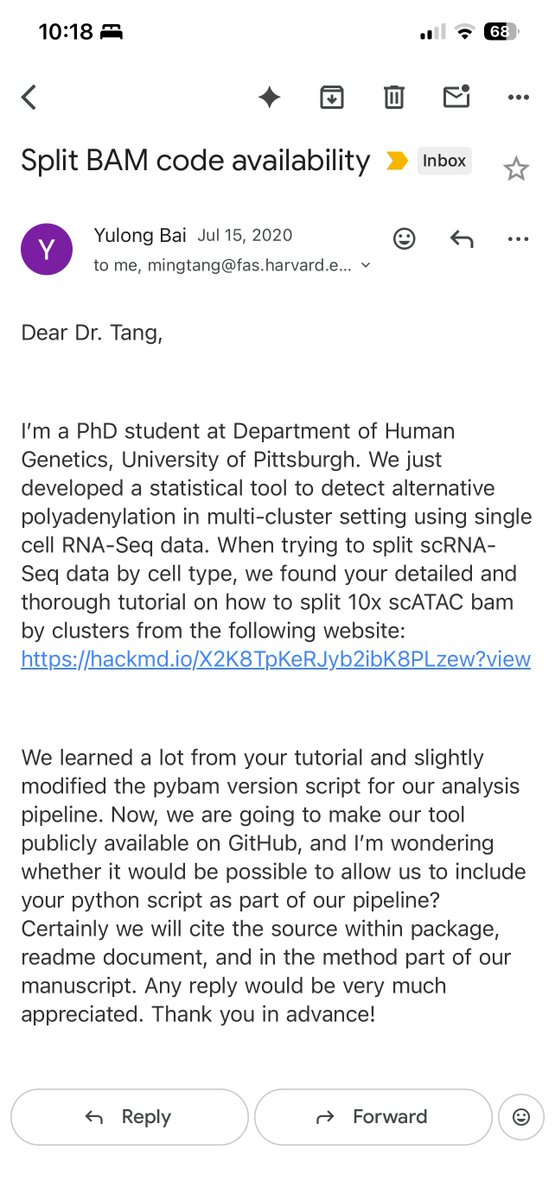
1/ I was at a career workshop last week and a bioinformatician from BMS came up to me. "Hey, I've used your code before. Just wanted to say thanks." That kind of thing stays with you. So I went back and searched my email to see what he might have been referring to.
Ming "Tommy" Tang tweet media
English
2
14
205
42.2K
Brynne retweetledi
Soumya Sharma
Soumya Sharma@soumya_sharma26·
Having a body with 0 health issues is the luxury everyone forgets is a luxury.
English
55
1.5K
15.4K
205K
Brynne retweetledi
Chaz Hong MD PhD 🇺🇸
Chaz Hong MD PhD 🇺🇸@chaz_hong·
I am reminded once again that research matters. My wife’s friend was diagnosed with metastatic ovarian cancer, resistant to our favorite drug Cis/Carboplatin. Genetic testing revealed, among other things, KRAS G12A mutation. She was started on a KRAS inhibitor but unfortunately developed massive myopathy to the point she could barely walk. At that point, she needed bilateral nephrostomy tubes for renal blockage and was given weeks to live. But her mutation panel had also revealed modestly elevated tumor mutation burden (TMB) and CHEK2 mutation, which is involved in DNA damage response. Based on this (though the evidence was limited), she was started on immune checkpoint blockade (ICB) as a last-ditch effort. Since then, her tumors have melted away, and our friend is now strong enough to clear the snow during LAST NIGHT's blizzard in Northeast. Below is a photo she just sent us. I share not just because this is a miracle, but a SCIENCE IN ACTION! #SpartansWill #ResearchSavesLives @MSUMD, @MSU_Medicine, @HFH_MSU_HS
Chaz Hong MD PhD 🇺🇸 tweet media
English

91
521
3.7K
92.7K
Brynne retweetledi
Dr Rishabh Jain
Dr Rishabh Jain@DrRishabhOnco·
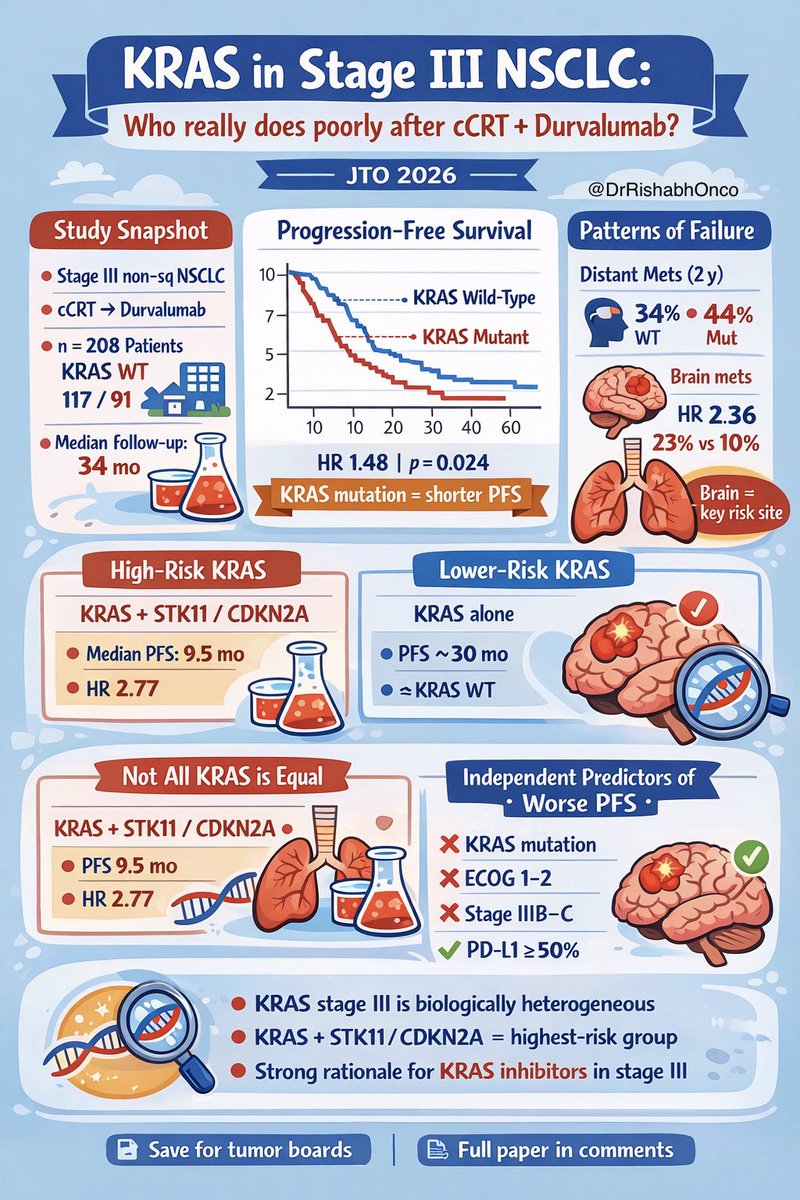
KRAS in stage III NSCLC is not all the same 🧬 New Journal of Thoracic Oncology data show KRAS-mutant disease has worse outcomes after cCRT + durvalumab, driven by specific co-alterations. 🧪 Study essentials • Stage III non-squamous NSCLC • cCRT followed by durvalumab • n = 208, multi-institutional ⚖️ Key results • Median PFS: 16 vs 28 months (KRAS-mut vs KRAS WT) • Higher distant mets in KRAS-mut (2y: 44% vs 34%) • Brain mets significantly higher in KRAS-mut (HR 2.36) 🧠 🧬 Critical insight • KRAS + STK11 and/or CDKN2A = worst outcomes • KRAS without these co-alterations ≈ KRAS WT • TP53 co-mutation not protective here 🎯 Why this matters • Stage III KRAS-mut NSCLC is heterogeneous • High-risk subgroup identified for treatment intensification • Strong rationale for KRAS inhibitors in stage III trials 🔖 Save this for tumor board discussions 📖 Full paper in comment ⬇️ #OncoTwitter #MedTwitter #LungCancer #NSCLC @OncoAlert @myesmo @esmo_open @asco
Dr Rishabh Jain tweet media
English
4
27
68
3.9K
Brynne retweetledi
Yakup Ergün
Yakup Ergün@dr_yakupergun·
Great new, BUT Lately, headlines claiming that “pancreatic cancer has been completely eliminated in mice” are circulating widely. The core information is true; the conclusion drawn from it is wrong. Mariano Barbacid and his team demonstrated a triple-targeted treatment combination that very strongly suppresses pancreatic cancer in mouse models. In some mice, tumors completely disappeared and no recurrence was observed. But let’s pause. This is a preclinical study. Meaning: – It has not been tested in humans – Efficacy and safety are unknown – It does not represent a clinical treatment Seeing “complete responses” in mouse models is not new in pancreatic cancer research. The real challenge has always been translating these results to humans. Tumor biology and the microenvironment often break the effect when moving from mice to patients. Why does this still matter? Because simultaneously targeting KRAS, EGFR, and STAT3-related resistance pathways shows real biological relevance. That is a valid scientific signal. Let’s be clear: “A cure has been found” — false “Patients will soon be cured” — false “A promising laboratory signal worth testing in humans” — true
✦✦✦ 𝙿𝚊𝚖𝚙𝚑𝚕𝚎𝚝𝚜 ✦✦✦@PamphletsY

🚨🇪🇸 BREAKING — Spanish Scientists Cured Pancreatic Cancer in Rats.

English
8
58
282
163.2K
Brynne retweetledi
Stephen V Liu, MD
Stephen V Liu, MD@StephenVLiu·
How do we overcome lorlatinib resistance in ALK+ NSCLC? Trial adding binimetinib (MEK inhibitor) to lorlatinib showed RR only 6.7% with PFS 51d. Cohort adding TNO155 (SHP2 inhibitor) to lorlatinib post resistance showed no activity, terminated early. lungcancerjournal.info/article/S0169-…
English
2
8
38
4.8K
Brynne retweetledi
Dr. AK 🇮🇳
Dr. AK 🇮🇳@docakx·
Spanish oncologist Mariano Barbacid's team achieved complete elimination of KRAS-mutated pancreatic tumors in mice using a low-toxicity trio of drugs (gemcitabine, ATRA, and neratinib), as detailed in a January 27, 2026, PNAS study.
English
201
4K
28K
2.1M
Brynne retweetledi
Molecular Cell
Molecular Cell@MolecularCell·
In vivo proteomic labeling reveals diverse proteomes for therapeutic targets dlvr.it/TPyf4l
Molecular Cell tweet media
English
0
24
113
9.3K
Brynne retweetledi
Journal of Clinical Investigation
Journal of Clinical Investigation@jclinicalinvest·
Molecular glue as a new therapeutic strategy in metastatic KRAS-mutant lung cancer Goutham Narla @gouthamnarla & team @UMichMedSchool combined a PP2A molecular glue with RAS/MAPK inhibitors to restore tumor-suppressor activity and overcome drug resistance in mice with metastatic KRAS-driven #NSCLC: doi.org/10.1172/JCI193… The figure shows RPT04402 enhances adagrasib’s cytotoxic effect in sensitized and resistant lung cancer cell lines cells, which showed minimal cytotoxicity with adagrasib alone.
Journal of Clinical Investigation tweet media
English
3
1
15
1.5K
Brynne retweetledi
Biology+AI Daily
Biology+AI Daily@BiologyAIDaily·
MolGenBench: A Comprehensive Benchmark for Structure-Based Molecular Generation 1. The article introduces MolGenBench, a new benchmark designed to bridge the gap between molecular generation algorithms and real-world drug discovery outcomes. It integrates a large-scale dataset with 120 protein targets and 220,000 experimentally confirmed active molecules, offering a rigorous evaluation framework. 2. A key innovation is the inclusion of a hit-to-lead (H2L) optimization scenario, which is critical for drug development but often overlooked in existing benchmarks. This scenario evaluates models' ability to optimize compounds for potency and selectivity, simulating a crucial phase in drug design. 3. The study proposes novel metrics such as the Target-Aware Score and Mean Normalized Affinity (MNA) Score to assess models' ability to rediscover target-specific actives and optimize compounds. These metrics provide a more comprehensive evaluation compared to traditional benchmarks. 4. The authors systematically evaluated 10 de novo design methods and 7 H2L optimization approaches, covering diverse architectures (autoregressive, diffusion, Bayesian Flow Networks) and training data sources. This comprehensive assessment highlights significant gaps between current models and real-world drug development needs. 5. The results show that current generative models struggle with rediscovering known active molecules and generating target-specific compounds. The study also reveals limitations in predicting physically valid molecular conformations and leveraging protein structural information effectively. 6. MolGenBench uncovers that models trained on crystal structures outperform those trained on simulated complexes in certain tasks, emphasizing the importance of high-quality training data. The benchmark also highlights the need for more rigorous evaluation metrics that reflect real-world applicability. 7. The study concludes that substantial advances are needed to improve the practical impact of molecular generative models in drug discovery. It provides actionable insights for future development, emphasizing the need for task-aware design and generalized optimization. 📜Paper: biorxiv.org/content/10.110… 💻Code: github.com/CAODH/MolGenBe… #MolGenBench #DrugDiscovery #AIinPharma #Benchmarking #StructureBasedDrugDesign
Biology+AI Daily tweet media
English
0
1
6
3.1K
Brynne retweetledi
Lilly Oncology Medical
Lilly Oncology Medical@LillyOncMed·
Learn about a currently enrolling phase 1 study of an oral pan-KRAS inhibitor being investigated in patients with KRAS-mutant solid tumors 🧬. Click below to learn more about this trial in progress presentation at ESMO25.
English
4
7
53
633.9K
Brynne retweetledi
philip lewis
philip lewis@Phil_Lewis_·
Today, the Supreme Court will hear a hugely consequential case that will determine the future of the Voting Rights Act theguardian.com/us-news/2025/o…
English
43
897
1.8K
557.8K
Brynne retweetledi
PubMed.ai
PubMed.ai@AIpubmed·
Covalent Inhibitors of the PI3Kα RAS-Binding Domain: A New Frontier in Targeted Cancer Therapy 🔗 Find More Research Here: pubmed.ai/?utm_source=X&… Key insights from the study: - Covalent inhibitors targeting the PI3Kα RAS-binding domain effectively disrupt oncogenic signaling. - Demonstrated strong tumor-suppressive effects in RAS- and HER2-driven cancers. - Offers a precise mechanism of action, reducing off-target toxicity compared to broader PI3K inhibition. 👉 Highlight: This research expands the therapeutic potential of covalent inhibitors beyond kinase-active sites — into protein–protein interaction domains critical for cancer signaling. How do you see domain-specific targeting reshaping the next wave of cancer drug development? #CancerResearch #PI3K #TargetedTherapy #DrugDiscovery #MolecularOncology
PubMed.ai tweet mediaPubMed.ai tweet mediaPubMed.ai tweet media
English
0
4
6
2.8K
Brynne retweetledi
Eric Topol
Eric Topol@EricTopol·
Metformin, the first line drug for Type 2 diabetes, has been used for 60 years without a clearcut mechanism of action. It turns out it's not just reducing glucose output from the liver. Metformin also works via the brain science.org/doi/10.1126/sc…
English
38
531
2.6K
235.8K