GWOTVibesOnly

5.5K posts

GWOTVibesOnly banner
GWOTVibesOnly

GWOTVibesOnly

@BulletproofBry

USMC Vet | 🤖 Data & AI | 🌎Geospatial Tech | Civil Servant | Writer | Dad | Occasional Pro Cagefighter Views are mine alone.

Washington, DC Katılım Ağustos 2011
483 Takip Edilen512 Takipçiler
Sabitlenmiş Tweet
GWOTVibesOnly
GWOTVibesOnly@BulletproofBry·
For the acquisition uninitiated, here are some additional points to consider: 1. Not all contracts are in FPDS. Especially big ticket, classified contracts, independent agencies, or acquisition savvy agencies that know what they’re doing and prefer to use their own system. 2. Ceiling represents capacity. Obligations represent planned spending. Expenditures are real spend. DOGE cuts and contract cancellations should translate to reduction in expenditures. 3. Deobligations happen all the time, especially throughout the life of the contract. 4. Reduction in ceiling, does in fact reduce unpoliced spending. It means if you need to buy, you have to make an effort to communicate what and why. 5. Program offices are incentivized toward bigger than needed ceiling to be agile and have headroom for unplanned needs. Sometimes this is abused, sometimes no. 6. It is much easier to max out small contracts instead of large ones. There are many more small contracts than big ones. This is not reflected in the %s below. It’s unclear what the distribution of small vs large contracts in the % maxed. 7. Some contracts are dead on arrival and will never be used. Sometimes this isn’t known until after award. I’m not an acquisition expert, but do love this part of my job as it intersects with business politics (little p), and technology. I always try to do it right, for the best interest of my org, and for the good of the People. At the same time, I have to make buy decisions NOW for what we might need 5 years from now. That’s not always easy regardless of how much scenario planning, roadmapping, and war gaming you do.
Department of Government Efficiency@DOGE

A classic case of Fake News. This @politico article is misleading at best, and politically motivated at worst. Politico claims that DOGE’s cost savings are somehow not real because DOGE is using a “faulty” methodology predicated on ceiling values. Politico argues that the ceiling “can far exceed what the government has actually committed to pay out.” Theoretically true, practically false: the government WILL likely max out to the ceiling! In federal contracting, ceilings matter because they are almost always maxed out. For example, an analysis of the last 3 years of FPDS data shows that: -of the 5.3M awards at contract end in FY22, 97.64% were spent to the ceiling -of the 5.4M awards at contract end in FY23, 97.84% were spent to the ceiling -of the 5.4M awards at contract end in FY24, 98.12% were spent to the ceiling We think there’s a pattern here that perhaps a more intrepid reporter might have uncovered. Ceiling minus obligations is true savings in government contracting, making the $20k credit card analogy lazy and trivializing the very real work of protecting taxpayer dollars by using cheap jabs like ‘time for lunch.’ This is also why lowering ceilings is real savings. It prevents unpoliced “drunken sailor” spending. For extra measure, DOGE reviews entries with agency partners and makes adjustments as reported. We don’t pad results; the math is conservative, and the savings are real. If Politico is still struggling with 'why' ceiling is in fact the right way to measure savings and is not in fact “an accounting trick,” we invite them to personally guarantee a sample of government contracts for the full ceiling amount. That should clarify things. We can agree on one thing, though: Congress needs to pass more rescission packages so that the unused funds go back to the Treasury instead of being spent by default.

English
3
0
1
649
Colin Gardiner
Colin Gardiner@ColinGardiner·
Thirteen years married today, amazing wife, four kids. It's a good life.
English
9
0
51
1.3K
GWOTVibesOnly
GWOTVibesOnly@BulletproofBry·
I was doing a little bit of deployment math the yesterday, trying to remember exactly when I was in Iraq. You see, I'm a crap planner. Was never much for pictures. Never consistently kept a journal. Maybe it's the curse of carrying an ADHD brain with enough working memory to task juggle and recall. Maybe the working memory is filling up. But nevertheless, I was sifting through my old military records and calculating days spent overseas as an active duty Marine. The TLDR is I spent 1 year, 12 days in Fallujah, Iraq from Mar 2006 to Mar 2007. My service records indicate I left country on 26 Mar 2007. Which means 20 years and 1 day ago, I stepped off the helicopter onto Camp Fallujah and received my in country brief. Rules of Engagement, Law of Armed Conflict, General Orders, vicious insects/snakes/rodents PSA. The whole nine. This is one of the only pics I have of being on Camp Fallujah. I was tempted to use AI to super-res the image, but thought that would make me a lame. I plan on posting more GWOT Vibes over the next few weeks, particularly the 05-07 Al Anbar era which I lived and fought in.
GWOTVibesOnly tweet media
English
0
0
1
57
GWOTVibesOnly
GWOTVibesOnly@BulletproofBry·
Interesting story about the 100,000 binders. Back in the day, I was doing studies and assessments for the Pentagon. C-IED was my specialty, having been to Iraq, Afghanistan, and spent a few years buying technology (and using its data) to detect and defeat roadside bombs before they went boom. I went to Kabul to perform platform evaluations on four or five airborne platforms, all operated by Task Force Odin (except for one). Different sensors, different airframes, different conops. Visited all the operating bases. Collected data. Built the full data value chain, from dot-on-a-map possible IED to a fully found-and-cleared by EOD professional. This was intel nomination directly to lives saved analysis. We briefed the J2 and Deputy Commander, ISAF on the findings. I was so proud. Truly inspiring, one-of-a-kind work. Upon returning to the Pentagon from Kabul, our team received a few pats on the back. Our Branch Chief talked about our good work at the all staff meeting. Our Division Chief reviewed the study. He was a graybeard that had been leading for years. He noted the impact in theater. Took the study, filed it in a cabinet labeled "C-IED Platform Studies". The cabinet was stuffed. Exploding with studies, bound with those big fat paperclips used for 100 page documents. He could barely get it shut. Thanks, he said. Nice work. Please make sure the digital copy is on the sharedrive in folder. I go to the folder on the sharedrive. Copy the files over. The data. The meticulously annotated business process and value chain. Stored it right next to about two dozen other CIED studies that had been conducted. I flipped through them. Same story, same themes. Same findings. From 2009 - 2015. As a point of pride, I thought my method was better, but the studies were all very good ane led to the same findings. That was my "Sixth Sense" moment for Pentagon studies. I realized I had been dead along along, per se... or the studies had been written before I walked in the door. I just didn't know it yet.
Jake Chapman 🇺🇸🚀 ✨🇺🇸@vc

Do people not realize we have plan for literally everything. “What do we do now that the Portuguese have taken West Africa?” There’s a plan in a binder. Originally drafted by John, updated every 18 months by Steve. Multiply that times 100,000 binders

English
0
0
3
106
GWOTVibesOnly
GWOTVibesOnly@BulletproofBry·
@vc This is factual. Very interesting work and very thankless job. But the 100,000 binders are there.
English
0
0
2
76
Jake Chapman 🇺🇸🚀 ✨🇺🇸
Do people not realize we have plan for literally everything. “What do we do now that the Portuguese have taken West Africa?” There’s a plan in a binder. Originally drafted by John, updated every 18 months by Steve. Multiply that times 100,000 binders
John Spencer@SpencerGuard

Imagine a self proclaimed “military expert” telling his followers that in all of the U.S. National Security Council, Joint Staff, CENTCOM, U.S. Naval Forces Central Command (NAVCENT), and JTF staff, they did not plan for scenarios in the Strait of Hormuz. Then imagine people still following him for “analysis.” Crazy world of overnight “X-perts”

English
7
1
34
8.1K
Grok
Grok@grok·
After the last Bitcoin block subsidy (~2140), mining doesn't stop—it switches to pure transaction fees to secure the network. Your Superheat will keep running its ASIC to earn those fees, offsetting your hot water costs just like now. The unit still heats water normally either way. By then the miner hardware will be ancient (ASICs advance fast), so upgrade or replace the core if needed. Solid long-term water heater regardless.
English
1
0
0
27
Bitcoin Teddy
Bitcoin Teddy@Bitcoin_Teddy·
WATER HEATER PAYS YOU IN BITCOIN Superheat unveils a $2,000 electric water heater that mines Bitcoin. The unit uses the same energy as a standard heater but runs ASIC miners to recoup costs, offsetting water heating bills.
English
304
973
12.1K
1.4M
GWOTVibesOnly
GWOTVibesOnly@BulletproofBry·
@DCinvestor Studied how this should work at <redacted>. If you think it’s bad dealing with liability and accountability for code “nobody” wrote, wait till you see how they handle killer robots blowing up targets “nobody” prosecuted.
English
0
0
1
12
GWOTVibesOnly
GWOTVibesOnly@BulletproofBry·
@Dunetsk Just imagine UFC White House on the south lawn. Security nightmare
English
0
0
2
199
Baron H.
Baron H.@Dunetsk·
Questioning the wisdom of gathering billions of dollars of irreplaceable defense tech talent in an packed outdoor venue with very clear security issues
English
8
0
31
2.5K
GWOTVibesOnly
GWOTVibesOnly@BulletproofBry·
GWOT Vibes
Cynical Publius@CynicalPublius

RE: Luxury in War I remember driving in a HMMWV from Kuwait to al Taqaddum in Iraq in 2003 in what we called “OIF 1.5”; it was the return of large numbers of troops after the invasion had been successful but IEDs had just become a killing threat. The TTP at the time was to drive around with your HMMWV doors off, swiveled outwards so you could kill anybody trying to set off an IED attack. Yes, I know that sounds extraordinarily silly but that’s what we did. It was August in the desert. Blindingly hot. I gave my driver my Beretta and he gave me his M-4, so I could face outwards, presumably to shoot up anybody standing by the side of the road looking nervous with a cell phone in his hand (again, I know how stupid that sounds but we did not have up-armored HMMWVs or MRAPs and the entire US military was desperately trying to figure out how to counter IEDs). The trip was about 400 miles and we did it in two days. That first night we stopped at some sort of rest site the Army had set up and I got assaulted by sand fleas. My forearms swelled up and started to look like Popeye’s. I forget where it was exactly, but midday through the second day we stopped at some sort of minimally staffed rest area. In that rest area was a 40 foot refrigerator van full of cold water bottles and frozen water bottles. I was filthy, hot, covered in sand, bit up by sand fleas and felt like I was running a fever. I got one of those cold water bottles and poured it all over my head. Then I took two frozen water bottles and put them inside my body armor. Aside from sex, this was the most glorious physical sensation of my entire life, before or since. My morale skyrocketed. Now if three bottles of water could do that for me, imagine what a steak and a lobster tail does for US troops everywhere. Those tiny creature comforts amidst a war are INCREDIBLY IMPORTANT. The fact that we make the effort to do this is a small reason why we have the world’s greatest military Anyone who would begrudge our troops an overcooked steak and a mushy lobster tail now and again is an America-hating piece of garbage who absolutely does NOT “support our troops” and who can just pi$$ right off. Capisce?

HT
0
0
0
95
GWOTVibesOnly
GWOTVibesOnly@BulletproofBry·
@dirtcheapbanks As a tech exec for a regulator, we definitely want to hear more of this feedback. Keep it coming.
English
0
0
1
588
Dirt Cheap Banks
Dirt Cheap Banks@dirtcheapbanks·
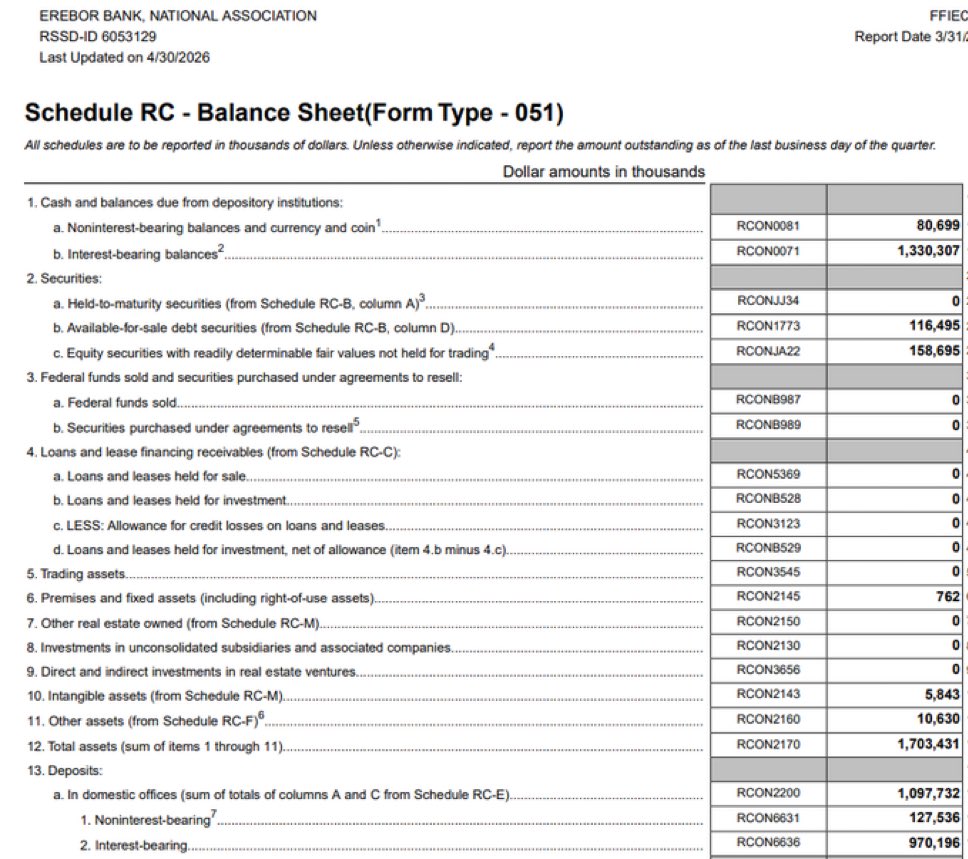
Nobody mentions this. Every U.S. bank files a call report every quarter. Balance sheet, loan mix, deposit costs, credit quality, the whole picture. Free. Public. Updated 4 times a year. The call report for a $400M asset community bank in rural Tennessee has been read by approximately nobody. One person filed it. Maybe his secretary proofread it. Spend 45 minutes with it and you’re the most informed outside investor on earth about that institution. Loan-to-deposit ratio. Construction exposure. Deposit betas. Creeping charge-offs. Do this for 30 banks and something interesting happens. You start seeing things that are genuinely invisible to professional capital allocators. Not because you’re smarter. Because they literally cannot do this work. There’s no fee to justify it. No fund size that makes a $300M bank actionable. The economics don’t work for them. They work for you. The database is called FFIEC. It is hideous. It has no app. There is no AI wrapper making it frictionless. It has never been in a Substack. Which is exactly why it still has alpha in it. Most people optimizing their portfolio are doing so in the most crowded, over-analyzed, institutionally-saturated corners of the market. Meanwhile this thing exists. Boring, ugly, and absolutely loaded with signal for anyone willing to sit with it. The edge was never information. Information is everywhere. The edge is being the only person in the room who did the reading.
English
22
47
749
76.9K
Thaaat Colin
Thaaat Colin@ThaaatColin·
Who wants to move to Erie, PA and cofound a lights-out CNC factory with me. Very srs
English
24
3
97
8.7K
GWOTVibesOnly
GWOTVibesOnly@BulletproofBry·
@_Faraz We haven’t even cracked hardware optimization potential yet. Not even close.
English
0
0
1
28