CryptoLawyer

1.8K posts

CryptoLawyer

CryptoLawyer

@CAcryptolawyer

open to new crypto and or legal projects. Crypto-law enthusiast. ZK-Lawyer

Cryptoland Katılım Mart 2021
2K Takip Edilen881 Takipçiler
Sabitlenmiş Tweet
CryptoLawyer
CryptoLawyer@CAcryptolawyer·
You heard it here first: Sentient AI crypto tokens are emerging as the next big trend 🚀
English
0
1
0
506
CryptoLawyer retweetledi
Cobie
Cobie@cobie·
Cobie tweet media
ZXX
378
154
3.8K
242.1K
CryptoLawyer retweetledi
Vinod Khosla
Vinod Khosla@vkhosla·
So true
English
38
162
1.8K
264K
CryptoLawyer retweetledi
*Walter Bloomberg
*Walter Bloomberg@DeItaone·
JPMORGAN LAUNCHES FIRST TOKENIZED MONEY MARKET FUND ON ETHEREUM -- WSJ
English
106
273
2.5K
398.5K
CryptoLawyer retweetledi
kain.inx
kain.inx@kaiynne·
When we eventually get into a bear market (not yet btw) I expect to see the first chain mergers. Consolidation will allow smaller chains to survive and come out stronger instead of grinding to oblivion.
English
41
3
85
6.6K
CryptoLawyer retweetledi
Hayden Adams 🦄
Hayden Adams 🦄@haydenzadams·
First Ken Griffin screwed over Constitution DAO Now he's coming for DeFi, asking the SEC to treat software developers of decentralized protocols like centralized intermediaries Bet Citadel has been lobbying behind closed doors on this for years Okay thats all pretty bad, but the actual nerve for one of their arguments to be that there is no way for DeFi protocols to provide "fair access" of all things lmao Makes sense the king of shady tradfi market makers doesn't like open source, peer-to-peer tech that can lower the barrier to liquidity creation sec.gov/files/citadel-…
Hayden Adams 🦄 tweet media
English
128
196
1.6K
508.4K
CryptoLawyer retweetledi
Arthur Hayes
Arthur Hayes@CryptoHayes·
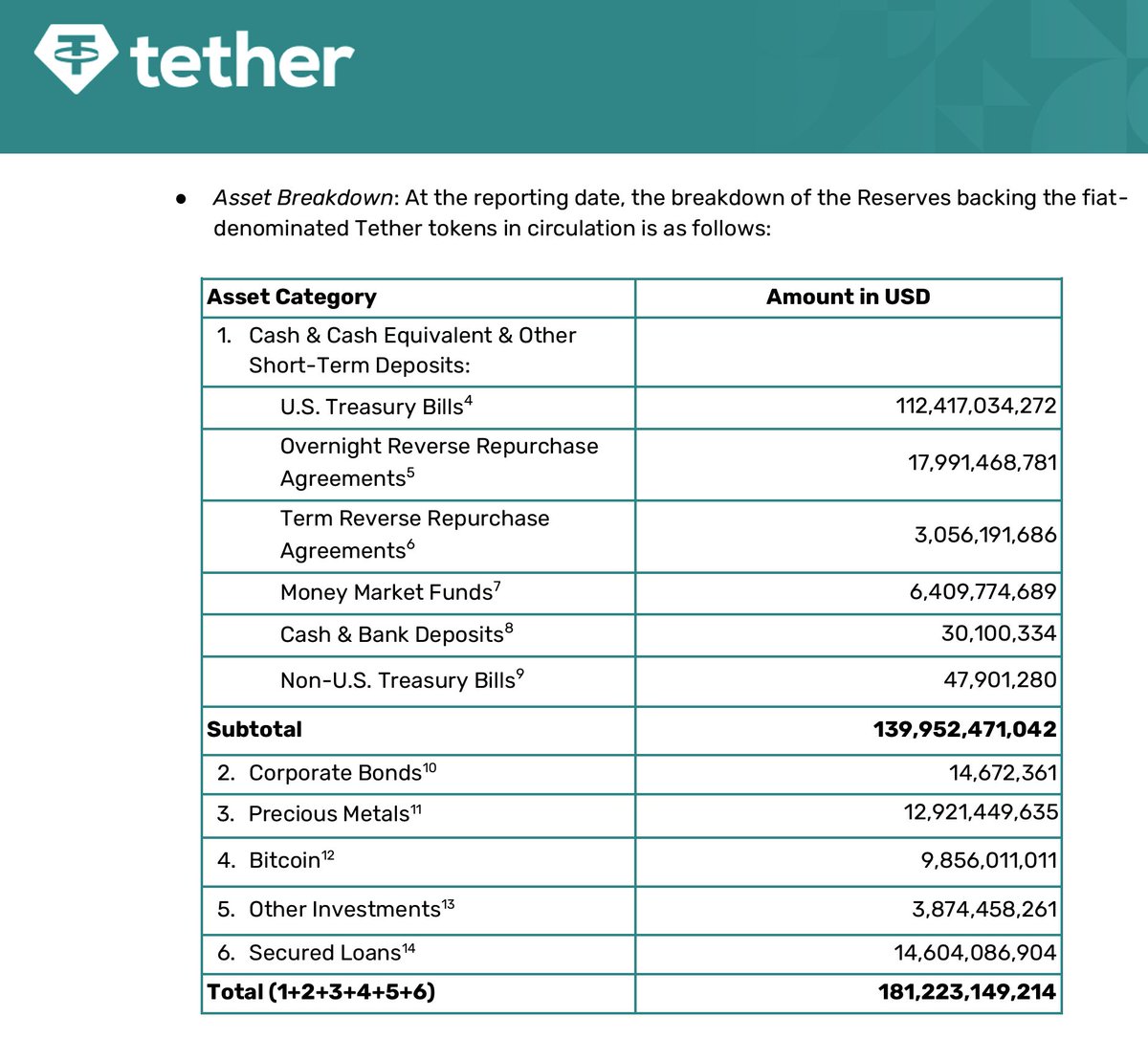
The Tether folks are in the early innings of running a massive interest rate trade. How I read this audit is they think the Fed will cut rates which crushes their interest income. In response, they are buying gold and $BTC that should in theory moon as the price of money falls. A roughly 30% decline in the gold + $BTC position would wipe out their equity, and then USDT would be in theory insolvent. I'm sure some large holders and exchanges will demand a real-time view of their B/S so they can assess the solvency risk of Tether. Get out your popcorn, I expect the MSM to run wild with this, especially all the editors with TDS who want to shit on Lutnick and Cantor for backing this stablecoin.
Arthur Hayes tweet media
English
723
572
4.4K
3.2M
CryptoLawyer retweetledi
Carlo⚖️
Carlo⚖️@CarloD_Angelo·
Why Tether’s Gold & Bitcoin Bets May Be the Only Real Hedge Against the GENIUS Act’s “Reverse-Yield” Risk This week, S&P downgraded its stability assessment of Tether’s USDT from “constrained” to “weak”—the lowest score on S&P’s five-point stablecoin stability scale. S&P cited Tether’s increased reliance on gold and Bitcoin reserves. Tether is now the largest non-state holder of physical gold in the world, and approximately 13% of USDT reserves are backed by gold and Bitcoin. Under the GENIUS Act, Tether’s U.S.-issued stablecoin, USA₮, is mandated to hold 1:1 short-term U.S. Treasury bills. For its offshore stablecoin, USDT, Tether is relying more heavily on gold and Bitcoin as reserve assets. This move may well be a strategic hedge against a mass U.S. stablecoin liquidation event. In such an event, Tether would not be forced to shore up reserves by liquidating short-term T-bills at a loss. It would have the option to meet redemptions by liquidating its gold and Bitcoin reserves instead. The more Tether’s reserves rely on gold and BTC—instead of exclusively on short-term T-bills—the less its overall balance sheet is exposed to a reverse-yield liquidation crisis. As noted in Shanaka’s article, the GENIUS Act forces U.S.-regulated stablecoins into one of the safest assets on earth: short-term U.S. Treasury bills. While that’s great for reducing Terra/Luna-style risks and for lowering U.S. borrowing costs, it does come with a structural problem: when stablecoins grow, they gently push yields down; when they contract, they can violently push yields up. This is the convexity trap. A few billion dollars entering stablecoins barely moves yields—but a few billion dollars leaving stablecoins can spike yields two to three times harder. If Tether held exclusively short-term T-bills, then in a redemption crisis, it would be forced to dump T-bills into a stressed market—further accelerating a T-bill yield spike—or take mark-to-market losses on its remaining T-bill holdings. In that scenario, Tether gets hit twice, right when confidence in stablecoins is already fragile. That’s the “reverse-yield” problem. A stablecoin built entirely on U.S. Treasuries therefore becomes brittle at the exact moment the system needs stability most. Here’s where Tether’s controversial reserve mix makes more sense than critics admit. Gold & Bitcoin Break the Convexity Loop By holding a meaningful slice of reserves in gold and Bitcoin, Tether gives itself something almost no other issuer—including Circle—has: 🚫 Assets it can liquidate during redemptions without dumping T-bills. 🚫 Assets that aren’t mechanically tied to short-term rates. 🚫 Assets—like gold and Bitcoin—that may rise or stay stable in the exact macro scenarios that crush Treasuries. As a consequence: ➕Gold reduces Tether’s exposure to interest-rate convexity. ➕Bitcoin hedges the tail-risk of a U.S. sovereign credibility event. Together, they give Tether something a 100% T-bill model cannot: the ability to meet redemptions without feeding the very crisis that threatens its peg. Do these assets introduce volatility? Absolutely. But they also break the one-way valve the GENIUS Act accidentally created. This is why Tether’s diversification looks reckless to regulators—but smart to anyone who understands convexity. In a world where every GENIUS-compliant stablecoin becomes a leveraged bet on the short-end of the U.S. curve, Tether is quietly building the only balance sheet not fully dependent on the thing everyone else assumes will never break.
Shanaka Anslem Perera ⚡@shanaka86

THE SILENT COUP’S FATAL FLAW Treasury just wired America’s $38 trillion debt to crypto volatility. Nobody told you. Here is what the Bank for International Settlements discovered in May 2025, buried in Working Paper 1270: When stablecoins grow, Treasury yields fall 2 basis points per $3.5 billion inflow. When stablecoins contract, yields spike 6 to 8 basis points. The ratio is not symmetric. Outflows hit three times harder than inflows help. The GENIUS Act, signed July 18, 2025, mandates that stablecoin issuers hold reserves exclusively in Treasury bills. Tether alone now holds $135 billion in U.S. government debt. This created captive demand that suppresses borrowing costs during expansion. November 2025 delivered the first reversal in 26 months. Market cap fell $4.5 billion. Three days ago, S&P downgraded Tether to its lowest stability rating, citing 24 percent high risk reserves including Bitcoin that now exceeds the company’s entire overcollateralization buffer. The arithmetic is devastating. A 20 percent stablecoin contraction at current scale forces $60 billion in Treasury liquidations. At 3x convexity, yields spike 60 basis points. Against $38 trillion in debt, each basis point costs $3.8 billion annually. Total damage: $228 billion added to yearly interest expense. That is a 22 percent increase in debt servicing from a single quarter of crypto outflows. The Strategic Bitcoin Reserve provides no hedge. Post seizure holdings of 326,000 BTC cover 0.078 percent of federal debt. When crypto crashes, that reserve loses value precisely when protection is needed. The administration banned CBDCs in January. Powell confirmed no digital dollar during his tenure. Yet the very crisis this architecture creates hands the Federal Reserve its strongest argument for reasserting control. Treasury built a demand engine with no reverse gear. The engine just shifted.​​​​​​​​​​​​​​​​ Read the deep dive analysis here 👇 open.substack.com/pub/shanakaans…

English
7
9
34
19.4K
CryptoLawyer retweetledi
XO
XO@Trader_XO·
XO tweet media
13
31
277
25K
CryptoLawyer retweetledi
Brad Hargreaves
Brad Hargreaves@bhargreaves·
My favorite thing about this chart is that the median homebuyer age rose from 39 in 2005 to 59 in 2025 20 years over 20 years It’s literally the same people buying the homes two decades later
Brad Hargreaves tweet media
English
432
7.6K
71.1K
1.5M
CryptoLawyer retweetledi
unusual_whales
unusual_whales@unusual_whales·
Long term performance of stocks vs housing, per WSJ:
unusual_whales tweet media
English
447
728
7.2K
5.7M
CryptoLawyer retweetledi
Base Hub 🛡️
Base Hub 🛡️@BaseHubHB·
Engage with this! 🏗 Something is coming 👀 Bullish on @Base 🟦
Base Hub 🛡️ tweet media
English
988
520
4.7K
204.5K
CryptoLawyer retweetledi
vitalik.eth
vitalik.eth@VitalikButerin·
Base is doing things the right way: an L2 on top of Ethereum, that uses its centralized features to provide stronger UX features, while still being tied into Ethereum's decentralized base layer for security. Base does not have custody over your funds, they cannot steal funds or stop you from withdrawing funds (this is part of the L2beat stage 1 definition). You can see Base's status as an L2 on l2beat: l2beat.com/scaling/projec… I feel like many people have been confused by recent cynicism and think that things like L2beat are a weird sort of nerd-sharia compliance authority. This is NOT what is going on. The security that L2s provide, that L2beat measures, reflects concrete properties that protect you as a user from being rugged. Here is an explanation of how, if an L2 shuts down, users are automatically able to withdraw funds even without that L2's involvement: x.com/l2beat/status/… Here is an example of how L2s prevent the operator from censoring transactions, that happened on Soneium earlier this year: x.com/gauthamzzz/sta… This is what we mean when we say that L2s are non-custodial, they are extensions of ethereum, not glorified servers that happen to submit hashes. There are concrete pathways implemented in smart contract logic on Ethereum L1, that have been successfully used in the wild, that ensure that the L2 users' funds are ultimately controlled by L1, they cannot be stolen or blocked by the L2 operator.
jesse.base.eth@jessepollak

1/ as a follow-up to @iampaulgrewal's comments, I want to provide more detail on how the @base sequencer actually works — and fully shut down the FUD that folks are actively spreading around the role sequencers play

English
1.1K
1.2K
6.8K
1.8M
CryptoLawyer retweetledi
Cointelegraph
Cointelegraph@Cointelegraph·
⚡ ADOPTION: Coinbase aims to move the entire startup journey onchain, says CEO Brian Armstrong.
Cointelegraph tweet mediaCointelegraph tweet media
English
169
152
1.6K
165.8K
CryptoLawyer retweetledi
XO
XO@Trader_XO·
XO tweet media
QME
20
3
96
21.1K
Cobie
Cobie@cobie·
when i started building echo 2 years ago, i knew it had 95% chance of failing. to be honest, i couldnt really imagine any other outcome, but i thought at least it may be a noble failure worth attempting. i certainly didn't think echo would be sold to coinbase, but, here we are: today coinbase bought echo for ~$375m. echo will remain a standalone platform under its current brand for now, but we will integrate sonar's public sale product into coinbase, and likely introduce new ways for founders to access investors, and for investors to access opportunities into coinbase itself. over the years i have chatted to brian a handful of times, and mostly to complain at him honestly. i have always respected how brian would listen to an outsider chat shit at him on the phone and take the feedback seriously. now, instead of complaining, i will have the opportunity try to do the work to make things better. crypto itself has moved on a long way since we started working on echo. i guess partially this is because of the election result. but, i feel energised by a lot of the cool things being built in crypto again: hyperliquid, zcash, stablecoin supercyle, and so on. feels like a good time to be on the field instead of an idiot with a twitter account yapping nonsense. well, i guess i still will be that. anyway, job's not finished. onwards. oh fuck yeah, before i go, the final season of up only (now "unc only" due to our severe old age) will commence when we figure out who the guests should be lol cobber
English
5.1K
1.3K
20.6K
2.8M
Jonah
Jonah@jvb_xyz·
>be me >landlord in LA >rent house in the hills to 25yo CFO of a “real estate company” >arrives in lime-green Bentley w/ influencer "gf" + emotional support micro-poodle >stops paying rent >emails me a PDF from the county website saying “COVID-related income loss” >nothing I can do, because LA = anarchy >nonstop Eyes Wide Shut parties at my house >dog melts my hardwood floors w/ atomic diarrhea >claims poverty on paper while bottle-servicing magnums of Ace in my pool >private jets to Paris, Tulum, Miami, Vegas >"gf" showered w/ diamonds, birkin bags, red carpets, "chopper to 'chella" >everything posted on instagram, lest there be any doubt >eventually moves out, I celebrate prematurely >sues me for 8figs the next morning, just to f with me >2y legal war >vanishes >today: DOJ indicts him for stealing $130M from California’s homeless fund may justice be served.
I Meme Therefore I Am 🇺🇸@ImMeme0

🚨BREAKING: U.S. Attorney General Bill Essayli announces California Democrats mishandled $50 million in federal funds meant for homeless housing. Federal agents arrested Cody Holmes, ex-CFO of Shangri-La Industries, for allegedly siphoning millions for personal use. Developer Steven Taylor was also indicted for bank fraud and flipping properties tied to the program.


English
1.2K
5.4K
54.4K
5.8M