The saddest Book Cover series in history...
The History of the Decline and Fall of the Roman Empire is a monumental historical work by Edward Gibbon, published between 1776 and 1789, that traces the long collapse of the Roman Empire from its height in the 2nd century AD to the fall of Constantinople in 1453.
Gibbon argued that the empire declined gradually due to a combination of internal weaknesses and external pressures, including political corruption, economic troubles, military overexpansion, reliance on mercenary forces, and invasions by Germanic and other groups.
One of his most famous and controversial ideas was that the rise of Christianity shifted focus away from civic duty toward spiritual concerns, weakening traditional Roman institutions. The book is still widely read for its narrative style and scholarly influence, even though many of its interpretations have been revised by modern historians.
#archaeohistories
An incredible glimpse into the past has been brought to life...
The face of an 18-year-old girl who lived 9,000 years ago in the ancient region of Thessaly has been reconstructed, offering a fascinating view of how facial features have evolved over time. Her face, which witnessed a pivotal era in human evolution, was revealed thanks to a complex forensic archaeology project.
The remains were discovered in 1993 in the Cave of Theopetra, and now, after thousands of years, we can finally see what she looked like. It's amazing to think about the stories her face could tell from the dawn of modern human civilization.
#archaeohistories
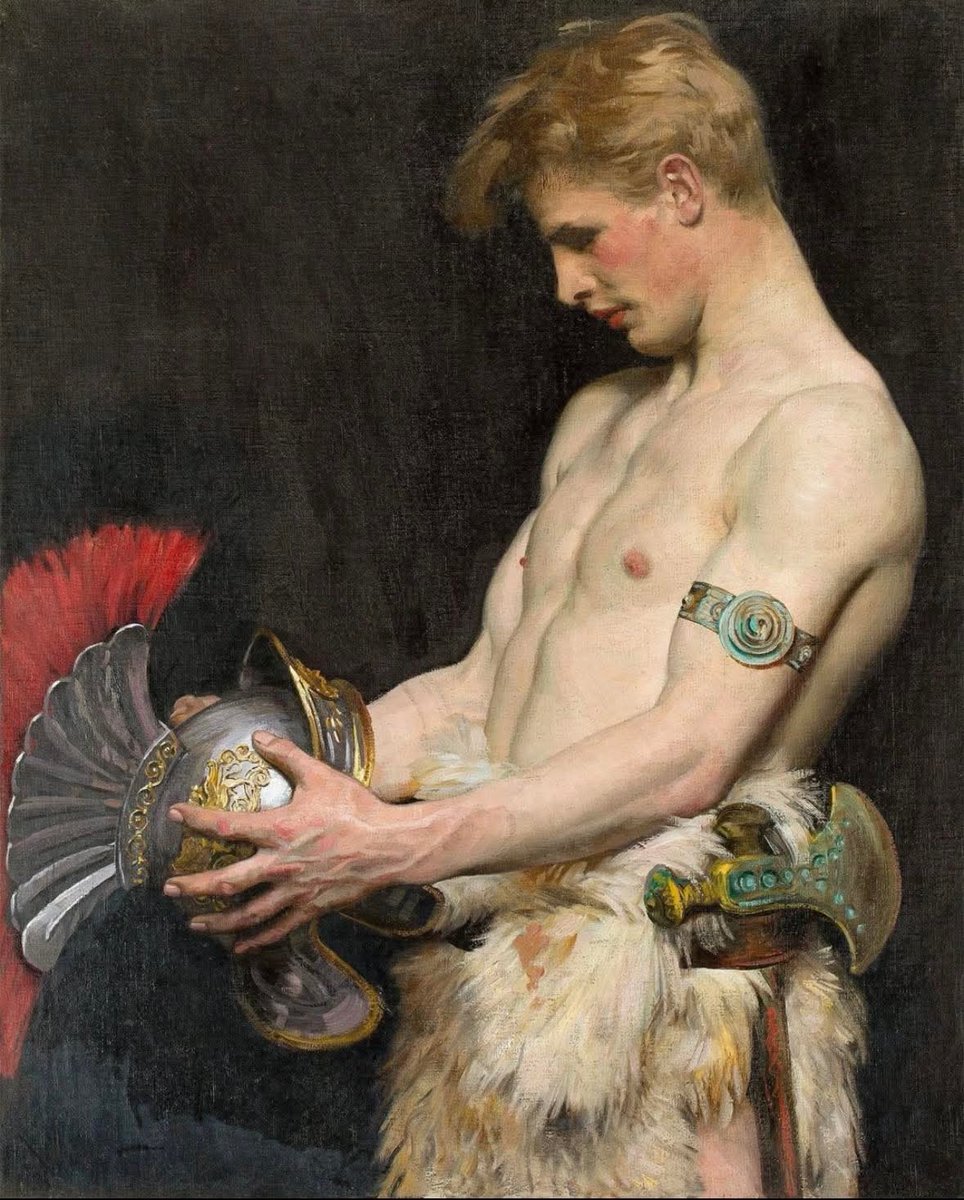
Germanic Warrior Holding a Roman Helmet, oil on canvas by Osmar Schindler, 1902 ...
Osmar Schindler’s 1902 painting, Germanic Warrior Holding a Roman Helmet, shows the encounter between the Roman Empire and the Germanic tribes. The young warrior, bare-chested and draped in furs, studies a Roman helmet, highlighting the contrast between Rome’s organized military power and the rougher strength of the tribes that resisted it. His armlet and weapons underline his role as a fighter, while the helmet suggests victory in battle, spoils of war, or the adoption of Roman objects into Germanic culture.
The Roman Empire’s frontier along the Rhine and Danube was one of the most volatile borders in antiquity. Germanic warriors frequently clashed with Roman legions, most famously in the Battle of the Teutoburg Forest in 9 AD, where three Roman legions were annihilated by a coalition of tribes. Yet, conflict was not the only form of contact. Trade, recruitment of Germanic soldiers into Roman auxiliary forces, and cultural exchange blurred the lines between conqueror and “barbarian.”
Schindler’s painting reflects the late 19th and early 20th Century fascination with antiquity and nationalism, interpreting the warrior not just as an enemy of Rome but as a symbol of independence and identity.
#archaeohistories
@FoxNews This is already, and has been since the beginning of time on efect. New citizens renounce to other citizenships and alliances when they get sworn as U.S. Citizens.
'ALL OR NOTHING': Sen. Bernie Moreno is introducing legislation to end dual citizenship in the U.S., requiring Americans with foreign citizenship to choose one nationality or automatically lose their U.S. citizenship.
Moreno, who immigrated from Colombia, says American citizenship demands “exclusive allegiance."