Channing Allen

3.2K posts

Channing Allen banner
Channing Allen

Channing Allen

@ChanningAllen

Co-founder @IndieHackers, the world's largest online startup community. Building @UseHatchAI, the world's most productive AI assistant.

NYC Katılım Aralık 2009
103 Takip Edilen21.8K Takipçiler
Sabitlenmiş Tweet
Channing Allen
Channing Allen@ChanningAllen·
We built an app called Hatch It enables Karpathy's entire LLM Knowledge Base workflow out of the box, in 2 or 3 clicks, in a single interface. No need to stitch together Obsidian + plugins + markdown files + custom tools + etc. Hatch is an AI workspace where files, docs, and chats all live together. Not only can the chats READ files and docs, but they can WRITE and ORGANIZE them as well. This means you can set up an LLM Wiki in literally 3 steps, as I show in this video.
Andrej Karpathy@karpathy

LLM Knowledge Bases Something I'm finding very useful recently: using LLMs to build personal knowledge bases for various topics of research interest. In this way, a large fraction of my recent token throughput is going less into manipulating code, and more into manipulating knowledge (stored as markdown and images). The latest LLMs are quite good at it. So: Data ingest: I index source documents (articles, papers, repos, datasets, images, etc.) into a raw/ directory, then I use an LLM to incrementally "compile" a wiki, which is just a collection of .md files in a directory structure. The wiki includes summaries of all the data in raw/, backlinks, and then it categorizes data into concepts, writes articles for them, and links them all. To convert web articles into .md files I like to use the Obsidian Web Clipper extension, and then I also use a hotkey to download all the related images to local so that my LLM can easily reference them. IDE: I use Obsidian as the IDE "frontend" where I can view the raw data, the the compiled wiki, and the derived visualizations. Important to note that the LLM writes and maintains all of the data of the wiki, I rarely touch it directly. I've played with a few Obsidian plugins to render and view data in other ways (e.g. Marp for slides). Q&A: Where things get interesting is that once your wiki is big enough (e.g. mine on some recent research is ~100 articles and ~400K words), you can ask your LLM agent all kinds of complex questions against the wiki, and it will go off, research the answers, etc. I thought I had to reach for fancy RAG, but the LLM has been pretty good about auto-maintaining index files and brief summaries of all the documents and it reads all the important related data fairly easily at this ~small scale. Output: Instead of getting answers in text/terminal, I like to have it render markdown files for me, or slide shows (Marp format), or matplotlib images, all of which I then view again in Obsidian. You can imagine many other visual output formats depending on the query. Often, I end up "filing" the outputs back into the wiki to enhance it for further queries. So my own explorations and queries always "add up" in the knowledge base. Linting: I've run some LLM "health checks" over the wiki to e.g. find inconsistent data, impute missing data (with web searchers), find interesting connections for new article candidates, etc., to incrementally clean up the wiki and enhance its overall data integrity. The LLMs are quite good at suggesting further questions to ask and look into. Extra tools: I find myself developing additional tools to process the data, e.g. I vibe coded a small and naive search engine over the wiki, which I both use directly (in a web ui), but more often I want to hand it off to an LLM via CLI as a tool for larger queries. Further explorations: As the repo grows, the natural desire is to also think about synthetic data generation + finetuning to have your LLM "know" the data in its weights instead of just context windows. TLDR: raw data from a given number of sources is collected, then compiled by an LLM into a .md wiki, then operated on by various CLIs by the LLM to do Q&A and to incrementally enhance the wiki, and all of it viewable in Obsidian. You rarely ever write or edit the wiki manually, it's the domain of the LLM. I think there is room here for an incredible new product instead of a hacky collection of scripts.


English
46
76
940
179.5K
Sam Parr
Sam Parr@thesamparr·
Here are the 3 common money mistakes founders made after selling their company. How I know: I've interviewed 100's of founder's who've sold their company (ranging from $10m to many billions) + made all these mistakes myself. 1. Not investing in index funds. You're smart. You sold a company. You are clearly a genius at money and investing. Wrong. Most think they can stock pick, start their own real estate investing biz, etc. In most all cases, they wish they just invested into the sp500. One guy I talked with sold his co in 2012. He made ~$400m. Put a huge chunk into angel investments and other private stuff. He would have $1.2b today if most were in sp500. But he has like $500-$600m now (and most is illiquid). He said he wish he did index funds. Investing in RE, like other businesses, is a business. You can maybe pull it off...but its just learning/starting a new thing, which means you have to learn to be great. Same with angel - its a job to do it well. And picking stocks...for most people (and most all hedge funds with billions of dollars and thousands of employees), doesn't beat the index. 2. Not staying liquid. Tons and tons of people buy illiquid stuff or investments. "I've got tons of money!, what's 20% in angel investments and 40% into a house?" Maybe it'll work. But most everyone I've talked with who put large chunks into illiquid things, they regretted it. Sometimes it works well but when its a big chunk (50%+), it doesn't feel great. Particularly for founders, who may go a while without income, may want $$$ to start a new business or pounce on a good idea. Liquidity is king. 3. Buying fancy stuff in first 6 months. Maybe even 12 months. Investments, fancy cars, fancy houses. The money is burning a hole! You want to do something!! A dope vacation is awesome and worth it. But more often than not, people regret buying or investing in something big within the first 12 months. They wish they let it settle in. A vacation home they ended up not using. A Ferrari when they're not even a car guy. Or other stuff that doesn't even fit their interest but they bought it because they thought they should. Just wait 12 months! Then decide to buy, invest, and do. -- There are many, many more. But these top 3 come to mind.
English
11
2
74
10.5K
rahul
rahul@0interestrates·
why do people (including me) have an aversion to AI writing but not as much to AI code? if a piece of text smells AI i stop reading it but i use things coded entirely with AI every day
English
318
17
793
125.5K
Channing Allen
Channing Allen@ChanningAllen·
@tmeire_ Hatch is the best thing that's happened to my VA in 4 years. She lives inside my workspaces and is 10x more productive & useful to me now. I'd literally recommend that every VA (especially ESL ones) use an app like Hatch as a force amplifier to win more job offers.
Channing Allen tweet media
English
0
0
0
22
Thomas Meire
Thomas Meire@tmeire_·
I don't think the 9/10 number is right. It might take a while, but I believe the majority will work with AI in the end. Some people held on to the typewriter longer than others when the computer came around. The question is what they need to adapt towards. In many industries, it's still far from obvious what those new ways of working, acting, thinking will be. And nobody is able to give proper guidance or an inspiring story. They don't get any further than "it will touch every industry and it will be glorious", but in the mean time they use AI as an excuse to fire hundreds us thousands of people. That's why they're booing. What would your guidance be for the part-time VA's that see their current job disappear because of the adoption of Hatch?
English
1
0
2
38
Channing Allen
Channing Allen@ChanningAllen·
Today's Luddites are in the universities, not the factories. Booing Eric Schmidt is like booing gravity. The forces behind AI are now bigger than Schmidt and bigger than Google/OpenAI/Anthropic. Maybe 1/10 of these students will adapt & land on their feet. As for the rest?
BladeoftheSun@BladeoftheS

Google CEO tries to tell University students to love AI. They tell him to BOO off. This is what most people think of the hated AI, we don't want it.

English
11
2
12
1.8K
Andrej Karpathy
Andrej Karpathy@karpathy·
Personal update: I've joined Anthropic. I think the next few years at the frontier of LLMs will be especially formative. I am very excited to join the team here and get back to R&D. I remain deeply passionate about education and plan to resume my work on it in time.
English
7.9K
11.1K
148.6K
26.9M
Channing Allen
Channing Allen@ChanningAllen·
@jcrnkovic95 And my point is they should try riding the AI wave instead of standing in front of it booing
English
0
0
0
16
josip
josip@jcrnkovic95·
@ChanningAllen nobody is booing AI, they boo the fact that tech overlords made it their life mission to make as many people as possible redundant instead of idk curing diseases
English
1
0
0
41
Channing Allen
Channing Allen@ChanningAllen·
@sflorimm They should be priced at $100/mo. Leading labs can only offer $20 subscriptions by incinerating the cash they've raised from investors.
English
0
0
0
175
Floro S.
Floro S.@sflorimm·
Why are all AI tools priced at $20 month? Why is no one trying a $10 plan? Claude, GPT, Gemini, Codex all around $20
English
101
0
57
6.8K
Paul Bertrand
Paul Bertrand@pbertrand_dev·
@ChanningAllen @LisamarieH5ywb almost no junior jobs around in some industries houses unaffordable huge inflation and then you have a ceo saying: oh just trust us this time its gonna be great for all of us i think all of those things combined makes them not trust them / not very excited
English
1
0
2
42
Channing Allen
Channing Allen@ChanningAllen·
It's possible I'm too close to the issue and projecting my understanding of it onto others (students in this case). My understanding: AI progress is inexorable. The CEOs you mentioned are being driven by AI progress more than they're driving it. Remove a CEO, another will take his place. Remove a lab, another will take its place. Regulate a nation's research, another (China, etc.) will deregulate and leap forward. Not to nitpick, but I'm not calling anyone's emotions ridiculous or unjustified. I'm calling them maladaptive.
English
1
0
0
27
Lisa
Lisa@LisamarieH5ywb·
@ChanningAllen When people act like these young people's fear/anger is ridiculous and unjustified they are being willfully ignorant because their fears are based on quotes from AI tech creators that can be easily found.
English
1
0
1
41
Sam Parr
Sam Parr@thesamparr·
I read a ton. But I retain very little. Trying to learn how to learn better. Here is what I've figured out so far (and am trying): 1. Define the specific problem you want solved or skill you want to learn. If I don't start a book with this in mind, then its just entertainment. Example: "Get better at leadership" isn't a problem. Needs to be specific. Like “3 people don't seem engaged. How to give feedback that gets them to happily change their behavior.”
English
35
5
96
11.7K
Channing Allen
Channing Allen@ChanningAllen·
@tmeire_ It was probably lost in translation (which is on me), but I only think 1/10 is true because 9/10 will CHOOSE not to adapt. In other words, the jobs and opportunities will be there, but only for those who adopt new ways of working, acting, and thinking.
English
1
0
0
54
Thomas Meire
Thomas Meire@tmeire_·
I feel like your last sentence is exactly why they're booing. The corporate world is massively failing at painting an inspiring future for the majority of these kids. It's all AI layoffs and "white collar jobs will disappear in X months". They're booing because they were signing up for the team that would help someone accomplish things that they couldn't on their own. The associate lawyer, the junior programmer, the lab tech would all help the senior people achieve their goals, to be that senior profile themselves one day. They spend years and a lot of money on it and they see their future taken away by "a team of AI agents" and the corporate world (represented here by Schmidt) isn't offering them any viable alternative.
English
3
1
6
134
Channing Allen
Channing Allen@ChanningAllen·
@LisamarieH5ywb What did Elon, Altman, and Amodei say that should make them angry? Genuinely asking.
English
1
0
0
41
Lisa
Lisa@LisamarieH5ywb·
@ChanningAllen Sure, no reason for them to be angry or concerned based on messaging from Elon, Altman and Amodei.
English
1
0
1
53
Channing Allen
Channing Allen@ChanningAllen·
@Stefan_pavlovc Monarchism is ushered in by men with guns. Technological advancement is ushered in by markets of everyday people choosing new products over old products. Torches and pitchforks are effective when pointed at people, not processes.
English
0
0
0
26
Stefan Pavlović
Stefan Pavlović@Stefan_pavlovc·
@ChanningAllen I dunno Russian Tzar, French King and similar elitists said fuck the people and ended up dead and with revolutions.
English
1
0
1
43
Channing Allen
Channing Allen@ChanningAllen·
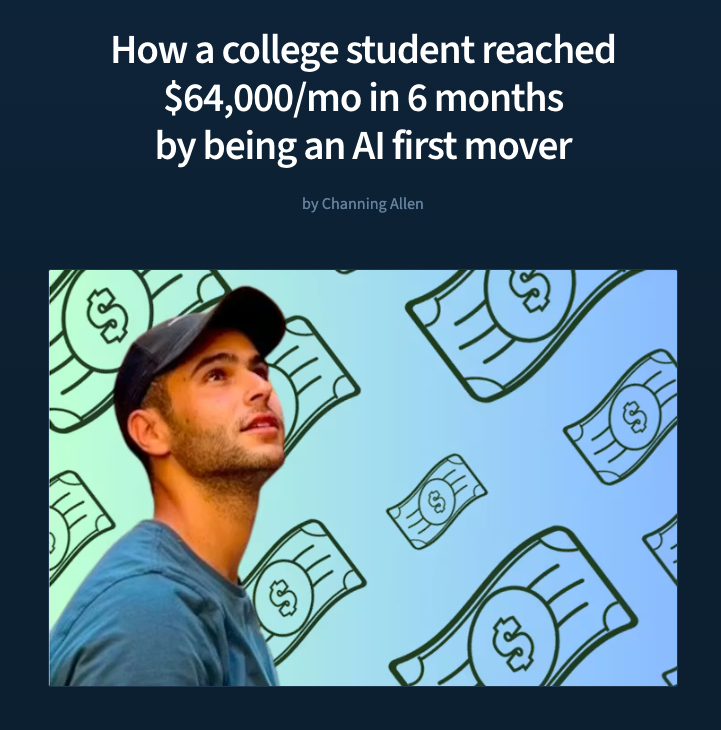
So dope seeing Yasser hit $10M ARR bootstrapped 🥹 I interviewed him in his first 6 months of Chatbase (he was already at $64k/mo!) and his story is so cool. Removing the paywall from the interview since he's blowing up right now: indiehackers.com/post/how-a-col…
Channing Allen tweet media
Yasser@yasser_elsaid_

We just crossed $10M in ARR at @Chatbase! 🎉 🎉 And today, we're launching Chatbase as the full harness for customer-facing AI agents. Similar to how Claude code is a harness for coding agents, Chatbase is the harness for customer experience agents. That means we give the model the context, tools, workflows, guardrails, and human-in-the-loop systems to be the best ambassador for your brand. It's going beyond just solving issues and is giving your customers the best experiences across every channel. This is a milestone I have been thinking about and obsessed with since day 1, and I am super excited to bring my vision for customer facing agents to life with Chatbase. Thank you to every one of our customers and to the amazing Chatbase team for getting us here! Next stop: $100M ARR

English
0
0
13
1.2K
Channing Allen
Channing Allen@ChanningAllen·
Channing Allen@ChanningAllen

Building in public doesn't make sense. For most companies. Most of the time. Even indie ones. I guess it does if you're building for builders. But I don't think you should. Overcrowded. Winner-take-most. Incentive to grift (a bit). But if you're building for the other 99.9% of the market: costs eclipse benefits. - You attract copycats - Jealous losers attack your site & your reputation - Incentive to over-focus on vanity metrics instead of long-term growth - You give aspiring founders like @dagorenouf the false impression it's easier than it is We're days away from inviting beta users to our new AI platform. It's B2B. I hope it gets huge and makes us filthy rich and makes the world a better place and introduces features & interfaces that seem "obvious" to AI enthusiasts in retrospect. But we probably won't "build it in public." We won't share revenue. We won't talk about the tech stack. We kinda don't even want to publicize that we (the founders of Indie Hackers) are behind it. Instead we want our users to spread the word for us. Share it with their friends and companies. Share videos of it on YouTube, TikTok, Instagram, X. And we ourselves want to focus on selling. On talking to customers. And on executing some of the same marketing strategies we've honed over the past decade to build the biggest (arguably) free startup community in the world. I say all this because I feel kinda bad for teasing the app on X for the past couple months, only to now realize we won't be building in public. But I also say it because it doesn't get said enough in the indie hacking community: It's okay to not build in public. The majority of big indie tech companies are run by dudes (yes, mostly male) you've never heard of. And that's not a coincidence.

English
1
0
1
392
John Joubert
John Joubert@johnjoubert·
So does this mean that building in public is more of a liability than an asset? 🤔
Channing Allen@ChanningAllen

@FarzaTV The problem with your ideas isn't that they're nonsense, the problem is they're so NOT-nonsense that you're getting copycatted to hell by all the big players. Distribution is the moat in the AI era but it's hard to outdistribute Google etc and still reach venture scale 🤷‍♂️

English
1
0
1
413
Channing Allen
Channing Allen@ChanningAllen·
@FarzaTV I've built a career on betting on teams like that :) Good luck my man
English
0
0
1
173
Farza 🇵🇰🇺🇸
Farza 🇵🇰🇺🇸@FarzaTV·
@ChanningAllen Huh. Big companies might be able to do an initial copy. But, never underestimate the power of a tiny, focused, relentless team and their ability to build a product people love. History will repeat itself 100 times.
English
1
0
22
840
Farza 🇵🇰🇺🇸
Farza 🇵🇰🇺🇸@FarzaTV·
No matter how much stuff I put out, I sometimes still wake up and feel like all my ideas are nonsense and I got nothing. But what then often happens is I re-remember that all I can do is try. And if I show up, I find ideas always nearly always follow. If you’re someone out there that wants to make stuff or just in the thick of it, please continue trying and showing up. You'll likely end up surprising yourself.
English
80
66
1.1K
30.4K