For decades, Democrat and Republican administrations have promised that export opportunities and a “level playing field” will benefit American manufacturers and workers. REALITY CHECK: It’s never happened.
Charles Benoit
14K posts

@Charles_Benoit
Int'l Trade attorney. Trade Counsel for @cpa_tradereform. Tariffs for Revenue and Development. @GeorgetownLaw alum. Whole world should buy local.

For decades, Democrat and Republican administrations have promised that export opportunities and a “level playing field” will benefit American manufacturers and workers. REALITY CHECK: It’s never happened.

A Utah copper mine is coming back online with advanced tech. Domestic production of critical minerals in rural Utah means greater economic strength and a safer nation. This is how we build what America needs, right here at home. 🇺🇸 More here: bloomberg.com/news/articles/…

Thanks to @POTUS, the United States is the world’s top oil and natural gas producer. We are also the largest natural gas exporter and a top oil exporter. To be clear, the Trump administration has no plan to implement restrictions on oil and gas exports.


Especially given the U.S.' America First policies, it wouldn't be strange to see an export ban. This could do serious harm to European importers of U.S. crude, and some Asian nations too.


UNITED STATES WEIGHS CRUDE EXPORT TARIFF — AND POSSIBLE BAN — TO CURB SURGING ENERGY PRICES AMID MIDDLE EAST CONFLICT. || POTENTIAL CURBS COULD WIDEN WTI CRUDE–BRENT CRUDE GAP, LOWER DOMESTIC FUEL COSTS BUT DISRUPT GLOBAL SUPPLY AND PUSH INTERNATIONAL PRICES HIGHER.


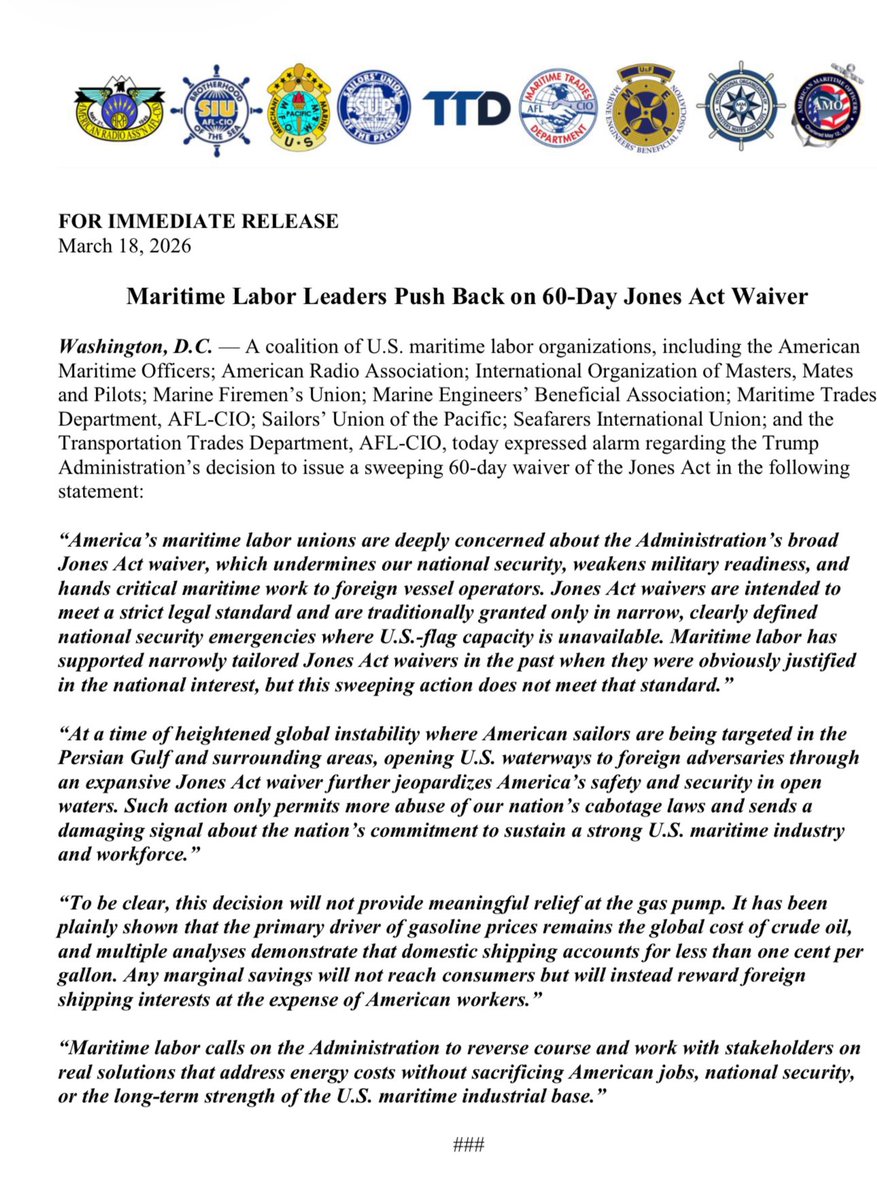
White House approves 60-day Jones Act waiver, opening U.S. domestic energy trades to foreign-flag ships despite industry warnings the move will have little impact on fuel prices. #shipping #energy gcaptain.com/trump-waives-j…

How can any Republican vote to confirm Markwayne Mullin after this exchange with Sen. Rand Paul? (Start at 7:30) youtube.com/watch?v=l086_K…


Argus: Early Jones Act waiver fixtures are coming in well above recent domestic benchmarks, signaling a sharp rise in U.S. coastwise shipping costs as foreign-flag tonnage now enters the market. argusmedia.com/en/news-and-in…

In addition to establishing energy dominance, President Trump is delivering targeted relief for short-term disruptions. This is precisely why the Admin has invested since Day One to restore U.S. supply chains. Onshoring production and expanding capacity means a stronger, safer America for the long term.

Right now, in barns and equipment sheds across the American Midwest, farmers are making the most consequential decision of this war. Not generals. Not senators. Farmers. At $683 per ton urea, corn economics have collapsed. Nitrogen is the single largest input cost for corn production. At pre-war prices a farmer could justify 180 pounds per acre and expect a margin. At $683 the math breaks. Soybeans fix their own nitrogen from the atmosphere through root bacteria. They do not need the molecule trapped behind the Strait of Hormuz. The seed decision is being made this week across roughly 90 million acres of American cropland. Once the planter rolls into the field, the choice is irreversible. Corn seed in the ground stays corn. Soy seed stays soy. The acreage allocation locks in. USDA Prospective Plantings reports March 31. That report will tell the world how American agriculture responded to the Hormuz blockade. But the decisions it captures are being made now, in conversations between farmers and agronomists and seed dealers who are looking at nitrogen prices and making the rational economic choice: plant the crop that does not need the input you cannot afford. Every acre that shifts from corn to soybeans tightens the corn balance sheet for the rest of the year. Corn feeds livestock. Corn feeds ethanol. The Renewable Fuel Standard mandates 15 billion gallons of corn ethanol annually, consuming roughly 43 percent of the US corn crop regardless of price. That demand is inelastic. If acres shift and production falls while the mandate holds, corn prices spike. Feed costs spike. The protein cascade reverses. The US cattle herd sits at 86.2 million head, a 75-year low. Poultry and pork margins that were benefiting from cheap feed compress when corn crosses $5 per bushel. This is how a naval blockade 7,000 miles from Iowa reaches the American grocery shelf. Not through oil. Not through shipping. Through nitrogen. The farmer cannot afford the molecule. The molecule cannot transit the strait. The farmer plants soy instead. The corn supply tightens. The ethanol mandate consumes its fixed share. The remaining corn reprices. The feed reprices. The meat reprices. The grocery bill reprices. The decision is not political. It is arithmetic performed on a kitchen table by a person who needs to plant in three weeks and cannot wait for a ceasefire, an escort convoy, or an insurance normalisation that the Red Sea precedent says takes years. The deepest penetrator in the American arsenal cannot reach a sealed Iranian doctrinal packet. But the fertiliser price it failed to resolve is reaching every planting decision on 90 million acres of the most productive farmland on Earth. The war’s most irreversible consequence is not happening in a bunker. It is happening in a barn. And by the time USDA publishes the data on March 31, the seeds will already be in the ground. Full analysis in the link. open.substack.com/pub/shanakaans…

Thank you to American farmers who continue to feed our country and the world! 🇺🇸🫛🌽🌰🐄🥩🐖🌾🐔👕➡️🌏 #NationalAgWeek


Effectively all growth in corn production over the last 20 years is for ethanol. ~20 million acres of conservation land, grassland, and soybean rotation was turned into corn monoculture that effectively strip mines the topsoil. Meanwhile it’s the most fertilizer dependent crop with only a 40% uptake rate. So ~1.7 million tons of nitrogen runoff flows into the Mississippi basin annually while also polluting their own water supplies. This runoff ends up expanding the Gulf deadzone, which is also where 40% of domestic seafood comes from. It’s hard to find a worse way to create fuel, with a wicked level of waste and downstream consequences.