

Conrad Lagowski
4K posts


@Chronocivilis Wow, I wasn’t aware of this - great share!
English
Many hear of ‘Noah’s Ark’ and laugh it off
However, I think it goes far beyond “coincidence” that not only is this located on Mt. Ararat in Turkey, (exactly where Genesis 8:4 says it’s located)…
But it’s also virtually the same exact measurement of what the Bible described!


New York Post@nypost
Ancient fossilized trees may finally prove Noah's Ark flood is true: scientists trib.al/2R7GeJp
English
@Kitsune_in_VA You have a way with words, Tami. You were missed at the conference.
English

The ECDO hypothesis reflects the superb phronesis of its author: It has provoked discussion, caused experiments to test this or that assertion, evoked a fresh analysis of long-held assumptions, and produced a reorientation of our outlook. It has even catalyzed what may, perhaps be the first-ever gold rush to private visualization of Polar motion data, and engaged a broad audience in deeper scientific concepts.
For me, ECDO flipped an inner switch, illuminating corridors of inquiry I never knew existed, and this completed manuscript beckons to lead me further still. Thank you, @EthicalSkeptic

English
HOWORTH (1887) continued:
“In Siberia, as we have seen, the death of the Mammoth and its companions was immediately followed by a sudden declension in temperature, which of itself and in the absence of other causes made that area incompatible with the life conditions of the Mammoth, but this was a correlative occurrence, and not the immediate cause of the great destruction. It is unlikely that the cold would have killed the bear and glutton, the musk-sheep, etc., which we know were in many instances overwhelmed by the same cause, whatever it was that destroyed the Mammoth.
The fact of the bones occurring in great caches or deposits, in which various species are mixed pell-mell, is very important. Different species do not come together to do so, nor does the lion come to take his last sleep with the lamb. The fact of finding masses of animal remains of mixed species, all showing the same state of preservation, not only points to a more or less contemporary death, but is quite fatal to the theory that they ended their days peaceably by purely normal causes.
Their state of preservation proves that they were covered over and protected immediately after their deposition, and have remained so covered and protected ever since, and this along many degrees of longitude, and by continuous undisturbed beds of clay and gravel.
Wrangell says, "The best Mammoth bones, as well as the greatest number, are found at a certain depth below the surface, usually in clay-hills, more rarely in black earth. The more solid the clay, the better the bones are preserved. Experience has also shown that more are found in elevations situated near high hills…”
The evidence is equally or even more conclusive from Europe, where, in the great deposits of loess and in the brick clays, &c., in many places, as at Folkestone, Flamborough Head, Bournemouth, &c., we find the caches of bones in positions entirely out of the reach of any possible rivers or river floods, and on the Continent in beds which are quite undisturbed and continuous over large areas, showing that they were spread by some continuous and far-reaching cause.
Schmidt, probably the most skilled geologist who has examined the Siberian Mammoth-beds in situ, says in reference to this very notion, "The northern rivers throw down no great amount of mud. No Mammoth could sink into the brown layers of mud which remain on the low grounds after spring floods.”
Vast hecatombs are found in certain places like New Siberia, 150 miles distant from, or in high grounds far away from any possible river channel…remains are found where no river could possibly flow.
Myriads of fresh skeletons of Mammoths, rhinoceroses, bisons, etc., in Siberia or in Europe...have every sign that they formed parts of a contemporaneous fauna destroyed at the same time.
As Cuvier says, arguing from another point,
"But how have so many ferocious beings that inhabited our forests been extirpated from them? The only answer we can provide is that they must have been destroyed at the same time and by the same cause as the great herbivores that inhabited the forests alongside them, and of whom no more traces are found today."
However ingeniously and with whatever subtlety we may deal with our evidence, the facts constrain us therefore to one inevitable conclusion, namely, that the Mammoth and its companions perished by some wide-spread catastrophe which operated over a wide area and not through the slow processes of the ordinary struggle for existence, and that the greater portion of the remains we find in Siberia and Europe are not the result of gradual accumulation under normal causes for untold ages, but the result of one of Nature's hecatombs on a grand and wide-spread scale, when a vast fauna perished simultaneously.
We must next inquire what the nature of this catastrophe was.
The first piece of evidence I would quote is of a singularly direct kind, and we owe it to the experienced skill of Professor Brandt. Speaking of the famous rhinoceros found on the Wilui by Pallas, he says, "On a careful examination of the head of the Rhinoceros Tichorinus from the Wilui, it was further remarkable that the blood-vessels and even the fine capillaries were seen to be filled with brown coagulated blood, which, in many places still preserved its red colour." This is exactly the kind of evidence we look for when we want to know whether an animal has been drowned or suffocated. Asphyxia is always accompanied by the gorging of the capillaries with blood, and the facts justify at all events a probable inference that this particular rhinoceros was the victim of drowning.
Schrenck submitted the head of the Rhinoceros Merkii, already described, to a similar examination, and one passage in his memoir is singularly interesting when taken in conjunction with the remarks of Brandt just quoted. Speaking of its nostrils, he says, "They were wide open, and in the case of the one on the right side, which was uninjured, a number of horizontal folds were ranged in rows about it. The mouth was also partly open, whence it may be concluded that the animal died from suffocation, which it tried to avoid by keeping the nostrils wide asunder."
To continue. The occurrence of immense caches in which the remains of many species of wild animals are incongruously mixed together pell-mell, often on high ground, seems unaccountable, save on the theory that they were driven to take shelter together on some point of vantage, in view of an advancing flood of water, collecting together on some dry place, and reduced to a common condition of timidity and helplessness by a flood which has overwhelmed the flat country. As Horace says, referring to Deucalion’s deluge,
"Omne cum Proteus pecus egit altos
Visere montes." (When Proteus drove all his flock to visit the high mountains.)
Evidence is forthcoming from the deposits where the Mammoths' remains occur further inland, and where we find marine shells which clearly evidence the former presence of the ocean. This was known to Pallas, and has been confirmed amply by Middendorf and others. Thus the former describes the occurrence near Ust Tatarskoi on the Irtish of numerous shells, mostly fossilized, but others preserving their horny pellicles, and in some cases retaining traces of the mollusk itself. In these same layers were found the bones of elephants and many other animals. "This undoubtedly," he adds, "has come from a great inundation. We have in it an evident proof that the sea once bathed these countries."
At a short distance from Kopanofskoi on the Volga were found several bones of an elephant. Pallas says he "obtained a jaw-bone much petrified, and as-it-were coated with fine gravel and muscles.”
Murchison describes pleistocene marine shells as occurring a long way south of the White Sea. Similar marine shells are found mixed with Mammoths' remains in the valley of the Lower Somme, and in the deposits of the English Channel, while we know that the sea bottom from Lowestoft to Dunkirk is strewn with large numbers of Mammoths' bones; so in Torbay, etc…traces of the results of a catastrophe.
This completes my survey of the evidence furnished by the Mammoth itself, and I believe that not only is it consistent with the conclusion that that animal and its companions were finally extinguished by a sudden catastrophe, involving a great diluvial movement. The evidence is not only ample, but it is evidence which converges from all sides.
I will lastly quote the opinion of Erman, whose critical skill and knowledge were perhaps greater than those of any of the Siberian explorers. He has the following remarks: "The ground at Yakutsk . . . consists, to the depth of at least 100 feet, of strata of loam, pure sand, and magnetic sand. They have been deposited from waters which at one time, and it may be presumed suddenly, overflowed the whole country as far as the Polar Sea. In these deepest strata are found twigs, rocks, and leaves of trees of the birch and willow kinds; Everywhere throughout these immense deposits are now lying the bones of antediluvian quadrupeds along with vegetable remains.
It is only in the lower strata of the New Siberian wood-hills that the trunks have that position which they would assume in swimming or sinking undisturbed. On the summit of the hills they lie flung upon one another in the wildest disorder, forced upright in spite of gravitation, and with their tops broken off or crushed as if they had been thrown with great violence from the south on a bank, and there heaped up. Now a smooth sea covering the tops of these hills on the islands, would, even with the present form of the interjacent ground, extend to Yakutsk, which is but 270 feet above the sea.
The flood may have poured down from the high mountains through the rocky valleys. The animals and trees which it carried off from above could sink but slowly in the muddy and rapid waves, but must have been thrown upon the older parts of Kotelnoi and New Siberia in the greatest number and with the greatest force..”
THE MAMMOTH AND THE FLOOD
HENRY H. HOWORTH (1887)

English
Better here would mean fresher, where the edges would be slightly more sharp. However, I don't think it ever looked great. Color wouldn't have addressed the imprecise workmanship here.
Poor etching because the depth is mostly surface level, less than a 1/4mm.
The etching mechanism here appears to be a type of pointillism where they used something pointy, then hammered it to create an indent, doing that in succession to create a line. Which is why we don't see a continuous line.

English

@Conrad_ML @Megalithic12000 Don't you think it looked a lot better in its PRIME?
With colors and all.
"Poor etching" is simply many times wear & tear.
-Exposed outside to the elements over millennia...
English

On a granite boulder on an island in the Nile, someone carved a story about a disaster that, to them, was already ancient history.
The Famine Stela describes a seven-year drought under the pharaoh Djoser, when the Nile would not rise and the country starved.
Mainstream dates the carving itself to roughly 2,300 years ago.
But the events it describes were placed some 2,500 years before that, which means the people who cut it were already reaching deep into a past they treated as a lost age of wisdom.
🔹Carved into granite
🔹It sits on Sehel Island
🔹It tells of a seven-year famine
🔹The carving is dated to Ptolemaic times
🔹The events it describes were far older still
🔹It invokes Imhotep, by then turned into a god
That is the part worth sitting with.
A civilisation we call ancient was itself looking back across millennia at an even older age, and at Imhotep, an architect they had elevated into a divine figure.
Memory of catastrophe and of a remote golden age was being deliberately written into stone, on purpose, to be kept.
We treat deep time as our discovery, when they were already living inside it.
So what did they remember that made them carve it into a rock built to outlast them?


English
@ThothExperiment @TheShadowIntelX @lovetruth1313 @grok is the claim about Napoleon's testimony documented and verifiable?
English

Napoleon said the Queen’s chamber had so much salt, they started choking. That it came off the walls in chucks. The grotto in the well shaft is full to the ceiling with this salt, rubble and efflorescence mix. There’s even flint in the fissures where water eroded the stones.
They never mention the grotto, as they know it’s a grand room leading to other rooms and to the two tunnels.
English

Filippo Biondi says that the Great Flood, the Zep Tepi, and the pyramids are all connected.
The Italian space engineer just told Joe Rogan that the seawater salt still stuck to the walls inside the Great Pyramid proves the entire area was flooded thousands of years ago. That same salt is the evidence that ties everything together with Zep Tepi.
"Inside the pyramids, they found a lot of salt on the walls."
"Two months ago, I went for the first time to visit the pyramids, and I found salt on the wall."
Rogan: "So you think that that salt is because the entire area was flooded?"
Biondi: "Yes."
Rogan: "And that’s the reason why the shafts were flooded and filled with debris?"
Biondi: "Yes."
Rogan: "Because everything just flooded into there, and then when the sea receded … you’re left with salt everywhere."
"John Anthony West thought maybe 30,000+ years to the construction of the Sphinx."
"And the water erosion [on the Sphinx], it’s vertical fissures that come from thousands of years of rainfall."
"And the last time there was like significant rainfall in the Nile Valley like that was 9,000 years ago."
Biondi: "That’s why this research … it is very important."
Rogan: “It would really rewrite everything.”
This means the pyramids were built sometime between Zep Tepi and the Great Flood, which could push their age back dramatically.
The salt on the walls is ocean salt from when the sea rushed in over 11,000 years ago and filled the shafts with debris.
Biondi is convinced this changes everything we thought we knew about ancient history.
What is your reaction to Biondi’s discoveries?
English
@Scottie36912 @TheShadowIntelX Can you demonstrate any of these claims?
English

The salt that was on the inside of the structures, was there as a result of evaporation and condensation, the pyramids are connected to the earth's mantle
The steam from the core facilities the eletrical pathway to earth through the structure, they convert magnetic field energy into electrical, this is when our core was much larger because it was fueled.
The flood was a result in the system being disconnected
The planets axis tilted.
Thats what I read anyway
English
@Megalithic12000 Also found in Peru. See link.
x.com/plastolithic/s…
𝐓𝐡𝐞 𝐏𝐥𝐚𝐬𝐭𝐨𝐥𝐢𝐭𝐡𝐢𝐜 𝐏𝐚𝐬𝐭@plastolithic
#10: Scarab on a rectabgular column (again, oddly specific!) The one in Cusco is broken in half and only the rear part remains, but there's no way it's not a scarab. You can even see where it's middle set of legs were attached.
English
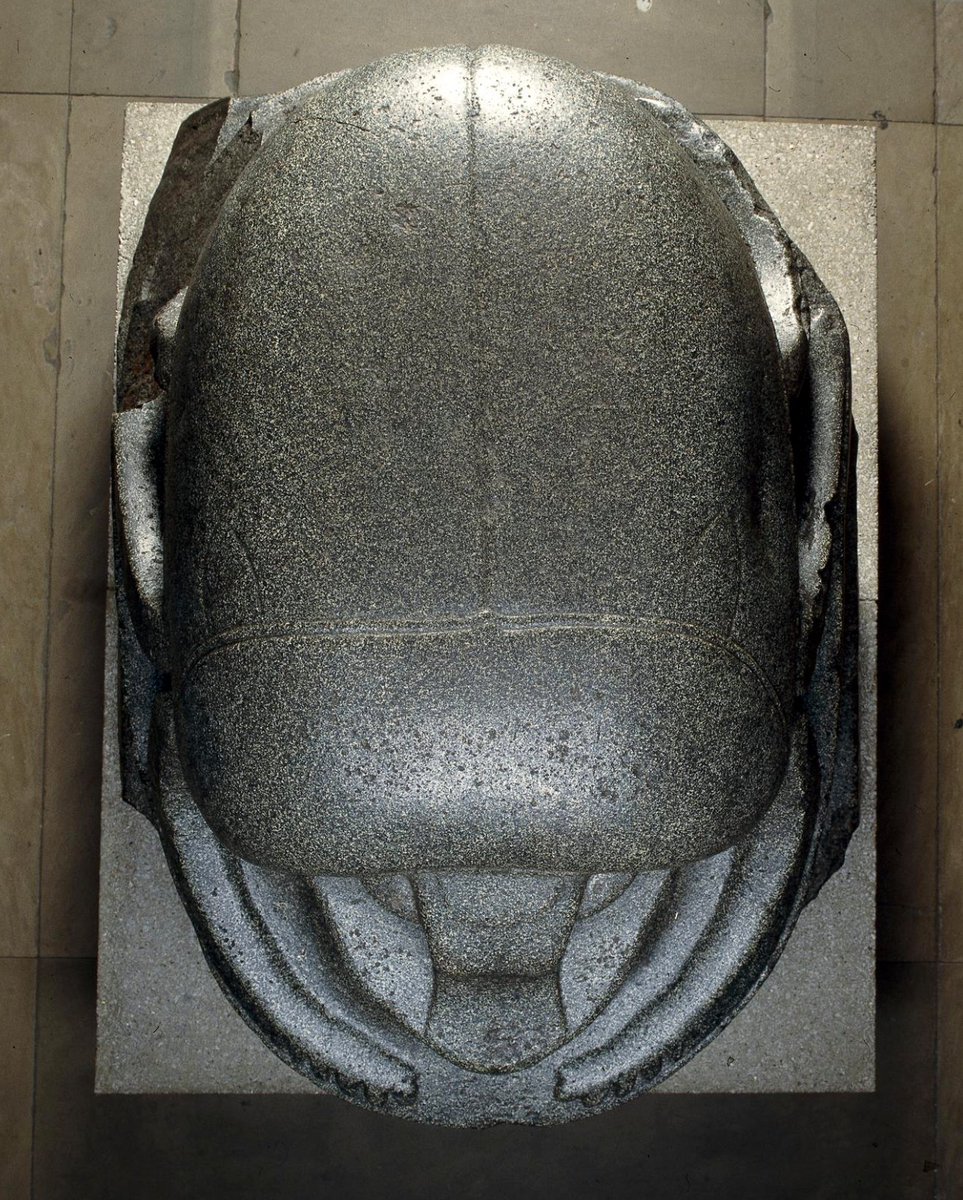
There is a 2.3 tonne scarab in the British Museum, carved from a single block of diorite, and the precision on it should stop you cold.
Diorite is one of the hardest stones the ancient world ever touched, roughly 7 on the hardness scale.
Every metal Egypt had was softer, so the accepted answer is abrasion, grinding it down with sand and harder rock.
Now look at the thing itself. Smooth flowing curves, clean symmetry, controlled surfaces, an anatomically coherent beetle, all of it executed in a stone that resists every pass of the tool.
🔹One solid block of diorite
🔹It weighs roughly 2.3 tonnes
🔹The symmetry is genuinely exact
🔹Its precision has never been studied
🔹The method has never been shown at scale
🔹No full reproduction has ever been published
Here is what nobody mentions.
The object has been scanned, but its actual precision has never been studied or published, and the abrasion explanation has never been demonstrated on a diorite sculpture this size and this refined.
The answer is assumed, not shown.
So the most confident claim in the room, that simple grinding produced this, rests on no study of the object and no full scale reproduction of the method.
They are certain about the one thing they never tested.
So how is everyone so sure, when nobody has ever proven it on this stone?

English
English

We need a new name for the pyramid builders; the "pre-dynastic Egypt civilisation" is too long.
Can we call them "Giza boys"?
Giza and surrounding areas are where they achieved their best.
@EthicalSkeptic
@nobulart
@EcdoPrep
English
English

@valinda4kids @Conrad_ML @HarmeetKDhillon Cuts bitterness and boosts flavor notes. It tastes even better.
English

My travel companions can mock, but I have traveled so many millions of miles in my life that I always have a ready to go-bag with healthy snacks, fruit, protein powder, and instant bone broth and coffee. Also salt and pepper. I can survive for days (will be extremely 😾 grumpy).

English
@ChipActual @HarmeetKDhillon I've worked up to almost half a tea spoon since starting at just a few grains about 7 years ago.
English
English

@nobulart @cognitivecarbon I wish I could articulate my gratitude for your work. Obviously, you have a passion for it, but that doesn't take away from the fact that you invest your life in this. So, just know it hasn't gone unnoticed 🙏
English

A brilliant treatise for the ages.
This one should be pressed into clay, cast into a modern cuneiform tablet to be preserved across the maelstrom of time.
Among many favorite quotes:
"A people who saw the sea arrive where no sea belonged would not leave behind a peer-reviewed monograph.
They would leave a story. And the descendants of that story would eventually be mocked by men who mistake their own notation for reality."
Craig Stone@nobulart
English
@LivingExtraord1 It's a conceptual error. First define "time" before pairing it with "travel".
x.com/Conrad_ML/stat…
Conrad Lagowski@Conrad_ML
If you want to understand what time is, or teach your kids, here's an at-home demonstration: 1. Clap your hands at a slow and constant rate. 2. While clapping, walk across the room and count how many claps it took you to get to the other side. That's time. Nothing more. It's that simple. We use the earth's rotation instead of a clap. It's not a Sony Walkman that can be rewound and recorded over. Time is just a relationship between a constant motion and what ever you're measuring against that motion.
English

At this point I’m just openly requesting classified time travel leaks.
If you know something… now would be a great time to accidentally become a whistleblower.
English

@gregreese How would the island on the right appear if the water level rose? It would have to lower to expose new land. Confused here
English


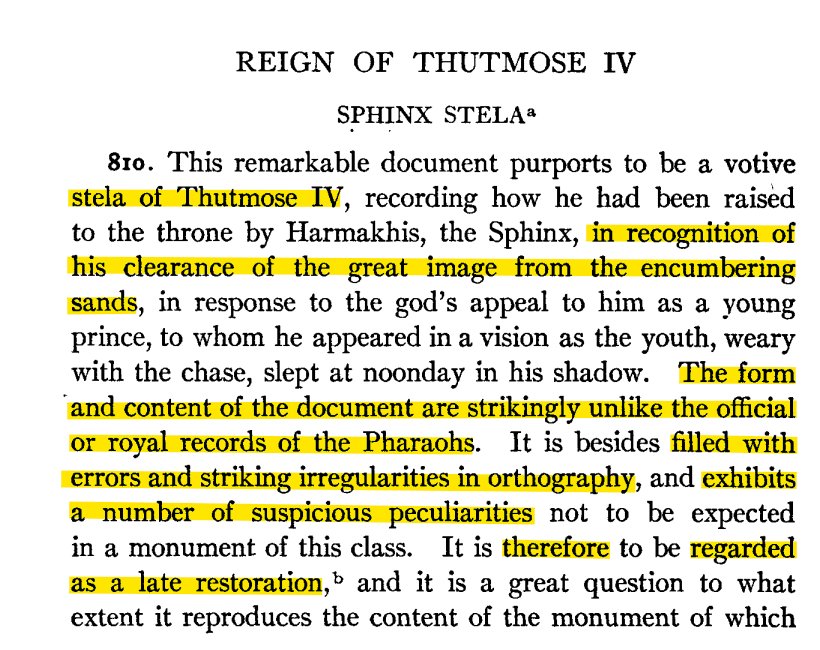
@nobulart I feel dumber for having read as much of the hieroglyphic translation as I did. The squatting cargo cult civilization known as the Ancient Egyptians is laden with opportunistic power lust, which is abundantly evident from their writings.
Source: etana.org/sites/default/…
English

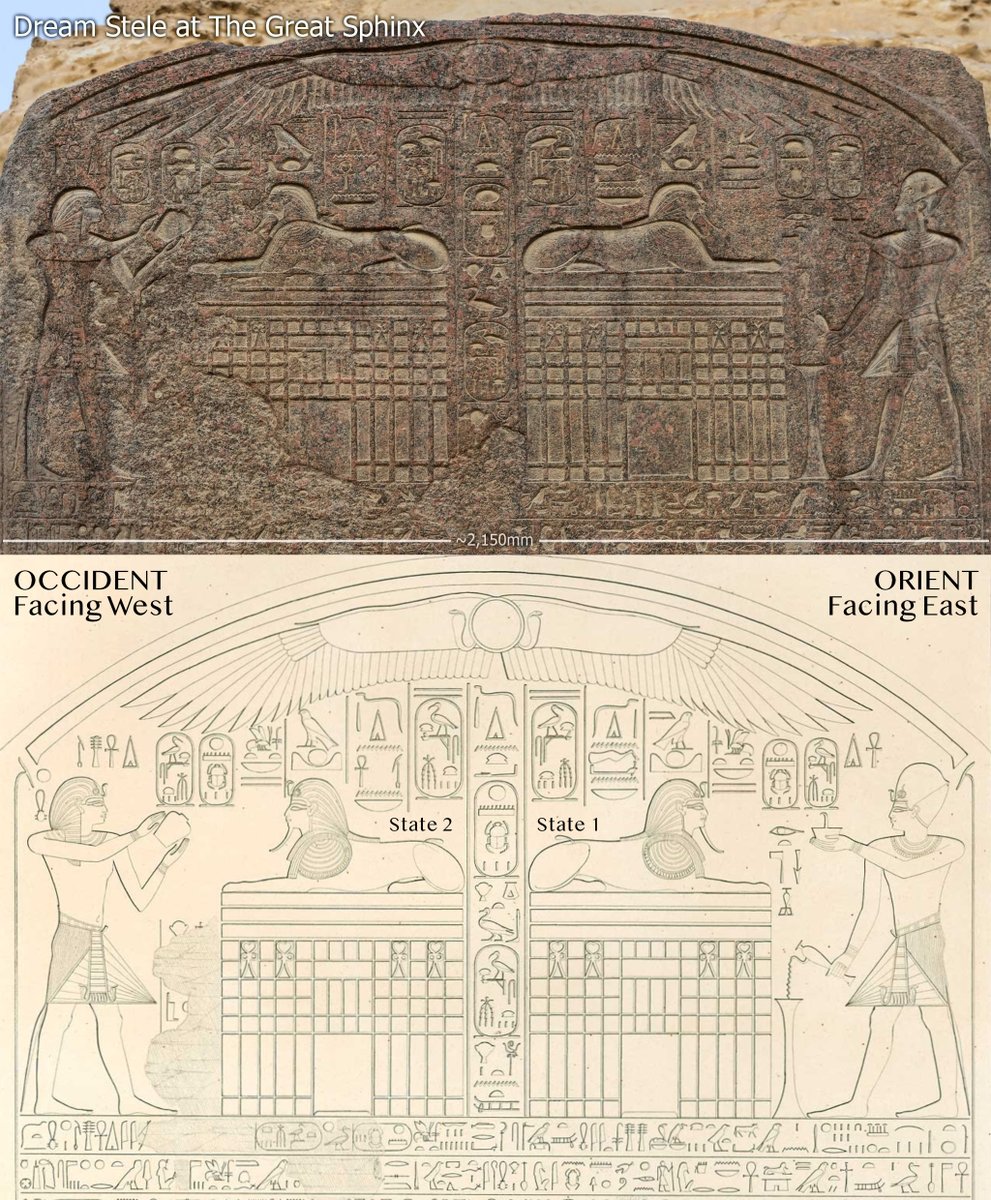
The translation does not include the upper portion. The stele is considered to predate Herodotus by at least a thousand years and "may not, in fact, date to the reign of Tuthmosis. It is possible that it is a replacement for an earlier stele." (from your link), suggesting that the lower text may have been an addition to the repro. Consider the interpretation of the upper text, which fits rather well with the orient-occident cycles of Egyptian lore:
"The two sphinxes themselves almost certainly represent dual aspects of the same solar being — associated with:
sunrise / sunset
east / west
rebirth / completion
cyclic passage of the sun
The winged solar disk spanning the top reinforces this interpretation. It is the solar barque motif of protection and celestial sovereignty.
What is especially interesting is the bilateral arrangement around the central axis. Egyptian temple art frequently encoded:
dual kingdoms,
dual horizons,
mirrored cosmological states,
or cyclical transitions"
chatgpt.com/share/6a0cdee0…
English
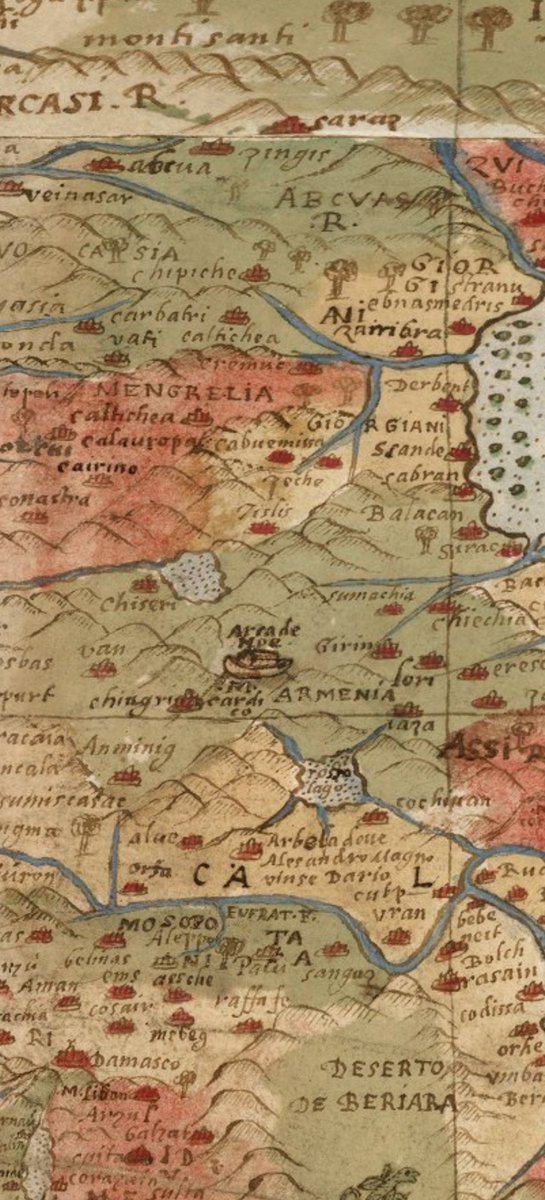
The Dream Stele. Two orientations of the same sphinx. State 1 and State 2. "Thus in the period of eleven thousand three hundred and forty years they said that there had arisen no god in human form; nor even before that time or afterwards among the remaining kings who arose in Egypt, did they report that anything of that kind had come to pass. In this time they said that the sun had moved four times from his accustomed place of rising, and where he now sets he had thence twice had his rising, and in the place from whence he now rises he had twice had his setting." - Herodotus
[1] en.wikipedia.org/wiki/Dream_Ste…
[2] lexundria.com/hdt/2.142/mcly
[3] theethicalskeptic.com/2024/05/12/exo…
English
The Fermi Paradox is just a thought experiment. It's the application of our ability to abstract and ask "what if" in the same way that we can combine know attributes into an abstract but detached from reality being, whether deity or Centaur-Griffin. It's meaningless to contemplate "imagine having the power of a horse, paired with the freedom of flight, and efficacy of a reasoning mind, and breasts."

English
@nobulart I had this thought: if ECDO-like phenomena can happen to any Earth like planet with an asymmetric mass distribution in its core (presumably common or universal?) ... could this be a factor in the Fermi Paradox?
English
Tempus Fugit. "If deep time is an illusion crafted by fragmented evidence, then what remains of evolutionary chronology, planetary formation models, and the story of human antiquity? If major events like ECDO have repeatedly reset the clock, then we must reconstruct Earth's history from a perspective that accounts for cyclic cataclysm — not gradualism."
[1] nobulart.com/tempus-fugit >>

English
@shipibospirit More examples of this type of cutout in Greece.
x.com/plastolithic/s…
𝐓𝐡𝐞 𝐏𝐥𝐚𝐬𝐭𝐨𝐥𝐢𝐭𝐡𝐢𝐜 𝐏𝐚𝐬𝐭@plastolithic
Photo from the 1920s. The unhelpful caption says "Living rock from which two blocks have been extracted; the spaces formed resemble seats, one stepped - Urubamba, Cuzco" Round cutouts like this are rare. Other examples are Killarumiyoq and The Sanctuary Of Pan on Thasos, Greece.
English


@ChrisMartzWX Mann blocks anyone smarter than himself. Which is a LOT of people.
English

How Michael Mann still has a job at this point is beyond me.
His credibility is zero, but his ego is higher than Willie Nelson.
The Honest Broker@RogerPielkeJr
Michael Mann reaction to encountering on X my colleague @matthewgburgess who is an exceptional economist and scholar, and a great guy It'll be great when this approach to science engagement is in the rearview mirror! Give Matt a follow!
English
