

croHODL
645 posts

@Bitcoin_Teddy EXCESSIVE ENERGY???
WRONG..... THE ENERGY CONSUMPTION $BTC WOULD POWER UP SMALL COUNTRIES....
●ONCE AGAIN THEY LIE●
WHAT THEY DON'T WANT YOU TO KNOW!!! WHAT THEY HIDE FROM YOU!!!
$BTC, #Bitcoin, #BITCOIN, #bitcoin, NOTHING ABOUT IT IS GOOD...
ANY ACTIVISTS SHOULD SELL..


English

NVIDIA CEO Jensen Huang says, “Bitcoin mining is taking excess energy and storing it into a new form. It's called currency. And you take that currency wherever you like. So you took energy from one place and now you've transported it everywhere.”
English
@LeonidasNFT @ord_io @ZapApp I am proud of bitcoin getting rid of you. So long spammer, home many more fold soon
English

We're shutting down @ord_io and @ZapApp at the end of the month
This really sucks because great people put a lot of hard work into these products, friends invested in me, our users believed in us, and I feel like I let everyone down
In the end we ran out of money and don't see a path forward
Despite that I'm still incredibly proud of everything that we did
I'm proud that we organically built two respected crypto brands that never farmed anyone or launched a token
I'm proud that we empowered over a million people to explore Ordinals inscriptions on Bitcoin
I'm proud that we shipped an app that let anyone sign up and buy a Bitcoin memecoin in under 30 seconds (an experience that many considered impossible)
For the past 3 years I've woken up every day excited to build in the Bitcoin ecosystem and feel blessed to have had that opportunity
I never took a salary, have no regrets, and wouldn't trade the epic moments we had along the way for anything
Thank you to my cofounder Zach, our team, our investors, and all of our users for being part of this journey with me 🧡
Ord.io@ord_io
Ord io is shutting down on June 1. Three years ago, we launched our idea for "an Ordinals explorer with upvotes". We had no idea what was about to happen. Since then, Ord io has grown into a platform used by over a million people to explore inscriptions on Bitcoin. It brought us so much joy to ship features like Satributes for discovering the rare sats behind inscriptions and Block Vision for monitoring real-time Runes minting activity. Even simple filters and sorting options took on a life of their own. "Sort by largest inscription" quickly turned into a leaderboard where inscribers competed to create the biggest "four megger". And even the things that annoyed us at the time are funny to look back on now, like when the Bitcoin Puppets community would "raid" other collections so hard that we had to remove the downvote feature. To help preserve some of the Bitcoin culture that happened on Ord io, we'll be uploading the full history of upvotes, replies, and public address profiles to GitHub. That way, if someone wants to build their own Ordinals explorer with this context in the future, they can. Thank you to every single artist, collector, dev, and degen who joined us for this ride 🧡
English

@elonmusk Hey Elon, it's my safe word too! join me on the show sometime to chat? I host one of the top Bitcoin shows
English

@BitMEXResearch @midmagic @adam3us @Dimi_h @hodlonaut Consensus is not static. That's the whole point, node runners can and should arrive at a new consensus when a new consensus forms...cry harder
English

Seems that some people are deeply disappointed that the 83 byte OP_Return limit wasn't a consensus rule and they think it ought to have been. Therefore they act as if it was a consensus rule.
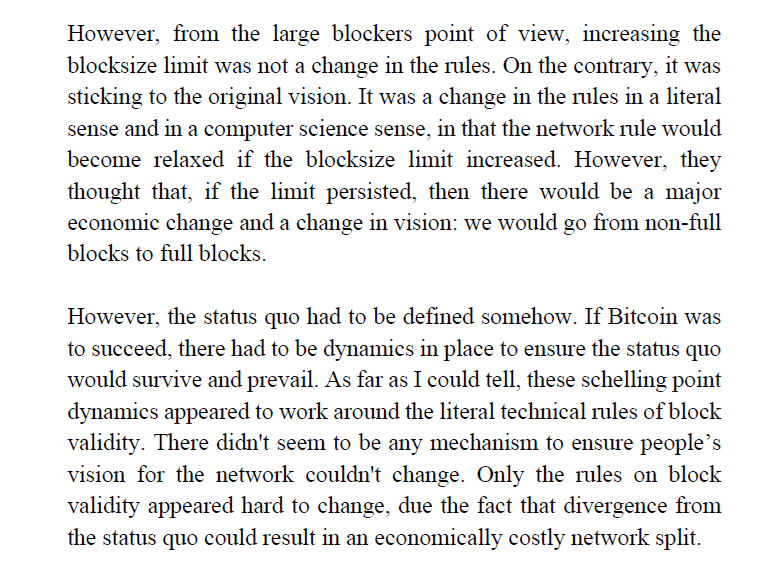
Very similar to how the larger blockers were deeply disappointed that the 1MB Blocksize limit was a consensus rule and tried to act as if it wasn't, act as if there was no such thing as consensus rules or act as if consensus rules are fuzzy.
Maybe the OP_Return relay limit should have been a consensus rule, but it isn't. They need to accept that reality and accept the reality of what consensus rules mean.
English
> we are implicitly conceding that miner greed + economic incentives are the ultimate rule-setter, not node-enforced principles
Perhaps @hodlonaut should read chapter 4 of "The Blocksize War". Despite what some people want, Bitcoin nodes do not enforce "principles", "visions" or "economic changes". Nodes only enforce the literal technical rules on block validity. The literal technical rules enforce a 1MB OP_Return limit. That is what nodes enforce, nothing more and nothing less.
amazon.co.uk/Blocksize-War-…
hodlonaut #BIP-110@hodlonaut
By repeatedly adjusting default mempool policy to match what miners will accept anyway (large OP_RETURN uncapped because “they’ll just mine it via bypasses like Libre Relay, or direct APIs”), we are implicitly conceding that miner greed + economic incentives are the ultimate rule-setter, not node-enforced principles. Meaning a (cleverly hidden) capitulation of Bitcoin as a decentralized project. You could say that the “CENSORSHIP!” argument from Core and their supporters on the concept of nodes filtering is a roundabout way of critizing decentralization itself. Nodes were always supposed to be the sovereign check, they decide what they accapt and relay. When we keep loosening policy to align with whatever is the current grift “use case”, and by extension what is short term profitable for miners, it trains the entire ecosystem to treat restrictive node behavior as pointless theater. Over time this hollows out node sovereignty: running a full node becomes more about passively observing the chain that miners + L2s + data-spammers have already decided on, rather than actively enforcing a monetary-first standard. As a cuck bonus it also leads to higher resource costs for every honest node (bandwidth, RAM, storage) à fewer independent verifiers in practice Decentralization starts looking like a performance act. Miners produce the blocks, a handful of relays and L2 sequencers steer the flow, and nodes just… validate after the fact. It’s not a hard-fork capitulation (consensus rules haven’t changed), but it is a cultural, philosophical and operational one. The most profound capitulation in practice. The philosophy flips from “Bitcoin should resist non-monetary garbage even if it costs us some short-term fee revenue” to “whatever pays miners gets standardized because resistance is futile.” Once you accept “miners will do it anyway” as the justification for policy, you’ve already handed the character of Bitcoin over to the highest bidder. Nodes stop being the immune system and start becoming just a polite audience. The OP_RETURN uncap looks a lot like another quiet step toward a two-tier network (miners + insiders set the tone, everyone else just watches. Keep doing this and running a node risks becoming a branding exercise instead of the actual source and guarantee of Bitcoin’s decentralization.
English


@BTCtreasuries Has been, compromised, disgraced Adam Back said...... There, I fixed it for you
English

Cypherpunk legend Adam Back said, "The treasury companies are #Bitcoin's price shock absorber."
English
@shub_mahe @1914ad Garbage company, garbage CEO. How come you have to even ask this?
English

⚠️ Quick $NAKA update:
Insiders hold 40% of shares outstanding. Not one of them has bought a single share on the open market.
The BTC treasury hasn't grown by a single sat.
The stock is down 99.3% and 70 days from Nasdaq delisting.
Bull Theory@BullTheoryio
Bitcoin Treasury Company "Nakamoto" is down -99.34% from its peak, erasing over $23.3 billion from its market cap. If you invested $100,000 in $NAKA last year, today it would be worth $600.
English

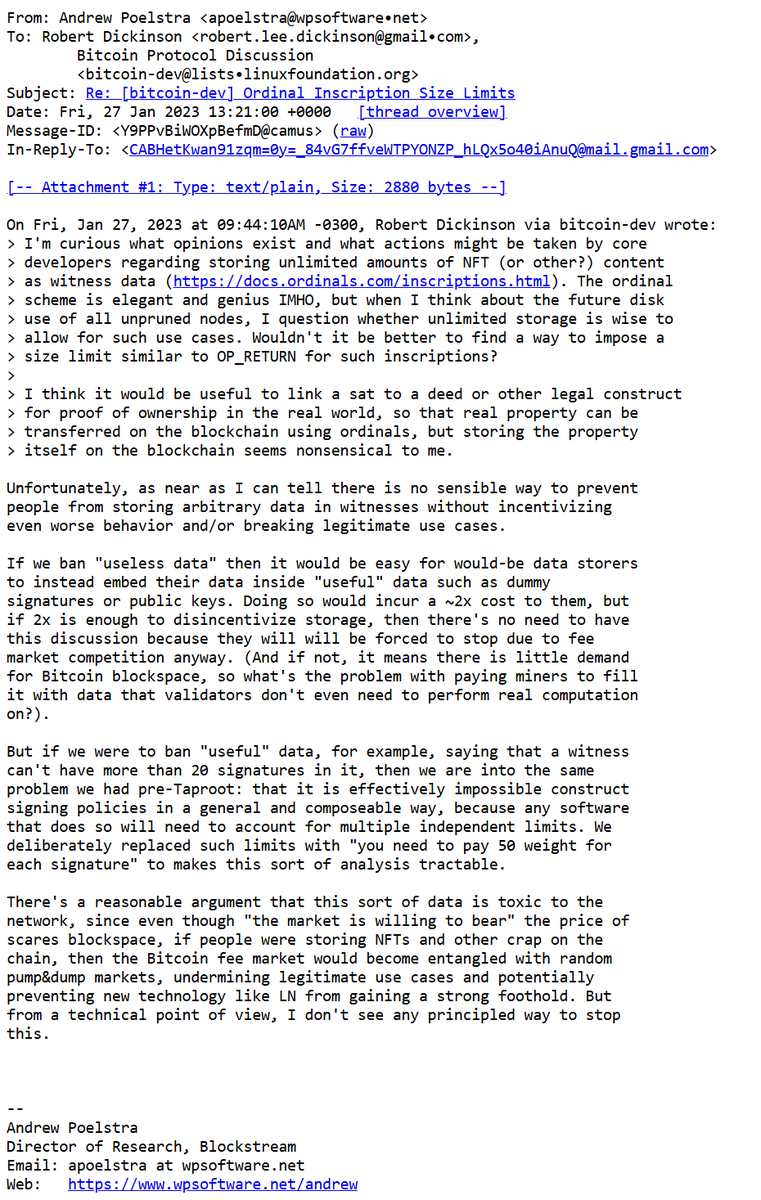
This whole censorship debate was over Jan 27, 2023 within 1 week of Ordinals coming out. After that filterooors are at best kinda dumb and at worst disingenuous & pro-censorship.
If your favorite maxi KOL ethicsfluencer led you to believe we can and should censor bitcoin then you should break the Gell-Mann Amnesia loop and think adversarially for once.
English
Unfortunately, as near as I can tell there is no sensible way to prevent people from storing arbitrary data in witnesses without incentivizing even worse behavior and/or breaking legitimate use cases. If we ban "useless data" then it would be easy for would-be data storers to instead embed their data inside "useful" data such as dummy signatures or public keys. Doing so would incur a ~2x cost to them, but if 2x is enough to disincentivize storage, then there's no need to have this discussion because they will be forced to stop due to fee market competition anyway. (And if not, it means there is little demand for Bitcoin blockspace, so what's the problem with paying miners to fill it with data that validators don't even need to perform real computation on?). But if we were to ban "useful" data, for example, saying that a witness can't have more than 20 signatures in it, then we are into the same problem we had pre-Taproot: that it is effectively impossible construct signing policies in a general and composeable way, because any software that does so will need to account for multiple independent limits. We deliberately replaced such limits with "you need to pay 50 weight for each signature" to makes this sort of analysis tractable. There's a reasonable argument that this sort of data is toxic to the network, since even though "the market is willing to bear" the price of scarce blockspace, if people were storing NFTs and other crap on the chain, then the Bitcoin fee market would become entangled with random pump & dump markets, undermining legitimate use cases and potentially preventing new technology like LN from gaining a strong foothold. But from a technical point of view, I don't see any principled way to stop this.
- apoelstra
-michaelscott
-cbspears

English

I am not exaggerating when I say the vast majority of accounts replying to me supporting BIP-110 were created in 2023 or later. I can count on clicking on their profile and it showing 2023+ account creation date. Even if there is a kernel of real organic support, it's pretty evident bots are attempting to embellish things.
English
@adam3us @knutsvanholm @BryanBSolstin If that was a question, then yes. But you don't have to so GFY
English

@knutsvanholm @BryanBSolstin Vague. Should we disable lightning by your logic? (It uses Bitcoin smart contracts). Are newer more private or efficient layer2 lightning or other models ok? Or should they be blocked by the purity police?
English

Bitcoin is money. Nothing else.
That's what I would like to see ossified.
English
@JM_speakss So you are asking the same people you don't believe the same question, and hoping you will now get a different answer?
English

Everyone on here claims they’re 90–100% allocated to Bitcoin.
I don’t believe you.
Be honest.
What percentage of your portfolio is actually in bitcoin?
English
@LawrenceLepard @carlodangelo I think he gets it, it's impossible he is that stupid. It just suits his engagement farming to continue on like that
English

@carlodangelo Peter really doesn’t get it. Not very smart.
English

@isabelfoxenduke You should check in to the closest mental institution... And fast
English

I do agree that most BIP 110 supporters are feds. At least at the leadership level. They clearly want any hope of a Bitcoin fee market to die — and for the network to death march to zero security bitcoin.
Udi Wertheimer@udiWertheimer
bitcoin maximalists simultaneously argue that quantum isn’t posing any danger to bitcoin AND that jpegs of wizards and penises are an exsistential threat this is past stupidity at this point. these people are feds
English
@WalkerAmerica Engagement farming galore. Not surprising for a spam loving shitcoiner
English

@WalkerAmerica Glad I was allowed to come in and tell you to GFY shitcoiner
English
@sashahodler @bitcoin_bugle @adam3us @rodarmor Absolutely can't wait for BIP-110 to teach you a lesson and destroy your stupid, imbecile narrative.
English

@bitcoin_bugle @adam3us @rodarmor Dr. Back is the undisputed heavyweight champion of proof-of-work. The OG Cypher Punk!
He's been defending the protocol for 15+ years, and really came out strong against the knotzi's trying to censor transactions.
A vote for Adam is a vote for Bitcoin & Freedom!

English

#MaxiMadness🏀 Final Four 🧵
The Road Ends Here📍 — Pause whatever you're doing and vote below ⏬

English