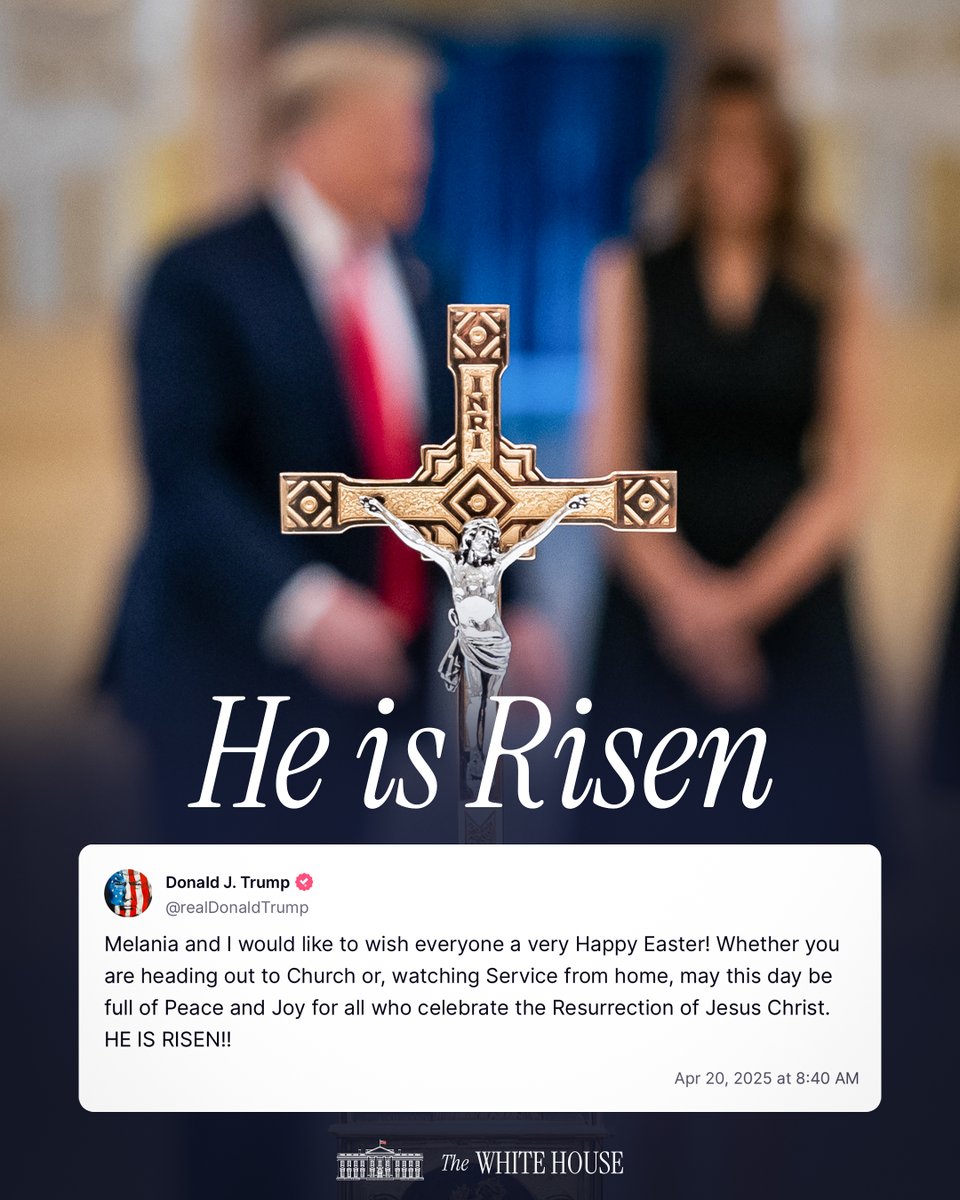
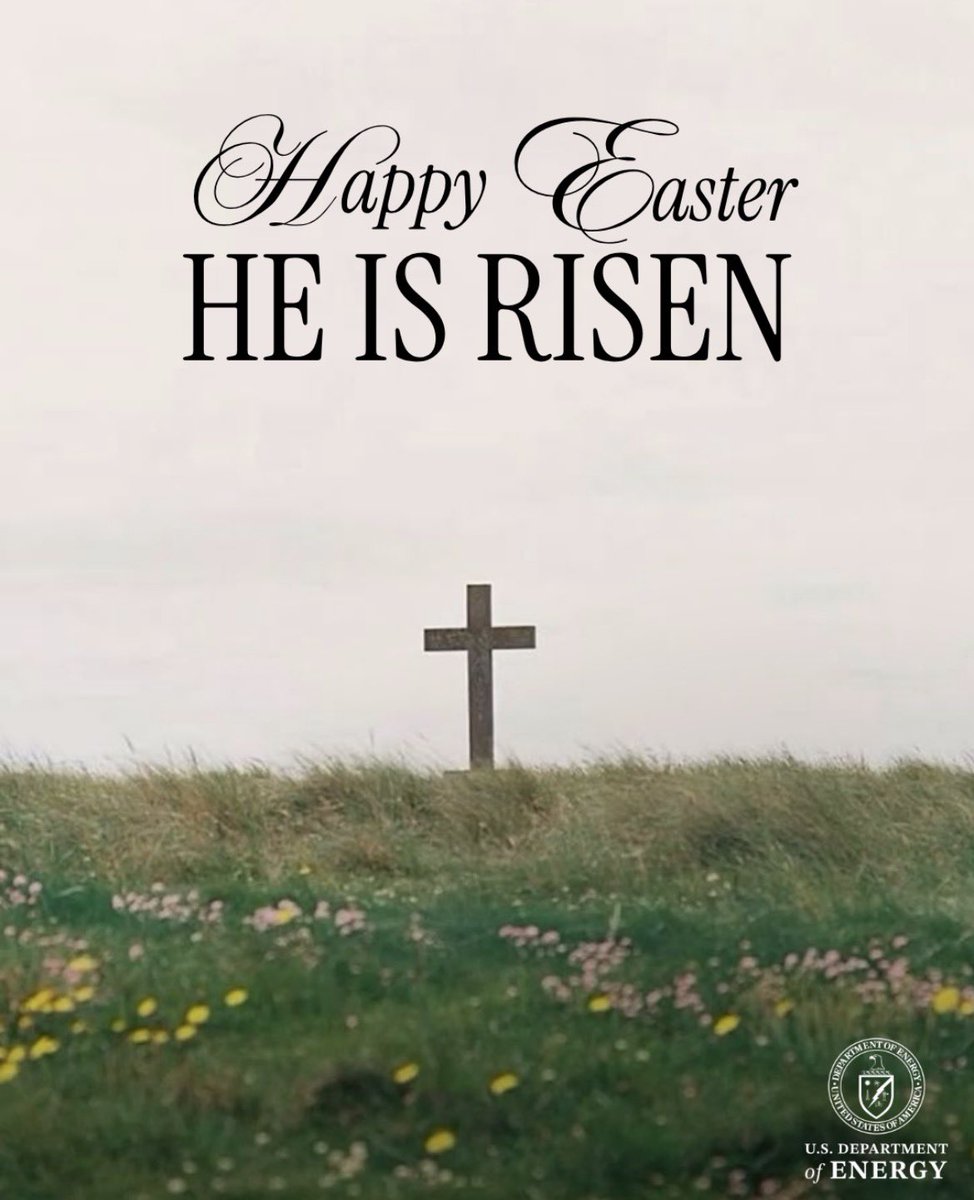
✝️"Melania and I would like to wish everyone a very Happy Easter! Whether you are heading out to Church or, watching Service from home, may this day be full of Peace and Joy for all who celebrate the Resurrection of Jesus Christ. HE IS RISEN!!" –President Donald J. Trump
Pray for our nation. And for President Trump. I believe he's fighting for peace and I trust Jesus has a good and glorious plan to advance His Kingdom. Pray too for all the people of the Middle East. May Christ indeed reign in their hearts. May they know His love and goodness and the emptiness is what allah or anything else offers. Amen.
@FLOTUS@LawSignal May God bless you. Praying for you and the President. And all world leaders. May God's Kingdom forcefully advance today in the peace and power and love of our Lord and Savior, Jesus Christ.
In the light of #Easter, let us allow ourselves to be amazed by Christ! Let us allow our hearts to be transformed by his immense love for us! Let those who have weapons lay them down! Let those who have the power to unleash wars choose peace! Not a peace imposed by force, but through dialogue! Not with the desire to dominate others, but to encounter them!
Good Friday reminds us of Jesus Christ’s sacrifice. May this day further deepen the values of harmony, compassion and forgiveness. May brotherhood and hope guide us all.
@DavidCMBell@TaylorRMarshall@FredSimonTLM -gation of said Canon.
In any event, thank you for taking the time to reply. Have a very blessed Good Friday and God bless you and yours.
On Catholics praying with Non-Catholics:
Code of Canon Law 1917: Canon 1258
§ 1. It is not lawful for the faithful in any manner to assist actively at or to take part in the sacred rites of non-Catholics.
§ 2. Passive or merely material presence can be tolerated for the sake of honor or civil office, for a grave reason approved by the bishop in case of doubt, at the funerals, weddings, and similar solemnities of non-Catholics, provided there is no danger of perversion [of the faith] or scandal.
@poperespecter1@MattGaspers He showed his colours when he wouldn't stand up for Catholic doctrine nor the religious freedom of @CarriePrejean1. Now the Bishop mocks the Pope. Just a woke nightmare.
The notion of a resurgent Marcionism is absurd. If there’s a “resurgence” of anything, it’s the original heresy of the Judaizers (Acts 15) — which, thanks be to God, more and more Christians are recognizing and rejecting.
I used to go through phases when I felt hungry for God. I’d go to church several weeks in a row and read the Bible every day, and then the enthusiasm would always eventually fade, bringing the phase to an end
Since becoming Catholic two years ago, my love and enthusiasm for the faith has only steadily grown. I’m more on fire for the faith today than I was on day one
If this is a phase, it’s by far the longest and most enduring one yet
I don’t think it is, though
I pray it never ends
1983 Code of Canon Law addresses related issues differently:
- Canon 844 regulates sacramental sharing (e.g., limited possibilities for Catholics to receive certain sacraments from Eastern Orthodox priests under specific conditions, or vice versa; stricter limits with Protestants due to differences in valid orders and doctrine). It emphasizes avoiding danger of error or indifferentism.
- Canon 1365 provides for a "just penalty" for prohibited participation in sacred rites, preserving the principle against illicit Communicatio in sacris.
Passive presence (e.g., attending a non-Catholic wedding or funeral for family/civil reasons) remains tolerable in many cases, provided there is no active participation in rites that contradict Catholic faith and no scandal or risk to one's Some Catholics, particularly those attached to the pre-Vatican II tradition (e.g., certain sedevacantist or SSPX-linked views), argue that the older prohibition in Canon 1258 remains binding in principle because it reflects divine law and perennial teaching against active participation in false worship. They see post-Vatican II developments as a harmful relaxation that risks indifferentism. Mainstream Catholic teaching and law, however, hold that the Council and 1983 Code represent a legitimate development in pastoral application without altering the underlying faith (no salvation outside the Church, the uniqueness of the Catholic Church as the fullness of the means of salvation, etc.).
- Permitted/Encouraged: Praying together with other Christians (e.g., Lord's Prayer), participating in ecumenical prayer services.
- Not Permitted: Actively joining in non-Catholic sacramental worship
- Non-Christians (Jews, Muslims, etc.): Even more caution applies under Nostra Aetateand related norms, dialogue yes; joint worship that blurs distinctions, no.
Actually 1983 makes you the uninformed. 1983 Code of Canon Law addresses related issues differently:
- Canon 844 regulates sacramental sharing (e.g., limited possibilities for Catholics to receive certain sacraments from Eastern Orthodox priests under specific conditions, or vice versa; stricter limits with Protestants due to differences in valid orders and doctrine). It emphasizes avoiding danger of error or indifferentism.
- Canon 1365 provides for a "just penalty" for prohibited participation in sacred rites, preserving the principle against illicit Communicatio in sacris.
Passive presence (e.g., attending a non-Catholic wedding or funeral for family/civil reasons) remains tolerable in many cases, provided there is no active participation in rites that contradict Catholic faith and no scandal or risk to one's Some Catholics, particularly those attached to the pre-Vatican II tradition (e.g., certain sedevacantist or SSPX-linked views), argue that the older prohibition in Canon 1258 remains binding in principle because it reflects divine law and perennial teaching against active participation in false worship. They see post-Vatican II developments as a harmful relaxation that risks indifferentism. Mainstream Catholic teaching and law, however, hold that the Council and 1983 Code represent a legitimate development in pastoral application without altering the underlying faith (no salvation outside the Church, the uniqueness of the Catholic Church as the fullness of the means of salvation, etc.).
- Permitted/Encouraged: Praying together with other Christians (e.g., Lord's Prayer), participating in ecumenical prayer services.
- Not Permitted: Actively joining in non-Catholic sacramental worship
- Non-Christians (Jews, Muslims, etc.): Even more caution applies under Nostra Aetateand related norms, dialogue yes; joint worship that blurs distinctions, no.