Is “Feminisation” Driving Cancel Culture? Unpacking Helen Andrews' Thesis youtu.be/FU6GOrAFafU?si… via @YouTube
YouTube
English
David Maywald
14K posts

@DavidMaywald
Passionate about my family, sustainability, lifelong learning, and making a positive difference ☀ Board Member and Father ツ Thankful to live on Ngunnawal land





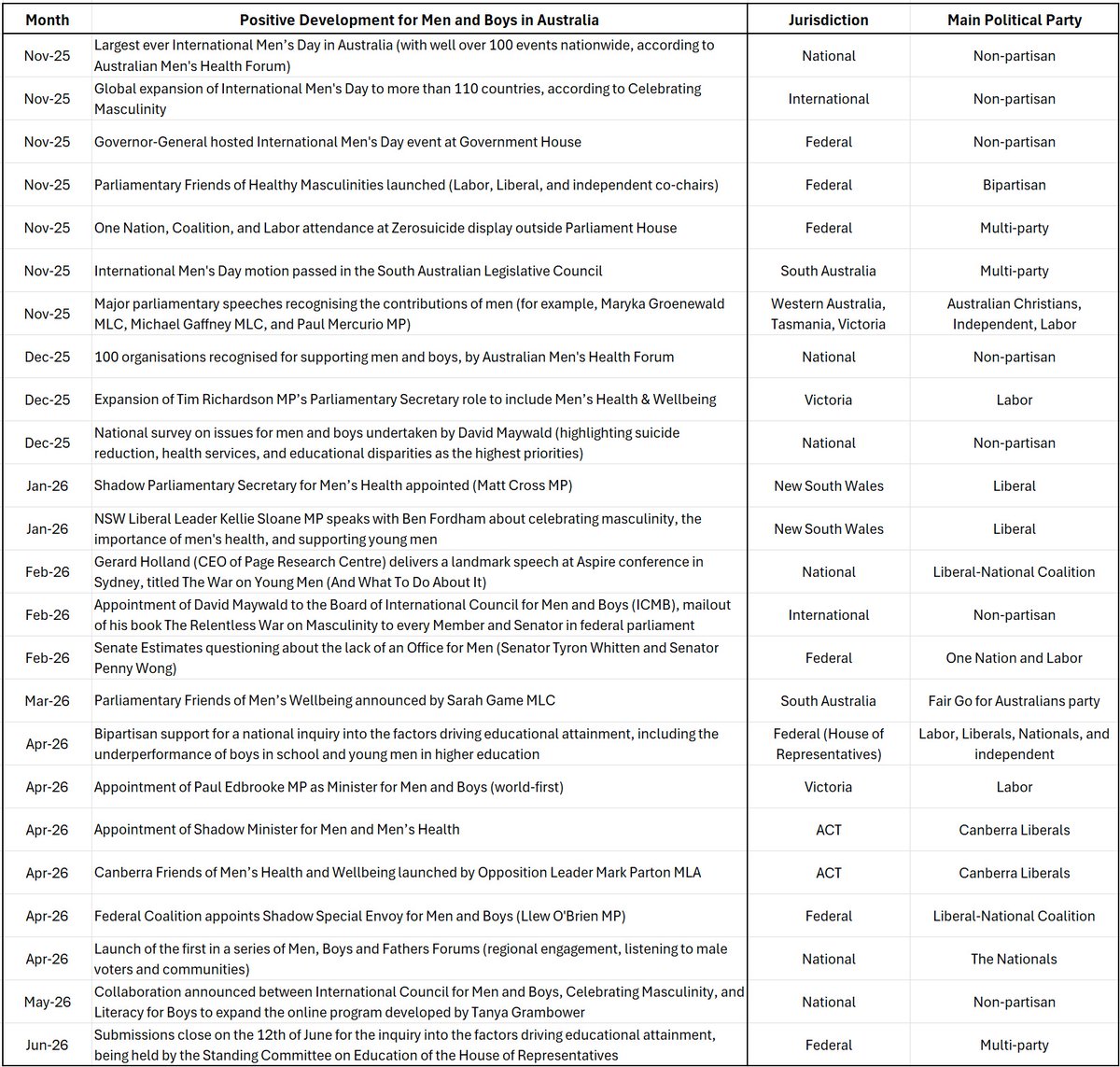

There have been at least two dozen positive developments for men and boys in Australia, during the last six months. These include several important appointments at state and federal level, the world-first Minister for Men and Boys in Victoria, a national inquiry into education for boys and young men (for the first time in 24 years), and the establishment of completely new forums/groups that focus on male wellbeing at both state and federal level. Importantly, these span every state, territory, and the federal level. And these two dozen advances also span every political party (except the Greens) from Labor, Liberal, Nationals, One Nation, small parties and independents... I was heartened to see the ACT Greens emphasise the experiences of male victims, last week in CityNews coverage of Mark Parton's support for men's health and wellbeing. I accept that you could point to one or two of these developments with scepticism, or even cynicism. But that negativity completely fades away when looking at these two dozen important steps forward in totality... Ordinary people have been speaking up for a couple of years, we want fairness and opportunity to be spread across society, we're tired of elites sending money and attention to their pet causes. Genuine gender equality is about a lot more than shaping education systems for girls, delivering unearned economic empowerment for some women, and beating innocent men around the head with a big bat called "violence against women"... Females face disparities, males face disparities. People are seeing through the old tired narratives, and they have lived experience of the issues faced by boys and men. It's time to capitalise on the remarkable advances for men and boys during the last six months, by taking practical concrete actions that solidify this progress... Get on board.

"Drivers who killed women received substantially longer sentences than those who killed men. As we see in the table below, the average sentence for killing a woman was 9.7 years, whereas the average sentence for killing a man was 4.4 years." stevestewartwilliams.com/p/bias-in-the-…
I have huge respect and admiration for Warren Farrell, and absolutely love his 2001 book Father and Child Reunion. This book was genuinely groundbreaking. Long before shared parenting and father involvement became mainstream public discussions, Farrell was courageously documenting the enormous importance of fathers in the lives of children: not only for boys, but for girls, mothers, and the wellbeing of families as a whole... What makes this book so powerful is that it combines deep compassion with serious research. Farrell refuses to treat fathers as disposable or secondary parents. Instead, he presents a compelling case that children thrive when loving fathers remain meaningfully involved in their lives after separation and divorce... Importantly, this isn't a book against women or mothers. It is profoundly pro-family. Farrell advocates for cooperation, fairness, emotional healing, and arrangements that place children’s long-term wellbeing first. Decades later, many of the issues raised in this book remain highly relevant. Father and Child Reunion helped lay the intellectual and moral groundwork for modern shared parenting advocacy, fatherhood movements, and a broader recognition that men’s wellbeing matters too. Father and Child Reunion is one of the most important and influential books ever written on fathers, families, and children.



This Is Why Australia Killed the Apprenticeship youtu.be/kvCPHnoGOIc?si… via @YouTube




What Men Want in Bed is one of those books that sparked raised eyebrows, nervous laughter, heated debate, and genuine reflection all at once. Published in 2010 by Australian social commentator and sex therapist Bettina Arndt, the book tackled a subject that many people were curious about but few were willing to discuss openly: men’s emotional and sexual experiences in long-term relationships. Drawing from interviews, research, and plenty of candid stories, Arndt explored themes such as desire discrepancies, male vulnerability, rejection, communication, ageing, intimacy, pornography, and the pressures placed on modern men. What made the book especially interesting was its willingness to treat male sexuality seriously, sympathetically, and sometimes humorously, at a time when public conversations around relationships often focused far more heavily on women’s perspectives. The controversy came largely from the suggestion that men’s needs, frustrations, and emotional experiences deserved more empathy and attention. Some critics accused Arndt of reinforcing stereotypes or being too sympathetic to men, while supporters praised her for bringing balance to relationship discussions that had become increasingly one-sided. Either way, the book generated exactly the kind of conversations that many couples, therapists, and commentators had been avoiding... Importantly, the tone of the book is not angry or cynical. It's curious, practical, and often surprisingly compassionate toward both sexes. Arndt repeatedly emphasises that healthy relationships depend on understanding, honesty, goodwill, and mutual effort from both men and women. More than fifteen years later, the book still feels relevant because many of the issues it raised remain unresolved... Its lasting contribution was helping legitimise open discussion about male intimacy, emotional needs, and relationship dynamics in mainstream conversation. Whether readers agreed with every argument or not, the book undeniably encouraged more honest dialogue between men and women, and that alone made it an important and worthwhile contribution. @TheRealMenToo