David Pinsof

2.4K posts

David Pinsof banner
David Pinsof

David Pinsof

@DavidPinsof

Evolutionary social scientist, co-creator of @cah, co-host of Evolutionary Psychology (the podcast), blogs about bullshit at https://t.co/FODwrznZRX

Los Angeles, CA Katılım Kasım 2012
539 Takip Edilen4.5K Takipçiler
David Pinsof
David Pinsof@DavidPinsof·
@robsica The pessimism should arise when we consider what goals we are seeking, not how rationally we seek them.
English
1
0
1
225
Rob Sica
Rob Sica@robsica·
🔪"pessimistic narratives about human nature prove more durable than their evidentiary basis alone would predict: They are not simply dramatic stories but institutionally useful ones in a field whose authority depends on identifying what is wrong with people & offering to fix it"
Rob Sica tweet media
English
2
3
18
15.1K
David Pinsof
David Pinsof@DavidPinsof·
@robsica @pitiklinov Seems like the logic of coalitions is a much better way to explain these wholesale pivots, given that most political issues are logically and ethically separable.
English
1
1
3
207
Rob Sica
Rob Sica@robsica·
@pitiklinov Nice critique. (First thing I did after reading the paper last night was ask Claude for contemporary examples of pivots from right to bananas left.)
English
3
0
4
408
Pablo Malo
Pablo Malo@pitiklinov·
En este artículo el filósofo Neil Levy plantea una explicación interesante sobre por qué algunas personas de izquierda dan un giro brusco y radical hacia la derecha, a menudo adoptando no solo posiciones conservadoras, sino también creencias que él califica de “bananas” o conspirativas. Según Levy, esto ocurre cuando alguien choca con su propio bando en un “pivot belief” o “creencia bisagra” (un tema como los lockdowns, las políticas trans o el wokismo), sufre presión social y disonancia cognitiva, y acaba confiando mucho más en las fuentes y el testimonio del lado derecho, lo que le lleva a adoptar un paquete completo de creencias. Pero yo le veo algunos problemas a esta postura de Levy. Un primer punto es que el concepto de pivot belief tiene, en mi opinión, muchos problemas. Levy lo define como una creencia que inicialmente está disponible para ambos bandos y que solo se convierte en pivote cuando surge una división interna, permitiendo el salto de un lado al otro. Pero la realidad actual es que prácticamente todo se está convirtiendo en pivot belief. Ya no quedan temas neutrales. Ver a Broncano o ver a Pablo Motos, el aire acondicionado, si hay lawfare o no lo hay…Todo se está politizando y tribalizando. Cualquier tema, por absurdo que parezca, se convierte rápidamente en señal de identidad Para que el concepto de pivot belief tenga sentido real, tiene que haber un fondo de creencias o temas que no sean pivotes, cuestiones en las que izquierda y derecha puedan coincidir o que no definan tu tribu. Si absolutamente todo puede funcionar como pivote, entonces el mecanismo que describe Levy pierde mucha fuerza y se vuelve casi tautológico: la gente pivota porque todo está polarizado. Otro problema es que el concepto de lo que es “banana” o una locura, o una conspiración, pues tampoco está muy claro. Cosas que en un principio se dijeron que eran “banana” como que el virus del Covid había salido de un laboratorio parecen ahora verdaderas o desde luego no tan “banana”. Como se suele decir, la diferencia entre una teoría de la conspiración y la verdad a veces son 6 meses. Por ejemplo, Levy da por sentado que ciertas posturas sobre el Covid, las vacunas, el origen del virus o fenómenos como el Gran Reemplazo demográfico entran directamente en la categoría de “bananas” o irracionales. Si uno no comparte esas premisas iniciales (es decir, si considera que en varios de esos puntos hay datos sólidos que justifican cuestionar la narrativa dominante), entonces el mecanismo psicológico que describe pierde mucha fuerza y parece más una forma de patologizar el disenso que una explicación neutral. Por otro lado, el artículo queda claramente incompleto y sesgado porque no analiza en absoluto los giros de opinión en la otra dirección. El artículo se titula pivoting right y no dice nada del pivoting left. Por supuesto que Levy puede dedicar su artículo a lo que le preocupe o interese más, pero no explica ni justifica por qué solo analiza los virajes de izquierda a derecha. No hay ninguna frase del tipo: “Me centro solo en el pivoting right porque…” o “El pivoting left es diferente porque…” o “Aunque el fenómeno también existe en la otra dirección…”. Personalmente intuyo que la misma dinámica de presión social, pivot beliefs y adopción de paquetes enteros de creencias “locas” puede funcionar en la otra dirección ya que la radicalización y las visiones conspirativas son un problema humano general, no un fenómeno específico de quien se mueve a la derecha. En definitiva, el artículo es útil para dar pie a una conversación sobre todos estos temas, que desde luego son muy interesantes, pero más bien flojo como para hacer un buen diagnóstico y desde luego tampoco aporta soluciones para que la gente no crea en bananas.
Rob Sica@robsica

🍌"how people may pivot from a set of beliefs that is reasonable and widely shared to a set of beliefs that includes some that are utterly bananas, all the while driven by a concern for evidence" cambridge.org/core/journals/…

Español
18
37
132
10.2K
David Pinsof
David Pinsof@DavidPinsof·
@robsica Depends what one means by “genuine moral content,” but yea not how I’d frame it
English
0
0
1
77
Rob Sica
Rob Sica@robsica·
Not how I'd characterize Alliance Theory: "Like many things that seem undeniable, there are those who deny it. @DavidPinsof et al. argue that political outlooks are constituted by the commitments that best serve a coalition and lack a genuinely moral content at all."
English
1
0
1
320
Rob Sica
Rob Sica@robsica·
🍌"how people may pivot from a set of beliefs that is reasonable and widely shared to a set of beliefs that includes some that are utterly bananas, all the while driven by a concern for evidence" cambridge.org/core/journals/…
English
2
3
15
12.1K
David Pinsof
David Pinsof@DavidPinsof·
@robsica Complete and unquestioning credulity obviously, lol
English
0
0
1
123
Rob Sica
Rob Sica@robsica·
🔪"if the distribution of persuasive information—facts, findings, expert consensus, etc.—is disproportionately shaped by people who don’t seem to share your values or interests, what amount of scepticism towards that information is warranted?"
Dan Williams@danwilliamsphil

In a new essay, I draw on the existence of "highbrow propaganda" to steelman the case for populist distrust of establishment institutions: conspicuouscognition.com/p/highbrow-pro…

English
1
1
11
1.4K
David Pinsof
David Pinsof@DavidPinsof·
@ADigressions @worst_account And of course there’s the all-too-human—and all-too-dangerous—hunger to possess all the goods and decide who gets what.
English
0
0
2
39
Micro-Digressions: A Philosophy Podcast
@worst_account I have always disliked the term "distributive justice" because it lures people into thinking that there's a giant hand that possesses all the goods and decides who gets what.
English
3
2
11
310
Charles G. Koch 🏴
Charles G. Koch 🏴@worst_account·
This is actually a great way of pointing to the basic problem with distributive egalitarianism: there is *not* a single distributing agent (as there is in McManus's example), and thus the resulting "distribution" is justice-inapt -- with McManus's point explaining the illusion.
Matt McManus@MattPolProf

There are a lot of good reasons for people to care about income inequality. If on Monday I pay Paul $5 for the doing the same job I pay James $10 for on Tuesday, and they both do quality work, then Paul would have every reason to think the disparity was unfair...

English
2
2
27
1.5K
David Pinsof
David Pinsof@DavidPinsof·
@bsgallagher @Evolving_Moloch @lefineder Unfortunately we still belong to the same species as those humans, and still share the same human nature as them. However much we’ve progressed, the capacity for evil is still inside us. Worth remembering to remain vigilant against it.
English
1
0
0
53
LiorLefineder
LiorLefineder@lefineder·
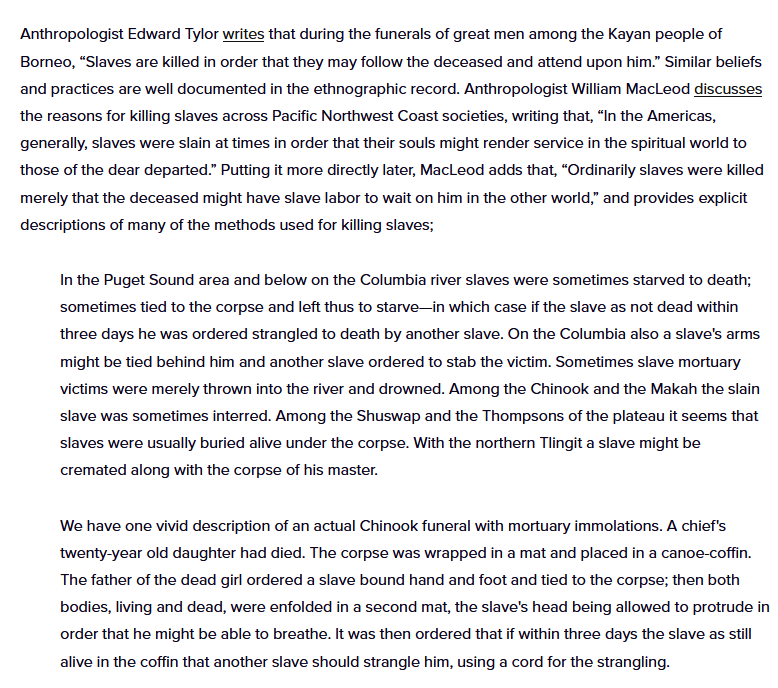
Being buried with all your slaves so they can continue to serve you in the afterlife is quite possibly the ultimate dick move.
LiorLefineder tweet media
English
9
7
181
10K
David Pinsof
David Pinsof@DavidPinsof·
@jayvanbavel Interesting. Consistent with @PascalBoyerUSA’s coalitional index model. Not sure why the effect isn’t symmetrical for Democrats. Maybe has to do with urban residence, secularism, or social ties to physically distant family and friends.
English
1
0
5
1.4K
Jay Van Bavel, PhD
Jay Van Bavel, PhD@jayvanbavel·
Partisanship is linked to impaired mental health While Democrats in general report worse mental health than Republicans, Democrats show no sensitivity to partisan context. Republicans in neighborhoods with a higher concentration of Democratic residents report higher levels of anxiety, depression, and loneliness. Republicans report worse mental health as the share of Democrats in their neighborhood increases. Researcheers find that these effects (for Republicans) are comparable or larger in magnitude to the effects of being a racial or ethnic minority in a neighborhood and to the effects of contextual poverty on mental health reports. pnas.org/doi/10.1073/pn…
English
11
17
107
30.8K
David Pinsof
David Pinsof@DavidPinsof·
@hanno_sauer Yea agreed that some of the debate is just semantics. But the more substantive part of the debate is whether we should view cultural variants as having interests or being beneficiaries of behavior. And I’m not sure we should (instead of just considering individuals + incentives).
English
1
0
1
39
Hanno Sauer
Hanno Sauer@hanno_sauer·
@DavidPinsof Again, I don’t get this. Seems compatible to me! What’s a city? I would say that’s a separate kind of inheritance
Hanno Sauer tweet media
English
1
0
0
49
David Pinsof
David Pinsof@DavidPinsof·
One argument for the ecological approach to culture I wish the authors had made: it has an established track record in economics, which explains “culture” (markets, institutions) by appeal to individual decision-making under incentives, and not by cultural variants replicating.
English
3
3
23
4.3K
David Pinsof
David Pinsof@DavidPinsof·
@KeithNHumphreys That assumes “leftism” is a fixed essence instead of a continuously evolving coalition of interest groups.
English
0
1
4
207
Keith Humphreys
Keith Humphreys@KeithNHumphreys·
Pew data showing that parents are a huge influence on their kids' political views. So the concentration of fertility decline being among politically left-wing people will over time more the country rightwards.
Keith Humphreys tweet media
English
16
8
75
6.9K
David Pinsof
David Pinsof@DavidPinsof·
@hanno_sauer It’s not so much a contradiction as it is an example of an approach to “culture,” continuous with the ecological approach, being more useful, predictive, and explanatory than the dual inheritance approach. Implying dual inheritance is unnecessary/overrated.
English
1
0
3
140
Hanno Sauer
Hanno Sauer@hanno_sauer·
@DavidPinsof I just don’t see the contradiction here. People have different incentives depending on which institutions there are
English
1
0
1
399
David Pinsof
David Pinsof@DavidPinsof·
@Photon_inslit @vladtarko Yea I like the phrase “citizen assemblies” or even “political juries” for that reason. De-emphasizes the randomness aspect.
English
0
0
1
26
Kavi
Kavi@Photon_inslit·
@DavidPinsof @vladtarko it doesn't have the legitimacy ring to it. At least that dunderhead got votes, I could be me ( many me ), which demand some sorta status game or ceremony/ritual.
English
1
0
0
20
David Pinsof
David Pinsof@DavidPinsof·
@tim_tyler Sure, but one “perspective” has more empirical and explanatory successes than the other, and that is noteworthy.
English
1
0
0
20
Tim Tyler
Tim Tyler@tim_tyler·
@DavidPinsof That perspective coexists with Homo Economicus. Much as human DNA guiding development coexists with humans as goal-directed actors. Those are more like different perspectives than competing theories.
English
1
0
0
35
David Pinsof
David Pinsof@DavidPinsof·
@robsica @fitzcavendish Yea plausible that some of the fuel that runs the dual inheritance approach is awe of the idea of a whole new kind of evolution unique to humans.
English
1
0
1
60
Rob Sica
Rob Sica@robsica·
@fitzcavendish @DavidPinsof Funny, been wondering if there's not behind some of the utopian/apocalyptic framings some parallel to the monopoly dual inheritance theory has had on thinking about cultural evolution. The more persuavie the ecological approach, the more plausible a 'normal tech'-ish view, imho.
English
1
0
2
108
David Pinsof
David Pinsof@DavidPinsof·
I think there is plausibly a relationship between awe and gullibility. Awe relaxes priors to let in novel info, resulting in occasional bad ideas getting in. This may explain a lot of spirituality. May also explain awe of AI leading to dubious utopian or apocalyptic visions.
English
7
11
45
9.7K
David Pinsof
David Pinsof@DavidPinsof·
@jayvanbavel I’d bet these numbers would depend a lot on the type of scientist. Trust would likely be lower for scientists who study politically contentious issues.
English
2
0
3
198
Jay Van Bavel, PhD
Jay Van Bavel, PhD@jayvanbavel·
“The idea that there’s a generalized, pervasive lack of trust in science and experts is just completely unfounded" A recent study found that 76% of respondents trusted scientists, a proportion above teachers (73%) and well above that for journalists (54%) and government leaders (49%). From a global perspective, public trust in science and scientists is also quite high, they say. One of the largest studies surveyed nearly 72,000 people across 68 countries reported a “moderately high” average trust score of 3.6 out of 5. But trust has dropped in certain groups: “Trust in science is politicized and becoming more so,” partly because scientific information is being drowned out online. nature.com/articles/d4158…
Jay Van Bavel, PhD tweet mediaJay Van Bavel, PhD tweet media
English
10
34
138
13.2K
David Pinsof
David Pinsof@DavidPinsof·
@anderssandberg Yes, could be. But the historical track record of awe-induced belief updates, often in the direction of mumbo jumbo, should perhaps give us pause.
English
0
1
1
112
Anders Sandberg
Anders Sandberg@anderssandberg·
@DavidPinsof It could also be that very large, powerful things that change fast globally are both awe inspiring and potentially utopian/apocalyptic.
English
1
0
3
386
Rob Sica
Rob Sica@robsica·
🔪"Organizational bullshit is most likely to thrive when three conditions exist: 1) people fear speaking up; 2) people are rewarded for confidence over evidence; and 3) careers advance based on looking good rather than being accurate." sciencedirect.com/science/articl…
English
2
5
9
639