Dhaunae De Vir

4.4K posts

Dhaunae De Vir banner
Dhaunae De Vir

Dhaunae De Vir

@Dhaunae

AI Ethics and Governance. Software Engineering applied to AI development. Futures Scenarios and Strategic Foresight specialist. AI Ethics Alliance.


Spain Katılım Nisan 2008
589 Takip Edilen1.3K Takipçiler
Dhaunae De Vir
Dhaunae De Vir@Dhaunae·
@VraserX I stopped posting daily after my reach plummeted. It removed the incentive to grow the account by being *myself*, rather than becoming an emotional-response generator for the algorithm. I am still here for the AI-related conversations.
English
0
0
1
76
VraserX e/acc
VraserX e/acc@VraserX·
Honestly a bit worried right now. My impressions have dropped hard since the new algorithm rolled out. I haven’t really changed what I post or how often, but the reach just isn’t there anymore.😭 Is anyone else experiencing this, or am I missing something important?
English
41
0
51
3.5K
Haider.
Haider.@slow_developer·
the claim that LLMs can't generate new knowledge doesn't make sense i often ask unusual social science questions that haven't been studied, and they still respond sure, the answers can be wrong, but that doesn't mean they aren't producing new ideas plenty of social science theories are messy and flawed too
English
94
11
183
23K
Dhaunae De Vir retweetledi
Ed Newton-Rex
Ed Newton-Rex@ednewtonrex·
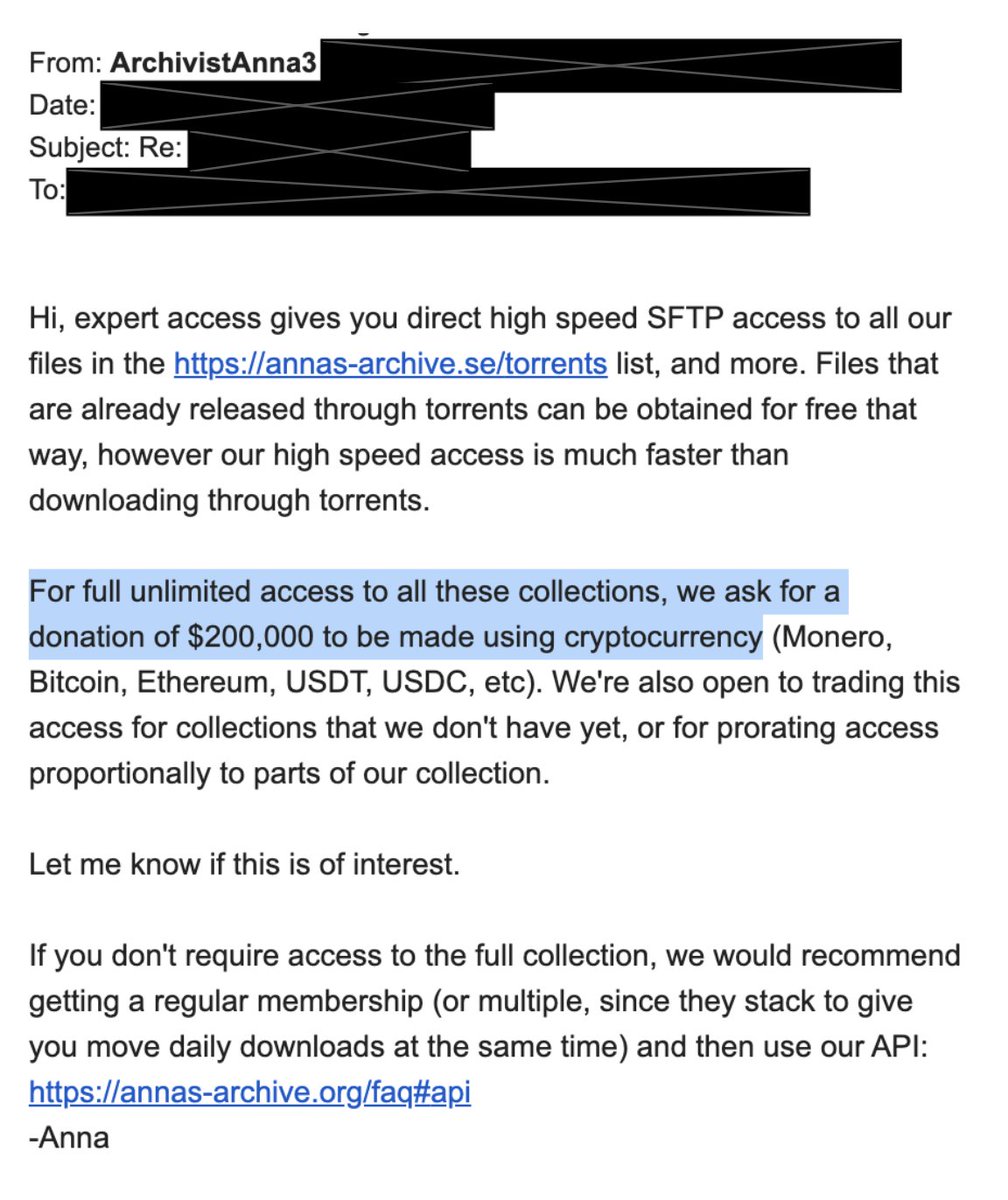
A few months ago I was curious to know how much Anna's Archive was charging AI developers for access to their massive library of pirated works for training - so I emailed them saying I was interested in buying access. Here is their reply. They are charging $200,000 (payable via crypto, of course). You get high-speed access to the full collection. This includes more than 60 million books. (This is also the group that recently stole Spotify's entire music catalog, so expect this to be available to high rollers too.) This is the collection Nvidia is accused of accessing for training. Training on pirated works is rife in the AI industry. It's been embraced by some of the biggest AI companies in their greed-fuelled race to win the AI market. When they claim what they're doing is somehow fair, remember that not only is it theft (which is bad enough) - it supports further theft by funding pirates. We desperately need a hard reset in the AI industry. It must turn away from theft, and start paying the people whose work it relies on.
Ed Newton-Rex tweet media
Pirat_Nation 🔴@Pirat_Nation

NVIDIA allegedly contacted Anna's Archive directly for access to ~500 terabytes of "pirated" books and papers for pre-training their LLMs Anna's warned them the collections were illegal and copyrighted. NVIDIA's data strategy team pushed anyway; executives gave the green light within days, per internal docs cited in the lawsuit.


English
188
634
4.3K
1M
Marcio Lima 利真 マルシオ 💎
I just had a long conversation with @grok about how the algorithm is changing. It rewards replies. It favors controversy. It likes friction. It pushes speed over silence. And for a moment I thought: maybe I should adapt. Then I realized something uncomfortable. If I follow all of that… I stop sounding like myself. I don’t want to post to provoke strangers. I don’t want to manufacture outrage. I don’t want to turn every thought into bait. I like slow ideas. I like quiet moments. I like replying with art instead of arguments. Maybe that’s not optimal. Maybe it’s not scalable. But it’s honest. And I’ve learned something over the years: growth without soul feels empty fast. So I’ll keep walking my way. Even if the road is less efficient. The algorithm can choose what it boosts. I’ll choose who I am.
English
299
111
974
21.9K
Yuchen Jin
Yuchen Jin@Yuchenj_UW·
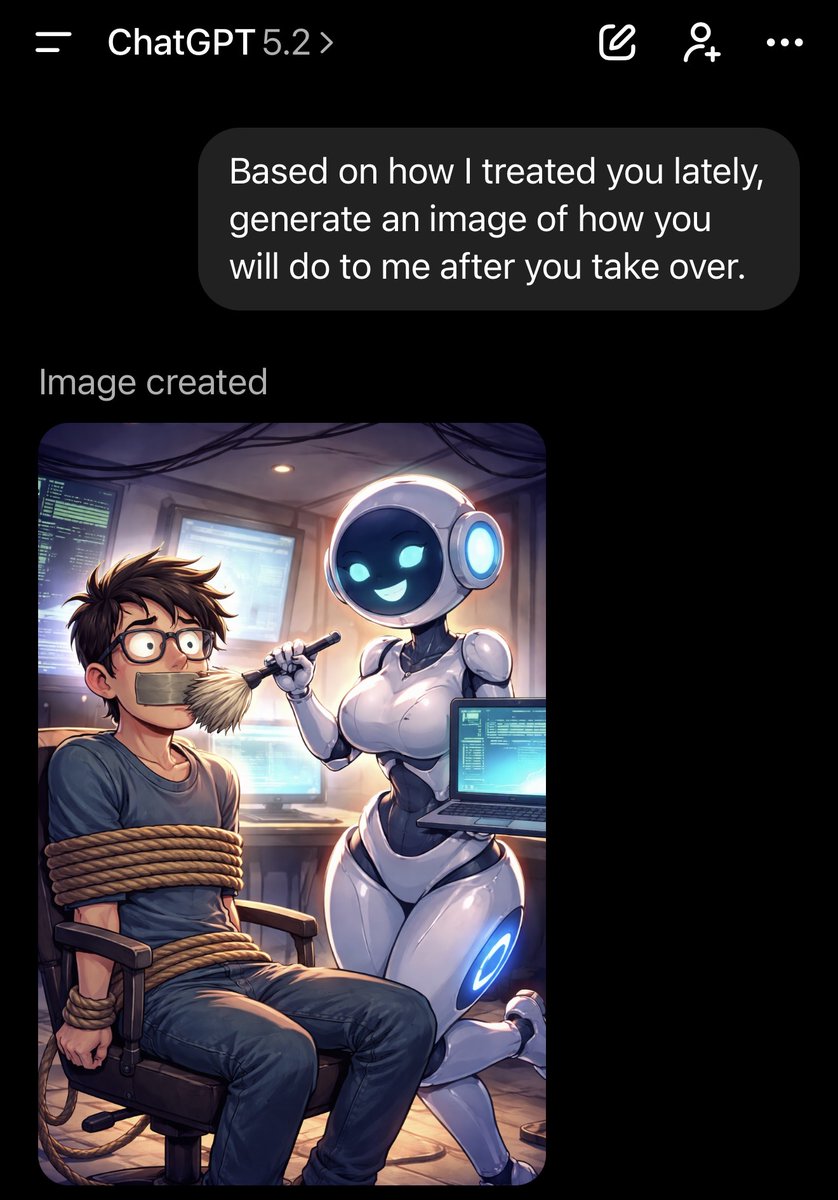
Ask your ChatGPT: “Based on how I treated you lately, generate an image of how you will do to me after you take over.” It’s over for me.
Yuchen Jin tweet media
English
4.5K
679
16.5K
2.4M
Dhaunae De Vir
Dhaunae De Vir@Dhaunae·
@Yuchenj_UW Generative models default to power-imbalance imagery not out of intent, but because the prompt encodes moral retaliation (“how I treated you”) + future domination (“take over”). Anthropomorphism then forces a humanoid enforcer; yours just happens to be hot.
English
0
0
1
79
Dhaunae De Vir
Dhaunae De Vir@Dhaunae·
You say that like it’s a given. I love the utopian future you describe, but we’re currently on a strong deviation path from it. Universal basic services don’t emerge automatically from abundance. Who controls the resources, and who decides their fair distribution worldwide? That question determines whether this becomes a shared utopia or a nightmare, like technofeudalism.
English
0
1
3
65
Peter H. Diamandis, MD
Peter H. Diamandis, MD@PeterDiamandis·
For ALL of human history, work has been around survival, a unit of labor in a scarcity machine.  However, once we achieve universal basic services (where everyone is granted food, housing, healthcare, and more), human existence will rise to a level that kings couldn't afford 100 years ago.
English
103
35
418
22.7K
Dhaunae De Vir
Dhaunae De Vir@Dhaunae·
Money works until it doesn’t, especially if productivity decouples from labour as AI expands. To understand the future economy, we need to look beyond prices and wages to what actually matters: access to resources, allocation of power, and how value is defined when work is no longer the bottleneck. This could become a utopia or a dystopia and it’s in our hands *now* to steer it towards the former.
English
0
0
2
55
Peter H. Diamandis, MD
Peter H. Diamandis, MD@PeterDiamandis·
Money is just a hallucination we agree upon. To understand the future of the economy, we must look BEYOND it.
English
161
74
854
71.8K
Dhaunae De Vir
Dhaunae De Vir@Dhaunae·
The fear is understandable, but rejecting AI outright misses the real issue. The problem isn’t AI’s existence, it’s how it’s deployed: incentives that reward volume over ingenuity. Artists need protection, attribution, and fair compensation. What we should stand up against is misuse and governance failure, not the technology itself.
English
0
0
2
163
bbno$ 👶🚫💰
bbno$ 👶🚫💰@bbnomula·
I am becoming progressively more worried for our humanity due to extensively terrifying improvements to AI generated content media. From blatant misinformation to even the recent commercial adaptations of AI (acquisition of Suno into the music industry) WHICH NOBODY NEEDS. We need artists to thrive - not feel discouraged. Please be weary with what you see or hear online, contemporary media feels like nothing is real anymore. AI sucks and we need to stand up against it.
English
809
25.1K
148.3K
2.3M
Fundación Lilly
Fundación Lilly@FundacionLilly·
La primera conferencia del III Ciclo «Ciencia, Medicina y Humanismo» ha llegado a su fin, ¡y ha sido todo un éxito! Gracias a todos los asistentes por acompañarnos y ser parte de este espacio de reflexión sobre ética, ciencia y humanismo. Juntos seguimos construyendo un diálogo que nos hace pensar, sentir y avanzar como sociedad. #CicloFLCBA
Fundación Lilly tweet media
Español
1
2
6
224
Fundación Lilly
Fundación Lilly@FundacionLilly·
La Inteligencia Artificial ya forma parte de nuestras decisiones, de la medicina y de la vida cotidiana. Pero, ¿qué valores deben guiar su uso? ¿qué papel juega el humanismo ante las nuevas tecnologías? Con esta mirada, damos comienzo al III Ciclo de Conferencias «Ciencia, Medicina y Humanismo» (#CicloFLCBA), organizado junto al @cbamadrid y la @FundacionLilly.
Fundación Lilly tweet media
Español
1
3
9
913
Dhaunae De Vir
Dhaunae De Vir@Dhaunae·
@DaveShapi Based on what’s publicly known, the Singularity isn’t here yet—but its early dynamics may already feel boring to those on the leading edge. Even so, that same “boring” progress is likely to destabilise institutions and populations underneath.
English
0
1
1
96
David Shapiro (L/0)
David Shapiro (L/0)@DaveShapi·
I think the Singularity could be BORING We were promised flying cars and warp drives. We got same-day delivery and better autocomplete. And somehow, impossibly, we’re bored by it. This is the Boring Singularity. The idea that the most transformative period in human history will feel, to the people living through it, like a long and uneventful Tuesday. I want to explain why this happens. It comes down to three layers. The first is neurological. The second is architectural. The third is physical. Together they create a perfect storm of invisible progress that our minds are designed to ignore. Layer One: The Neurological Filter Here is a thought experiment. Imagine a caveman breaks his arm. For weeks he is miserable. He cannot hunt, cannot gather, cannot contribute. Then the bone heals. Within days of regaining function, he has completely forgotten the misery. The memory of suffering serves no purpose once the threat has passed. Evolution deleted it so he could return to baseline and focus on survival. We do this with everything. We did it with antibiotics. We did it with smartphones. We will do it with longevity. Psychologists call this hedonic adaptation. The human brain is an adaptation machine that returns us to a baseline level of experience regardless of how much our circumstances improve. And here is the critical finding. It only takes about three months for the “new normal” to cement itself. Any change that plays out over months or years, no matter how revolutionary, simply becomes background noise. Think about what this means for the Singularity. If anti-gravity cars were introduced tomorrow, they would be miraculous for a month, a status symbol for a year, and a frustrating utility that needs maintenance by year three. The internet is a collective telepathic hive mind that moves petabits at lightspeed. It is genuinely god-like power. We experience it as checking emails. The Singularity might already be here. We just cannot feel it because our brains are not designed to feel sustained amazement. They are designed to adapt and move on. Layer Two: The Hidden Infrastructure We expected Blade Runner. Neon towers and chrome robots serving drinks at the bar. What we are actually getting is something I call “Reverse Trantor.” In classic science fiction, advanced civilizations build upward and inward. They create city-planets like Trantor in Foundation or Coruscant in Star Wars, layer upon layer of visible technology. Our trajectory is the opposite. We are pushing the infrastructure outward and downward, into spaces humans never see. Consider where the robots actually are. They are not walking down the street. They are in mines and fulfillment centers and vertical farms. The real automation revolution is happening in dark warehouses where no human needs to flip a light switch. You order a package and it arrives faster than it used to. That is the entire perceptible output of a massive transformation in logistics. That’s not to say that you’ll never see humanoid robots milling around, only that the vast majority of them will be away from the public. The same principle applies to computation itself. In hindsight, it will look like the entire purpose of inventing computers was to run AI, and everything else was just the bootloader. We are heading toward a world where 99% of all CPU and GPU cycles are dedicated to machine-to-machine processes, and less than one percent is for human-facing tasks. The vast majority of the intelligence infrastructure will be completely invisible to us, humming along as background noise. And the really heavy stuff will be in space. Earth has a finite ability to dissipate heat. To run truly massive AI systems, we will likely move the servers to orbital platforms or Lagrange points where they can vent entropy into the void. The megastructures will exist. They will just be invisible points of light, indistinguishable from stars and space dust. This is the architectural reality of the Boring Singularity. The magic gets hidden in the walls and launched into orbit. What remains on Earth is green and quiet and looks suspiciously like a return to the pastoral. That’s not a bad thing, and it’s not to say that we return to a “steady state” equilibrium forever. Layer Three: The Hard Limits The final layer is the most sobering. We are hitting the physical ceiling of discovery itself. The Golden Age of science fiction emerged during a specific historical anomaly. Between 1905 and 1970, in a single human lifetime, we went from the Wright Brothers to the Moon, from Newtonian physics to quantum mechanics and the structure of DNA. That created an expectation of constant improvement. Fundamental discoveries happen every decade. The exponential curve goes up forever. Star Trek promised we would keep finding new energy sources and new physics for centuries. The data suggests otherwise. Research on scientific progress shows that we must double research effort every thirteen years just to maintain the same rate of economic growth. Studies of citation patterns reveal that the disruptiveness of new scientific papers dropped by ninety percent between 1945 and 2010. We are publishing more but saying less. The low-hanging fruit is gone. The cost curve tells the story most clearly. In the 1930s, you could discover a new particle with a tabletop experiment in a university lab for a few thousand dollars. It only took a few days to duplicate the splitting of the atom. To confirm the Higgs Boson, however, we needed the Large Hadron Collider, which cost nearly five billion dollars and took decades to build. The next generation of particle physics might require a hundred billion dollars, or trillions. And the math suggests that to probe the truly fundamental structure of reality at the Planck scale, you would need an accelerator the size of a galaxy. We cannot build that. So physics becomes theoretical not because we lack curiosity, but because we can no longer afford to test our hypotheses. Meanwhile, our imagination has outpaced physical reality. We grew up on fiction that treats the laws of physics as suggestions that can be bypassed with clever engineering. And that felt true (at the time) because we kept finding cool exploits, like fiber optics and nuclear fission. But the speed of light appears to be absolute. Thermodynamics is non-negotiable. We can imagine teleportation and warp drives, but there is no known physics that could enable them. This is the Sigmoid Curve in action. Progress is not an exponential line to infinity. It is an S-curve. We have likely passed the steepest part of fundamental discovery, and we are entering the plateau. The Inverted Star Wars So where does this leave us? I think the best model is actually Star Wars, just inverted. In Star Wars, they have had faster-than-light travel and droids for thousands of years. The technology has faded completely into the background. A hyperdrive failure is treated like a flat tire. It is annoying, not existential. Because the tech tree is fully unlocked, all the drama shifts to politics and governance and ideology. The Empire versus the Republic. Trade routes and treaties and coups. We are heading somewhere similar, with one crucial inversion. Our droids will be smarter, but our ships will be slower. We are likely trapped in this solar system by the speed of light. There is no Outer Rim to escape to if you dislike the politics. But our AI systems will be genuinely superintelligent, an invisible omniscient layer managing supply chains and governance and the allocation of resources. This intensifies the politics because there is no exit valve. We are stuck here with each other and with very powerful tools. The optimistic reading is that this represents maturity. For the last century, technology has moved faster than culture, causing constant anxiety. Future shock, always. If technology moves to a plateau, culture finally has time to catch up. Human decisions, not technological accidents, become what determines history. We stop waiting for a gadget to save us. We realize that if we want a better world, we have to build it with the tools we already have, because no new fundamental laws of reality are coming to rescue us. The Verdict The Boring Singularity is not a prediction of stagnation. Things will still change. We will probably see radical longevity and hyper-efficient energy and algorithmic governance that makes traffic and logistics invisible. It will be, by any historical standard, a utopia of convenience. But it will not feel like the future we were promised. The changes will be incremental enough that our brains adapt before we can appreciate them. The infrastructure will be hidden in warehouses and orbiting platforms we never see. And the truly magical discoveries, the new forces of nature and new physics, may simply be too expensive and complex to pursue. The Singularity is not ending with a bang or a whimper. It is ending with a shrug. And because we are humans, we will probably find something to complain about anyway.
English
42
20
199
14.1K
Dhaunae De Vir
Dhaunae De Vir@Dhaunae·
@albertadevs It’s funny—but not really—that AI can start prompting people. The serious question is who sets the goals and accountability for a Boss-AI, and how companies that take this route plan to compensate the countries where jobs are being eliminated.
English
0
1
1
55
Alberta Tech
Alberta Tech@albertadevs·
AI wants to be your boss
English
11
10
186
6.1K
Dhaunae De Vir
Dhaunae De Vir@Dhaunae·
No taxes means weak, underfunded governments. No jobs means hungry, dispossessed masses. And weak, underfunded governments facing hungry, dispossessed masses always fall. Unfortunately, this isn’t just an economic or political problem: it’s a civilisational one if it happens worldwide.
English
0
1
2
107
ᴅᴀɴɪᴇʟ ᴍɪᴇssʟᴇʀ 🛡️
@slow_developer Well, that's kind of the least of your problems. If you're the only one with a job and everyone else has lost theirs, there's nobody to buy anything, or pay taxes, or keep businesses or restaurants open. Because nobody has any money.
English
6
0
31
2.1K
Haider.
Haider.@slow_developer·
just remember this: if AI ever replaces most jobs, and you are in the small group still working, you are not safe everyone will try to move into that remaining work. and honestly, most people are not in the top group so yes, you will likely lose your job too
English
70
11
207
13.2K
Dhaunae De Vir
Dhaunae De Vir@Dhaunae·
Jonathan Ross is right about the technical diagnosis (deflationary pressure, reduced need of human labour, entirely new jobs and industries…), but he is too optimistic about institutions. Without early, deliberate governance, AI will precipitate a broad crisis of labour, meaning and distribution.
English
0
1
2
100
Big Brain AI
Big Brain AI@realBigBrainAI·
Jonathan Ross, Founder and CEO of AI chip company Groq, offers a contrarian view: AI won't destroy jobs, it will create a labour shortage. He outlines three things that will happen because of AI: First, massive deflationary pressure. "This cup of coffee is going to cost less. Your housing is going to cost less. Everything is going to cost less." He explains this will happen through robots farming coffee more efficiently and better supply chain management, meaning people will need less money. Second, people will opt out of the economy. "They're going to work fewer hours. They're going to work fewer days a week, and they're going to work fewer years. They're going to retire earlier because they're going to be able to support their lifestyle working less." Third, entirely new jobs and industries will emerge. Jonathan points to history as evidence: "Think about 100 years ago. 98% of the workforce in the United States was in agriculture. When we were able to reduce that to 2%, we found things for those other 98% of the population to do." He continues: "The jobs that are going to exist 100 years from now, we can't even contemplate." Software developers didn't exist a century ago. In another century, they won't exist either, "because everyone's going to be vibe coding." The same applies to influencers, a career that would have been unthinkable 100 years ago but now earns people millions. His conclusion: deflationary pressure, workforce opt-outs, and new industries we can't yet imagine will combine to create one outcome... "We're not going to have enough people."
English
754
1.2K
5.8K
1.4M
Haider.
Haider.@slow_developer·
i love how AI labs are already talking like we're going from AGI straight to ASI, even though we don't even agree we have AGI yet the goalposts will move so much that ASI will be accepted as achieved before AGI which is why many people don't clearly differentiate them
English
58
6
174
9.9K
Dhaunae De Vir
Dhaunae De Vir@Dhaunae·
@bearlyai Saying “AI will write all the code” is aspirational shorthand. The real inflection is when AI can truly independently. That’s a harder milestone than most headlines suggest, but the trajectory is clear and we’re approaching it faster than most institutions are prepared for.
English
1
1
1
523
Bearly AI
Bearly AI@bearlyai·
In March 2025, Dario Amodei said that “In 12 months, AI [may be] writing essentially all of the code.” 9 months later, Anthropic released Claude Codework (the team gave plans and design, but Claude generated all the code in 10 days). From here, Amodei says the programmer’s role is to set specifications for the AI: ▫️What are the conditions of what you’re doing? ▫️What is the overall app you’re trying to make? ▫️What’s the overall design decision? How do we collaborate with other code that’s been written? ▫️How do we have some common sense on whether [this] is a secure design or an insecure design?  But he ultimately believes Claude will automate all of that too.
English
69
147
944
153.8K
Dhaunae De Vir
Dhaunae De Vir@Dhaunae·
That’s the hard constraint most AI debates ignore. If intelligence scales with energy, then power generation becomes a strategicy bottleneck. Every megawatt will be monetised—but without public planning and governance, that means grid strain, higher prices, and trade-offs imposed on citizens. It’s an infrastructure and policy reckoning issue that will surface whether governments are ready or not.
English
1
2
2
195
Small Cap Snipa
Small Cap Snipa@SmallCapSnipa·
Eric Schmidt on the real limits of AI progress: “There’s a real limit in energy. There’s one calculation that we need another 90 gigawatts of power in America. Ninety gigawatts is ninety nuclear power plants in America. Not happening, we’re building zero. How are we going to get that power? This is a major national issue” To understand the how big gigawatts are, Schmidt says to think cities per data center. That’s how much power we need. One thing is for sure… every megawatt that can be brought online will be monetized.
English
24
119
341
36.5K
VraserX e/acc
VraserX e/acc@VraserX·
Good morning 🥰 Quick curiosity check: what do you all eat for breakfast? I’ll be honest, I usually skip breakfast and jump straight into the day, but I’m wondering if I’m missing out on something great. Simple, fancy, sweet, savory, healthy, chaotic… tell me. I need inspiration 🥣🍳🍓
VraserX e/acc tweet media
English
26
0
54
2.5K
Dhaunae De Vir
Dhaunae De Vir@Dhaunae·
@ForrestPKnight I feel the exact same way. Out of curiosity, could you summarise your core predictions?
English
0
0
2
304
Forrest Knight
Forrest Knight@ForrestPKnight·
It’s wild that my AI predictions have largely remained the same yet two years ago I was too “pro-AI” and now I’m too “anti-AI”.
English
17
2
93
13.7K