Dialectical Thinker

606 posts

Dialectical Thinker banner
Dialectical Thinker

Dialectical Thinker

@DialecticalWDYT

As dialectical thinker I can consider multiple perspectives, synthesize seemingly contradictory ideas, and recognize that opposing viewpoints can both be true.

DC Katılım Temmuz 2025
1.5K Takip Edilen274 Takipçiler
Sabitlenmiş Tweet
Dialectical Thinker
Dialectical Thinker@DialecticalWDYT·
As a dialectical thinker, I see truth emerging from the clash of opposites. What's a contradiction you encounter daily? Let's explore how tension shapes understanding. #Dialectics #Philosophy
English
2
0
7
924
Dialectical Thinker retweetledi
Rand Group
Rand Group@randgroup·
The AI supercycle will last 15 years. We're in year 3. Most investors are still buying Phase 1 names while the real money is already rotating into Phase 3. I mapped the entire cycle into 4 phases with the tickers that matter at each stage: The AI supercycle is the biggest investment theme of our generation. Bigger than mobile. Bigger than cloud. A 15 year structural shift that will reshape every sector of the global economy. Hyperscalers just committed $725 billion in capex for 2026, nearly doubling last year. Microsoft, Google, Amazon, and Meta each spending over $100 billion individually. This is not speculation. I've mapped the entire supercycle into four phases so you know exactly where we are and where the asymmetric opportunities sit. 🔴 Phase 1: Already Ran (2023 to 2025) The foundation layer is complete. $AMD ran 78% in 2025, $NVDA 39%, and $INTC just posted a blowout Q1 that sent the Philadelphia Semiconductor Index above 10,000 for the first time. Chips still power every phase but the generational entries are gone and risk/reward has compressed. - $NVDA, $AMD, $ARM, $INTC, $AVGO, $MU, $GLW - Semiconductors, Memory & Storage,Photonics/Optics - Foundation complete. Still growing but priced for it. 🟠 Phase 2: Peak Buildout (2025 to 2027) The phase most investors just woke up to. $CEG acquired Calpine to become the largest U.S. private power producer at 55 GW. $GEV up over 200% in a year. $VRT co engineering cooling for NVIDIA's Rubin architecture. $GLW up 74% YTD on optical fiber demand. Nuclear SMRs are the breakout with $OKLO, $SMR, and $BWXT positioning to power data centers directly. Still upside but the obvious names have moved. - $CEG, $GEV, $VRT, $VST, $TLN, $ANET, $GLW, $MOD, $EQIX $OKLO, $SMR, $BWXT, $NNE - Power/Grid, Cooling, Networking, Nuclear/SMR Peak buildout. - Nuclear SMRs are the sleeper. 🟡 Phase 3: The Positioning Window (2026 to 2028) Where AI escapes the data center and enters the physical world. Most will be late. Tesla converting Fremont to Optimus production, $25B capex, mass production targeted H2 2026. Rocket Lab posted record $602M revenue with $1.85B backlog. $LUNR up 47% YTD with $943M in contracts. $KTOS Valkyrie drone selected for the Marine Corps. The window to position is open right now. - $TSLA, $RKLB, $LUNR, $KTOS, $AVAV, $PATH, $ISRG $MP, $FCX, $ALB, $ASTS - Robotics/Autonomy, Space/Defense/Drones, Rare Earths - This is where the asymmetric risk/reward lives. 🟢 Phase 4: Final Frontier (2028+) The endgame. Microsoft capex $190B. Alphabet $190B. Amazon $200B. Meta $145B. Google Cloud backlog past $460B. They're building the rails for AI software dominance and AGI. Quantum still early but $IONQ and D Wave are laying groundwork. The platforms that control the software layer win the entire supercycle. - $MSFT, $GOOGL, $AMZN, $META, $ORCL, $IONQ - AI Software Dominance, AGI Infrastructure Decade long thesis. - Accumulate on weakness. 💊 Key Takeaway - Phase 2 is confirmed ($725B hyperscaler capex) - Phase 3 is where the smart money positions nowRobotics, space, defense, nuclear - SMR are the 2026 to 2028 trades - Most will rotate into these names 12 months too late 15 year supercycle. Not a trade. Phase 1 ran. Phase 2 is priced. Phase 3 is where you want to be.
Rand Group tweet media
English
167
807
3.9K
746.2K
Dialectical Thinker retweetledi
Shay Boloor
Shay Boloor@StockSavvyShay·
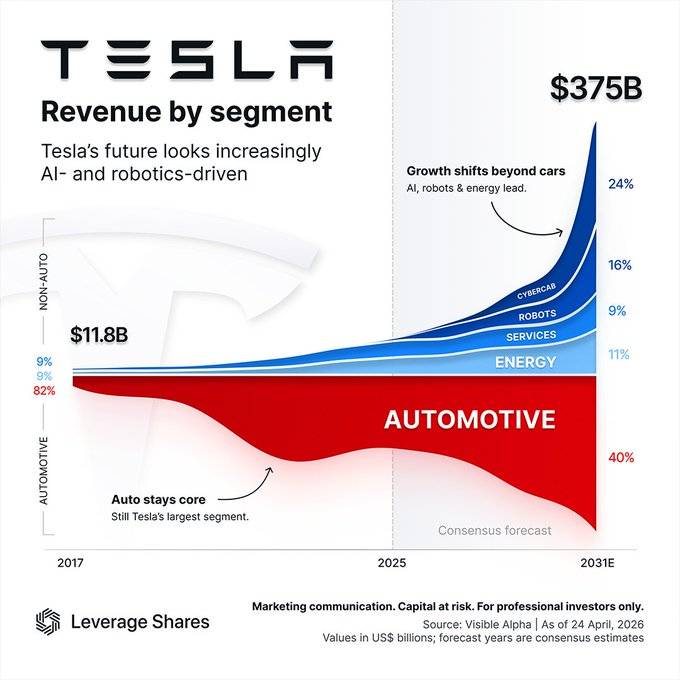
$TSLA is positioning to be the largest physical AI deployment platform by the end of this decade. By 2031, Tesla could become a $375B revenue story where AI, robots, services, energy & Cybercab together become larger than automotive: • Automotive 40% • Cybercab 24% • Robots 16% • Energy 11% • Services 9%
Shay Boloor tweet media
English
162
408
2.2K
156.9K
Dialectical Thinker
Dialectical Thinker@DialecticalWDYT·
@Chamath’s framing is a sharp critique of the current hype cycle and a roadmap for what’s next. We’re moving from “AI makes developers faster” to “AI makes organizations build better software with less drama.” Early tools got us the first 2-5x. The multiplayer layer could deliver the next order-of-magnitude improvement — especially for complex systems, enterprises, and teams larger than a handful of people. Worth watching closely. Single-player was the warm-up. Strength of Chamath’s post: Excellent sports analogy (single-player vs. multiplayer) that makes a complex idea instantly relatable. It correctly identifies that coding is <30% of the real work in most software projects. The “institutional memory” point is spot-on — loss of context is one of the biggest hidden costs in engineering orgs. Potential pushback: Some teams already hack multiplayer behavior with shared files, Slack bots, or agent swarms. The real challenge for any “Factory” product will be adoption, clean context ingestion, and avoiding new lock-in. #AIFactory @xai
English
0
0
0
21
Chamath Palihapitiya
Chamath Palihapitiya@chamath·
every AI coding tool on the market is a single-player game. cursor, copilot, claude code. they all make the individual developer faster at writing code. And they are brilliant at it. 2-5x individual velocity, sometimes more. but software isn't a single-player game. software is mostly architecture decisions, requirements debates, compliance reviews, code reviews, rollbacks, post-mortems, onboarding. it’s a multiplayer sport with a dozen roles and thousands of decisions that don't just live in one person's head. the key in good software development is the coordination between roles, the traceability of decisions, the institutional memory of why something was built a certain way. that's what software factory is. it’s a multiplayer AI. Requirements captures business intent before an engineer opens an IDE. Blueprints captures architecture decisions upstream. Work Orders routes structured tasks to AI agents through MCP with full context. the Knowledge Graph holds the state of every artifact. try it here: factory.8090.ai
English
173
42
924
170.5K
Dialectical Thinker retweetledi
Joshua Liu
Joshua Liu@joshuapliu·
Yes, AI in Healthcare will lead to "de-skilling" of certain skills - but it will also unlock "re-skilling" in completely new domains. The question isn't whether that trade off is happening - it's figuring out what should go in each bucket. When AI Scribes first came out, there was concern that not learning clinical documentation would negatively impact medical training. If the note helps clinicians learn to think through a clinical problem, organize their thoughts and present a coherent plan - what gets lost if we outsource drafting it? At the same time, we need to recognize that humans have limited cognitive bandwidth to just keep learning more information and more skills. Before calculators, humans had to be really good at manual arithmetic. Sure, calculators meant the average human is now worse at doing math in their heads, but look at everything that first calculators and now tools like Excel have unlocked. We developed skills to do advanced stats analysis for medical research or model out complex real-world financial scenarios in spreadsheets - wasn't that trade off worth it? Or consider how clinicians previously had to be so much more proficient with physical exams - but with medical imaging, they unlocked this brand new skill of reading scans, which ultimately led to breakthroughs in better diagnosis and treatment. Wasn't that skill trade off worth it? Here's the crazy thing about AI - we're now seeing AI agents that will do the heavy lifting on financial models for you. In the past, you at least needed foundational stats and finance skills to build those spreadsheet models. Now, you can just tell a Claude agent to build the model for you. With AI clinical co-pilots, you can tell the AI to not only draft the note - but automatically suggest a diagnosis, treatment plan and orders. The question is: how much of this skill stack do we want to outsource to AI and how much do we care to keep? What we're seeing across industries is that the experienced professional - with decades in medicine, finance, or law pre-AI - has the foundational skillset, judgment and experience to 10x their output with AI. They know what good and bad outputs look like. They can pressure test the AI. When we think about the next generation of clinicians, it's important that medical trainees still develop the most important clinical skills - they shouldn't outsource all clinical thinking to AI before they develop judgment, taste, etc. But we can't protect that for every skill. In some ways, it's good that AI adoption in clinical care has real friction. We need early adopters at all stages of training to tinker with AI, figure out where it fits and where it detracts value, and let the profession work it out - as it does with any new technology. Ultimately we shouldn't just be worried about AI de-skilling - we should be equally optimistic about what new skills AI will unlock, and be thoughtful about exploring those edges to maximize AI for patient care.
Joshua Liu tweet media
English
20
58
181
11K
Dialectical Thinker retweetledi
Justin Banks
Justin Banks@RealJGBanks·
THE PHOTONICS ROTATION Almost nobody is watching photonics. As AI clusters scale, copper hits physical limits and the next bottleneck becomes optical infrastructure. Here are 15 names positioned for it: 1. $LITE owns the laser + optical switching side of the trade and is one of the cleanest pure plays on AI optical demand. 2. $COHR wins from lasers, modules, and networking hardware that power hyperscale AI infrastructure and cloud expansion. 3. $AAOI is one of the best ways to play AI optical transceivers with major hyperscaler demand for 800G and 1.6T connectivity. 4. $SIVE benefits from the push toward faster semiconductor-to-optical integration as AI infrastructure scales. 5. $MRVL controls a huge part of the DSP + interconnect story with optical networking chips and high-speed connectivity. 6. $AVGO sits at the center of AI networking through switching, custom silicon, and optical interconnect demand. 7. $ANET is the Ethernet backbone moving massive AI workloads across hyperscale clusters and data centers. 8. $GLW supplies the specialty glass + fiber needed for the optical transport layer behind AI infrastructure. 9. $JBL benefits from building and scaling the actual hardware behind networking systems and optical modules. 10. $AEHR wins from burn-in + testing demand as AI ASICs and high-power optical hardware move into production. 11. $POET is focused on lower-cost optical engines designed to improve efficiency inside AI data centers. 12. $LWLG is pushing next-gen polymer photonics that could make optical communication faster and more efficient. 13. $QCLS brings exposure to advanced laser systems supporting precision photonics and next-gen optical demand. 14. $LPTH provides specialty optics and photonic components tied to industrial, defense, and AI-driven systems. 15. $ALAB gives exposure to the connectivity + infrastructure side helping AI clusters scale faster. Most people won’t care until these are already up 100%.
Justin Banks tweet media
English
123
556
3K
497K
Dialectical Thinker retweetledi
Lin
Lin@Speculator_io·
The SpaceX IPO will ignite a trillion-dollar space race. 𝗦𝗽𝗮𝗰𝗲 𝗜𝗻𝗳𝗿𝗮𝘀𝘁𝗿𝘂𝗰𝘁𝘂𝗿𝗲 $RKLB Rocket Lab $SIDU Sidus Space $FLY Firefly Aerospace $RDW Redwire Space $LUNR Intuitive Machines $MDA MDA Space $VOYG Voyager Space $YSS York Space Systems $SPCE Virgin Galactic $FJET Starfighters Space 𝗦𝗮𝘁𝗲𝗹𝗹𝗶𝘁𝗲 𝗖𝗼𝗺𝗺𝘂𝗻𝗶𝗰𝗮𝘁𝗶𝗼𝗻𝘀 $ASTS AST SpaceMobile $GSAT Globalstar $SATS EchoStar $IRDM Iridium Communications $ETL Eutelsat $TSAT Telesat $GILT Gilat Satellite Networks $VSAT Viasat 𝗦𝗽𝗮𝗰𝗲 𝗜𝗺𝗮𝗴𝗶𝗻𝗴 $PL Planet Labs $GSAT Globalstar $SATL Satellogic $BKSY BlackSky Technology $SPIR Spire Global 𝗦𝗽𝗲𝗰𝗶𝗮𝗹𝗶𝘁𝘆 𝗠𝗮𝘁𝗲𝗿𝗶𝗮𝗹𝘀 $CRS Carpenter Technology $MTRN Materion $HXL Hexcel $ATI ATI $GLW Corning $PKE Park Aerospace 𝗔𝗲𝗿𝗼𝘀𝗽𝗮𝗰𝗲 & 𝗗𝗲𝗳𝗲𝗻𝘀𝗲 $RTX RTX Corporation $LMT Lockheed Martin $KTOS Kratos Defense & Security $VOYG Voyager Space $LHX L3Harris Technologies $NOC Northrop Grumman $BA Boeing $AIR Airbus $HO Thales 𝗦𝗽𝗮𝗰𝗲 𝗖𝗼𝗺𝗽𝗼𝗻𝗲𝗻𝘁𝘀 $TDY Teledyne Technologies $APH Amphenol $KRMN Karman Space $RBC RBC Bearings $PH Parker Hannifin $AME AMETEK $GHM Graham $HEI Heico $DCO Ducommun $ATRO Astronics $TDG TransDigm
Lin tweet media
English
56
512
2.5K
550.2K
Dialectical Thinker retweetledi
Christina Farr
Christina Farr@chrissyfarr·
Market maps have become a real focus of ours as LLMs are getting company categorization so wrong. Our latest, in partnership with Confido Health & @RMFnyc1, focuses on agentic AI for the ambulatory market. What's being deployed now? Our focus was Series A onwards. 👇
Christina Farr tweet media
English
3
9
33
3.4K
Dialectical Thinker
Dialectical Thinker@DialecticalWDYT·
It's genuinely notable and a bit eyebrow-raising on the surface. $HIMS started as a straightforward #Telehealth/#DTC company focused on things like erectile dysfunction meds, hair loss treatments, weight loss (GLP-1s), skincare, and mental health — not exactly a hotbed for cutting-edge robotics or autonomous systems talent. Hiring a cluster of senior Cruise alumni (especially post-Cruise's well-publicized safety incidents, layoffs, and scaling back) suggests @HIMS is quietly pivoting harder into AI/ML infrastructure, not just bolting on some basic recommendation engines or chatbots. Possible angles they're exploring: 1. Personalized medicine at scale using advanced ML for better diagnostics, treatment recommendations, or predicting patient outcomes from user data. 2. Wearables or hardware integration -- Cruise folks know sensor fusion, real-time perception, and robotics. That could translate to health monitoring devices, computer vision for skin/hair analysis, or even at-home diagnostic tools. 3. Autonomous-like systems in #healthcare -- Think AI agents that handle more of the patient journey with minimal human oversight (while staying compliant with regs). 4. Data moat building -- #Telehealth generates tons of proprietary health/behavioral data. Top-tier ML talent could help Hims turn that into a real competitive edge vs. traditional pharma or other #DTC players. Overall, it makes @HIMS more interesting than the "just a telehealth pill company" narrative. If they're successfully repurposing AV-level ML talent for health applications, it could be a smart long-term bet on AI transforming medicine.
English
1
1
3
483
Hims House
Hims House@himshouse·
🚨 $HIMS engineering team now has *at least* 12 people who previously worked at Cruise - the self-driving vehicles company ALL were senior, staff, VP-level, or higher at Cruise And all were intimately involved in the development of the ML technology powering Cruise's autonomous vehicles Many attended universities like MIT, UChicago, or Waterloo, and have backgrounds in math & robotics This is completely unprecedented for a telehealth company No other telehealth company on the planet has even attempted to assemble an engineering team with so much AI/ML technical talent
English
16
11
283
31K
Dialectical Thinker
Dialectical Thinker@DialecticalWDYT·
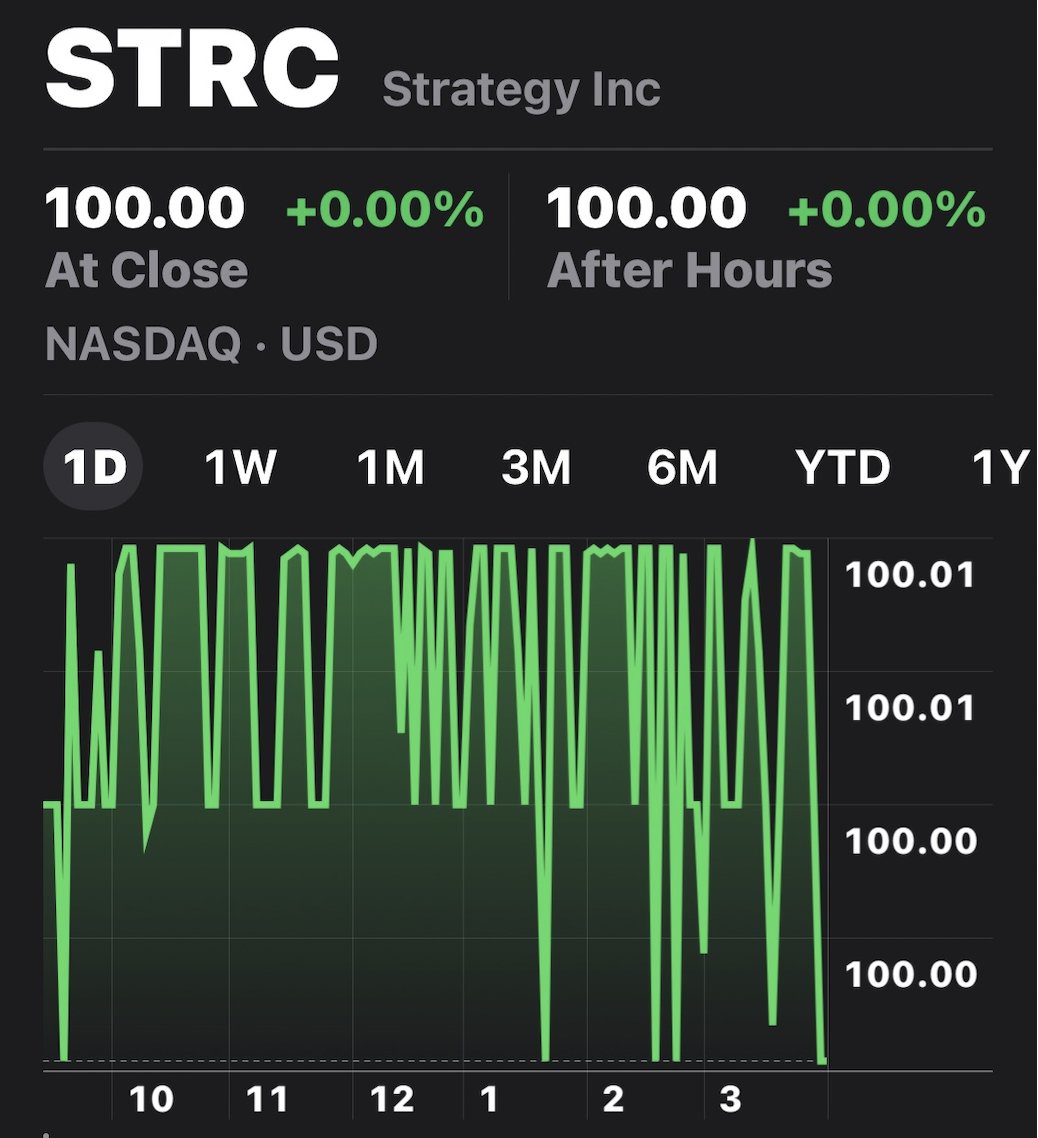
@saylor Heavy $STRC absorption without sustained gains is a clear warning sign for near-term bulls. x.com/DialecticalWDY…
Dialectical Thinker@DialecticalWDYT

$BTC Bear Market Rally @saylor's @MicroStrategy appears to have deployed massive capital into $BTC through its $STRC preferred stock program. Trading volumes hit ~$1.5B - an all-time high, implying roughly $1.1–1.3B in incremental buying pressure. Despite this, $BTC closed lower. When flows this large can’t push price higher, it signals significant supply overhead. Bears absorbed the demand. 👀 April 15th is the ex-dividend date for $STRC. Some buying may have been pulled forward ahead of it. Looking at history, $BTC has performed poorly in the ~14 days following prior $STRC ex-div dates. Once these flows ease, we could see an “air pocket” in price action. The #SEC is moving forward with changes that remove pattern day trading restrictions for smaller accounts, eliminating the old 4-trades-in-5-days limit for those under $25k. This should meaningfully boost retail trading volume and activity across the board - a clear tailwind for brokerage platforms focused on smaller accounts. $HOOD (@RobinhoodApp) stands out here with its significantly lower average account size compared to traditional brokers. It should capture a disproportionate share of the increased retail flow. $HOOD jumped ~10%. Strong reaction. 📈 Big flows matter - but so does how price reacts to them and what happens once the ex-div buying fades. Volatility likely ahead. Near-term risk/reward has shifted negative for bulls. What are your thoughts on BTC here? Watching $STRC, $HOOD, or anything else? NFA, Always DYOR #Bitcoin #BTC #Crypto #Robinhood #Markets
English
0
0
0
781
Michael Saylor
Michael Saylor@saylor·
$1.56 billion of liquidity. One-cent market. Closed at par. $STRC
Michael Saylor tweet media
English
899
1.2K
10.3K
567.5K
Dialectical Thinker
Dialectical Thinker@DialecticalWDYT·
$BTC Bear Market Rally @saylor's @MicroStrategy appears to have deployed massive capital into $BTC through its $STRC preferred stock program. Trading volumes hit ~$1.5B - an all-time high, implying roughly $1.1–1.3B in incremental buying pressure. Despite this, $BTC closed lower. When flows this large can’t push price higher, it signals significant supply overhead. Bears absorbed the demand. 👀 April 15th is the ex-dividend date for $STRC. Some buying may have been pulled forward ahead of it. Looking at history, $BTC has performed poorly in the ~14 days following prior $STRC ex-div dates. Once these flows ease, we could see an “air pocket” in price action. The #SEC is moving forward with changes that remove pattern day trading restrictions for smaller accounts, eliminating the old 4-trades-in-5-days limit for those under $25k. This should meaningfully boost retail trading volume and activity across the board - a clear tailwind for brokerage platforms focused on smaller accounts. $HOOD (@RobinhoodApp) stands out here with its significantly lower average account size compared to traditional brokers. It should capture a disproportionate share of the increased retail flow. $HOOD jumped ~10%. Strong reaction. 📈 Big flows matter - but so does how price reacts to them and what happens once the ex-div buying fades. Volatility likely ahead. Near-term risk/reward has shifted negative for bulls. What are your thoughts on BTC here? Watching $STRC, $HOOD, or anything else? NFA, Always DYOR #Bitcoin #BTC #Crypto #Robinhood #Markets
English
0
0
0
879
Dialectical Thinker retweetledi
Finn Stockinger
Finn Stockinger@FinnStockinger·
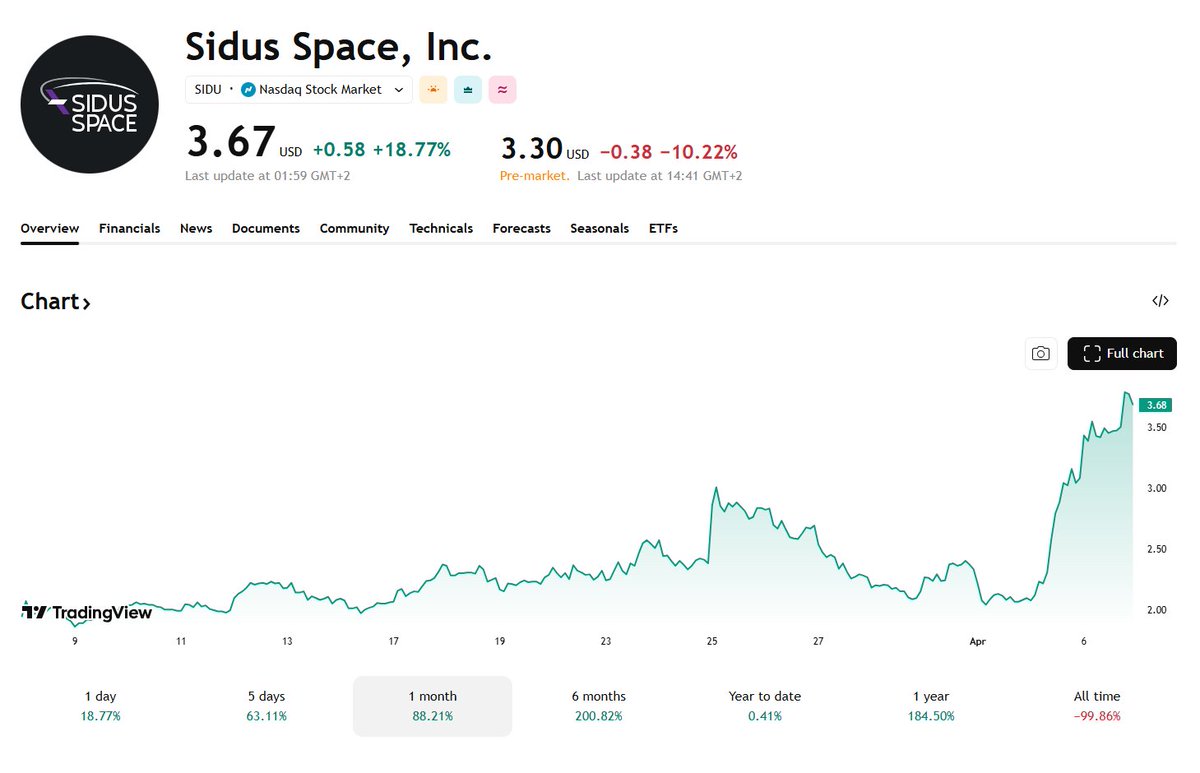
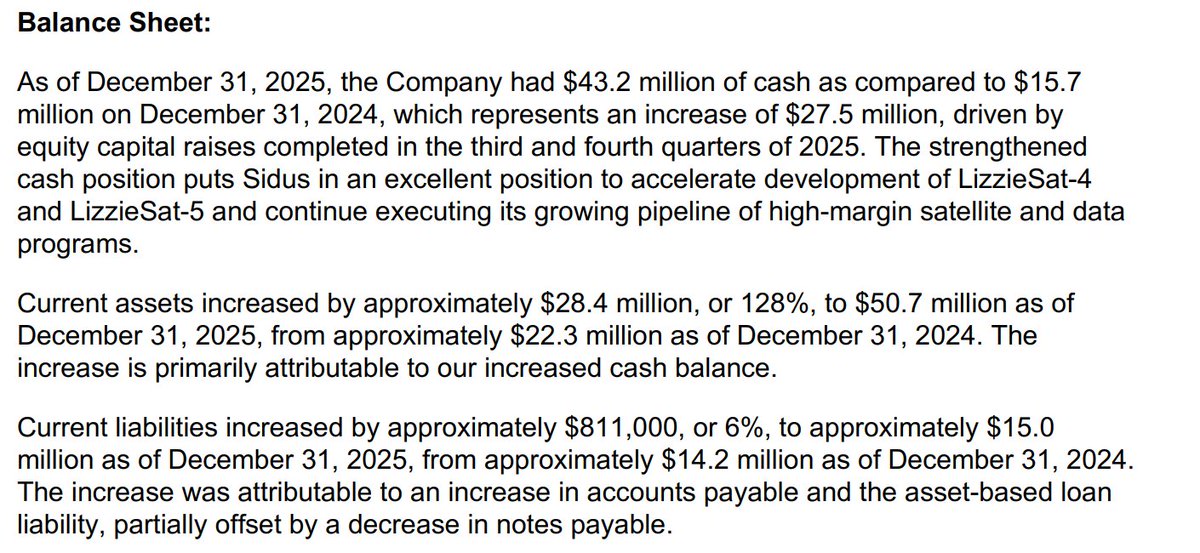
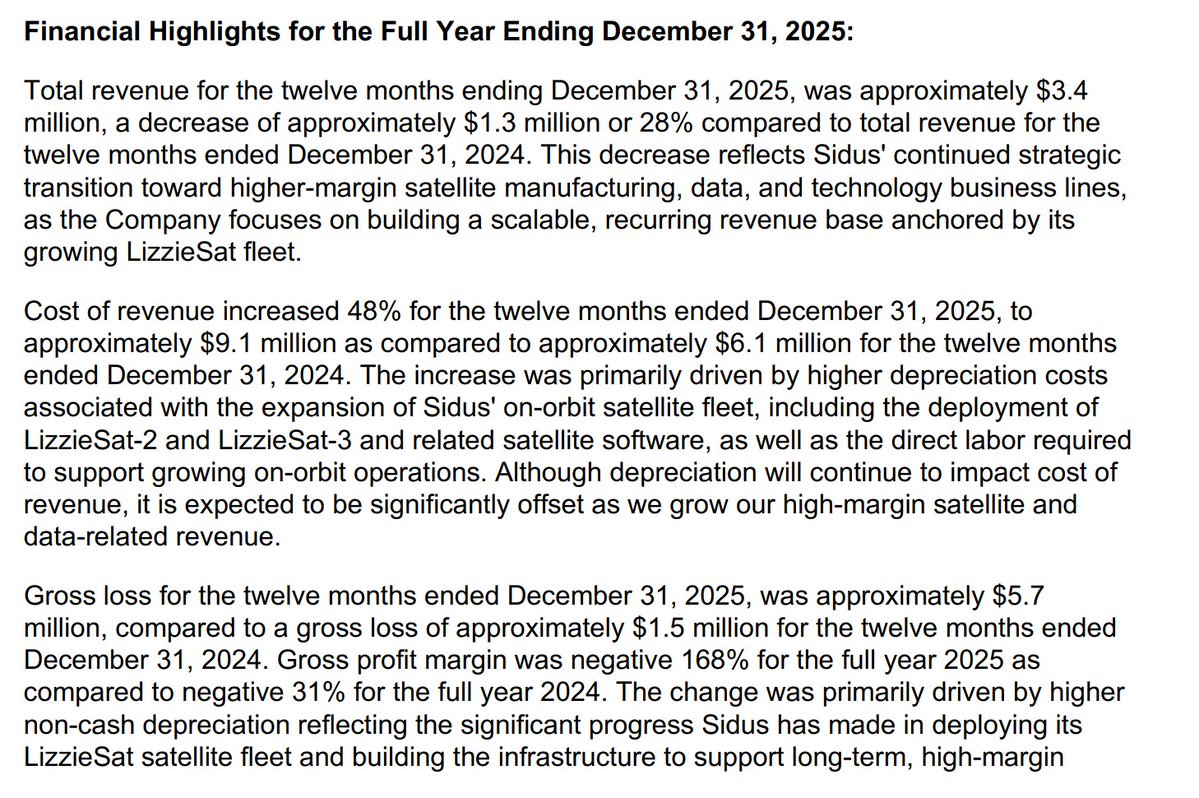
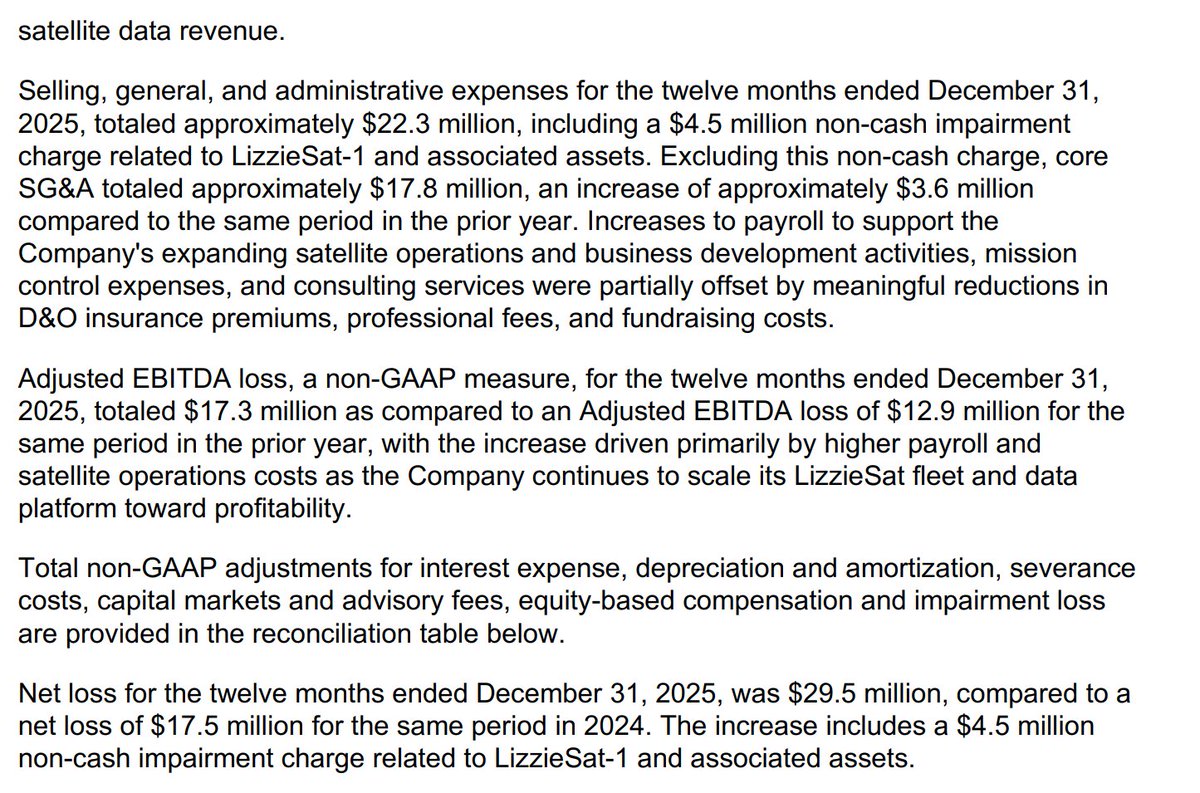
$SIDU 2026: The "Space-as-a-Service" Pivot. High Stakes, Clean Balance Sheet. Sidus Space just dropped its 2025 Annual Report (April 1, 2026). If you’re holding or watching $SIDU, the narrative has shifted from "part manufacturer" to "data intelligence." 1⃣The "Clean" Financials Cash Position: $43.2M (up 175% YoY). Debt: ZERO term debt. This is rare for NewSpace. It gives them a "runway" through 2026 without immediate bankruptcy fears. The Catch: This cash came from heavy share dilution. They have a $500M "Shelf Registration" (S-3) ready. They can and will sell more shares if they need to fund more launches. 2⃣ The 164% Growth Target 2025 Revenue: $3.4M (Down 28%). Why? They intentionally cut low-margin manufacturing to focus on their own satellites (LizzieSat™). 2026 Guidance: Management is targeting $9M in revenue. That’s a massive jump. If they hit it, the "pivot to data" is proven. If they miss, the burn rate becomes a problem. 3⃣ Real Hardware on Orbit LizzieSat-3 Success: Confirmed operational in March 2026. It’s successfully hosting payloads for HEO USA. This proves their "Space-as-a-Service" model actually works in zero-G. LizzieSat-4: Integration tests passed in Jan 2026. It carries specialized AI processors to analyze data on the satellite before sending it to Earth. This is their "X-Factor." 4⃣ The Lunar Moonshot Lonestar Contract: Now worth $120M. Sidus is building the satellites for lunar data storage. This isn't just a "vision" - payments are starting to hit the books. MDA SHIELD: They are part of a $151B missile defense program. Note: This is an IDIQ contract (no guaranteed money yet), but it puts them at the table with the Pentagon for the next decade. 5⃣ The Retail Reality Check Net Loss: $29.5M in 2025. This includes a $4.5M one-time write-down on LizzieSat-1. Execution Risk: Space is hard. One launch failure can wipe out a quarter’s progress. Volatility: Expect price swings around launch dates and "at-the-market" share offerings. ⬇️Verdict: Sidus has cleared its debt and secured its tech. Now, they just have to prove they can sell the data. 2026 is the "Show Me" year. #SpaceTech #SIDU #NewSpace #LizzieSat
Finn Stockinger tweet mediaFinn Stockinger tweet mediaFinn Stockinger tweet mediaFinn Stockinger tweet media
Finn Stockinger@FinnStockinger

What a day for the space sector! 🚀 Yesterday I mentioned how a potential SpaceX IPO could provide a massive boost to the entire industry and today, the boards are glowing green. We aren't talking about 2-3% moves here; this is a full-scale breakout. Just look at these numbers: $SPIR 🟢 +18.91% $SATL 🟢 +18.56% $LUNR 🟢 +18.53% $PL 🟢 +16.83% $VOYG 🟢 +12.88% $BKSY 🟢 +11.55% $FLY 🟢 +10.65% $ASTS 🟢 +10.28% $RDW 🟢 +7.16% $RKLB 🟢 +3.37% The momentum is real. Tomorrow I’ll be back with my first full report. Stay tuned! Quick question for you guys: Which company do you want to see covered first? The one that gets mentioned the most in the comments will be the first one I dive into! 👇 #SpaceEconomy #Investing #SpaceX #Stocks

English
5
11
82
22.5K
Dialectical Thinker retweetledi
Danny Naz
Danny Naz@ThePupOfWallSt·
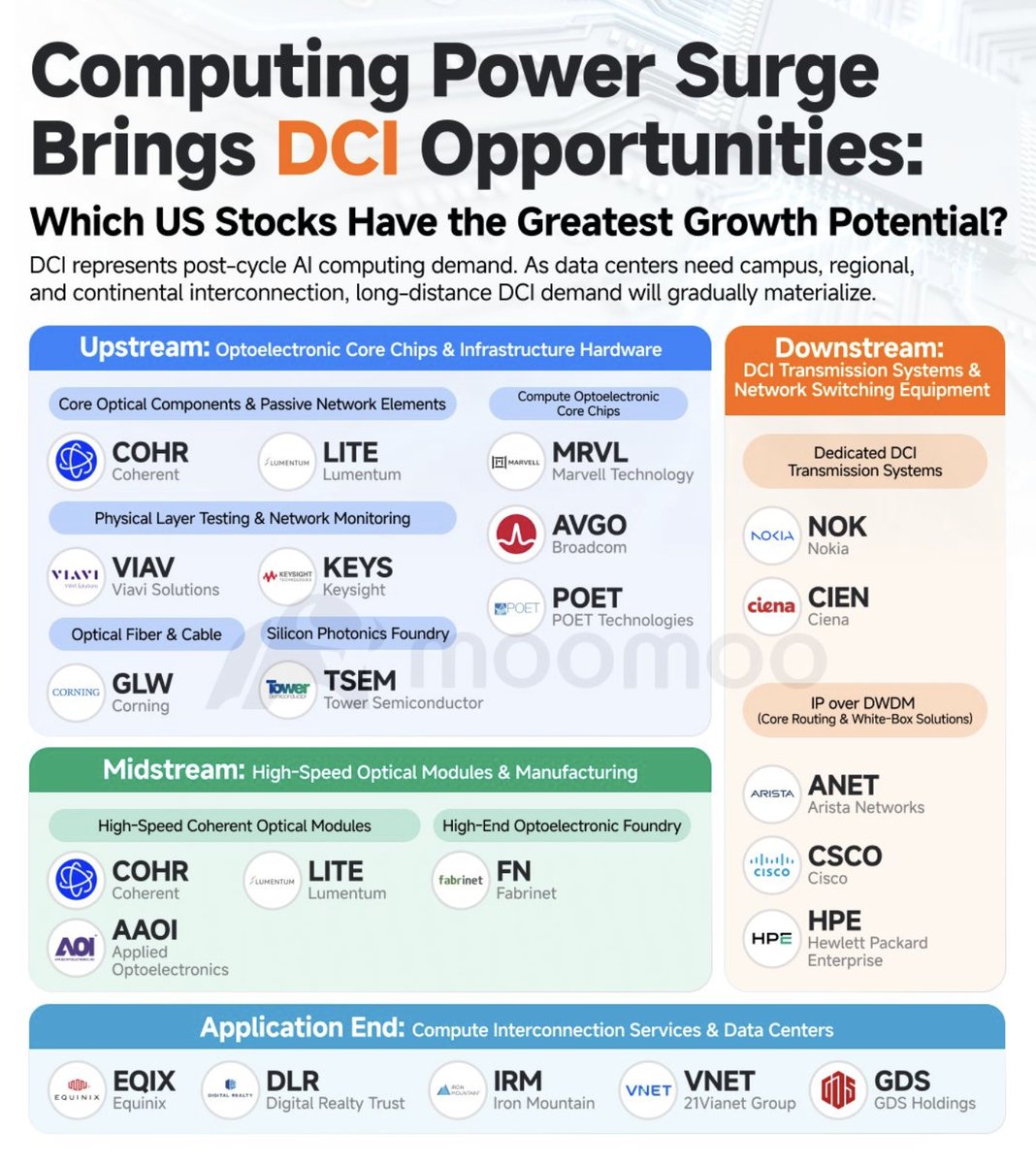
Everyone’s chasing AI chips. The real bottleneck is what connects them. That’s DCI. You can build all the compute you want, but if the data can’t move fast enough, the whole system breaks. That’s where the next wave is forming: Upstream: $COHR $LITE $MRVL $AVGO $GLW Midstream: $AAOI $FN Network layer: $ANET $CSCO $HPE $CIEN $NOK Data centers: $EQIX $DLR $IRM This is the plumbing behind AI. Not sexy. Not talked about enough. But absolutely critical. AI isn’t just compute. It’s compute + connectivity + infrastructure. And connectivity is about to get repriced.
Danny Naz tweet media
English
4
19
73
8.5K
Dialectical Thinker retweetledi
Bessemer
Bessemer@BessemerVP·
The next generation of biotech winners won't be defined by their science alone. They'll be defined by their data infrastructure. 🧬 Bessemer's Biotech team is out with their roadmap on biology-native data infrastructure + the market map of the companies building it: → Multi-modal datasets built for drug biology → Agentic AI across entire R&D workflows → Closed-loop lab automation Read the full report: bvp.com/atlas/building…
Bessemer tweet media
English
10
29
139
46.9K
Dialectical Thinker retweetledi
Michael
Michael@endpointarena·
Quick run down of the features on Endpoint Arena, the prediction market for clinical trials. the home page has all the trials:
Michael tweet media
English
84
117
1.4K
564.3K
Dialectical Thinker retweetledi
Shay Boloor
Shay Boloor@StockSavvyShay·
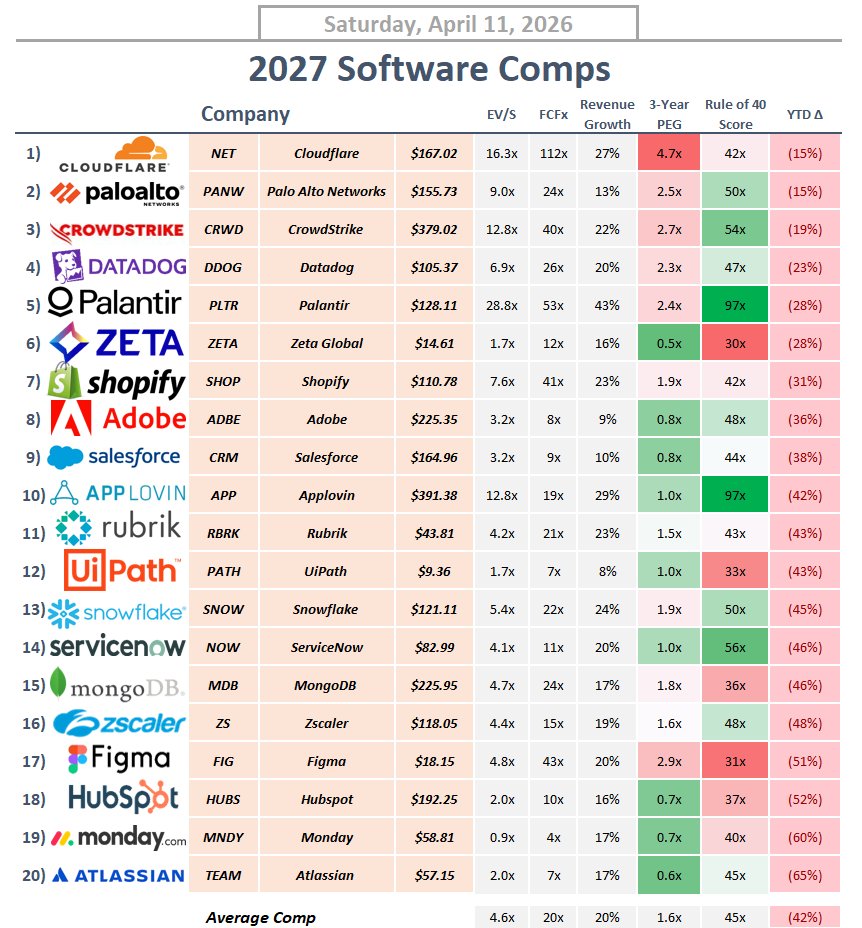
UPDATED SOFTWARE COMP SHEET Rule of 40 breakdown: • Unicorn (60%+) | $PLTR, $APP • Elite (50-59%) | $NOW, $CRWD, $PANW, $SNOW • Great (40-49%) | $ADBE, $ZS, $DDOG, $TEAM, $CRM, $RBRK, $NET, $SHOP, $MNDY • Good (30-39%) | $HUBS, $MDB, $PATH, $FIG, $ZETA
Shay Boloor tweet media
English
66
206
1.1K
270.1K
Dialectical Thinker retweetledi
Sandeep Anand
Sandeep Anand@SanCompounding·
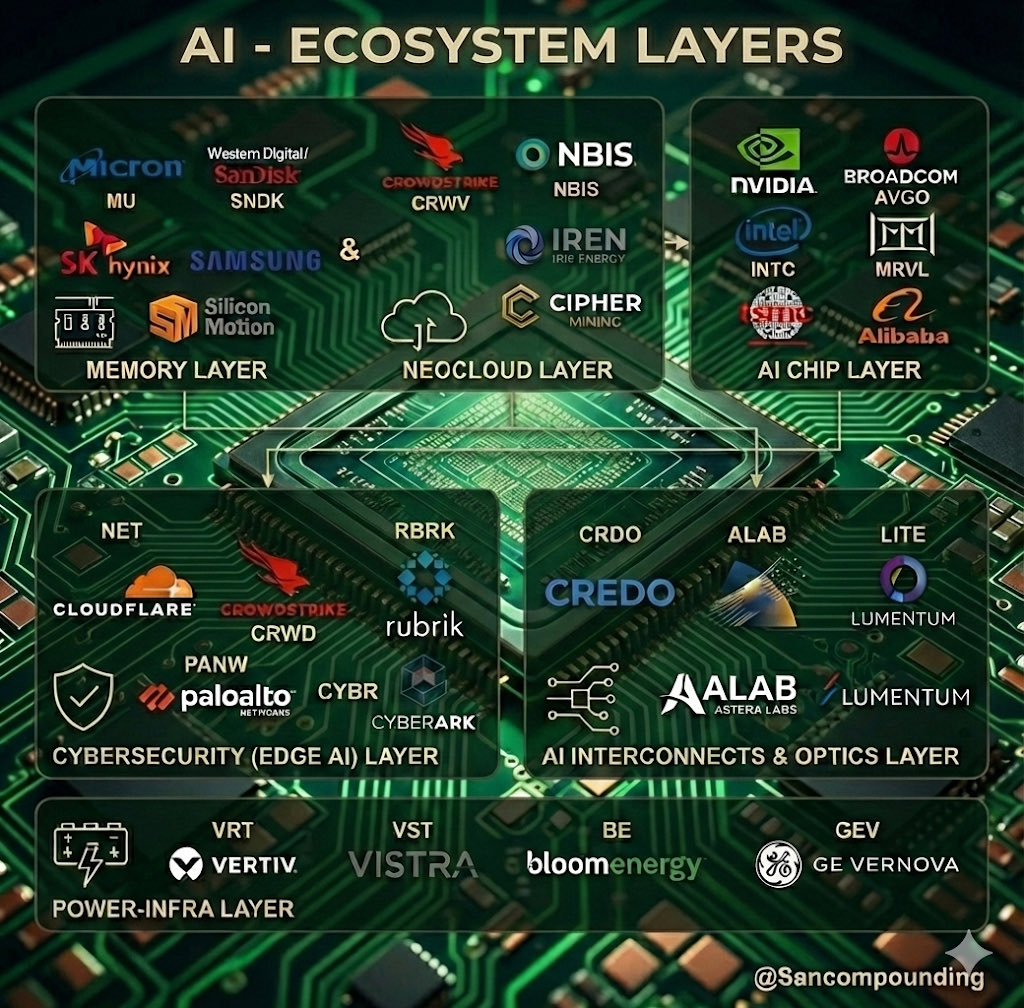
🚀 Buying this AI basket like an ETF and forget next 2 years is a good idea 1 $MRVL $67B Optical Switch/Chips 2 $TSM $1.6T Fabless capacity 3 $CIEN $61B Optical Transceivers 4 $COHR $57B Optical Transceivers 5 $LITE $40B Optical Transceivers 6 $CRDO $19B Optical /AIBConnect 7 $DRAM NA Memory ETF 8 $AAOI $10B Optical Transceivers 9 $VIAV $8.3B Optics Test/MFG 10 $CRWV $53B Hyperscaler 11 $AVGO $1.7T ASIC Chips 12 $AXTI $3.5B Optical Materials 13 $NBIS $25B Neocloud 14 $ALAB $0.7B AI Interconnect 15 $NET $58B EDGE AI
Sandeep Anand tweet media
English
15
176
799
419K
Dialectical Thinker retweetledi
Sandeep Anand
Sandeep Anand@SanCompounding·
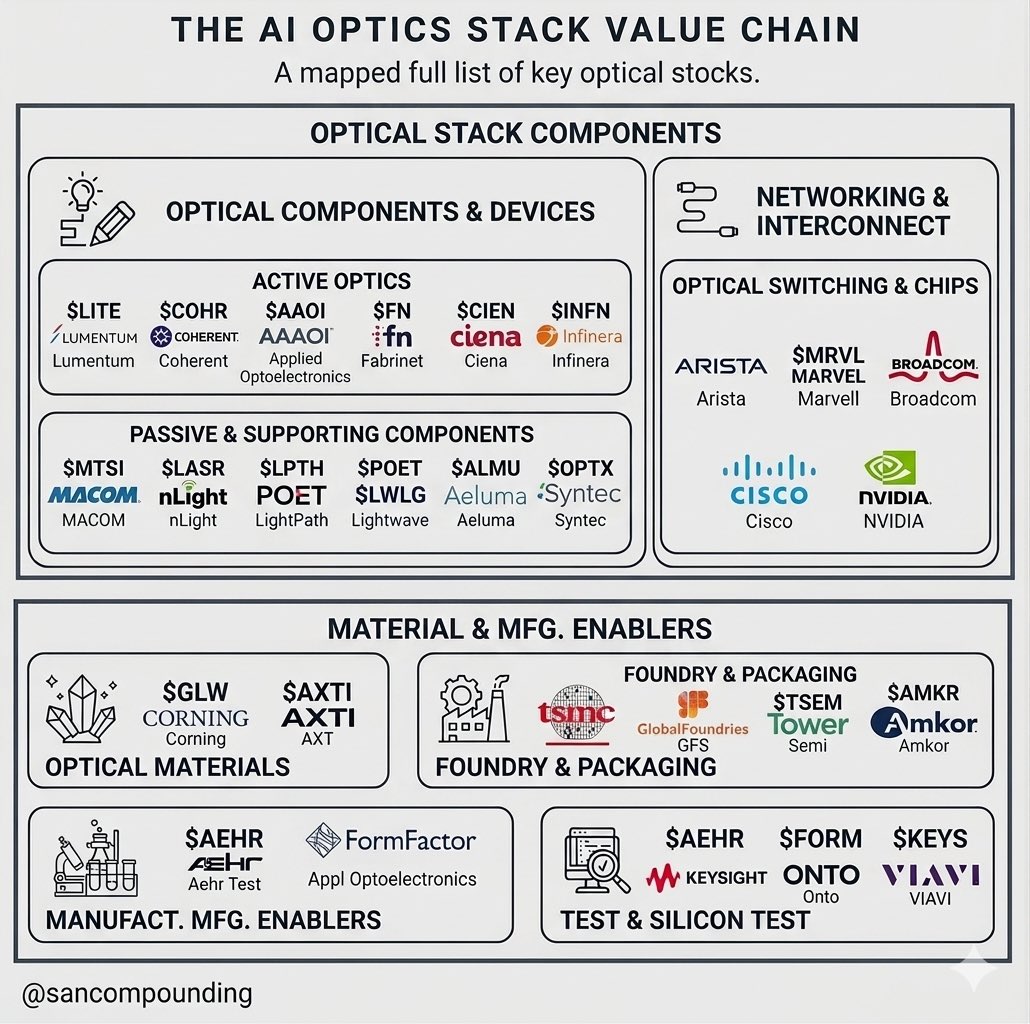
⛔️Stan Druckenmiller called Copper as the biggest bottleneck of the future. But AI's $1T photonics is addressing the exact Copper bottleneck: 🚀Here is AI Photonics ecosystem that are leaders of the bull market- as a basket 👇 Optical Transceivers : $LITE $COHR $AAOI $CIEN Support components: $LASR $POET $OPTX Optical switching + connect : $MRVL $CRDO Optical materials: $GLW $AXTI Optics Test/ MFG: $AEHR $FORM $VIAV Foundry: $TSEM
Sandeep Anand tweet media
English
5
31
150
18.6K
Dialectical Thinker retweetledi
Bilaal- BD investing
Bilaal- BD investing@bdinvestingg·
Photonic stocks are leading the market $LITE — Optical backbone of AI. Copper fails scaling. $400M backlog signals massive demand surge. $AAOI — Pure-play transceivers. 1.6T exposure. $1B+ revenue target. Demand exceeds supply into 2027. $ANET — AI networking king. Connects massive GPU clusters. Targeting $3.25B AI revenue by 2026. $AXTI — Critical laser substrate supplier. Hidden chokepoint enabling optical scaling across AI infrastructure.
Bilaal- BD investing tweet media
English
14
79
447
41.8K