
Dio

36K posts

Dio banner
Dio

Dio

@DioOmega

I’m interested in industries that connect the old and the new to the future.

Worldwide Katılım Mayıs 2013
1.9K Takip Edilen1.5K Takipçiler
Dio retweetledi
Brian Armstrong
Brian Armstrong@brian_armstrong·
CLARITY is closer than ever. The bill is strong. It will benefit the American people by making the US financial system faster, cheaper and more accessible. It will also ensure that the US leads in the global race to build the next generation of our financial system. Huge thank you to the Senate, their staff, and 3.7m @standwithcrypto advocates for helping to get this legislation to where it is today. Mark it up.
English

1.1K
2.4K
14.8K
1.2M
Dio retweetledi
Human Progress
Human Progress@HumanProgress·
Climate science is now moving away from the most extreme scenarios. @RogerPielkeJr explains why on our podcast: "Our expectation for future emissions has come down dramatically, largely because there was an assumption everything was going to go towards coal... Another big factor—and it’s one that really hasn’t made its way into climate projections yet—are changing outlooks on global population. The leading climate scenarios still have 12, 13 billion people on the planet in 2100 and still growing. And demographers are now seriously talking about a global population peak soon after mid-century."
English
24
37
177
87.6K
Dio retweetledi
Human Progress
Human Progress@HumanProgress·
Malthus's central claim—that population growth inevitably outpaces food production—was already wrong by the time it appeared in print. Between 1700 and 1798, the population of England grew 62.3%, while bread became 36.2% more abundant relative to the average income. humanprogress.org/earth-days-bad…
English
2
18
61
4K
Dio
Dio@DioOmega·
he infrastructure is held by firms. The regulation is imposed by the state. Democracies can’t escape this loop.
Paul Gurnett@quepasachico

The future of #AI may be decided less by intelligence… and more by who controls the infrastructure behind it. Datacenters, compute power, energy, and deployment control are becoming strategic assets with enormous influence over society, economics, and democracy. #AIgovernance is no longer just a tech issue. #AIGovernance #AITrust #AIInfrastructure #AISafety #AI theguardian.com/commentisfree/…?

English
0
0
2
38
Dio retweetledi
Matt Loszak
Matt Loszak@MattLoszak·
Data center demand is not impossible because of turbine blade shortages. We’ve done this before: In 2002, the US grid added 57 GW of natural gas capacity in a single year, and almost 200 GW in 5 yrs. That’s higher than data center forecasts. Then what’s the problem? 🧵
Matt Loszak tweet media
English
31
98
959
126.5K
Dio retweetledi
Cointelegraph
Cointelegraph@Cointelegraph·
🇯🇵 LATEST: Japan’s enterprise-focused blockchain Japan Open Chain to launch “EJPY,” a yen-pegged stablecoin for B2B settlements.
Cointelegraph tweet media
English
65
76
394
32.3K
Dio retweetledi
Bloomberg
Bloomberg@business·
Europe’s solar boom is running into a new problem: too much power. Prices are going negative, grids are overwhelmed, and energy is going to waste. bloomberg.com/news/articles/…
English
91
198
521
157.9K
Dio retweetledi
Peter Clack
Peter Clack@PeterDClack·
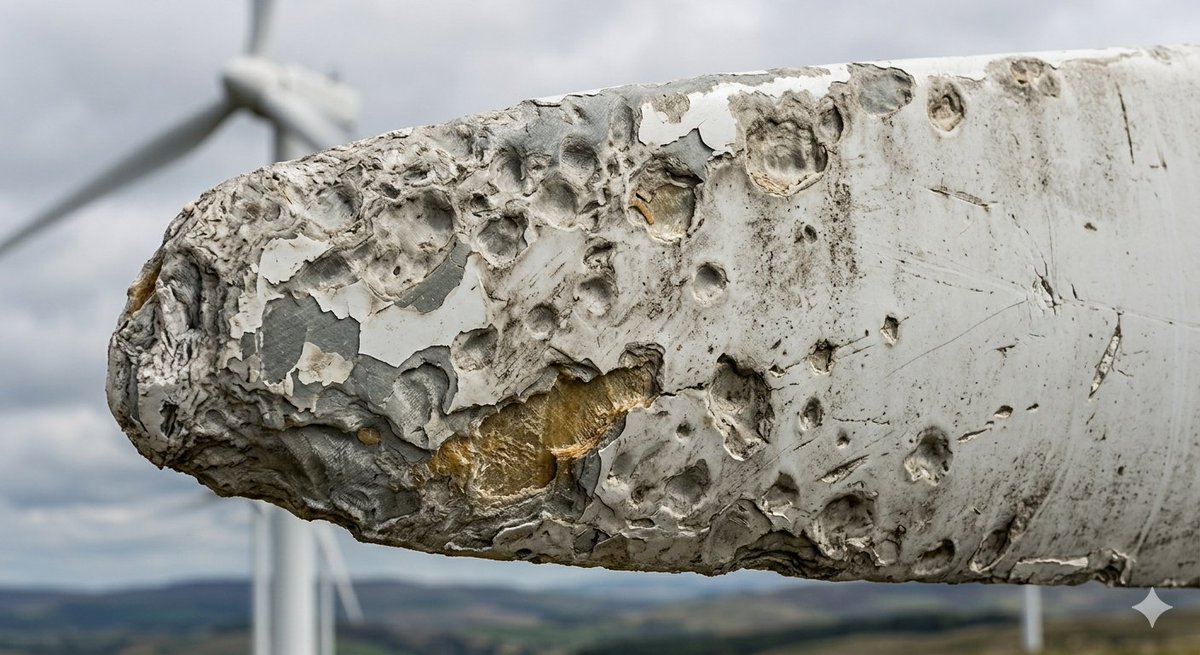
Many of the onshore wind farms along the coasts of the UK and Denmark are falling apart after only 10 years. A study reveals that energy contributions from wind farms begin to fall sharply after only 10 to 15 years, leaving the skeletons of steel and plastic blowing in the wind. The economic analysis reveals the lifespan of an onshore turbine is not 20 to 25 years, as stated by the wind industry itself, supported by the UK Government. This peer reviewed British study reveals that the energy production of onshore wind farms falls substantially as they get older, due to wear and tear. Energy and environmental economist, Professor Gordon Hughes (University of Edinburgh), carried out the statistical analysis of wind farm performance data in the UK and Denmark. He concluded that load factors, like electricity generated as a percentage of capacity, declined a lot faster than expected, suggesting a baseline 10 to 15 year lifespan. This is when the technical life of most turbines crunch to halt, and become unprofitable to continue. Rising maintenance costs makes them uneconomical. The study found the average UK wind farm's ability to meet electricity demand had fallen by a third after around 10 years, leading to a conclusion that many are fully uneconomic to run after only 12 years. While the wind industry generally forecasts a 25-year lifespan, the data reveals a different reality about the viability of keeping them spinning so long. Many companies now 'repower' (replace old turbines with new ones) long before the 25-year target to maximise subsidies and output. This often ends the lifespan of the original hardware much sooner. The wind farm study is published by the 'Renewable Energy Foundation on the Performance of Wind Farms in the United Kingdom and Denmark, 2012'.
Peter Clack tweet media
English
560
4.7K
9K
622.2K
Dio
Dio@DioOmega·
The gap won’t close. But it shows where power, information, and decisions distort—where things stop or fail to integrate. It’s not a problem but a lens. If it won’t close, make use of it.
Syed Ijlal Hussain@sijlalhussain

📍 AI adoption is not only uneven. It is invisible inside organizations. A recent Gallup analysis shows that 23% of employees don’t know whether their organization has adopted AI at all. This is not a communication issue. It is a structural disconnect between deployment and awareness. 1️⃣ Authority Gap: AI decisions are often centralized, but usage is decentralized. Employees operate around systems they neither see nor influence. 2️⃣ Visibility Failure: Organizations track implementation at the leadership level, not at the employee experience level. Adoption exists, but it is not legible across the workforce. 3️⃣ Execution Risk: When employees are unaware of AI integration, coordination breaks down. Systems operate in silos, limiting enterprise-level impact. This is why many organizations report AI progress while employees report ambiguity. The real challenge is not deploying AI. It is making adoption visible, usable, and integrated into how work is actually done. via Gallup buff.ly/XL5jwC7 @TCyberCast @sulefati7 @bulbi59 @corixpartners @bbailey39 @NathaliaLeHen @harbi_nh @Corix_JC @Transform_Sec @bociek191905 @Alovesublime @YalaCoder @kkruse @Yash_ai6 @DioOmega @EduardoValenteI @ozsilverfox @jameslhbartlett @giuliog @michaeldacosta @marmelyr @arigatou163 @O_Berard @faryus88 @ILoveBooks786 @RLDI_Lamy @VivMilanoFSL @FrRonconi @ramonvidall @ricardo_ik_ahau @olivierfroggy @kachofugetsujp @pchamard

English
0
0
1
32
Dio retweetledi
Özer Dölekoğlu
If the planets were the same distance from Earth as the Moon, this is how they would appear in the sky
English
2
8
12
833
Dio retweetledi
EIA
EIA@EIAgov·
The United States set a record for energy production in 2025 for the fourth consecutive year. #TodayInEnergy bit.ly/4nqYeqX
EIA tweet media
English
4
37
67
16.4K
Dio retweetledi
Bjorn Lomborg
Bjorn Lomborg@BjornLomborg·
The graphic excitement in a tweet about batteries replacing gas But actually, it only replaces the least frequent part of gas (OCGT), while CCGT gas still provides 4% And it conveniently ignores that coal provides 62% of all electricity 🤣 explore.openelectricity.org.au/energy/qld1/?r…
Crémieux@cremieuxrecueil

The battery revolution is amazing. Batteries have almost completely displaced gas in Queensland and all it took was two short years!

English
10
59
245
14K
Dio retweetledi
Vahrenholt
Vahrenholt@FritzVahrenholt·
Die beste Nachricht des Jahres: 44 Weltklimarat-Autoren ziehen die Katastrophenszenarien von 3-5 Grad Erwärmung zurück. Alle Quellen und Hintergründe heute in meinem Beitrag für Tichys Einblick und Achgut. Wann gibt es hierzu Sondersendungen in ARD und ZDF ? Sondersitzung des Deutschen Bundestages? Wann kommt die Abschaffung der CO2-Abgabe, des Verbrennerverbots und des Heizungsgesetzes ? tichyseinblick.de/kolumnen/klima…
Deutsch
201
2.3K
6.8K
89.1K