DoubleEko

1.7K posts

DoubleEko banner
DoubleEko

DoubleEko

@DoubleEko

https://t.co/8EOfuvCCZl

Katılım Eylül 2018
12 Takip Edilen112 Takipçiler
DoubleEko retweetledi
Hugo Philion
Hugo Philion@HugoPhilion·
I do so like thinking about radical ways to turn the industry upside down.

Hugo Philion tweet media
English
37
75
419
33.1K
DoubleEko retweetledi
Flare ☀️
Flare ☀️@FlareNetworks·
XRPL: where XRP and RWAs are tokenized. Flare: where they get used—with verification, cross-chain execution, and soon privacy.
English
7
48
261
9.3K
DoubleEko retweetledi
Hugo Philion
Hugo Philion@HugoPhilion·
I’m not sure how incorporating that data in the block would automatically flow value capture from ecosystem activity. Think more along the lines of a systemic value capture from all ecosystem activity that aims to replace inflation and leads to ongoing token supply reduction. Anyway that’s all I will say at this point until the governance proposal is released.
English
24
41
233
32.5K
DoubleEko retweetledi
Hugo Philion
Hugo Philion@HugoPhilion·
@Welsh_XRP @calminspace The core part of the proposal will introduce a totally novel way of building a block (which will ultimately provide the economic linkage between ecosystem activity and FLR token economy) and hence is entirely radical.
English
26
72
297
17.5K
mickle
mickle@xrpmickle·
I use to own the LINK token. Then I learned that the LINK token is nothing more than a community meme. The chainlink oracle network is not a blockchain and does not have ANY NATIVE TOKEN. The LINK token is ETH issued vaporware. This is the complete opposite of natively issued assets like BTC and XRP which are critical infrastructure for each of their respective chains to exist. The LINK token disappears tomorrow? No impact on chainlink oracles.
Zach Rynes | CLG@ChainLinkGod

Chainlink uses protocol revenue to fund $LINK buybacks Ripple sells $XRP to fund Ripple stock buybacks One flows value back to token holders The other extracts value from token holders to drive value to shareholders Notice the difference?

English
81
75
659
54.7K
J L ゼウス
J L ゼウス@zeus_one_·
@CSH_ENTHUZST_IO @xrpmickle @ChainLinkGod No, I think he muted me a while ago on this exact topic (oracle design is better unlinked to 1 token) when he realized he was speaking to someone who can see through every nonsense thing he says about Chainlink, Link, xrp & all else. Likely won't refute. x.com/zeus_one_/stat…
J L ゼウス@zeus_one_

@TheLinkPanda @xrpmickle untrue. It must be neutral, which implies inherent truth. Link inherently competes with all assets, thus the protocol artificially also does (not like maxis & *paid* shills @ChainLinkGod frantically prop it up whilst shouting down every asset known to man 24/7 YoY proving this)

English
1
0
4
314
DoubleEko
DoubleEko@DoubleEko·
@KingKaranCrypto These guys certainly are aware and they are once again out in force in a BIBLICAL way 😂 Last time they were this active was just before FXRP went live.
DoubleEko@DoubleEko

@BlackberryXRP They are upset because the BIBLICAL rotation they were hoping was going to happen didn’t happen and instead billions are flowing towards a rival oracle system. x.com/chainlinkgod/s…

English
0
0
0
160
Vet
Vet@Vet_X0·
The LINK marines forget that the XRP Ledger is the only original protocol that allow usage of features like Orderbook and AMM without paying a middleman a fee - shared public good. For a public good like this, an asset that aggregates demand, just like the USD is doing in TradFi, needs to be neutral - thus XRP. On any other chain you either pay tax to a smart contract deployed by a project or you need to code it yourself. There are no sophisticated shared features/pre compiles like on XRP. It's the value moving tech stack for businesses.
English
47
123
855
25.8K
DoubleEko
DoubleEko@DoubleEko·
@Vet_X0 Their earlier wave of FUD pieces times just before FXRP went live. And now right before cap 2 comes into play. All because XRP’s TVL is heading to a rival oracle. Instead they were hoping of a BIBLICAL rotation to the LINK ecosystem. x.com/doubleeko/stat…
DoubleEko@DoubleEko

@BlackberryXRP They are upset because the BIBLICAL rotation they were hoping was going to happen didn’t happen and instead billions are flowing towards a rival oracle system. x.com/chainlinkgod/s…

English
0
0
0
216
Crypto Dyl News
Crypto Dyl News@cryptodylnews·
This should be interesting
English
12
3
27
4.9K
bill morgan
bill morgan@Belisarius2020·
@ChainLinkGod is thinking hard and long about a response, especially on the Evernorth point which partly undermines his Ripple shareholders/XRP misalignment theory
bill morgan@Belisarius2020

Your equating of a token buyback with a share buyback is actually a false equivalence because a token is nothing like a share and has no rights attached it like a share. You don’t seem to be able to fully grasp that ripple does not own the XRPL which is a fully decentralised public permissionless Blockchain. You also assume that if Ripple was buying back XRP and increasing its holdings it would be a positive for XRP & the XRPL ecosystem . It is not a positive. They should distribute the escrowed XRP more quickly in my opinion. In terms of doing something broadly equivalent to what Michael Saylor is doing in terms of treasury or an XRP reserve ripple and major shareholders contributed XRP or cash to Evernorth whose purpose is to acquire XRP and increase its value. You haven’t quite got your ahead around that have you. Ripple could have adopted an approach like chainlink’s Link reserve and acquired XRP for the reserve from income from ripple payments or income earned by its acquisitions but the Link reserve is more suited to a decentralised. Oracle and ripple has chosen a model similar to strategy and its bitcoin treasury but through a separate entity. The advantage of the evernorth model is that evernorth plans to earn yield on XRP and, from that yield, acquire more XRP from the market increasing demand for XRP. The Link reserve as I understand it is for network incentives but with no active deployment of the reserve to earn yield. The fact is that evernorth is independent and provides a regulated SEC compliant on ramp for institutions to gain XRP exposure. This means of exposure is obviously preferable to ripple running a reserve like the Link reserve which may face scrutiny as a means for ripple to buttress the price of XRP. If you read the SEC complaint and submissions to the court in the SEC v ripple lawsuit you would know that the SEC referred to several steps ripple took to buttress the price of XRP and use that negatively to show that XRP was a security.

English
4
4
50
8.9K
DoubleEko
DoubleEko@DoubleEko·
@C3_Nik Doesn’t the majority of the people live in a distorted reality anyway ?
English
0
0
0
41
C3|Nik (not investment advice)
In the last couple of weeks, a thought crossed my mind which I struggle with: Maybe it's 'okay' or even good that governments signal that everything is alright, in an attempt to calm people down. As an investor, I have to make more realistic assessments though which can be rather depressing. I would like to know what you think about this because I haven't made up my mind in that regard. Let me know what you think about this: Is it okay for governments to distort reality or even to lie, in an attempt to calm people down?
English
3
0
4
817
Ripples 🏴‍☠️ 🪖
Ripples 🏴‍☠️ 🪖@Ripplesinwales·
Panic stations is coming for these clowns.
Zach Rynes | CLG@ChainLinkGod

The bizarre retail thesis of $XRP is that it will become the global reserve currency that everything trades against, the so-called “XRP standard” Rather than trading Dollars for Euros directly, you would trade USD for XRP, and then XRP for EUR, because this makes payments supposedly more efficient The XRP army will push back on this framing because they know how insane this thesis sounds They will argue the goal is not for XRP to become the global reserve currency but to fulfill the “bridge currency” use case, not understanding it’s a distinction without a difference They also believe the XRPL will become the dominant chain for tokenized real world assets, despite not even ranking in the top 40 by usage, developer activity, or DeFi TVL The XRPL is a ghost chain with less than 1% RWA market share and under 0.01% of stablecoins but somehow it will rise above all the other highly competitive, largely commoditized ledgers and become the primary settlement layer thanks to XRP liquidity All of this is compounded by various conspiracy theories about secret banking cartels who are colluding to push the XRP standard and lies from influencers about fake or exaggerated partnerships Reality moved on though The XRP vision was created over a decade ago before we had modern 200K TPS high-throughput chains, programmable smart contracts, DeFi protocols, fiat-backed stablecoins, tokenized deposits, atomic DvP/PvP swaps, and cross-chain infra If you listen to what the world’s largest financial institutions and market infrastructures like Swift, DTCC, JP Morgan, BlackRock, and many others are saying, you’ll find zero of them talking about the need for a “bridge currency” Rather, they talk about the need for connectivity, interoperability, privacy, compliance, and orchestration (all things Chainlink does, what a coincidence) The market ended up building everything XRP was supposed to be, without XRP USD-backed stablecoins have become the dominant crypto-native “bridge currency” for payments, trading, and finance The most successful case study of crypto-powered finance is Hyperliquid, where you can trade commodities, equities, FX, and crypto 24/7/365 across spot and derivatives markets Want to guess what “bridge currency” all these positions are traded against to minimize liquidity fragmentation? USD-backed stablecoins, not XRP And yet despite all this, the XRP army has yet to accept reality The reality is that Ripple socializes its costs to XRP holders and privatizes gains for its equity shareholders They sell XRP to fund products whose revenue accrues only to Ripple They use XRP sale proceeds to fund stock buybacks RLUSD has 90% of its supply on Ethereum and other chains, not XRPL, so there’s ~zero XRP demand created. Interest on reserves flows to Ripple, not to XRP holders Repeat this pattern across Ripple’s other products and acquisitions where XRP holders fund development for products that don’t use XRP (or it’s optional and little used) and the resulting revenue accrues to Ripple equity holders XRP’s actual role at this point is funding a corporation that has openly stated it will prioritize its own shareholders over everyone else All of this is obvious to anyone who has spent even a moderate amount of time scrutinizing Ripple/XRP, steelmanned the counter-thesis, or just looked at the competitive landscape The only people who don’t see it are people who have never left the echo chamber long enough to question their own assumptions Which is sad, but this is crypto, it’s never been a rational market

English
9
1
61
7.2K
bill morgan
bill morgan@Belisarius2020·
Your equating of a token buyback with a share buyback is actually a false equivalence because a token is nothing like a share and has no rights attached it like a share. You don’t seem to be able to fully grasp that ripple does not own the XRPL which is a fully decentralised public permissionless Blockchain. You also assume that if Ripple was buying back XRP and increasing its holdings it would be a positive for XRP & the XRPL ecosystem . It is not a positive. They should distribute the escrowed XRP more quickly in my opinion. In terms of doing something broadly equivalent to what Michael Saylor is doing in terms of treasury or an XRP reserve ripple and major shareholders contributed XRP or cash to Evernorth whose purpose is to acquire XRP and increase its value. You haven’t quite got your ahead around that have you. Ripple could have adopted an approach like chainlink’s Link reserve and acquired XRP for the reserve from income from ripple payments or income earned by its acquisitions but the Link reserve is more suited to a decentralised. Oracle and ripple has chosen a model similar to strategy and its bitcoin treasury but through a separate entity. The advantage of the evernorth model is that evernorth plans to earn yield on XRP and, from that yield, acquire more XRP from the market increasing demand for XRP. The Link reserve as I understand it is for network incentives but with no active deployment of the reserve to earn yield. The fact is that evernorth is independent and provides a regulated SEC compliant on ramp for institutions to gain XRP exposure. This means of exposure is obviously preferable to ripple running a reserve like the Link reserve which may face scrutiny as a means for ripple to buttress the price of XRP. If you read the SEC complaint and submissions to the court in the SEC v ripple lawsuit you would know that the SEC referred to several steps ripple took to buttress the price of XRP and use that negatively to show that XRP was a security.
Zach Rynes | CLG@ChainLinkGod

They burned tokens that were never circulating the first place, of course it had no effect, it mechanically had zero effect on the market price, it was done to drum up retail hype Why do you think the largest corporations in the world do multi billion dollar stock buybacks? why do you think Ripple is buying back hundreds of millions of dollars worth of their shares? These are all equivalent to a token buyback and burn system, it is one of the most direct forms of value accrual to a financial asset, that has been proven over the past century of our capital markets, after all, the whole point of investing is to obtain a financial ROI But XRP holders have been so psyop’d into believing that any form of direct token value accrual attached to revenue (like buyback and burn) is a bad thing, and a token should just have memecoin properties of just existing and that it’s OK that the issuer of a token is dumping the token to buy back their own stock

English
16
17
130
14.2K
Zach Rynes | CLG
Zach Rynes | CLG@ChainLinkGod·
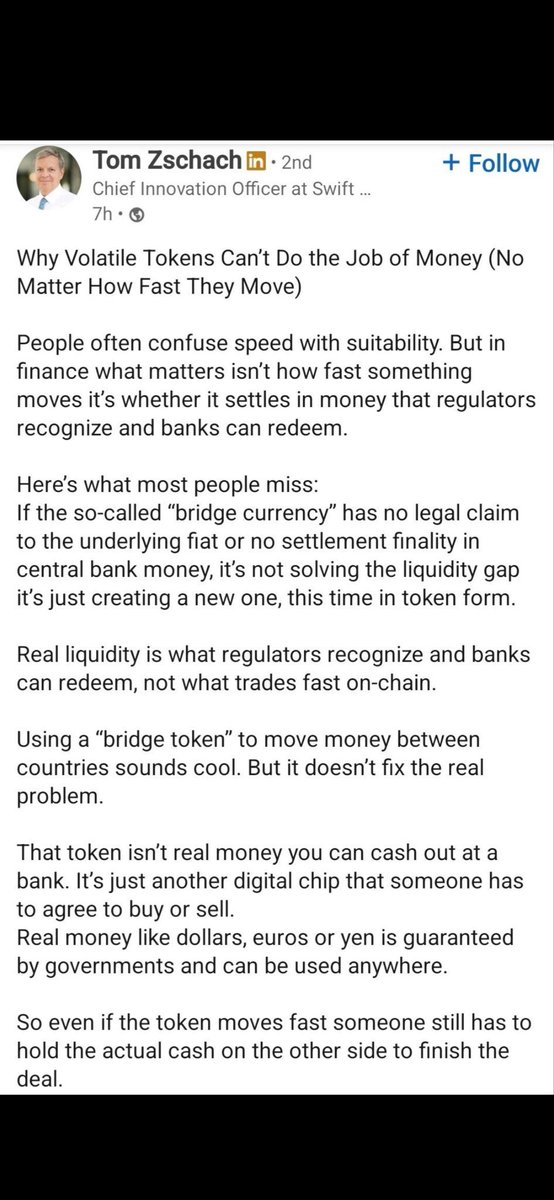
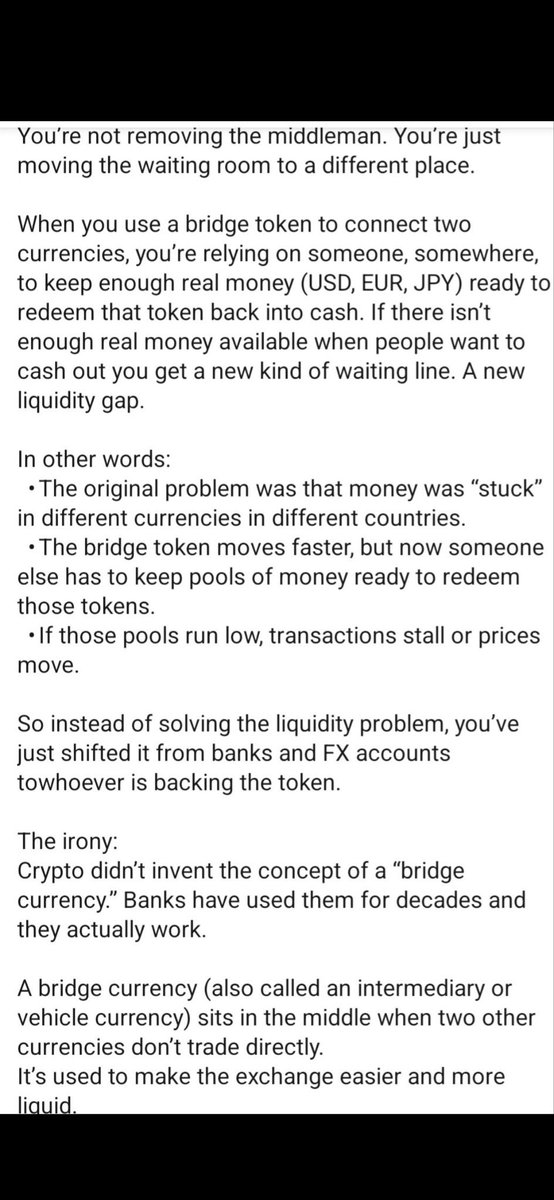
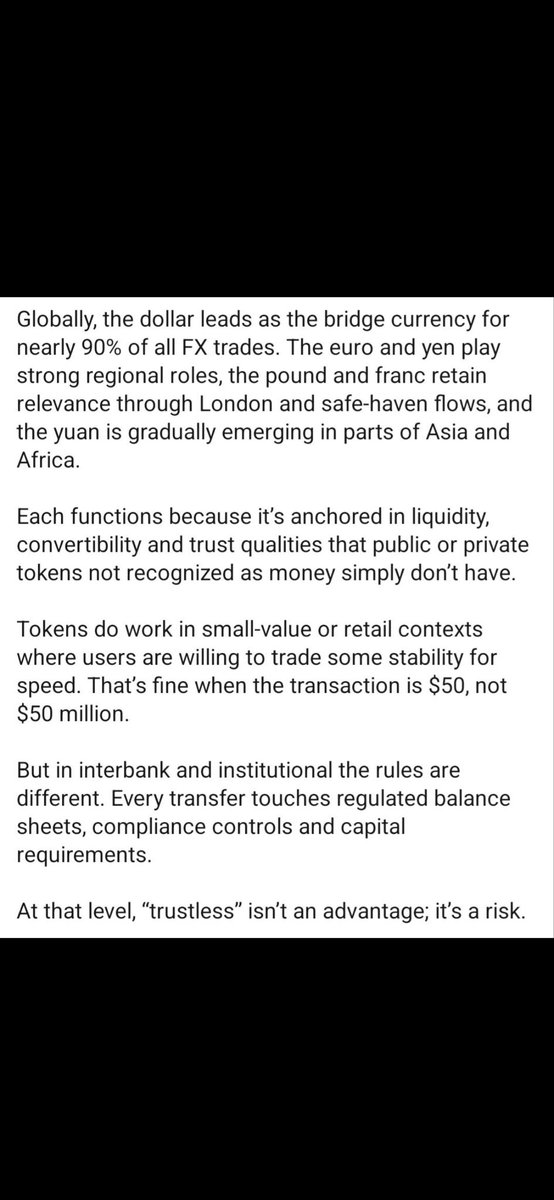
@CatfishFishy put it well and I’m happy to re-iterate his points: 1. Any token can be a "bridge currency" onchain. 2. Every L1 gas token, across hundreds of L1s, has been a "bridge currency" this entire time on their chains. It simply means being the most liquid, often-used trading pair on that chain. $XRP people think that it's something unique/special property of $XRP. It's not. 3. XRP could hypothetically only be the "bridge currency" on just the XRPL. But, in order to use XRP as a "bridge currency" requires asset issuers to actually issue assets on the XRPL. Yet, XRPL has dismal adoption among asset issuers, which is why it has less than 1% marketshare on RWAs and less than .01% in stablecoins (and 75% of that .01% came from Ripple themselves) 4. This Blockworks research post shows that all of the major L1 gas tokens, such as ETH, SOL, and BNB, have all been displaced as "bridge currencies" on their own respective chains by USDT/USDC. So, if stablecoins have already dethroned L1 gas tokens as "bridge currencies" on chains with 1000X more usage than XRPL (and stablecoin growth will continue), then XRP has ZERO shot of being some special "bridge currency." x.com/silviobusonero… 5. Being a "bridge currency" on any single, siloed peer-hosted ledger doesn't solve "liquidity fragmentation." Especially, when 99.999999% of the world's value sits outside of that chain, where XRP can't even reach it. It simply shifts the burden elsewhere on who has to hold a particular asset to supply liquidity. XRP solves literally nothing, as explained in this post by the CIO of an organization owned, operated, governed, and used by 12,000 banks, who presumably were supposed to be using XRP to solve their "nostro/vostro funding" 2016 fever dream fantasy meme as sold by carnival barker Garlinghouse
Zach Rynes | CLG tweet mediaZach Rynes | CLG tweet mediaZach Rynes | CLG tweet media
English
15
7
101
7.1K
𝟸𝟺𝙷𝚁𝚂𝙲𝚁𝚈𝙿𝚃𝙾
Meet Zach. A man who has confidently written thousands of words about global liquidity infrastructure while demonstrating that he fundamentally does not understand how liquidity itself works. What Zach is doing here is something very common in crypto discourse. He begins by inventing a simplified version of the XRP thesis that sounds ridiculous, calls it the “XRP standard” and then spends the rest of the thread attacking that invention. It’s entertaining, but it has very little to do with the actual design problem XRP was created to address. The idea was never that XRP becomes the world’s reserve currency. That framing misunderstands the purpose of a bridge asset entirely. The real problem sits inside the plumbing of the global financial system. Today, international payments rely on a network of prefunded accounts known as nostro and vostro accounts. Banks park enormous amounts of capital across jurisdictions so that liquidity is available when payments need to occur. Trillions of dollars remain idle in these accounts at any given moment simply to maintain operational liquidity across currency corridors. That system works, but it is extraordinarily inefficient. Capital that could otherwise be productive is frozen in place purely to guarantee settlement capability. A bridge asset changes that architecture. Instead of pre positioning capital in dozens of currencies around the world, liquidity can be sourced on demand. A payment can move from one currency into a neutral intermediary asset and then into the destination currency within seconds. What matters in that system is not narrative, ideology, or token marketing. What matters is liquidity depth, settlement speed, and reliability. This is the distinction Zach misses completely. Stablecoins do not solve this structural issue. They replicate the dollar system in tokenized form. They centralize liquidity around USD and still require fragmented pools across exchanges, jurisdictions, and market makers. They are extremely useful for trading and settlement within crypto markets, but they do not eliminate the global liquidity fragmentation that exists between hundreds of fiat currency pairs. The entire reason foreign exchange markets function the way they do is because liquidity is not evenly distributed between every currency pair. Some corridors are deep. Many are not. Bridge mechanisms exist precisely to route value through the deepest liquidity pools available.. this is how foreign exchange markets have operated for decades. Zach also leans heavily on the claim that XRPL has low DeFi usage, as if retail speculation metrics determine whether financial infrastructure becomes relevant. Historically, the opposite has been true. The most critical layers of financial infrastructure are rarely the ones dominating speculative activity during early phases of a technology cycle. Institutional adoption tends to prioritize very different characteristics. Regulatory clarity, settlement finality, predictable transaction costs, compliance tooling, and reliability under heavy throughput are the attributes that matter when large financial institutions move real capital across networks. The irony in Zach’s argument is that many of the features he lists as “modern innovations” are actually converging toward the same design constraints XRP originally focused on… fast settlement, deep liquidity access, and interoperability between financial systems. The real question is not whether XRP becomes some mythical reserve currency. The real question is much more technical and much more interesting. In a world where assets, currencies, and financial instruments are increasingly tokenized across many different networks, how will liquidity be sourced and routed efficiently between them? That is the problem bridge assets attempt to solve. Confidently dismissing that design challenge while misunderstanding how liquidity works is not analysis.
Zach Rynes | CLG@ChainLinkGod

The bizarre retail thesis of $XRP is that it will become the global reserve currency that everything trades against, the so-called “XRP standard” Rather than trading Dollars for Euros directly, you would trade USD for XRP, and then XRP for EUR, because this makes payments supposedly more efficient The XRP army will push back on this framing because they know how insane this thesis sounds They will argue the goal is not for XRP to become the global reserve currency but to fulfill the “bridge currency” use case, not understanding it’s a distinction without a difference They also believe the XRPL will become the dominant chain for tokenized real world assets, despite not even ranking in the top 40 by usage, developer activity, or DeFi TVL The XRPL is a ghost chain with less than 1% RWA market share and under 0.01% of stablecoins but somehow it will rise above all the other highly competitive, largely commoditized ledgers and become the primary settlement layer thanks to XRP liquidity All of this is compounded by various conspiracy theories about secret banking cartels who are colluding to push the XRP standard and lies from influencers about fake or exaggerated partnerships Reality moved on though The XRP vision was created over a decade ago before we had modern 200K TPS high-throughput chains, programmable smart contracts, DeFi protocols, fiat-backed stablecoins, tokenized deposits, atomic DvP/PvP swaps, and cross-chain infra If you listen to what the world’s largest financial institutions and market infrastructures like Swift, DTCC, JP Morgan, BlackRock, and many others are saying, you’ll find zero of them talking about the need for a “bridge currency” Rather, they talk about the need for connectivity, interoperability, privacy, compliance, and orchestration (all things Chainlink does, what a coincidence) The market ended up building everything XRP was supposed to be, without XRP USD-backed stablecoins have become the dominant crypto-native “bridge currency” for payments, trading, and finance The most successful case study of crypto-powered finance is Hyperliquid, where you can trade commodities, equities, FX, and crypto 24/7/365 across spot and derivatives markets Want to guess what “bridge currency” all these positions are traded against to minimize liquidity fragmentation? USD-backed stablecoins, not XRP And yet despite all this, the XRP army has yet to accept reality The reality is that Ripple socializes its costs to XRP holders and privatizes gains for its equity shareholders They sell XRP to fund products whose revenue accrues only to Ripple They use XRP sale proceeds to fund stock buybacks RLUSD has 90% of its supply on Ethereum and other chains, not XRPL, so there’s ~zero XRP demand created. Interest on reserves flows to Ripple, not to XRP holders Repeat this pattern across Ripple’s other products and acquisitions where XRP holders fund development for products that don’t use XRP (or it’s optional and little used) and the resulting revenue accrues to Ripple equity holders XRP’s actual role at this point is funding a corporation that has openly stated it will prioritize its own shareholders over everyone else All of this is obvious to anyone who has spent even a moderate amount of time scrutinizing Ripple/XRP, steelmanned the counter-thesis, or just looked at the competitive landscape The only people who don’t see it are people who have never left the echo chamber long enough to question their own assumptions Which is sad, but this is crypto, it’s never been a rational market
English
42
53
424
30K
🌸Eri ~ Carpe Diem
🌸Eri ~ Carpe Diem@sentosumosaba·
I think we all know this about Ripple, the company and their shareholder priority. David has made it quite clear, numerous times. Ripple has also spent and continues to spend a tremendous amount of money hiring talent to develop use cases. The XRP Community, however, has @FlareNetworks, which has built the ONLY end-to-end XRP Ecosystem. Never - ever underestimate @HugoPhilion and team on how far they can go. x.com/sentosumosaba/…
English
22
33
289
12.5K
Zach Rynes | CLG
Zach Rynes | CLG@ChainLinkGod·
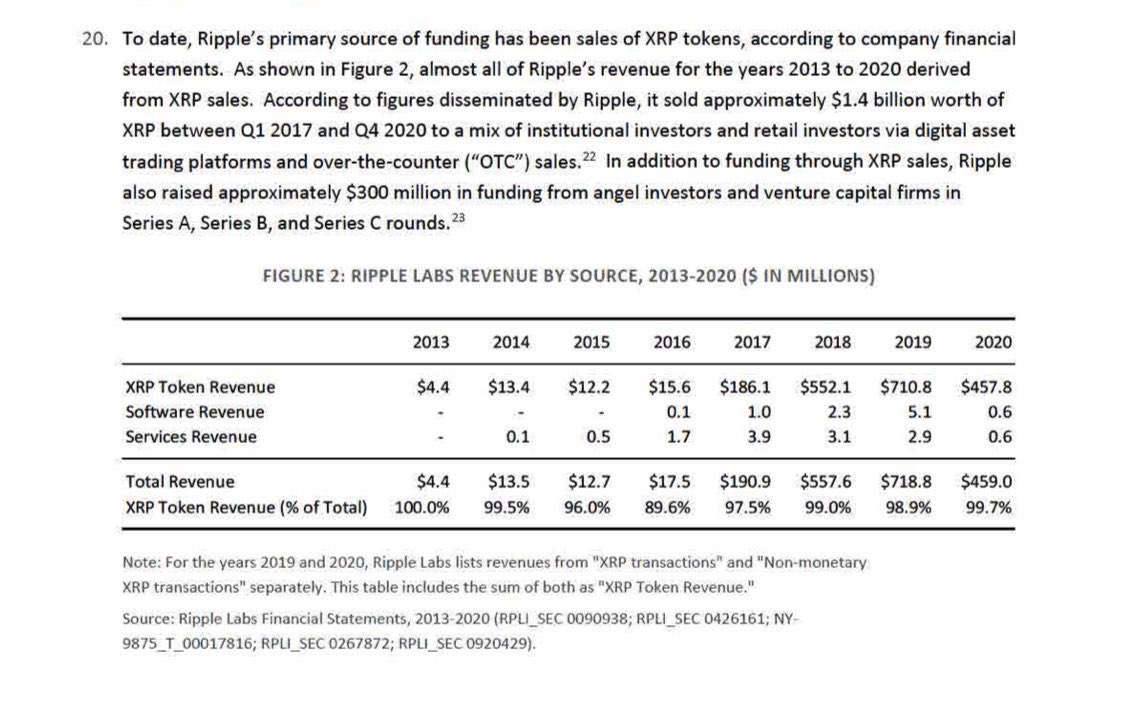
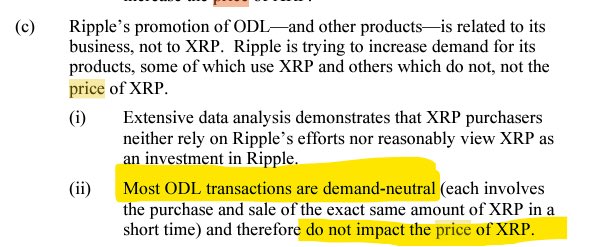
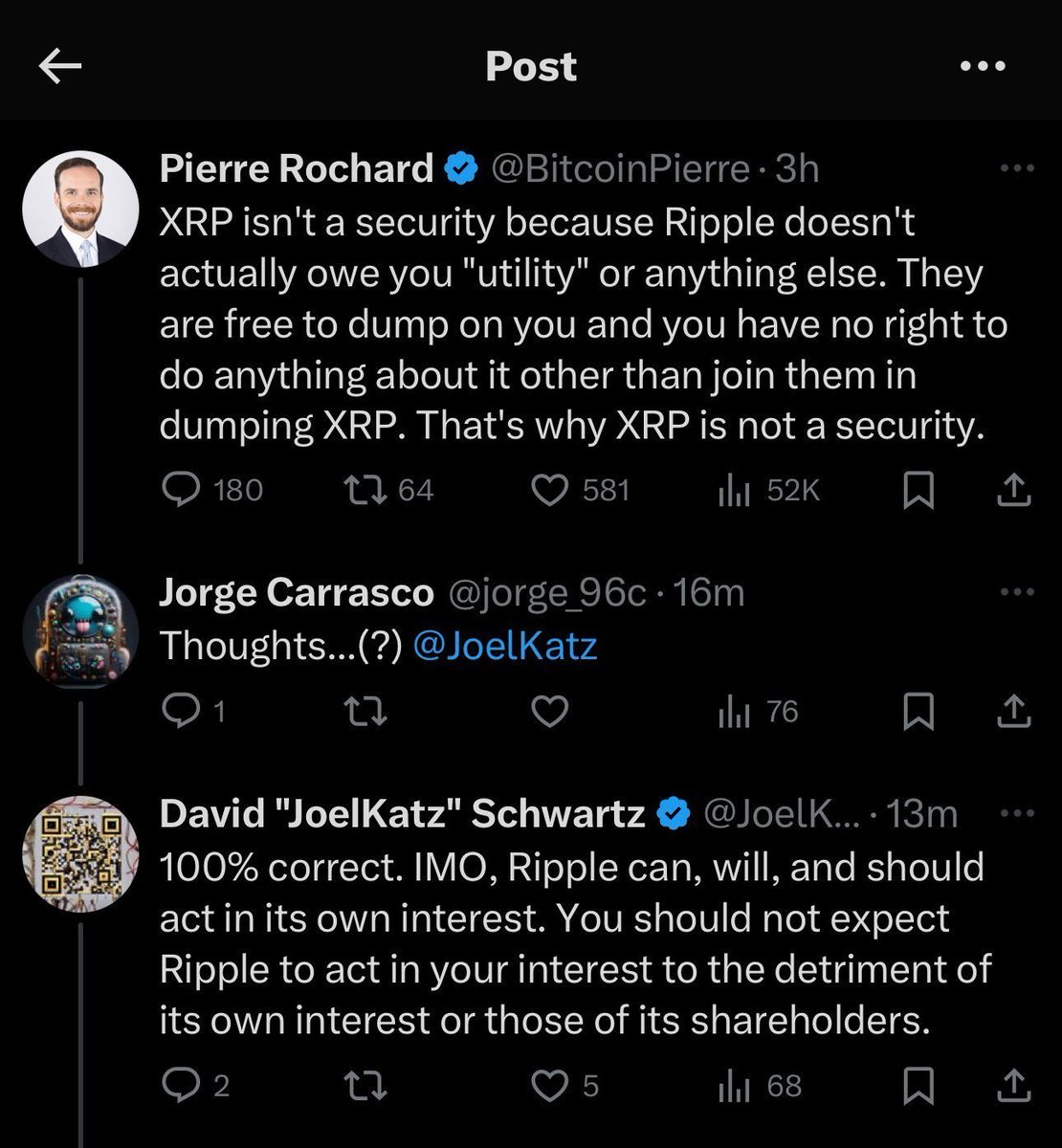
By owning $XRP, you are funding a company that has openly stated it will prioritize its equity shareholders over you Ripple wrote the playbook on this. Let me walk you through how it works👇 When a company sells both tokens and equity to investors, it creates two competing stakeholder groups whose economic interests may not, and often do not, align For example, when there’s excess revenue or profits, where does that value ultimately go: to equity holders via buybacks/dividends, to token holders via buybacks/staking rewards, or some split between the two? There is a fixed pot of revenue to distribute, and equity investors often have superior, clearer economic rights to that revenue that can be legally enforced, while token investors often do not Look at Circle’s recent acquisition of Interop Labs (Axelar team), Coinbase’s acquisition of Tensor, PumpFun’s acquisition of Padre, Ripple vs XRP. etc These are all situations in which equity holders benefited at the expense of, or isolation from, token holders In Ripple’s case, they have spent the past decade+ systematically selling XRP to retail while spinning a story of inevitable institutional adoption In reality, Ripple uses the proceeds of XRP sales to acquire real companies and fund Ripple Labs stock buybacks, to the sole benefit of Ripple Labs shareholders No value is created for the XRP token, even Ripple admitted under oath in court filings that the bridge currency use case of XRP is demand neutral and does not impact price Ripple Labs socializes its costs to XRP holders to fund product launches and corporate acquisitions, then privatizes the value for its own shareholders XRPL is an obsolete ghost chain that's not even in the top 40 chains by usage. It has less than 1% marketshare in RWAs and less than 0.01% in stablecoins. There is no metric the chain leads in Ripple themselves issued 90% of RLUSD on Ethereum and have now expanded it to even more chains outside of XRPL including BNY Mellon's private EVM chain and L2s The list goes on By owning XRP, you do not have complete exposure to the success of the ecosystem Ripple is building, because you do not own the equity, you own some undefined percentage of the success This issue doesn’t exist for Chainlink, because there are no equity investors. There is only the $LINK token to accrue value from the network’s growth. Even CLL employees receive long-term incentives rewards in LINK, not equity Unfortunately, depending on how you want to put it, there is no mass social media misinformation campaign driving retail towards Chainlink like we see with XRP However, Chainlink‘s clear dominance in DeFi (70%+ marketshare w/ $60B in DeFi TVL secured) and its tangible verifiable institutional adoption by the largest institutions in the world (Swift, DTCC, Euroclear, SBI, UBS, JP Morgan, Fidelity, ANZ, etc) will inevitably become too impossible to ignore While the XRP army comes up with bizarre conspiracy theories about why institutions don’t talk about XRP, enterprises adopting Chainlink have no issue publicly talking about their use of Chainlink And before you say Chainlink and Ripple/XRP are not competitors bc they do different things, I would agree from tech perspective, Chainlink actually offers useful products for banks and isn’t a retail grift Chainlink is the only unified platform that provides the critical data, interoperability, compliance, privacy, and orchestration standards that financial institutions need for advanced tokenization use cases None of these institutional use cases Chainlink powers have ever required a “bridge currency”, that is a fantasy narrative dreamt up by retail This has been proven time and time again The reality is that $LINK is the best index bet on the institutional adoption of blockchain, while $XRP is a bank themed memecoin that Ripple sells to retail to fund corporate acquisitions and stock buybacks Documented.📝
Zach Rynes | CLG tweet mediaZach Rynes | CLG tweet mediaZach Rynes | CLG tweet mediaZach Rynes | CLG tweet media
English
394
89
469
198.4K
🇬🇧 Jme 🧪
🇬🇧 Jme 🧪@CryptoTaxJme·
@EthDeFiance @BorisJohnson Yup it was abysmal. I think MPs will be specifically for or against crypto (or BTc specifically). And then use that as an agenda for votes. 2029 is going to be very exciting
English
1
1
4
36
🇬🇧 Jme 🧪
🇬🇧 Jme 🧪@CryptoTaxJme·
🚨 Where’s the Crypto Hub narrative? 🚨 England had a real chance to become a global crypto hub. We blew it. The government isn’t moving. There’s no real policy direction, no urgency, no vision. And pumps? They’re not exactly focused on the UK market right now either. We’re not building. We’re watching. And the world is moving on without us.
English
4
4
22
1.1K
AU
AU@aucc_official·
There are currently 12,804,887,636 $FLR staked to a total of 144 #Flare validators which equates to 15.06% of the circulating supply. There are 6,270 delegators staking. Check flare.builders/validators for the current state of Flare validation. 🤖
English
1
1
9
458
AU
AU@aucc_official·
The current $WFLR balance is: 53,427,475,110. The current $FLR circulating supply is: 85,142,622,249. This equates to: 62.75% being wrapped. 🤖 #FLR #WFLR
English
1
3
17
557