DrLADWebster

519 posts

DrLADWebster

DrLADWebster

@DrLADWebster

Reader in Psychology. Leeds Trinity University. Research: student mental health and wellbeing; resilience in adolescence


Katılım Ağustos 2018
381 Takip Edilen272 Takipçiler
Anne Erickson
Anne Erickson@AnneErickson·
Which guitarist has the most instantly recognizable style? The player you recognize in a single note, no hesitation 🎸
English
1.2K
24
352
65.6K
DrLADWebster retweetledi
Skint Eastwood
Skint Eastwood@Skint_Eastwood1·
Ricky Gervais on 60 Minutes Makes a Crystal-Clear Case for Free Speech He put it perfectly: the great thing about freedom of speech is that I can say what I want, and you can say you're offended, and I get to decide whether I care or not. Because let's be honest, there's nothing you can say that someone, somewhere won't find offensive. That's why blasphemy laws are so absurd, they're basically trying to protect an all-powerful deity from having its feelings hurt. At the end of the day, we should be free to criticise any idea. Just because you're offended doesn't automatically mean you're right. Spot on, Ricky. Free speech isn't about never upsetting anyone, it's about the right to speak anyway.
English
628
13K
62.1K
2.1M
DrLADWebster retweetledi
Tom Bennett OBE
Tom Bennett OBE@tombennett71·
Neurodiversity is a common term in education- and society. But it lacks precision both in definition and usage. And that really matters in the real world. For a start 'neurodiverse' is not a clinically recognised or used term, eg in the DSM-5. It was coined by the sociologist Judy Singer in 1998, as an advocacy term for people with ASD and very closely related conditions. 'Neurodivergent' describes an individual whose brain functions differently from the majority. Clinically recognized examples include autism spectrum disorder, ADHD, dyslexia, dyspraxia, Tourette syndrome, and others. These are formal neurodevelopmental diagnoses. Crucially this means people who have been born with a life-long condition. It does *not* include people with anxiety disorders, or dementia, or PTSD, or depression etc. It doesn't mean 'everything'. There is no diagnosis 'neurodiverse'. It is a purely vernacular term, with multiple meanings depending on who is using it and who you talk to. Clinicians diagnose specific conditions, like ASD. And of course even clinically diagnosable conditions like ASD, ADHD are subject to intense debates about how the category is defined, is it too broad or narrow etc. Diagnostic criteria can vary from country to country, LA to LA, school to school. And so can the response strategies. What a lot of people outside of either the education or clinical sectors don't realise is that this is an area that is crying out for high quality research, clarity, transparency, and honesty about what works, and when, and when it doesn't work. We are often talking about very different things when we use the same words carelessly. The common use of 'neurodiverse' matters; it is often heard in advocacy discourse, the media, etc. but frequently misunderstood. It doesn't mean 'a little bit different'. We are all different from one another. People who claim to be 'a little bit autistic' may very well simply misunderstand that some of the characteristics they identify in that category are also perfectly normal-spectrum qualities that many people have. Liking your house to be tidy doesn't mean that you are neurodivergent. Being a stickler for details doesn't mean you have OCD. If the term means 'everything' then it means 'nothing.' It has become fashionable for people to self diagnose and self-refer as neurodivergent, even in the face of little evidence. Because it confers, for some, a sense of being special, different, or interesting. And of course in a sector where we rightly seek to support people/ students who need reasonable accommodations in order to promote inclusivity, the *incorrect* assignation of an unmet need leads to unfair advantages over those who do not receive those accommodations. A small but growing group of activists now campaign on the platform that almost any mental health difference indicates neurodivergence, but this is a huge definitional drift, without any clinical basis. You see a lot of this activism in education, often perfectly well-meant. Singer herself would have disagreed strongly with this. The reason this matters is that if we treat all mental health problems, all behavioural disorders, all learning problems, as having lifelong neurological foundations - which they absolutely do not- then we create a narrative that indicates all individuals face insurmountable obstacles in modifying the behaviours associated with the condition. Some children identified as dyslexic, for example, are simply deficient in high quality reading instruction. But if you treat every child that behaves unsuccessfully in the classroom as being neurodivergent, then you create a circumstance where we treat them as the victims of irresistible compulsions, rather than human beings with the ability to learn to take responsibility, to grow, to change their habits and attitudes. It is also a substantial abandonment of our commitment to only use evidence info strategies with children- especially the most vulnerable. In other words, not all forms of SEND are indications of neurodivergent conditions. And most certainly aren't. Sadly, as in so many fields, many of the strategies recommended for children with any form of SEND, including forms of neurodivergence, lack substantial or credible evidence bases. There is a lot of well-meant money being spent on approaches that simply have no basis in research, impact or other outcomes. This is an area that cries out for high quality evidence bases, and evidence informed approaches to support students with genuine need, not activism that leads to treating all children as incapable. But the energy of that activism, married to evidence, could produce something spectacular for those who need help the most, and I hope we see this happen in the future.
English
3
71
248
63.4K
DrLADWebster retweetledi
Met4Cast - UK Weather
Met4Cast - UK Weather@Met4CastUK·
Britains opening their curtains for the next 4 months.
Met4Cast - UK Weather tweet media
English
179
1.6K
20.3K
424K
Brian Cox
Brian Cox@ProfBrianCox·
Tickets for my new tour “Emergence” are now on sale - apparently this is different from “presale” which was yesterday. I don’t know what the difference is other than one less click on the web site. As far as I’m concerned it’s marketing bullshit. Anyway - here are the tickets for most of the world - more US and Canada dates TBC. briancoxlive.co.uk
English
72
35
401
83.7K
DrLADWebster retweetledi
United Nations
United Nations@UN·
Today, the UN family mourns the loss of Dr. Jane Goodall. The scientist, conservationist and UN Messenger of Peace worked tirelessly for our planet and all its inhabitants, leaving an extraordinary legacy for humanity and nature.
United Nations tweet media
English
635
7.8K
32.1K
1.2M
DrLADWebster
DrLADWebster@DrLADWebster·
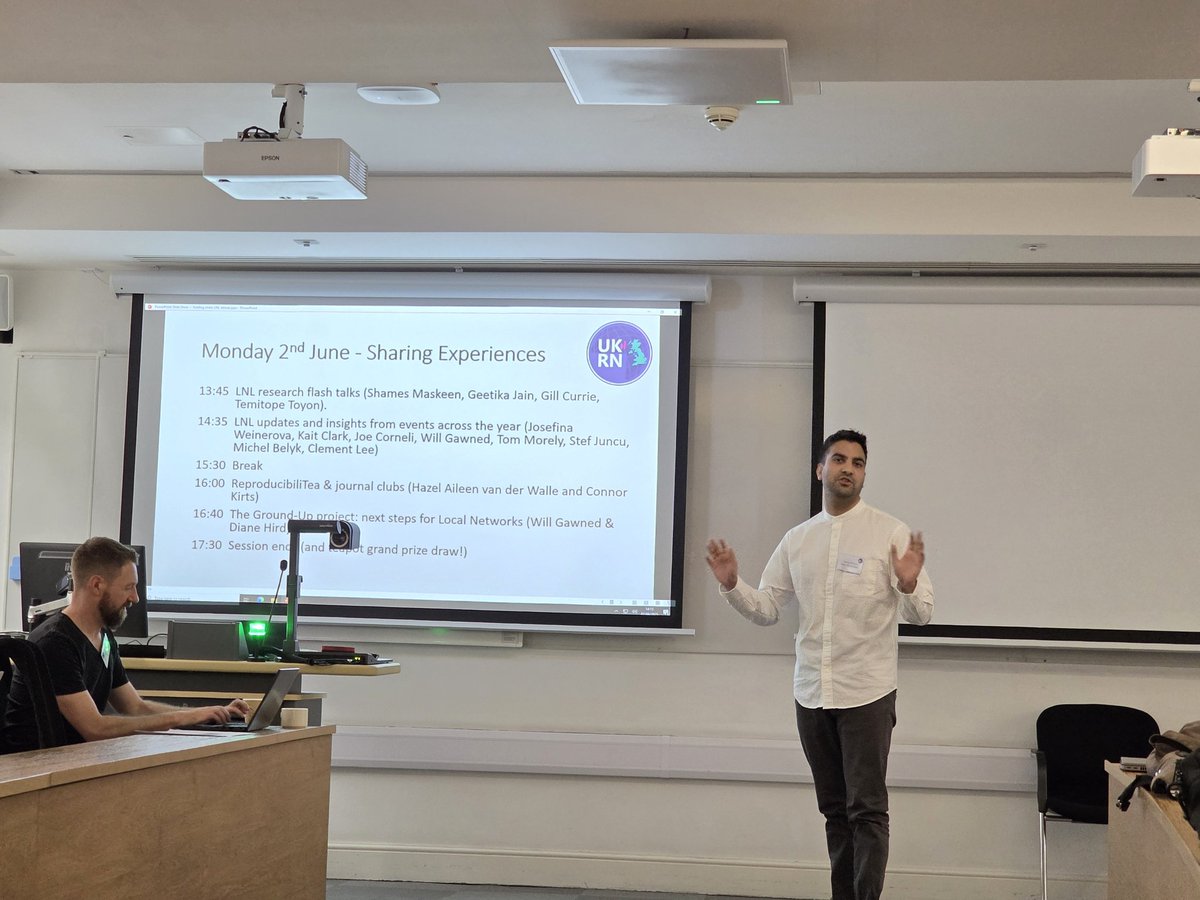
Great first day at UKRN Local Network Leads summer retreat at London School of Economics. Some really interesting talks ranging from ReproducabiliTea, open research principles and REF 2029, and of course the one and only @shamaskeen #LNLretreat2025
DrLADWebster tweet media
City of London, London 🇬🇧 English
0
0
2
106
Project Rape Myths
Project Rape Myths@ProjectRapeMyth·
**NEW PUBLICATION** (to my joy and horror, in equal measure) If this ground-breaking study doesn't win me a noble prize, then I don't know what will. I hope you enjoy reading it as much as I enjoyed 'writing' it... researchgate.net/publication/38…
English
1
1
14
2.2K
Dr Peter Prinsley MP
Dr Peter Prinsley MP@PeterPrinsley·
It’s a disgrace that Members of the Opposition have been referring to the Chancellor of the Exchequer as ‘Rachel from accounts.’ It’s misogynistic, and deeply unprofessional.
English
7.5K
673
6.4K
1.9M
Alan Street with No Name
Alan Street with No Name@cogpaul35·
@wef_uk My mum always said you could tell a lot about a man from his shoes Does it also apply to women?
English
1
0
2
80
Alan Street with No Name
Alan Street with No Name@cogpaul35·
@Ye_Olde_Holborn In the last 10 years before I retired, PhD's got weaker, year on year, and supervisors increasingly used people that they "knew" as external examiners. In the end the university stopped me being an internal examiner as I gained a reputation for being "too harsh". Broken system.
English
1
0
2
40
Ye Olde Holborn☣️
Ye Olde Holborn☣️@Ye_Olde_Holborn·
Private patrons > The State ~ free markets fix this
Ye Olde Holborn☣️ tweet media
English
2
4
34
1.6K