Fafi Merhi
563 posts

Fafi Merhi retweetledi


Elon Musk on why the smartest people drop out of college:
"You don't need college to learn. Learn stuff. Everything is available basically for free. You can learn anything you want for free. It is not a question of learning."
Musk explains what college actually provides:
"There is a value that colleges have, which is seeing whether somebody can work hard at something, including a bunch of annoying homework assignments, and still do their homework, and kind of soldier through and get it done. That's the main value of college. And also, you probably want to hang around with a bunch of people your own age for a while instead of going right into the workforce. So I think colleges are basically for fun and to prove you can do your chores. But they're not for learning."
On hiring at his companies:
"There is a requirement of evidence of exceptional ability. I don't consider going to college evidence of exceptional ability. In fact, ideally you dropped out and did something. Obviously, Gates is a pretty smart guy, he dropped out. Jobs was pretty smart, he dropped out. Larry Ellison, smart guy, he dropped out. Obviously not needed."
Musk shares how education should work:
"Generally, you want education to be as close to a video game as possible. Like a good video game. You do not need to tell your kid to play video games; they will play video games on autopilot all day. If you can make it interactive and engaging, you can make education far more compelling and far easier to do."
He challenges the current system:
"You really want to disconnect the whole 'grade level' thing from the subjects. Allow people to progress at the fastest pace that they can, or are interested in, in each subject. It seems like a really obvious thing."
Musk criticizes traditional teaching:
"Most teaching today is a lot like vaudeville. Somebody's standing up there lecturing to you. They've done the same lecture several years in a row. They're not necessarily all that engaged. That lack of enthusiasm is conveyed to the students; they're not very excited about it. They don't know why they're there. 'Why are we learning this stuff?' We don't even know why. A lot of things people learn, probably there's no point in learning them, because they never use them in the future."
On whether university is necessary:
"A university education is often unnecessary. That's not to say it's unnecessary for all people. But I think you learn about as much, the vast majority of what you're going to learn there, in the first two years. And most of it is from your classmates. If the goal is to start a company, I would say no point in finishing college."
Musk started his own school for his kids:
"I created a little school. It's small, only 14 kids now, and it'll have 20 in September. It's called Ad Astra, which means 'to the stars.'"
He explains what makes it different:
"There aren't any grades. There's no grade one, grade two, grade three. Not making all the children go in the same grade at the same time, like an assembly line. People are not objects on an assembly line. That's a ridiculous notion. Some people love English or languages. Some people love math. Some people love music. Different abilities at different times. It makes more sense to cater the education to match their aptitudes and abilities."
Musk shares a key principle:
"It's important to teach problem-solving, or teach to the problem, not to the tools. Let's say you're trying to teach people about how engines work. A more traditional approach would be: 'We're going to teach you all about screwdrivers and wrenches. You're going to have a course on screwdrivers, a course on wrenches.' This is a very difficult way to do it."
He offers a better approach:
"A much better way would be: 'Here's the engine. Now let's take it apart. How are we going to take it apart? Oh, you need a screwdriver, that's what the screwdriver is for. You need a wrench, that's what the wrench is for.' And then a very important thing happens: the relevance of the tools becomes clear."
The result:
"It seems to be going pretty well. The kids really love going to school. I think that's a good sign. I hated going to school when I was a kid; it was torture. The fact that they actually think vacations are too long, they want to go back to school. Weird, I know."
Musk reframes what education really is:
"If you think about it, what is education? You're basically downloading data and algorithms into your brain. And it's actually amazingly bad in conventional education. It shouldn't be this huge chore. The more you can gamify the process of learning, the better."
English
Fafi Merhi retweetledi

Fafi Merhi retweetledi

Quitting
Ten years ago today, I quit my job at The Washington Post, sold my furniture, packed my bags and left DC so I could go learn more about this nebulous thing called “technology.” Unlike what most of the advice books will tell you— “you must be running toward something greater with certainty!” —That was not how I felt. I was running away. I had met the limit of what I thought possible in my short career and I needed to jolt into something new.
I had decided to leave journalism during a bad snowstorm months before. I lived two miles from the old Post newsroom, had no car and needed to get to my desk. The busses weren’t running, Uber was not yet in DC, and I couldn’t afford a taxi during surge pricing. So I walked two miles with a blanket around my shoulders. At the time, I was among the youngest and lowest paid reporters at a shrinking newspaper that was looking for a buyer. I had made a very bad bet, and I knew it.
But even in that moment, I didn’t fully accept that I needed to quit right away. Anyone who has ever decided to quit their former life knows there’s a bit of a negotiation with the self. Negotiation on what it would take to make us stay, to make it tolerable. There’s always a last-ditch effort. And it’s almost always a bad deal.
My negotiation was mostly predicated on money, something I didn’t have very much of. I loved my job, I told myself. I worked all the time. I made $53,000 a year. And if I could somehow get a 15 percent raise, despite Union rules and buyouts and pay freezes that year, I would stay at the Washington Post. Maybe they’d finally let me do a story or two for the foreign desk! Maybe next year would be different!
So I went into the managing editor’s office and begged for a raise, which did not work. This was more cinematic and embarrassing than it needed to be. It was the one time I’ve cried at work, and I think I ended the conversation saying “I am just trying to better myself!” which was true, but a terrible line to use in a negotiation. Unsurprisingly, this bad line of argument failed and I left her office with a clear answer.
What followed the next ten years was not something I could have predicted, nor should we try to predict the future when making the decision to quit the present. But I learned more from that negotiation — not the one with the managing editor, the one with myself— than I have in all of my negotiations of the last decade.
Here are the lessons I learned from quitting:
— If you’re at the point where you are thinking of quitting everything —the job, the city, the furniture, the life you have— 15 percent is not enough. 100 percent is not enough. I look back at how little I thought of myself and how small my ask was. This Isn’t a sign that you should make the ask bigger. This is a sign that you should quit.
—If you’re going to quit, burn the boats. The times where I quit previous chapters required definitive changes where I couldn’t go back. If you’re going to quit one thing, quit many things at the same time, so you aren’t looking back to see if you made the right call. The other reason to burn the boats is it’s a test for whether you should be quitting. If you aren’t willing to burn the boats, quitting likely isn’t the answer to the problem you’re trying to solve.
—Quit while you’re young, unattached and mobile, but only quit once. Young people often bounce between jobs and experiment. I advise the opposite: make hard choices, have conviction and let those choices compound. But If you’re like me and you realize you’ve made a very bad bet that will never reverse, quit everything. Just make sure you do that only once. Everyone makes a very bad bet in a lifetime. But if you’re making many bad bets, the problem is you.
And for managers of would-be quitters, here’s my conclusion:

English
Fafi Merhi retweetledi

The Glyph E01 - The greatest NFT trading PnL of all time.
Did you know that the most epic #NFT trader of all time has been flying under the radar for almost 7 years? 🚨
The Glyph is a video series dedicated to uncovering the dynamic world of Ethereum through an innovative narrative approach focused on onchain stories. Undeniable and based on absolute truth.
In this episode I prove that 4 out of the 6 most profitable NFT trading wallets are actually...the same user. A combined realized NFT trading profits north of 40k $ETH! 🤯
0:00 Intro
1:00 The wallets
2:40 Linking the wallets
4:40 Gemini deposit address
5:20 Consolidating value NFTs
5:45 ENS link to a twitter account
7:30 Final thoughts
English

Heartbreaking. 😥
Yet still he does his job, bringing us news from a war-zone most journalists can’t access. Extraordinary man.
Maha Hussaini@MahaGaza
Bidding farewell to his third child in around two months.. Aljazeera correspondent Wael al-Dahdouh lost his eldest son Hamza in an Israeli airstrike today. In October, he lost his wife and 2 other children in the ongoing Israeli attacks.

English
Fafi Merhi retweetledi

looking at some of the early activity on the $pepe token.
the @onceupongg UI allows for a perpetual horizontal flow to naturally explore linked onchain activity and go down rabbit holes. i find it so addictive.
English
Fafi Merhi retweetledi

high stakes, arrogance, CT gods, & a double collapse. this wild story epitomizes the crypto market in 2021 and 2022.
a twitter debate turned into a $22M bet. i dive into what happened between @stablekwon, @GCRClassic, and @AlgodTrading. who won? possibly no one.
1/7 🧵
English
Fafi Merhi retweetledi

📢 i'm joining the team at @onceupongg to help build human readable blockchain explorers.
essay ⬇️
mirror.xyz/4484.eth/ZEBUA…
tldr ~ don't abstract away the blockchain, build tools that help traverse it and unlock a better understanding of the provenance of assets pinned on chain.
English
Fafi Merhi retweetledi

for those who care about crypto outside of flipping feet.
xo.w1nt3r.xyz
fun project by @w1nt3r_eth. this is how u onboard new users. small fun new experiences.
no need to change the world in one go. no need to replace web2.
English
Fafi Merhi retweetledi

every txn tells a story.
this one is about jump. they built a large position ~30m $chz (4.8m$) in early november and have sold roughly 40% of that over the past few days.
credit to @lookonchain for spotting.
cc @onceupongg
English
Fafi Merhi retweetledi

FTX hacker recently swapped ~ 65000 $eth into renBTC.
*then bridged out to $btc network.


Ren@renprotocol
Reminder that holders of Ren assets such as $renBTC, $renDOGE, $renZEC etc. should bridge back their assets to the respective native chains ASAP, before the Ren 1.0 network is sunset next month Also note if you are a liquidity provider in Curve and Uniswap renBTC pools ℹ️
English
Fafi Merhi retweetledi

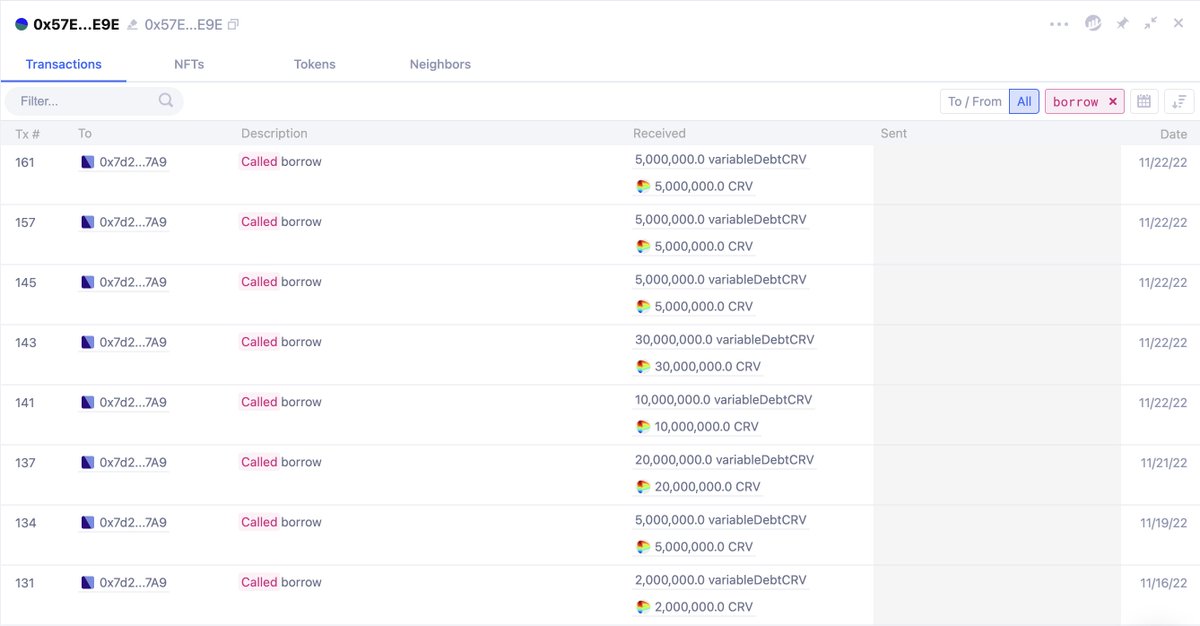
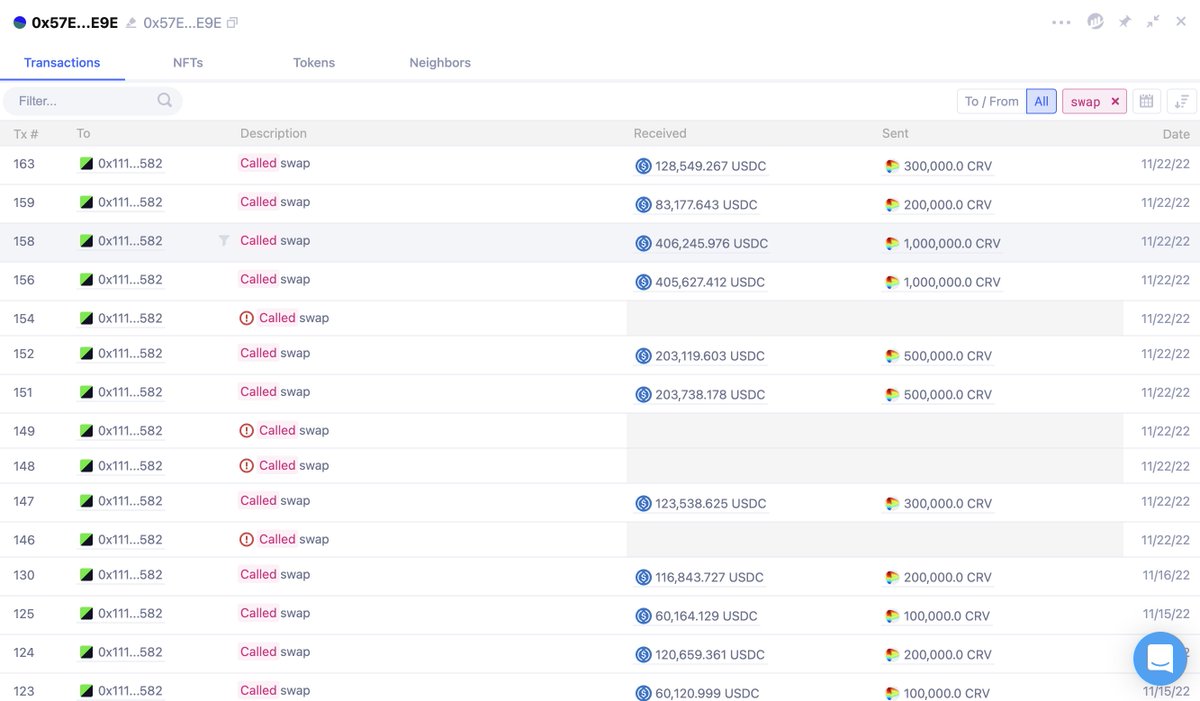
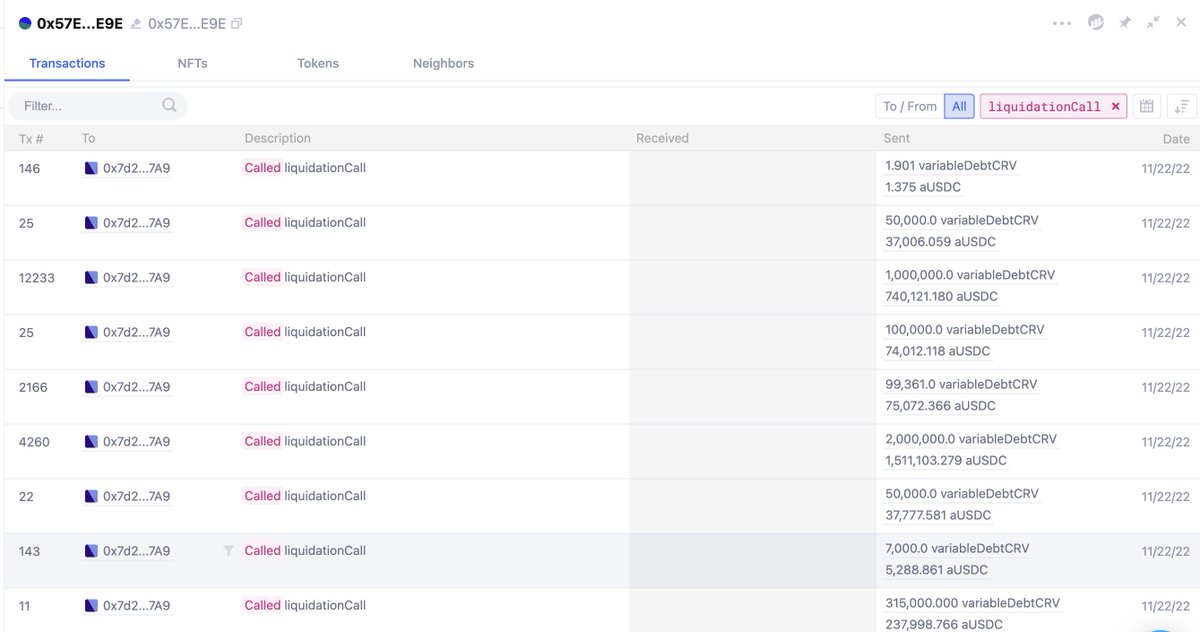
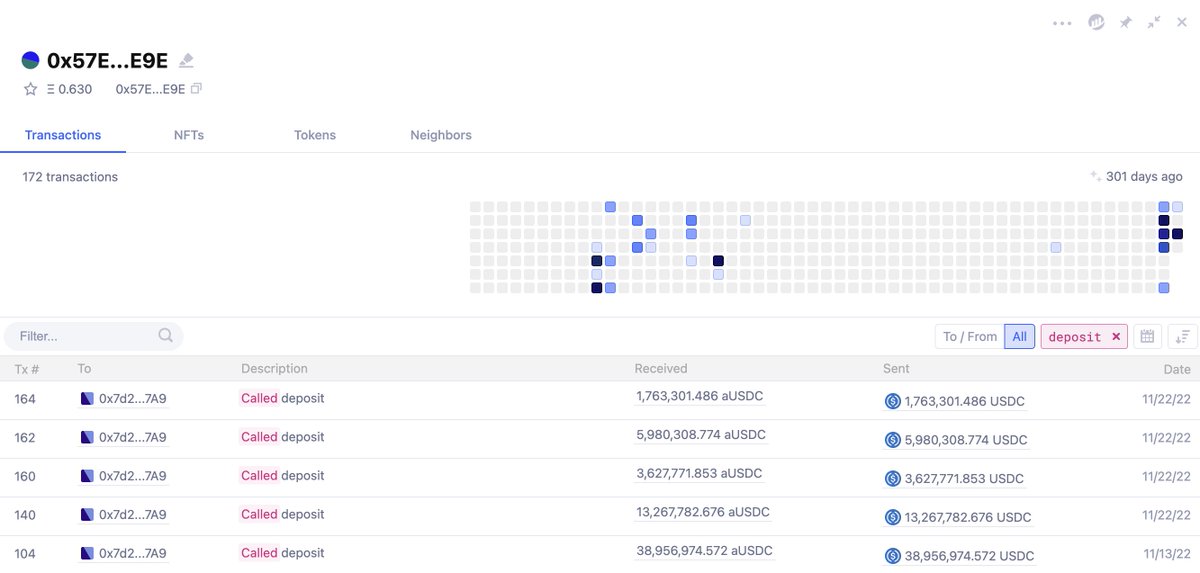
⚫️ deposit ~40m$ $USDC in @AaveAave
⚫️ borrow max $CRV
⚫️ dump $CRV to $USDC
⚫️ loop back into aave to borrow more
⚫️ $CRV price ⬇️
⚫️ place large longs on cex (possibly)
⚫️ short squeeze $CRV price ⬆️
⚫️ aave liquidations leaving ~1.8m$ in bad debt
screenshots from @onceupongg


English
Fafi Merhi retweetledi

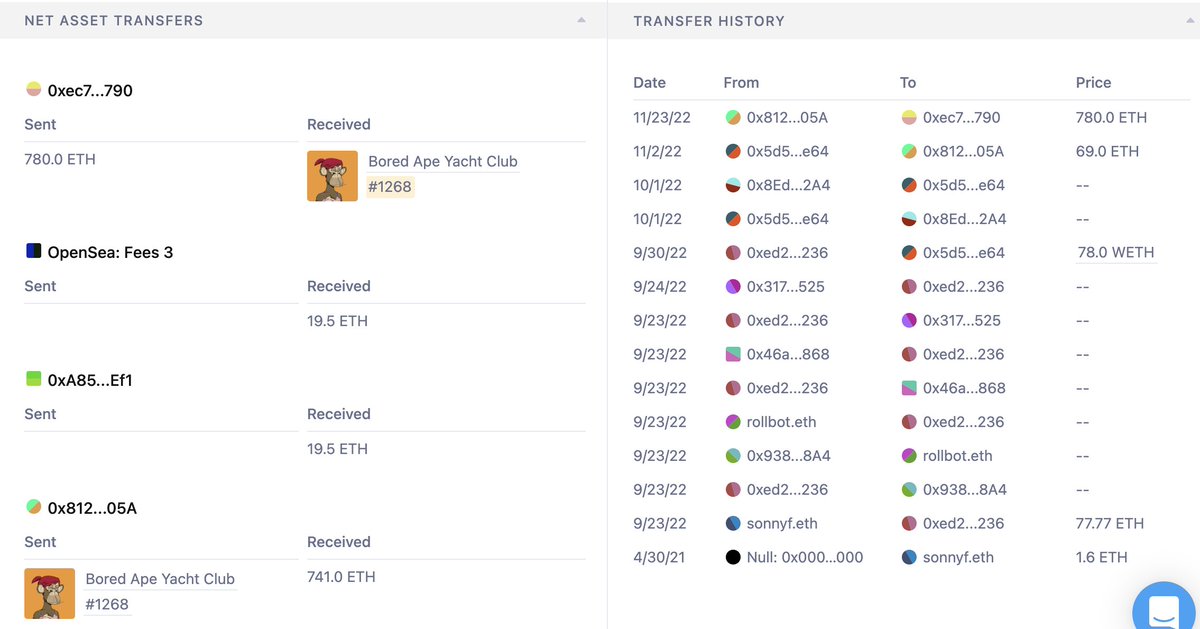
am i missing anything? why did this @BoredApeYC just sell for 780 $eth?
was purchased for 69 $eth only 20 days ago.

English