Salif Cybertruck or Bust 📐⚡️🔋🚀

14K posts

Salif Cybertruck or Bust 📐⚡️🔋🚀 banner
Salif Cybertruck or Bust 📐⚡️🔋🚀

Salif Cybertruck or Bust 📐⚡️🔋🚀

@Filasophical

📐 Thank you for using my referral code to get the most current incentives from Tesla: https://t.co/t2dhWOoNnP

Florida, USA Katılım Kasım 2012
589 Takip Edilen835 Takipçiler
Sabitlenmiş Tweet
Salif Cybertruck or Bust 📐⚡️🔋🚀
By the time #CyberTruck is here, #FSDBeta (amazing as it is rn) will be so much more improved! So close ur eyes, picture hitting #SmartSummon & ur #CyberBeast rolls up, drops the suspension, pops the door. U get in, it raises up & u ride on out leaving ppl standing there 🤯😮😳
Tesla Owners Silicon Valley@teslaownersSV

The cyber truck has and will continue to redefine how trucks and cars are made. @elonmusk twitter.com/teslaunivrse/s…

English
8
12
95
0
Salif Cybertruck or Bust 📐⚡️🔋🚀
Based on your replies to the comments, it seems to me that you’ve already made up your mind on getting black and just needed validation 😄 FWIW, in the last 7 years we’ve owned teslas with both black and white seats. 2 M3’s with black, 1 MYP with white and a Cybertruck AWD with black. We have young kids and without hesitation we prefer the white seats. White makes the interior look roomier and more elevated. In warm climates like Florida, it also keeps the interior cooler. The nice thing is it’s your money/your decision. So get whatever you want😂 Congrats on the new ride!
English
0
0
1
107
SurfRanch Vibes
SurfRanch Vibes@surfranchvibes·
I have the opportunity to get a 2026 quicksilver motor Y performance with black interior. I originally was going with white interior and have always owned white interior Teslas however black is the only one available right now. People with black interior would you go back to black or get white interior?
SurfRanch Vibes tweet media
English
244
11
262
48.6K
Chuck Cook
Chuck Cook@ChuckCook·
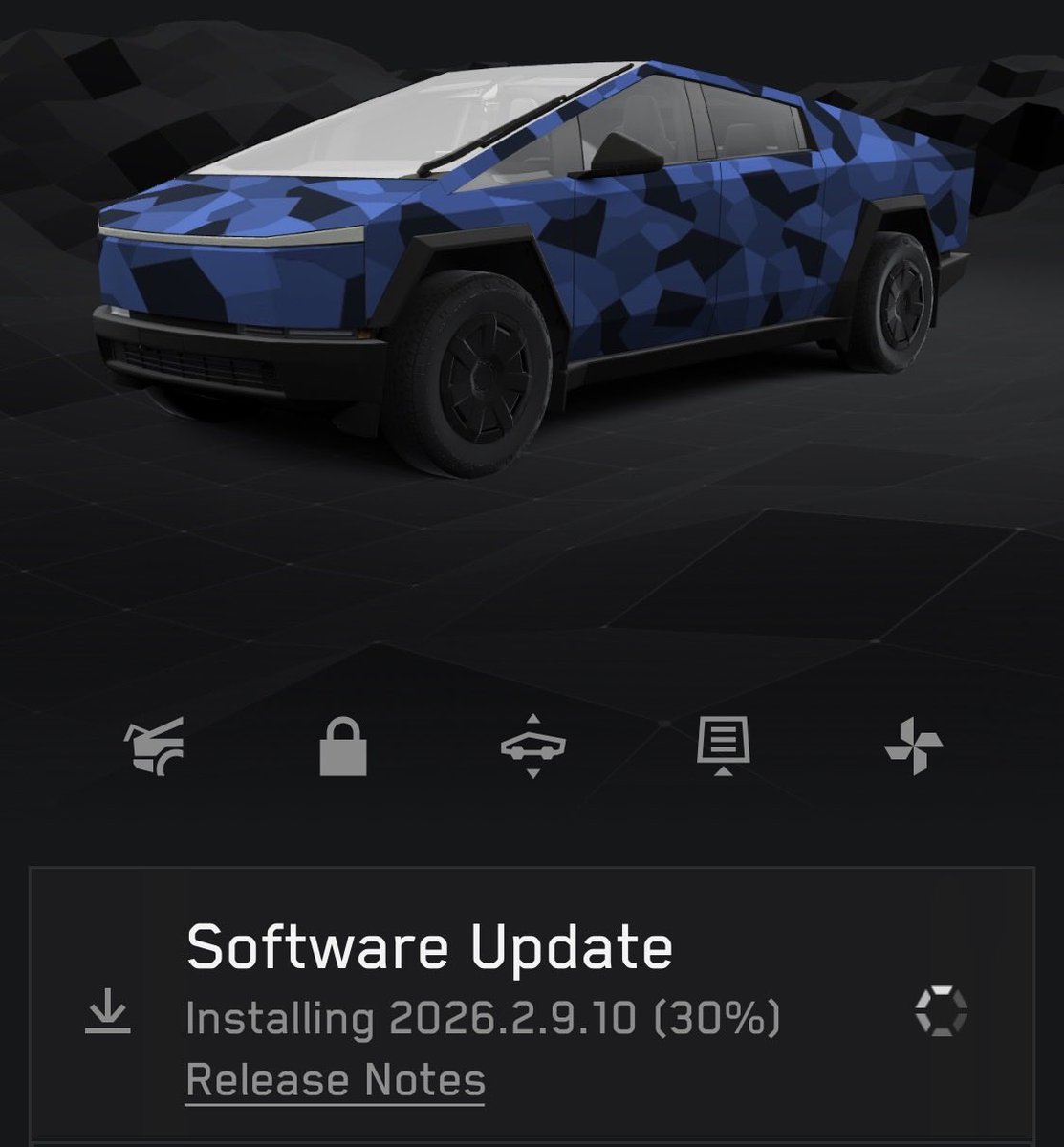
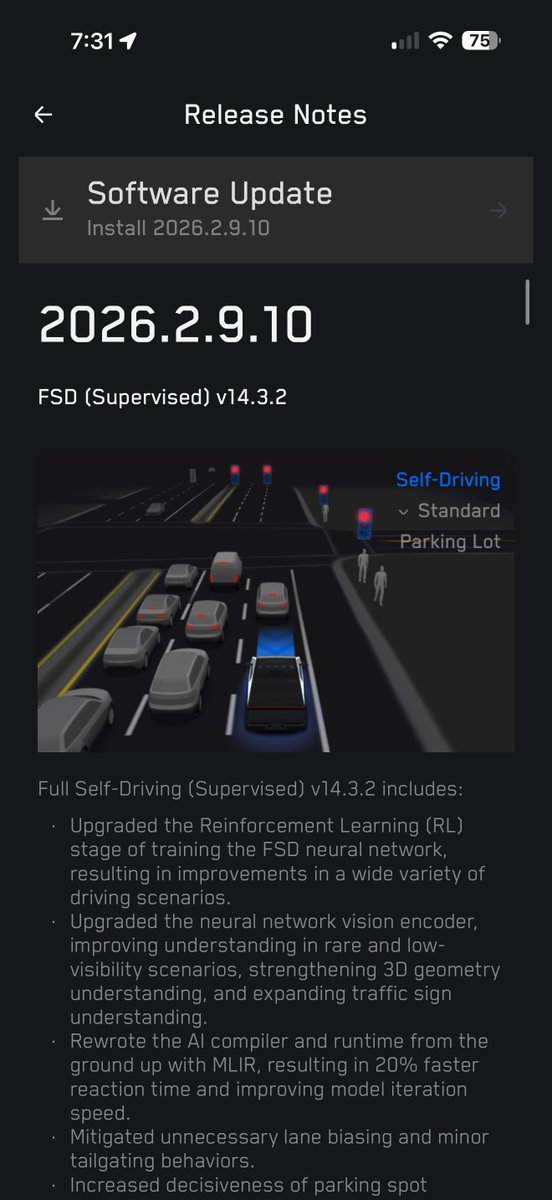
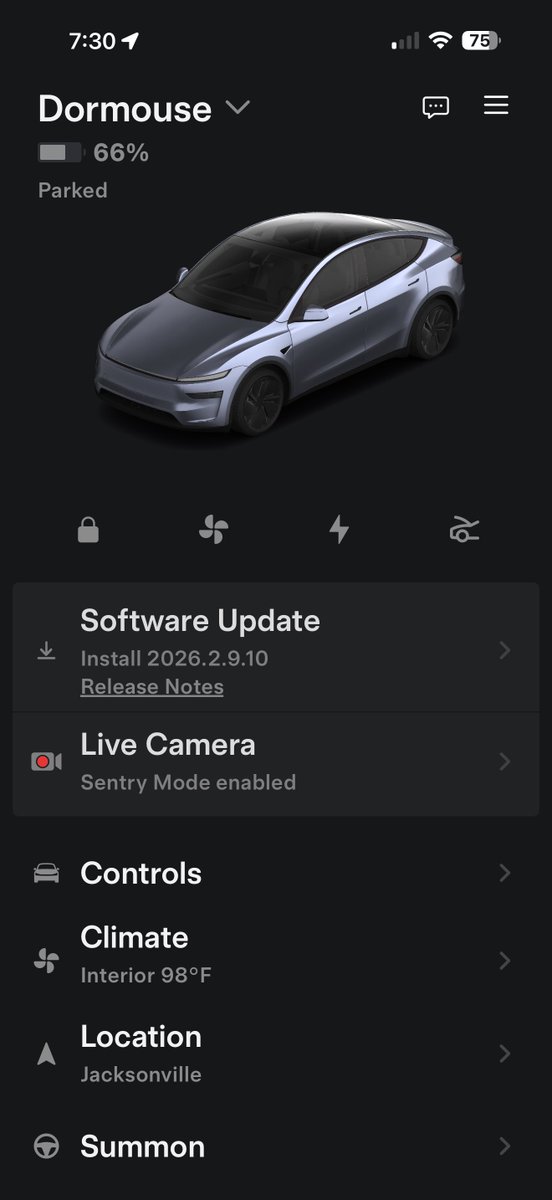
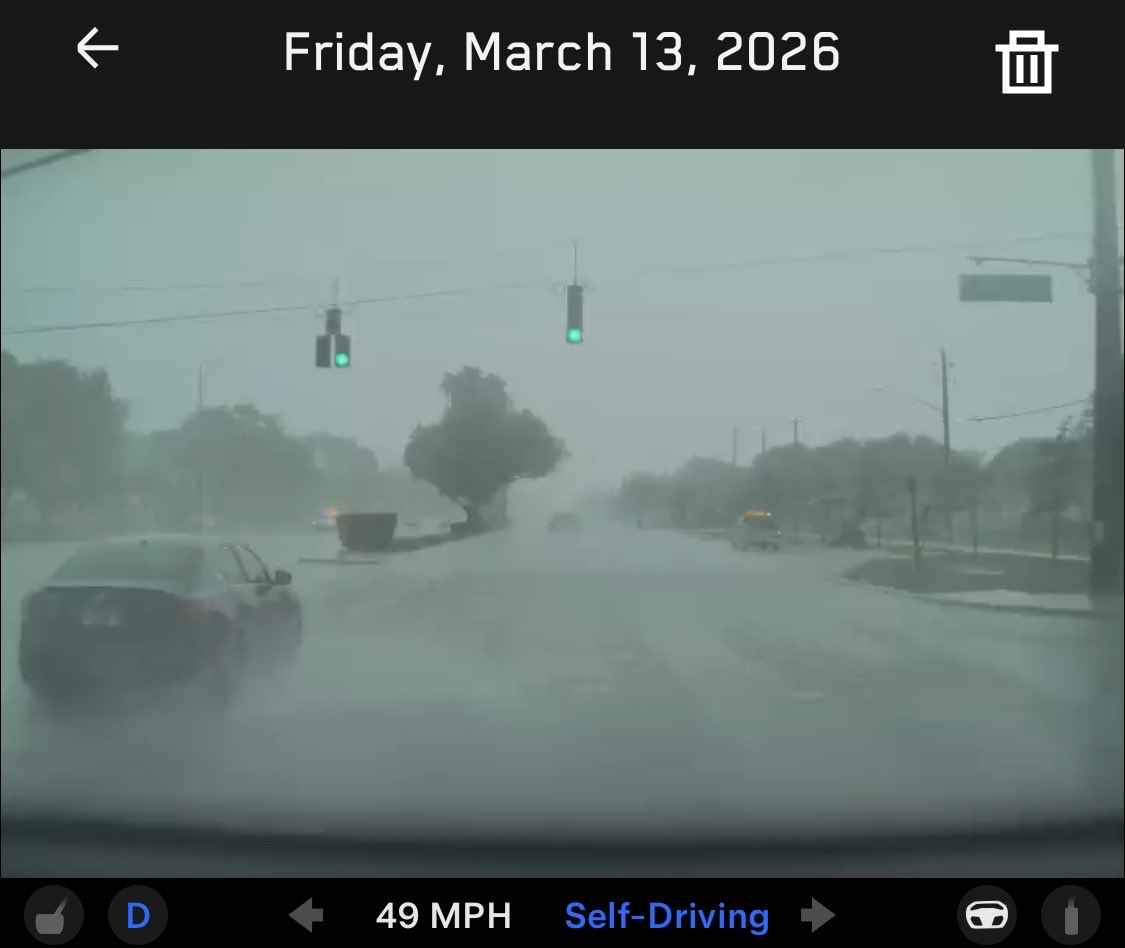
A new version of FSD v14.3.2 build 2026.2.9.10 is downloading to both of my vehicles. This is the same version of FSD as the last build. I am out of town until Monday so will be looking for change updates from the others.
Chuck Cook tweet mediaChuck Cook tweet mediaChuck Cook tweet media
English
18
9
292
10.2K
AJ Agarwal
AJ Agarwal@OGMarsLife·
Cybertruck peeps does your front camera dashcam footage has the bottom ~10% obscured like in my truck? I’ve carefully inspected the camera housing and can’t see anything out of place.
AJ Agarwal tweet media
English
2
0
0
236
Justin
Justin@JustinHorn·
In honor of @NASA launching a big rocket tomorrow 🚀 Old school rocket picture
Justin tweet media
English
3
0
6
62
Salif Cybertruck or Bust 📐⚡️🔋🚀 retweetledi
TesLatino
TesLatino@TesLatino·
I'd like to share a short compilation of our trip to Tennessee a week ago for the @ChatCharge event and a few visuals of our forest trails drive.
English
11
20
135
5.1K
teslajake
teslajake@jakesna·
@theficouple No maintenance costs or selling fees accounted for? lol
English
1
0
13
1.6K
theficouple
theficouple@theficouple·
Bought a house in 2023 for $260K. About to sell it for $330,000. $70,000 gain in 3 years & 0% tax on profit. …and people say a home is a liability!?
English
120
8
486
77.4K
TechGeek Tesla 🔋⚡️
TechGeek Tesla 🔋⚡️@JonBbC_TechGeek·
Hey @greentheonly @jamesdouma - Can you please explain why so many people have noticed improvements with FSD 12.6.4 on HW3 since it was first released in 2.2025 when the software version hasn’t changed? It’s been noted that the FSD sector of the update has been changing sizes. I’m assuming it’s the weights and not the parameters (neural nets) that are changing, but I can’t confirm… And if the weights are changing, how is that not resulting in a minor point release update? Are these changes that people have been noticing just speculative and anecdotal? Or are they real changes that are flying under the radar?
English
12
1
66
9.4K
Salif Cybertruck or Bust 📐⚡️🔋🚀 retweetledi
TesLatino
TesLatino@TesLatino·
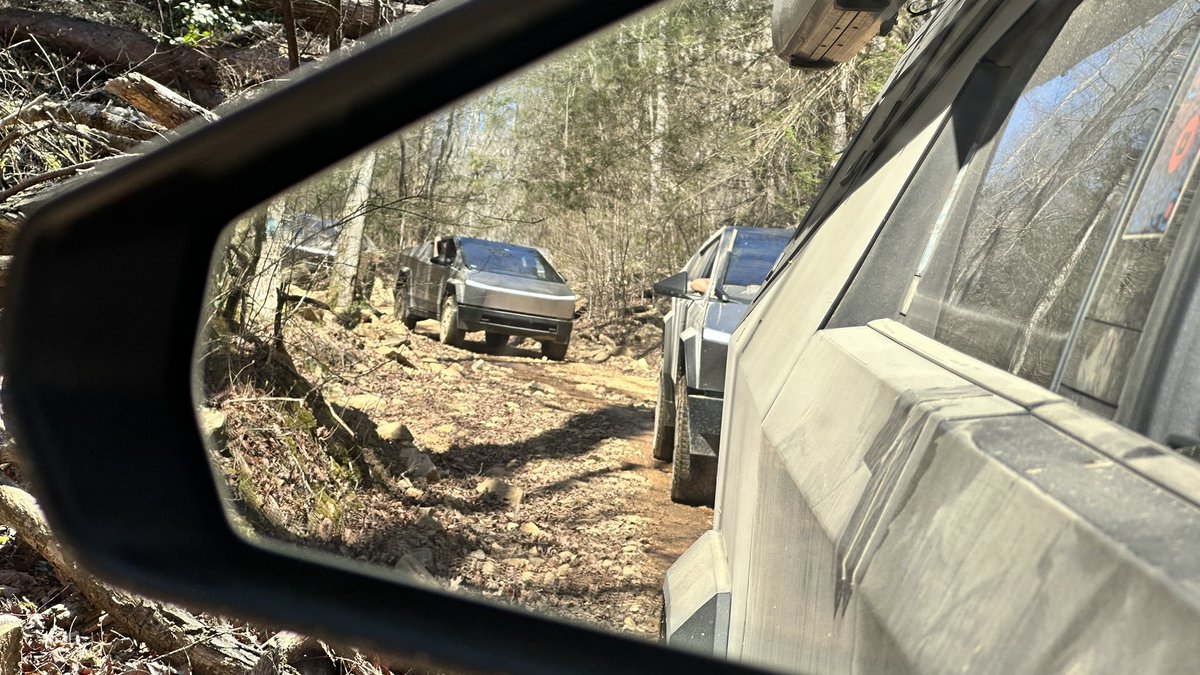
Good morning, world. There’s a large group of people that allowed me to guide them through a day-long off road excursion in Tennessee yesterday as part of the @ChatCharge 2026 activities and I am grateful for the opportunity to lead the pack. I was humbled by so many coming over asking great questions about what we were about to do, but more so by the words of encouragement and support for our unusual life journey, traveling to so many places , exploring both known and somewhat unknown secret locations in our continent. Last night I had to bail into the comfort of a hotel room, sleeping in a soft bed with what seems like brand new comfy sheets, in an attempt to escape from the insane volume of pollen to which I am highly allergic to, and this morning I reminisce. The memories and the new friends we made this week, are forever with us and I am glad I’m able to breathe another day. In the next few days, I will do my best to compile all the content I have at my disposal (mine and from others sharing it with me) in an attempt to show some of the wonderful things we did. I’d like to shout out to the @Tesla @Cybertruck team that supported me remotely during a moment of uncertainty while we were at the trails with a potential failure that turned out to be a whole lot of nothing, as we were moving from trail 1 to trail 2 of three. The group of over 30 Cybertrucks with a few other models had a great time at trail 1 (the easiest trail). Then 31 Cybertrucks took the crowd to a mildly difficult trail, showcasing a hint of what would come on the final and most difficult trail of the day, Haley Road at the Prentice Cooper National Forest. Eleven Cybertrucks joined for the final trail and we had a blast. We had all sorts of obstacles, including a rocky river crossing, rutted muddy hill climbs and more, and everyone did a great job. Even the first timers. Let’s hope I can do it justice when I stitch the video this week. Until then, my heart is yours and I thank you for all your support. 🙏 Please tag yourself if you were with us and comment on your experience.
TesLatino tweet mediaTesLatino tweet media
English
21
16
180
8K
Dan Burkland
Dan Burkland@DBurkland·
@Filasophical Lane change hesitations are unfortunately very much present on my S
English
1
0
0
21
Dan Burkland
Dan Burkland@DBurkland·
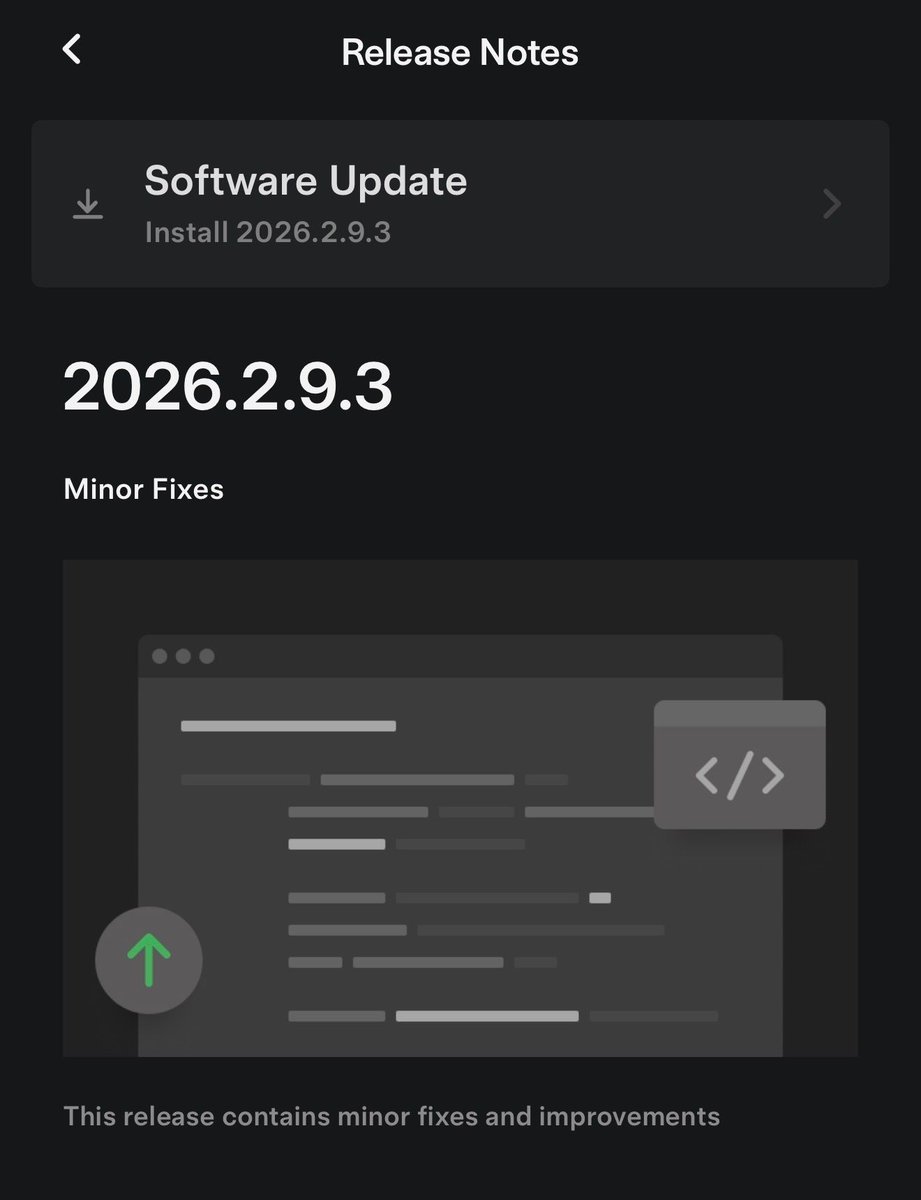
2nd Tesla OTA update in 3 days… First Tesla Software v2026.2.9.2 and now v2026.2.9.3. Happy Sunday!
Dan Burkland tweet mediaDan Burkland tweet media
English
8
2
64
3.3K
Salif Cybertruck or Bust 📐⚡️🔋🚀
Ahem, @CAF_Media In case you haven’t noticed, your “Morocco are champions” post is getting absolutely ratio’d in its own comments: 95%+ of them are savage — “delete the organization”, “disgrace”, “rigged for the host”, “Senegal are the real champions”. The fans have spoken loud and clear. This decision is rejected. The ratio doesn’t lie. 🔥
English
0
0
0
27
CAF Media
CAF Media@CAF_Media·
The CAF Appeal Board decided that in application of Article 84 of the Regulations of the CAF Africa Cup of Nations (AFCON), the Senegal National Team is declared to have forfeited the Final Match of the TotalEnergies CAF Africa Cup of Nations (AFCON) Morocco 2025 (“the Match”), with the result of the Match being recorded as 3–0 in favour of the Fédération Royale Marocaine de Football (FRMF). cafonline.com/news/caf-appea…
English
35.3K
12.6K
40.8K
18.3M
Ming
Ming@tslaming·
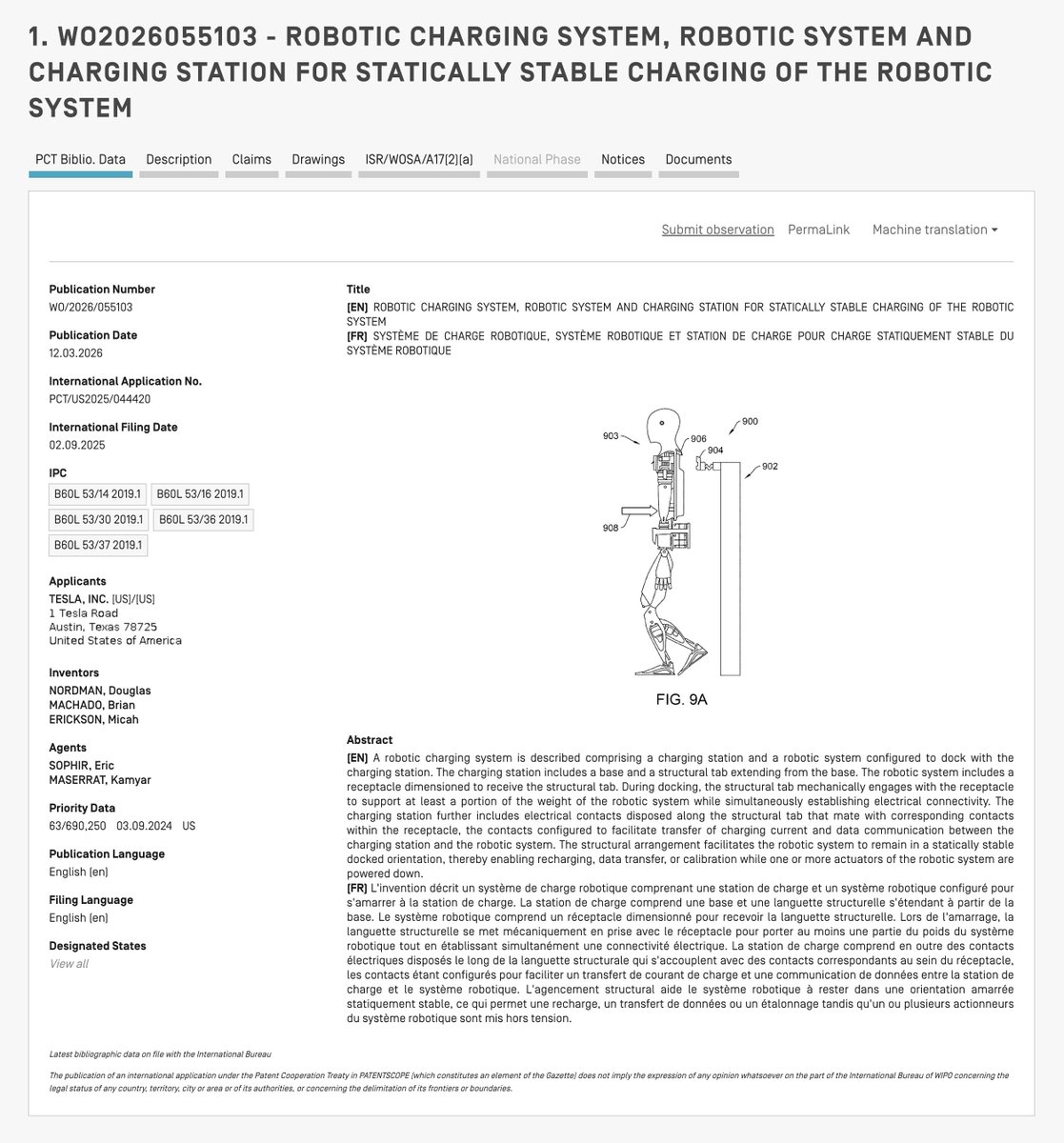
BREAKING 🚨 @Tesla HAS ENGINEERED AN AUTONOMOUS CHARGING DOCK THAT PHYSICALLY SUPPORTS THE OPTIMUS SO IT CAN COMPLETELY POWER DOWN AND RELAX WHILE RECHARGING 🤖 When picturing a fully automated factory, we imagine thousands of humanoid robots working flawlessly in constant motion. However, deploying walking machines at a massive industrial scale introduces a hidden physical tax. Every single second a bipedal robot stands still to recharge, it burns precious battery life just fighting the natural urge to fall over. Traditional wheeled robots can simply hit the brakes, plug into a wall, and completely shut off their motors. A humanoid robot does not have that luxury. It must constantly process spatial data and pump power to its legs to remain perfectly balanced against the pull of gravity. This active balancing act creates a massive energy drain across an entire robotic fleet. It slowly depletes high-capacity batteries while causing unnecessary heat and wear on expensive joint actuators. Patent WO 2026/055103 A1, which hit the public domain yesterday on March 12, 2026, reveals exactly how Tesla is eliminating this costly hardware bottleneck. Officially filed as a "statically stable robotic charging system", the engineering inside the document is beautifully simple. Instead of using a basic electrical plug, the Tesla robotics team designed a cantilevered steel dock that physically catches and bears the entire weight of the machine. This brilliant mechanical design allows Optimus to completely power down its artificial legs, relax its joints, and safely go limp. By giving the robot a true physical resting state, Tesla is channeling all that wasted balancing energy into pure, uninterrupted charging efficiency. But to understand why this physical support is such a game-changer, we have to look at the hidden energy cost of just standing still. ⚖️ The problem: Keeping a humanoid upright requires constant power Unlike wheeled robots that remain inherently stable when turned off, much like a parked tricycle sitting perfectly still without any effort, humanoid robots require active and continuous motor control to maintain their balance. This means the system must constantly process data and make tiny physical adjustments just to stand straight. When power to the actuators, which act as the mechanical muscles driving the robot, is removed, the joints become limp. Without that power, the robot can easily collapse under its own weight, much like a marionette doll whose strings have just been cut. This means a humanoid robot standing at a traditional charging station would have to keep its leg motors running just to stay upright. This constant idle power consumption works a lot like leaving a car engine running in the driveway, burning fuel while going absolutely nowhere. This wasted effort diverts valuable energy away from the battery pack, slows down the charging process, and causes unnecessary wear and tear on the internal joints. To stop this waste, Tesla moved away from traditional "plugs" and turned the charging station into a piece of structural furniture. 💡 Tesla's solution: A structural docking tab that acts as a physical kickstand Tesla designed a charging station featuring an upward angled structural tab, which acts essentially like a heavy-duty wall hook. This hook is made of a rigid steel core for extreme strength and wrapped in a protective polymer shell, acting as a tough plastic layer to prevent physical wear and tear during docking. The robot features a specially dimensioned receptacle, functioning much like a perfectly fitted internal pocket, located on its upper back between the shoulder structures. During the docking process, the robot performs a backward walking motion, covering a lateral travel distance of 20 to 80 millimeters (with an ideal target of 50 mm), followed by a coordinated squatting movement. This vertical drop of 10 to 40 millimeters (ideally 25 mm) lowers the robot onto the structural tab, sliding the tab securely into the back receptacle at a depth of anywhere from 5 to 100 millimeters. Once seated, the charging station mechanically supports the weight of the robot in a cantilevered orientation. This means the robot is securely suspended and balanced while anchored only at its back, much like a diving board extending out over a swimming pool. The robot can then safely power down its leg actuators, completely turning off those mechanical muscles, and rest entirely on the dock. Of course, for this "diving board" connection to work, the robot has to hit its mark with extreme precision. 🎯 Coarse and fine alignment: Guiding the robot to safety To ensure a perfect connection every time, the charging station uses a two-step alignment process. The base of the station features outward extending alignment arms that create a wide funnel shape. These arms guide the robot laterally, gently bumping it side to side as it approaches in reverse. This wide catch area acts much like the guide rails of an automatic car wash, physically correcting any minor positional errors (allowing for 5 to 100 millimeters of lateral misalignment correction) if the robot drifts slightly off course during its approach. As the robot squats, the tapered edges of the structural tab, which narrow at the tip like a smooth wedge, provide the final fine alignment for millimeter-perfect precision. This physical guidance is paired with a rear-facing camera on the robot that detects high-contrast visual markers on the station. These printed visual markers function like bold landing targets on a helipad, giving the robot perfect spatial awareness so it knows exactly where its body is in physical space before fully committing its weight to the dock. While this docking port is the gateway to energy, its location also serves a critical role in the robot’s physical survival. 🛡️ Anatomical protection: Guarding against backward falls Tesla designed the charging receptacle to sit perfectly recessed between two protruding shoulder structures on the upper back. By sinking this connection point into the body, much like a valley tucked safely between two mountains, the port is shielded from the outside environment. These structures physically mimic human shoulder blades, serving as a natural roll cage for the delicate hardware inside. If the robot accidentally falls backward on the factory floor, these shoulder protrusions will hit the ground first, acting exactly like a pair of built-in crash pads. This anatomical design absorbs the brute force of the impact before it reaches the center of the back. It prevents the sensitive electrical contacts and the receptacle itself from sustaining direct structural damage, much like a heavy-duty phone case protecting a glass screen from shattering upon impact. But Tesla didn’t just stop at a static port; they made the station itself move to meet the robot halfway. 🦾 Dynamic hardware: Retractable docking mechanisms The charging station is not just a static piece of metal bolted rigidly to the wall. The patent outlines a sliding carriage, operating much like a heavy drawer gliding on a smooth track, or a telescoping mechanism for the charging station base. The structural tab can remain safely retracted and hidden away during the initial approach of the robot. Once the robot is positioned close enough and coarse alignment is confirmed, the tab extends or pivots into proper alignment. This moving mechanism protects the exposed station hardware from accidental collisions during the unpredictable approach phase. It acts much like a drawbridge that only lowers when the friendly knight is perfectly in position to safely cross. This "tab-into-hole" design is the primary focus, but Tesla also developed a backup plan that flips the entire concept on its head. 🔄 Inverted configuration: The mating tab alternative Tesla also engineered a completely inverted mechanical configuration for this system, essentially flipping the plug and the socket entirely inside-out. Instead of having a receptacle hole in the back of the robot, an alternative design gives the robot a protruding cantilevered mating tab on its back. This acts as a rigid, outward-sticking fin that securely carries the weight of the machine. In this scenario, the charging station features a recessed U-shaped mating channel, which is a deep vertical groove specifically carved out to catch and hold the fin. As the robot squats, its external tab slides down into the station channel, locking tightly like a puzzle piece dropping into its final place. This completely opposite approach proves that Tesla is actively exploring multiple physical standards to find the perfect fit for their robotic fleet. Regardless of which side has the "fin", the math behind the connection relies on a very specific set of angles to ensure the robot never gets stuck. 📐 Precise geometry: Gravity-assisted locking mechanisms The specific angles of the docking hardware are carefully calculated to let gravity do the heavy lifting, essentially using the massive weight of the machine to secure its own resting position. While the primary claim angles the structural tab between 25 and 65 degrees (with a steep 45 degrees being the optimal target), the patent also accounts for other embodiments ranging from 35 to 75 degrees. Combined with a 5 to 10 degree internal draft angle—a slight taper on the walls of the pocket like the slanted sides of a paper cup—this geometry creates a self-locking mechanism. Any downward push only makes the connection tighter and more secure. Gravity naturally wedges the robot securely onto the tab, acting as an invisible hand holding the machine in place. This prevents the heavy robot from slipping off while eliminating the risk of "binding"—the frustrating friction that happens when parts get stuck together—when the robot finally stands up to undock. Once the physical connection is locked, the station’s next job is to handle the delicate transfer of power and data in a very specific order. ⚡ Sequential electrical engagement: Protecting the hardware The structural tab contains integrated power and communication contacts, specialized metallic touch points designed to handle both heavy electricity and sensitive information. These mate with corresponding spring-loaded pins inside the robot. These pins act like tiny metallic pogo sticks that constantly push back to guarantee a tight, vibration-proof connection. Tesla engineered these contacts with staggered lengths, making some metallic strips physically longer than others like the uneven steps of a ladder. The longer power contacts engage first to establish a stable charging current. Then, the shorter communication contacts connect to handle data transfer. Operating at less than 12 volts and under 1 ampere, these sensitive data lines are safely spaced 4 to 6 millimeters away from the high-voltage power lines to prevent interference. Once connected, they handle rich bidirectional data transfer via Ethernet, CAN bus, RS-485, or USB. The robot transmits its state-of-charge, thermal status, and actuator conditions, while the station feeds back charging voltage and error codes. When the robot undocks and rises, the communication lines disconnect first. This clever physical sequencing prevents data corruption—avoiding the digital equivalent of yanking a USB drive out while a file is still saving—and stops dangerous electrical arcing, the destructive sparks that can jump across the gap as metal pulls apart. Interestingly, Tesla covers all its engineering bases by noting this exact sequence could actually be reversed in alternative designs. Regardless of which pins connect first, once the electricity flows, a crucial question remains: How does Optimus actually know it is safe to finally relax? That is where the internal hardware takes over. 🧠 Load sensing and calibration: Smarter energy management The robotic system uses load sensors, acting like high-tech digital scales embedded in its legs, to monitor the docking process in real-time. As the robot squats, these sensors measure the exact proportion of weight being transferred to the station. They feel the physical pressure shift just like a person leaning back into a sturdy chair and feeling the weight naturally come off their feet. Once the sensors confirm the station is fully bearing the load, the robot shuts down the necessary actuators to save massive amounts of battery. This mechanically stabilized position is also utilized to recalibrate the kinematic chain of the robot. It takes advantage of this perfectly still moment to reset the complex mathematical alignment between all of its moving joints and visual sensors. The system can run deep diagnostic routines and execute fine camera calibrations perfectly still while pulling continuous external power directly from the wall. This single moment of "sleep" at the dock is what ultimately enables the robot to work harder and longer once it wakes up. But getting off the dock safely requires just as much engineering as getting on. 🚶‍♂️ The undocking sequence: A graceful exit When it’s time to get back to work, the robot doesn’t just blindly pull away. Just as the docking process is a highly choreographed dance, undocking requires an equally precise reverse sequence to avoid catastrophic hardware damage. If Optimus simply tried to walk forward while still resting its weight on the dock, it would physically snap the structural tab or violently scrape the internal contacts. Instead, the patent explicitly outlines a coordinated "rising motion." Think of it like standing straight up from a deep armchair before attempting to walk away. This vertical lift smoothly slides the robot's back receptacle up and off the angled steel tab. As it rises, this exact physical movement triggers the staggered electrical disconnect we talked about earlier—safely severing the sensitive data lines before pulling the heavy power connection. Only after the robot has fully cleared the mechanical lock does it perform a "forward walking motion" along its exact original approach path. As it steps away, the station's retractable alignment arms might extend back out to reset for the next robot, while Optimus's rear-facing camera takes one last look at the station's visual markers to verify its trajectory before heading back to the factory floor. So, what does this highly choreographed routine of docking, resting, and undocking mean for the big picture of Tesla's humanoid program? 🚀 How this patent contributes to Tesla's now and future Ultimately, the core invention of this patent—the ability to mechanically hold a humanoid robot so it can completely turn off its balancing motors—solves one of the biggest bottlenecks in autonomous robotics today. Right now, this structural charging dock allows Tesla engineers to rapidly test and iterate on the Optimus platform without constantly burning out joint actuators or dealing with prematurely dead batteries. It provides a safe, supported resting state for overnight diagnostics without human supervision. Looking into the future, this docking station is the foundational block for a massive autonomous workforce, especially if paired with advanced internal power like Tesla's 4680 battery cell program. While the patent only specifies generic "rechargeable battery packs," leveraging those high-density cells as a logical next step would provide Optimus with long working shifts, and this dock ensures that energy is never wasted on the simple act of standing still. This powerful synergy means vast fleets of Optimus robots will soon be able to work continuously around the clock. They will autonomously manage their own power needs, seamlessly docking and resting, while physically building the autonomous future.
Ming tweet media
English
11
21
105
4.3K
The Tesla Cowboy
The Tesla Cowboy@TeslaCowboy1·
Ok, I’ve been let out of the hospital, but it looks like a couple of weeks before I’ll be able to return to normalcy. No solid food for two weeks, and after that, my diet will be pretty bland until I see my gastroenterologist in a month. At least I’m home in my bed, but it’s not looking good for me to make a Starbase launch anytime soon 😕 My prayers are to make the Chattanooga Charge @ChatCharge as reservations have already been made. We’ll cross that bridge soon and I’m hopeful. Thanks for the prayers, I feel better than they believe I would be, so they worked! I miss y’all and hate I’m not down at Starbase, but I’m happy this health scare is over and our return to heaven on Earth 🤠
English
12
1
41
788
TesLatino
TesLatino@TesLatino·
Where are we?
TesLatino tweet media
English
21
1
86
2.2K
Salif Cybertruck or Bust 📐⚡️🔋🚀 retweetledi
Sawyer Merritt
Sawyer Merritt@SawyerMerritt·
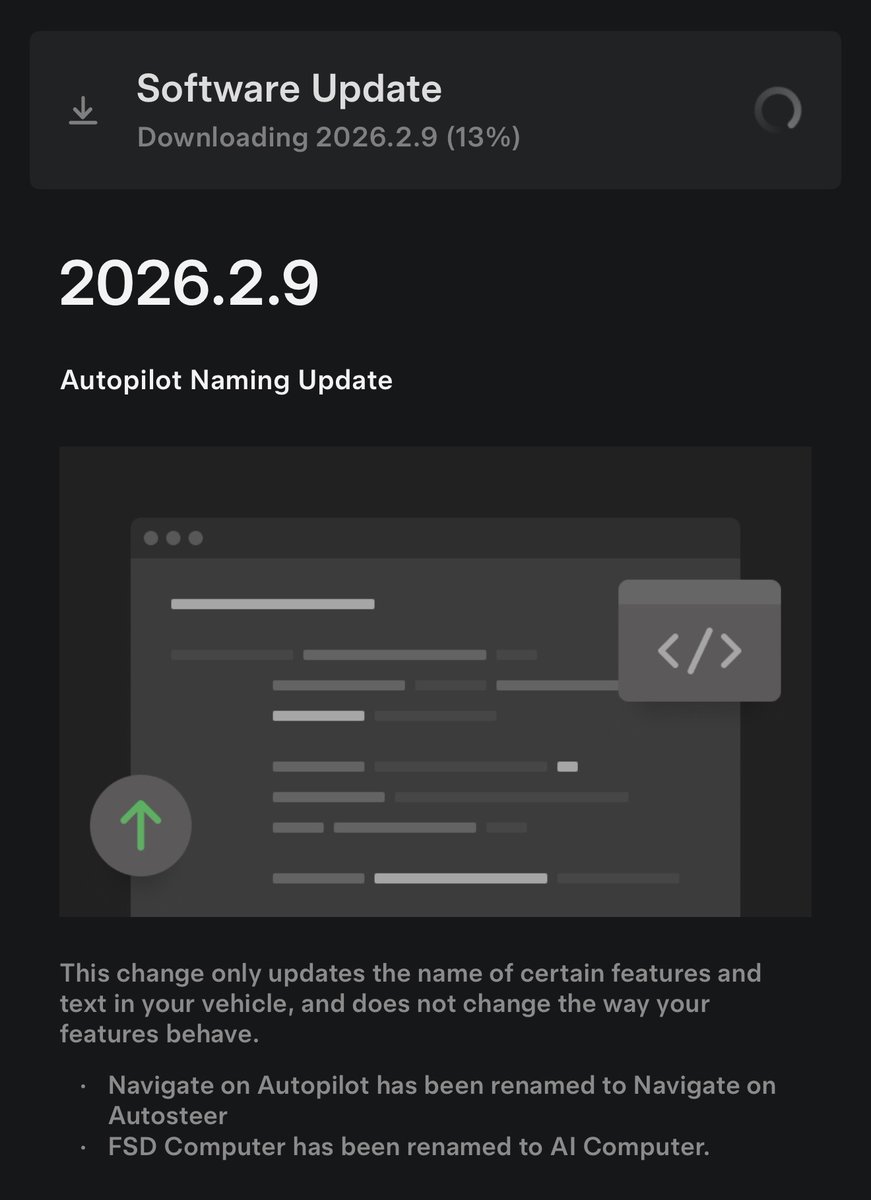
Tesla just sent out a software update that changes the Autopilot naming. "This change only updates the name of certain features and text in your vehicle, and does not change the way your features behave. • Navigate on Autopilot has been renamed to Navigate on
Autosteer • FSD Computer has been renamed to Al Computer."
Sawyer Merritt tweet media
English
134
120
1.7K
214.8K