Jonathan Afilalo

1.2K posts

Jonathan Afilalo banner
Jonathan Afilalo

Jonathan Afilalo

@FrailtyMD

Clinician scientist. Voracious learner. Director of McGill Geriatric Cardiology Program. Creator of https://t.co/PVflDwZCSD & https://t.co/4IJWOncQte.

Katılım Ocak 2018
587 Takip Edilen1.8K Takipçiler
Jonathan Afilalo retweetledi
John T. Saxon, MD
John T. Saxon, MD@jtsaxon·
This week, a team of researchers quietly published in @JACCJournals one of the most profound studies of valvular heart disease in recent memory. The PREVUE-VALVE study used a decentralized, in-home echocardiography model to estimate the prevalence of valvular heart disease among U.S. adults aged 65–85. Importantly, this was not a clinic-based echo cohort; participants were recruited nationally and underwent comprehensive transthoracic echo in their homes, with studies interpreted by a core lab. That intentional design choice is critical: PREVUE-VALVE is a true prevalence study, accurately representing the true burden of valve disease in the U.S. population. The findings are striking: 8.2% of older Americans have moderate or greater valvular heart disease, and 18.4% have “clinically significant” disease when mild-to-moderate regurgitation is included. TR was the most common lesion, followed by AS, MR, AR, and MS. The burden rises sharply with age, reaching nearly 15% among adults aged 80–85. Extrapolated nationally, this means approximately 4.7 million Americans aged 65–85 currently have moderate or greater VHD, projected to increase to 6.5 million by 2060. Using the broader clinically significant definition, the number is already over 10 million and projected to approach 15 million. For structural heart programs, health systems, and policymakers, the message is clear: the valve disease burden is large, growing, and will require thoughtful planning around screening, access, and treatment capacity. Congratulations to @djc795, Michael 'Mickey' Brener MD MS, and all co-authors for a stunning glimpse into the present and future of valve disease! jacc.org/doi/epdf/10.10…
John T. Saxon, MD tweet media
English
2
37
100
12.7K
Jonathan Afilalo
Jonathan Afilalo@FrailtyMD·
CHAMPION-AF trial: LAAC vs. DOAC for AF Design: RCT multicentre international Population: N=3,000 AFib patients eligible for DOAC - 72y old - 68% male - 85% white - 69% paroxysmal - 48% ablated - CHADS-VASc 3.5 ± 1.3 Intervention group: LAAC Watchman Flx device + DOAC/ASA or DAPT x 3m then ASA indefinitely Control group: DOAC Primary outcome: CV death, CVA, or systemic embolism at 3y -> noninferior *but trend towards 17 more CVAs in device group (NNH 91) Safety outcome: Nonprocedural major bleeds at 3y -> superior Secondary outcome: All major bleeds at 3y -> noninferior Tertiary outcome: All major & clinically significant nonmajor bleeds at 3y (Fig S7) Other: No between group difference in EQ-5D or SF-12 vs. CLOSURE-AF trial: - Opposite conclusion i.e. LAAC inferior to DOAC - CLOSURE-AF population was "higher risk" - Multiple different LAAC devices vs. only 1 - DAPT post LAAC vs. mainly DOAC+ASA - Investigator led vs. industry sponsored nejm.org/doi/full/10.10…
Jonathan Afilalo tweet mediaJonathan Afilalo tweet mediaJonathan Afilalo tweet media
English
1
0
1
307
Jonathan Afilalo
Jonathan Afilalo@FrailtyMD·
Apitegromab for lean mass preservation during tirzepatide-induced weight loss Big effect in all-comers, expect more benefit in older subgroup at risk for sarcopenia! nature.com/articles/s4159…
Jonathan Afilalo tweet mediaJonathan Afilalo tweet media
English
0
1
0
163
Jonathan Afilalo
Jonathan Afilalo@FrailtyMD·
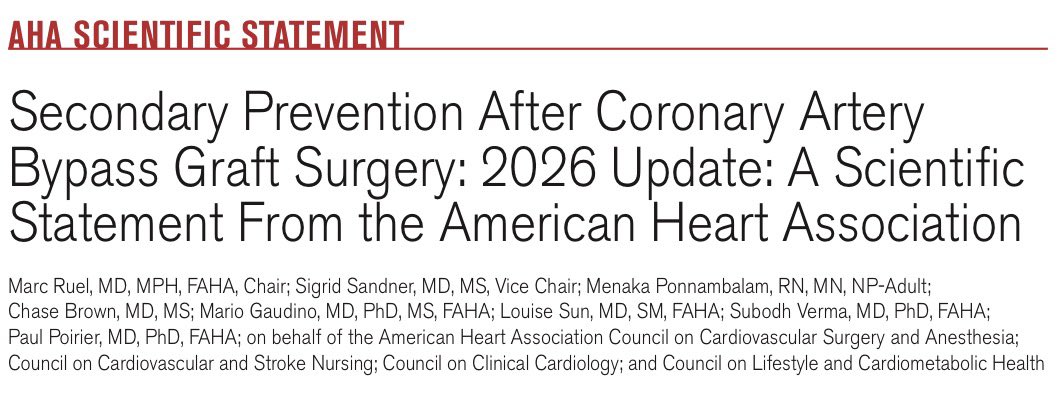
“Systematic screening for preexisting conditions can identify frailty and inform personalized rehabilitation strategies, improving outcomes and adherence to secondary prevention after CABG.” ahajournals.org/doi/pdf/10.116…
Jonathan Afilalo tweet media
English
0
1
2
261
Jonathan Afilalo retweetledi
Alasdair MacLullich
Alasdair MacLullich@A_MacLullich·
🧠 About 1 in 4 older people in hospital have dementia. ⚠️ But a lot of this has never been diagnosed. Older people with undiagnosed dementia are frequently admitted to hospital and discharged from hospital without any attempt to make the diagnosis or flag a potential diagnosis and arrange follow-up. This is a major missed opportunity - to use hospital admission as an opportunity to diagnose dementia where possible, or to flag likely dementia and then arrange follow-up. In this JAGS paper, Tan and colleagues describe a practical hospital-wide approach combining an electronic health record flag with nurse-administered 4AT and AD8 screening. Among 11,180 hospital encounters, 83.3% were screened; 18.0% had known dementia, 4.3% screened positive for potential dementia, and 9.0% for cognitive impairment. That matters because hospital admission is not just a point of acute care, but also an opportunity to identify major cognitive disorders that affect treatment, safety and discharge planning. The 4AT is useful here. The 4AT is the most validated and used *delirium* tool globally. But the 4AT also has built-in cognitive tests - so it provides a dual role as a delirium screener but also a tool to assist in detection of dementia. ☑️ This is relevant to the 4Ms - detecting both delirium and dementia/cognitive impairment is necessary - and the 4AT can help with both in the form of one 2-minute tool.
Alasdair MacLullich tweet media
English
1
6
10
587
Jonathan Afilalo retweetledi
Michael Morelli
Michael Morelli@morellifit·
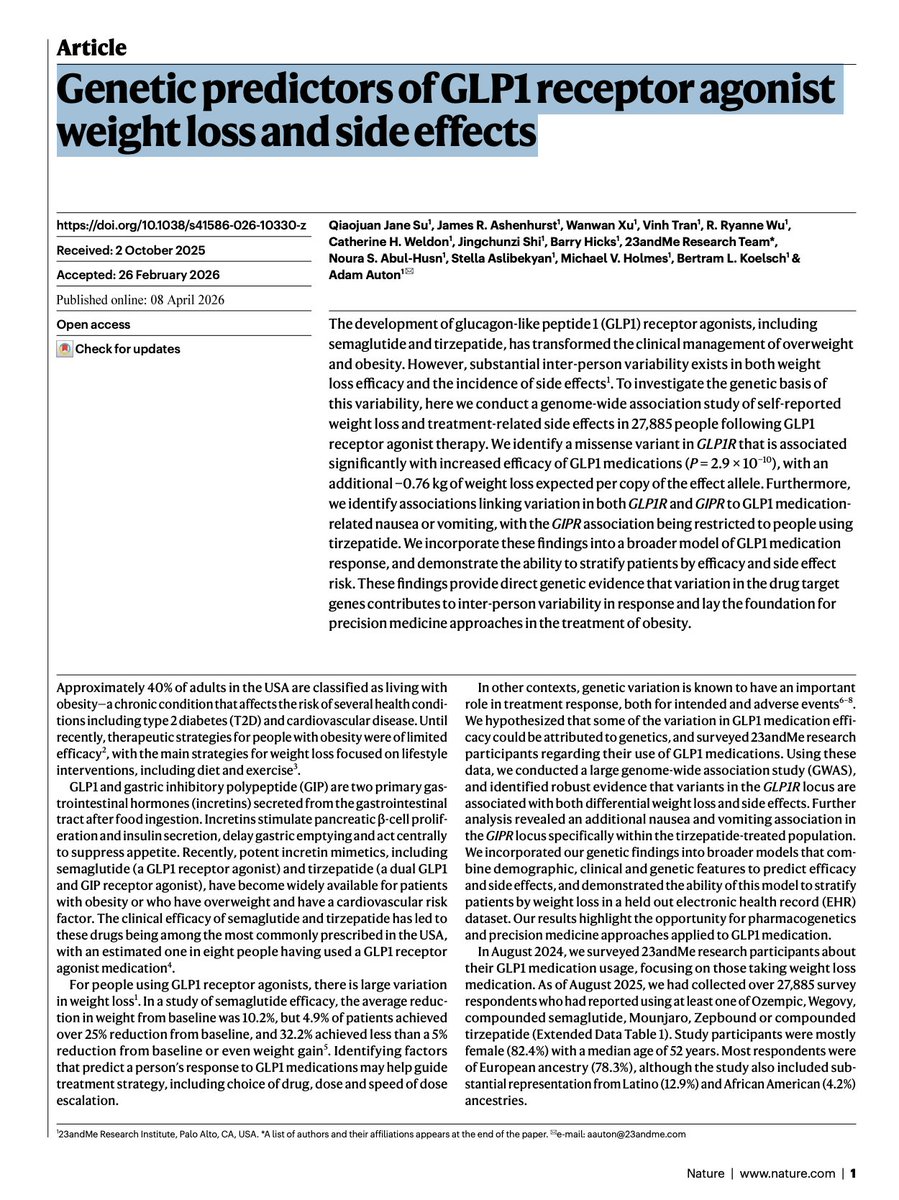
A massive Nature study of 27,885 GLP-1 users just dropped some major news about Ozempic and tirzepatide. Your DNA determines how much weight you lose and how bad the side effects hit. 1 in 3 people see minimal results, and now we know why: (1/9)
Michael Morelli tweet media
English
63
448
2.3K
629K
Jonathan Afilalo retweetledi
科技小柴
科技小柴@TechShiba·
The mechanistic link between APOE4 and meningeal lymphatic clearance adds a crucial dimension to the 'drainage' hypothesis of AD. It’s particularly striking how this suggests that Alzheimer's might not just be a proteopathy of production, but a failure of vascular-lymphatic hydraulics. The sex-dimorphism mentioned here could finally explain the disproportionate burden on women beyond just longevity. This shifts the therapeutic horizon: are we looking at the future of 'lymphatic rejuvenation' for APOE4 carriers?
English
0
1
6
479