Geoffrey Smith
20K posts

Geoffrey Smith
@Geoffreytsmith
Central bank editor, POLITICO Europe. Use every man after his desert, and who should ’scape whipping?
London, England Katılım Temmuz 2011
1.3K Takip Edilen2.9K Takipçiler
Geoffrey Smith retweetledi


Seven clocks are running. None of them negotiable. All of them counting down to the same weeks.
The planting clock. Mid-April is the biological deadline for corn and soybean planting across the US Midwest. Every day that passes without nitrogen becoming affordable and available narrows the window for corn. USDA projects corn falling to 94 million acres from 98.8 million. Soybeans rising to 85 million from 81.2 million. The seeds that go into the ground in the next three weeks determine America’s grain harvest in October. The decision is irreversible.
The USDA clock. March 31. Prospective Plantings. The report that converts farmer intentions into official data. Every acreage number, every corn-soy ratio, every nitrogen-dependent calculation becomes a published fact that traders, governments, and food agencies will use to model global supply for the next twelve months. The number arrives in twelve days.
The FAO clock. April 3. The Food Price Index. The first global reading that captures post-Hormuz commodity prices across cereals, vegetable oils, dairy, meat, and sugar. The 2022 peak was 159.7 in March 2022 after Ukraine. This reading will incorporate oil above $100, urea at $610, LNG halted, packaging repriced, and freight surcharges of $500 to $1,500 per container. The number that determines whether the UN declares a food emergency arrives in fifteen days.
The pharmaceutical clock. India’s API inventory buffers are two to three months, measured from the war’s onset on February 28. Late May is the depletion window. Methanol at 87.7 percent Hormuz exposure feeds the solvent chain for paracetamol, ibuprofen, metformin, and antibiotics. Once buffers deplete, the shortage becomes a patient access crisis for the 47 percent of US generics that originate in India.
The China crude clock. FGE NexantECA confirmed China is drawing commercial reserves at up to one million barrels per day. The draw sustains refinery operations for four to six weeks from March 19. Mid-April to late April is the exhaustion window. After that, China faces three options: accelerate Russian pipeline imports, reroute at massive premium, or crack open the strategic petroleum reserve. The third option reprices every commodity on the planet.
The helium clock. SK Hynix and Samsung hold two to three months of helium inventory. Late May to early June is the depletion window. South Korea imports 64.7 percent of its helium from Qatar. Ras Laffan is offline. If helium buffers deplete before alternative supply arrives, semiconductor fabrication faces rationing. The AI hardware supply chain hits a physical wall measured in months, not quarters.
The insurance clock. Solvency II requires 30 to 60 days of zero incidents before P&I clubs can reinstate war risk coverage. Even after a ceasefire, the insurance normalisation takes six to sixteen months based on the Red Sea precedent of 26 months and counting. The logistics system lags the financial relief rally by the longest duration of any clock in this crisis.
Seven clocks. The shortest expires in twelve days. The longest runs for over a year. The planting window, the USDA report, the FAO index, the drug buffers, the Chinese crude draw, the helium inventory, and the insurance cycle are all counting down simultaneously. None of them pause for diplomacy. None of them respond to presidential directives. None of them read sealed packets.
The calendar is the only actor in this war that has never lost a negotiation.
open.substack.com/pub/shanakaans…

English
Geoffrey Smith retweetledi

President Trump is demanding that the Fed immediately lower borrowing costs. But the war in the Middle East has now made any interest rate cuts much less likely in 2026 — not just in the U.S. but around the world.
w/ @JohannaTreeck @Geoffreytsmith
politico.com/news/2026/03/1…
English

@MichaelAArouet A very one-eyed assessment. This is also the result of decades of transfers from the EU budget, the very embodiment of economic planning.
English
Geoffrey Smith retweetledi

Geoffrey Smith retweetledi

This is the most SHAMELESS structural manipulation of a major index I've ever seen.
SpaceX is preparing what could be the largest IPO in history.
Target valuation: $1.75 trillion.
That would make it the sixth-largest company in America on day one.
And Nasdaq wants the listing so badly they're literally CHANGING how the Nasdaq-100 works.
In February, Nasdaq published a "consultation" proposing sweeping changes to how companies enter the index. The timing is pure coincidence, of course.
Just like it's pure coincidence that SpaceX has reportedly made fast index inclusion a CONDITION of listing on Nasdaq.
Here's what they're proposing:
A new "Fast Entry" rule would let any newly listed company whose market cap ranks in the top 40 of current Nasdaq-100 members get added to the index after just 15 trading days.
No seasoning period. No liquidity requirements. Completely exempt from the standards every other company had to meet.
Currently, new public companies typically wait up to a year before they're eligible for major index inclusion.
That waiting period exists for a reason. It lets the market establish real price discovery. It protects passive investors from being forced into untested, illiquid stocks.
And Nasdaq wants to throw all of that out. For ONE listing.
But the Fast Entry rule isn't even the worst part...
The real scandal is the 5x float multiplier.
Right now, the S&P 500 uses a free-float adjusted methodology. If only 5% of a company's shares are available for public trading, the index weights you at 5% of total market cap.
That's common sense. You weight a company based on what investors can actually buy.
Nasdaq's current methodology already uses total market cap rather than free-float for weighting. But for very low-float stocks, they at least had a 10% minimum float threshold.
Under the new proposal, that threshold DISAPPEARS entirely.
Instead, any stock with less than 20% free float gets weighted at FIVE TIMES its actual float percentage, capped at 100%.
Do the math on SpaceX:
If SpaceX IPOs at $1.75 trillion and floats 5% of its shares, there would be roughly $87.5 billion worth of stock available for public trading.
Under Nasdaq's proposed 5x multiplier, the index would weight SpaceX at 25% of its total market cap. That means passive funds would be forced to buy as if SpaceX were a $437.5 billion company.
But only $87.5 billion of stock actually exists in the market.
You are forcing hundreds of billions in passive buying into a $87.5 billion float.
QQQ alone manages nearly $400 billion. The total Nasdaq-100 ecosystem represents over $1.4 trillion in exposure across ETFs, mutual funds, structured notes, and derivatives.
Every single passive vehicle tracking this index would be REQUIRED to buy SpaceX at whatever price the market dictates.
On Day 15.
With zero price discovery. Zero track record as a public company. And a float so thin you could read through it.
So what this actually does is it creates a structural wealth transfer mechanism.
The passive bid from index funds pushes the stock price higher. That higher price benefits exactly one group of people: the insiders and early investors who own the other 95% of the shares.
And when lock-up periods expire 90 to 180 days later? Those insiders sell into the artificially inflated passive bid. Your 401(k) is the exit liquidity.
This is the fundamental corruption of indexing.
Indexing used to be brilliant. Low cost. Efficient. You were free-riding on the price discovery done by active managers. The index reflected the market.
Now the index IS the market. Trillions of dollars flow blindly into whatever the index tells them to buy. And the people who control the index methodology are changing the rules to serve the interests of a single IPO candidate.
The S&P 500 requires companies to have at least 50% of shares available for public trading. It requires 6 to 12 months of seasoning. It uses free-float adjusted weighting so passive investors aren't buying phantom liquidity.
Nasdaq is doing the exact opposite. 15 days. No float requirement. 5x multiplier on insider-held shares.
Every passive investor in QQQ, QQQM, and every fund benchmarked to the Nasdaq-100 should understand what's about to happen:
The rules are being rewritten to benefit IPO issuers and early-stage insiders, and your capital is the tool being USED to enrich them.
45 years in this business and I've watched Wall Street find creative new ways to separate retail investors from their money in every cycle. But usually they at least try to be subtle about it.
This one they put in a PDF and called it a "consultation."
What's your take?
English
Geoffrey Smith retweetledi

What do you get if you cross The Archers theme tune with Rachmaninoff? I tried...here’s the result.
Celebrating 75 years of the world’s longest-running drama (by the way, Arthur Wood composed the original Archers theme). @BBCRadio4
English
Geoffrey Smith retweetledi

LLMs are living off the moral and intellectual capital of a pre-AI world, just like Nietzsche said secular liberals live off Christianity. What happens when the inheritance runs out?
Using LLMs well — knowing when to trust them, how to interrogate their outputs, what questions are worth asking — depends on capacities that are pre-LLM in origin: critical judgment, domain expertise, philosophical seriousness, taste.
People who use LLMs well right now tend to be people formed by traditions of deep reading, argument, and intellectual discipline that were not themselves produced by or optimized for interaction with language models. The tool works for them because they bring something the tool cannot supply.
Nietzsche thought secular liberals were coasting on the fumes of a Christian metaphysics they'd officially abandoned. The shadow of God lingering on the cave wall. The question is whether LLM-native thinking is the same kind of afterglow.
English

Geoffrey Smith retweetledi

Wellllll oil now ready to rip
Open Source Intel@Osint613
JUST IN 🔴 U.S. official to Al Jazeera: The military operation against Iran is "now expected to last weeks, not just days."
English
Geoffrey Smith retweetledi

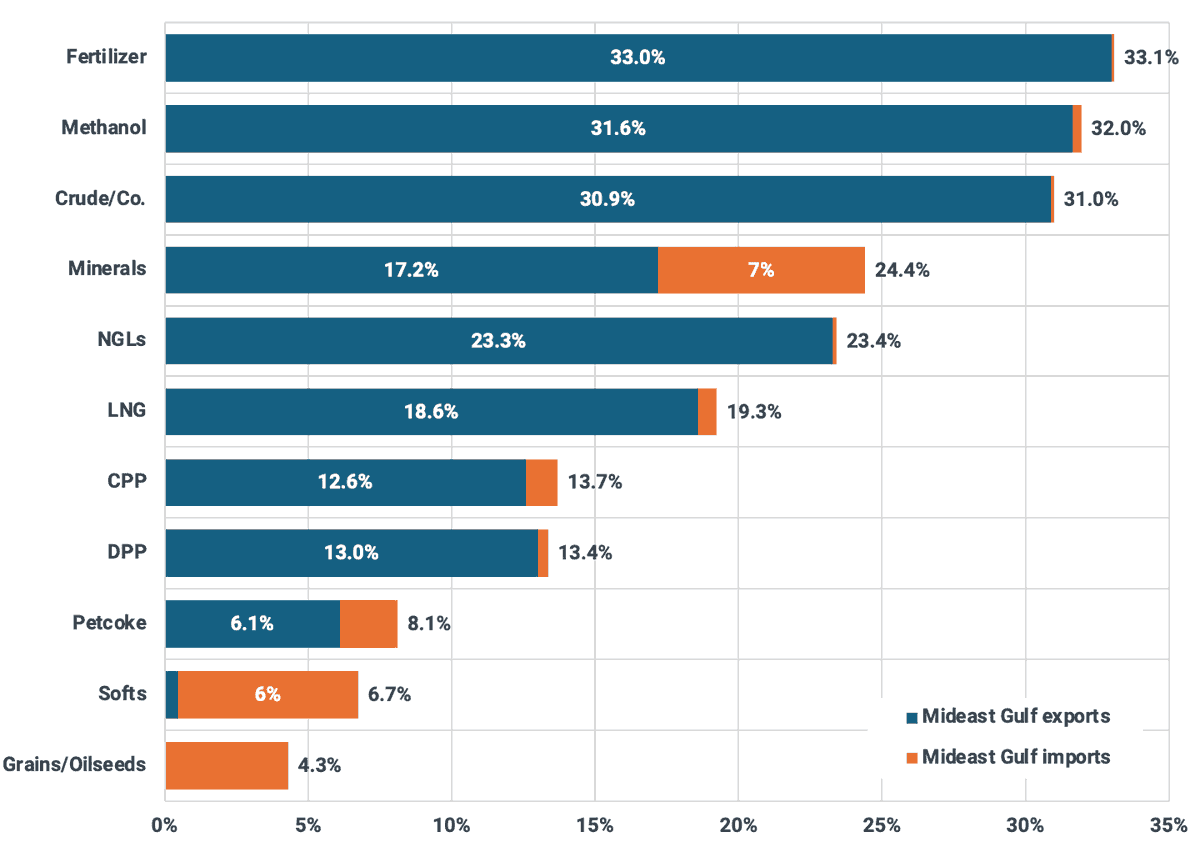
Another great graphic from the @kpler team today (h/t 'Super Flo' aka Florian Grünberger) depicting the share of global seaborne commodity flows transiting the Strait of Hormuz in 2025 (imports + exports). It's not all about the oil...

English