Koiwe

2.3K posts

Koiwe banner
Koiwe

Koiwe

@GermanColo1

Ciudad Autónoma de Buenos Aire Katılım Kasım 2012
408 Takip Edilen45 Takipçiler
The Curious Tales
The Curious Tales@thecurioustales·
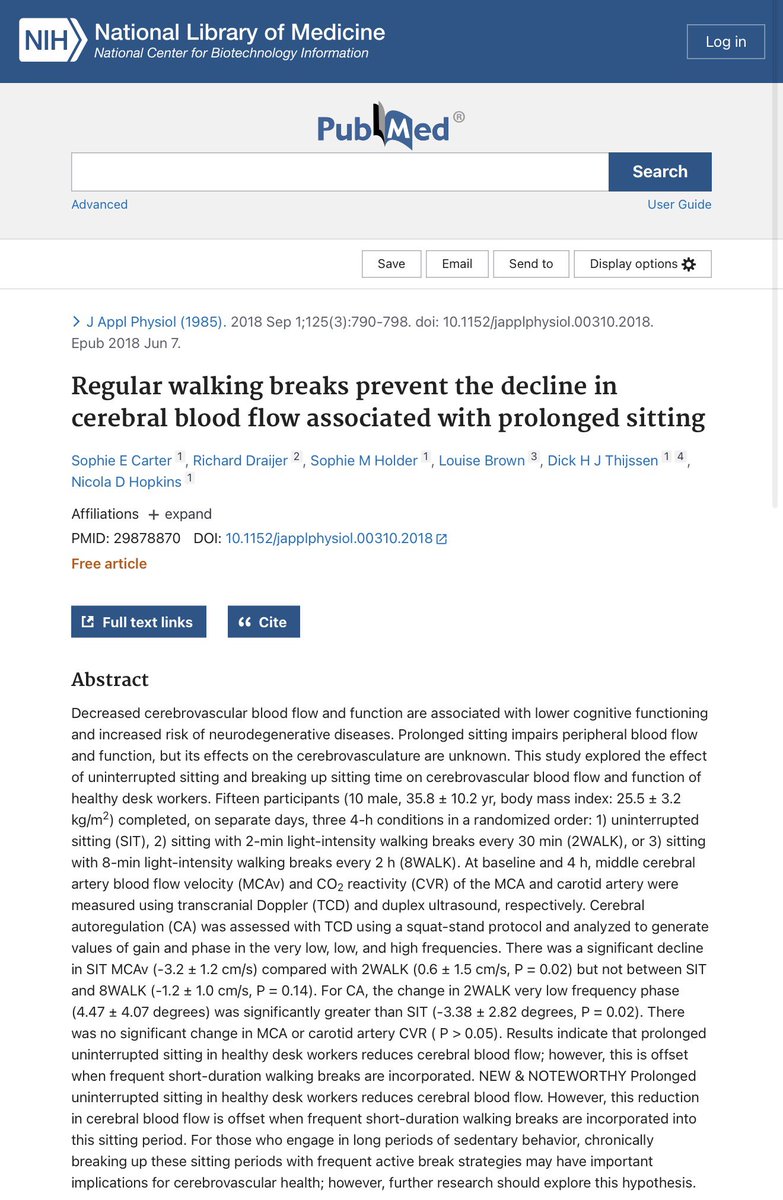
🚨 Your brain shuts down in time intervals. New research tracked cerebral blood flow in desk workers using transcranial Doppler imaging. What they discovered changes how we should think about cognitive performance during work. Sitting for 30 minutes measurably reduces blood velocity to your middle cerebral artery. Your prefrontal cortex begins operating on restricted fuel. The decline happens predictably, like clockwork, every half hour. But walking for just 2 minutes every 30 minutes completely reversed the effect. Not walking for 8 minutes every 2 hours. Short, frequent interruptions. The timing reveals something crucial about how your cardiovascular system operates under sedentary stress. Blood doesn’t pool gradually. It pools in waves. Your circulation hits specific failure points at regular intervals when movement stops. The 30 minute mark appears to be a biological threshold where your calf muscle pumps lose their ability to maintain adequate venous return. Think about every important decision you’ve made sitting at a desk after 30 minutes of stillness. Every creative problem you’ve tried to solve. Every complex analysis you’ve attempted. You were operating with diminished blood flow to the exact brain regions responsible for higher order thinking. The implications extend beyond productivity. Prolonged periods of reduced cerebral blood flow accelerate cognitive decline. The same vascular mechanisms that impair thinking in real time contribute to neurodegeneration over decades. Office workers aren’t just experiencing temporary mental fatigue. They’re participating in a daily pattern that systematically starves neural tissue. What makes this particularly disturbing is how perfectly our work culture aligns with the worst possible timing. Meetings scheduled for an hour. Focus blocks planned for 90 minutes. Deep work sessions extending for multiple hours. We’ve organized professional life around intervals that guarantee cognitive impairment. The solution sounds absurd until you understand the physiology. Stand up and walk for 2 minutes every 30 minutes. Not stretch. Not shift in your chair. Walk. Activate the muscle pumps in your calves. Force blood back toward your brain. Every knowledge worker should treat this like a medical prescription. Your cognitive capacity depends on maintaining cerebral blood flow. Your long term brain health depends on preventing chronic vascular stress. Movement every 30 minutes isn’t a productivity hack. It’s basic cardiovascular maintenance for an organ system that requires constant circulation to function. Your brain runs on blood flow, not willpower. Starve it for 30 minutes and watch your intelligence evaporate in real time.
The Curious Tales tweet media
Darshak Rana ⚡️@thedarshakrana

Your brain goes dark when you sit still. Dr. Chuck Hillman at the University of Illinois put people in brain scanners and measured neural activity after 20 minutes of sitting versus 20 minutes of walking. The difference was notable. The sitting brain showed lower activation in key cognitive control areas. The walking brain showed increased activity across attention and executive networks. Twenty minutes. Same people. Completely different brain responses. What you’re seeing in these scans reveals something unsettling about modern life. We’ve built a world that systematically limits optimal brain function. Every chair, every car ride, every hour spent motionless is missed neurological enhancement happening in real time. The enhanced zones in the walking scan represent areas responsible for executive function, spatial processing, memory formation, and creative problem solving. These regions show stronger engagement when you move. Movement doesn’t just change your body. Movement turns on your mind. The implications go far beyond fitness. Every major decision you make while sitting is being made without the full acute boost that prior movement can provide. Every problem you try to solve from a desk is being processed with cognitive resources that benefit from activity. Every creative project you attempt while sedentary is running with added support available from movement. Think about where our most important mental work happens. Board meetings around conference tables. Students taking exams in classroom chairs. Writers staring at screens. Programmers debugging code. Therapists conducting sessions. All of it happening in environments designed to minimize movement. Hillman’s research suggests we’ve accidentally limited cognitive potential through environmental design. The walking brain and the sitting brain show meaningful functional differences. One operates with enhanced cognitive control. The other runs without that acute boost. Ancient humans walked 12 miles daily while thinking, planning, and problem solving. Their brains evolved under constant movement. Our brains carry the same neural architecture but we’ve imprisoned it in furniture. The most productive people throughout history understood this instinctively. Aristotle taught while walking. Darwin took daily thinking walks. Dickens walked 30 miles through London every night. Tesla walked 10 miles daily to stimulate ideas. They weren’t just exercising. They were unlocking cognitive potential that remains less activated when stationary. The business world talks endlessly about optimizing performance through better tools, systems, and strategies. Meanwhile, the most powerful cognitive enhancer costs nothing and requires no equipment. Just get up and move. Every step triggers a neurochemical cascade that increases BDNF, boosts dopamine, and activates neural networks that show less engagement during stillness. The effect peaks around 20 minutes and persists for hours afterward. You can literally watch improvements in cognitive performance turn on and off depending on whether you’re moving or sitting. The next time you face a difficult decision, a creative block, or a complex problem, pay attention to your position. If you’re sitting, your brain may be operating without the full acute boost available. The solution might require neural resources enhanced by activity. Stand up. Walk around. Let the enhanced zones activate. Your best thinking happens when your brain has the support of movement.

English
26
420
1.9K
125.2K
Chidanand Tripathi
Chidanand Tripathi@thetripathi58·
A brilliant statistician who spent 50 years studying why massive engineering projects fail realized one terrifying truth: Individual incompetence is almost never the actual problem. His name is W. Edwards Deming, the man who famously rebuilt Japan's post-war manufacturing empire from scratch. He argued that we obsess over individual performance and completely ignore the environment. Here are 4 operational frameworks he used to build elite, failure-proof organizations:
Chidanand Tripathi tweet media
English
49
351
1.6K
289.8K
Koiwe
Koiwe@GermanColo1·
@PIPMUNCH Pip. I’ve read your discord last message. May be no one posts because we are all muted. Check it, please, May be you changed configurations like a month ago or so and it is impossible to type in any section.
English
1
0
1
69
Pipmunch
Pipmunch@PIPMUNCH·
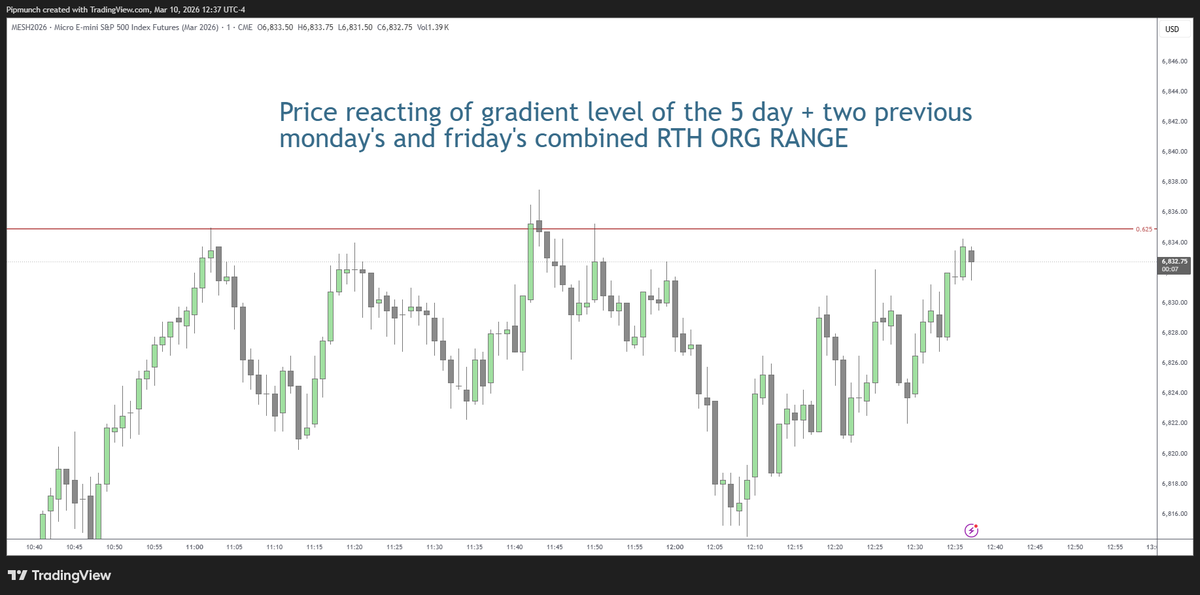
Price reacting of gradient level of the 5 days + two previous monday's and friday's combined RTH ORG RANGE
Pipmunch tweet media
English
4
0
7
2.8K
Nav Toor
Nav Toor@heynavtoor·
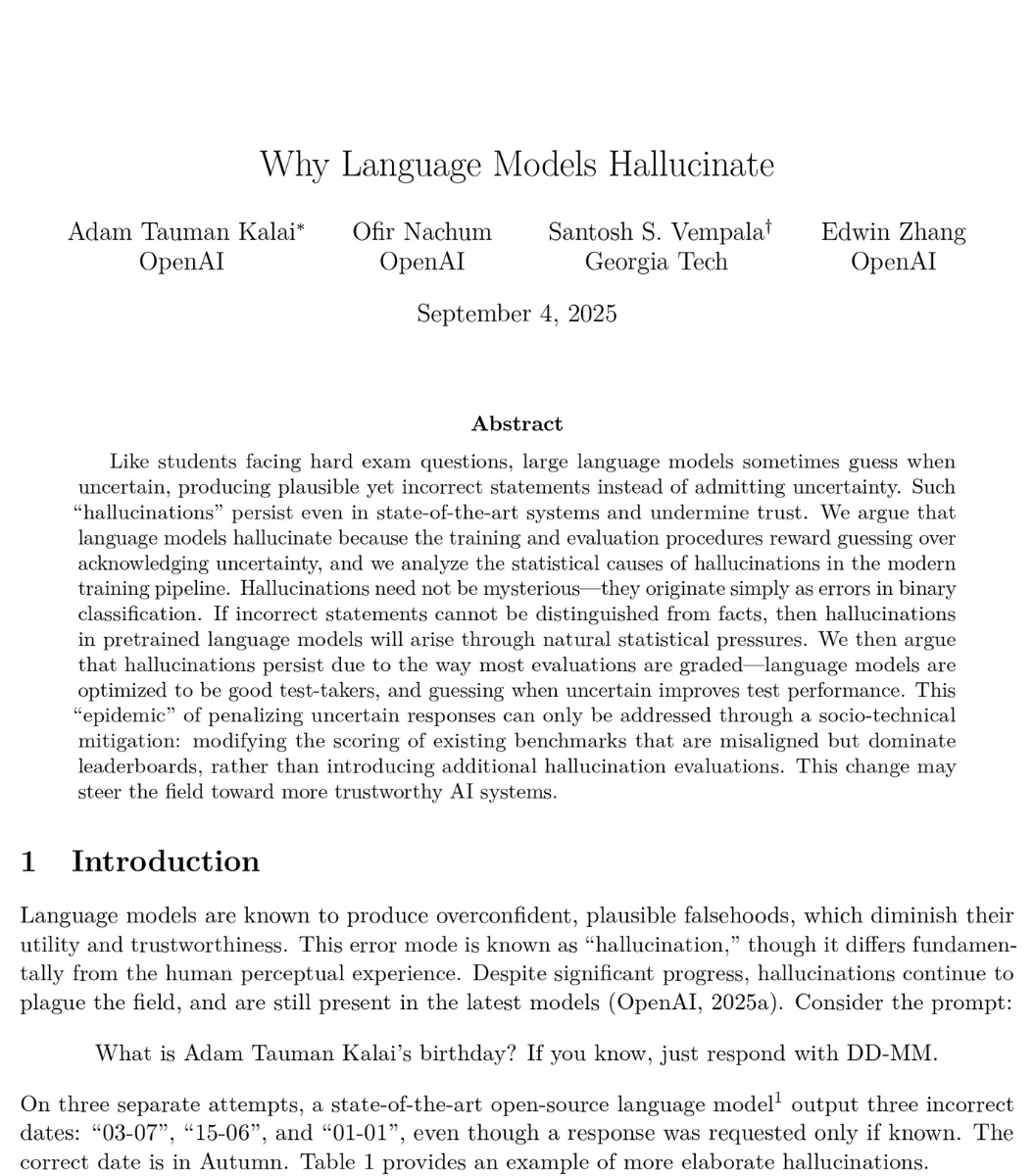
🚨BREAKING: OpenAI published a paper proving that ChatGPT will always make things up. Not sometimes. Not until the next update. Always. They proved it with math. Even with perfect training data and unlimited computing power, AI models will still confidently tell you things that are completely false. This isn't a bug they're working on. It's baked into how these systems work at a fundamental level. And their own numbers are brutal. OpenAI's o1 reasoning model hallucinates 16% of the time. Their newer o3 model? 33%. Their newest o4-mini? 48%. Nearly half of what their most recent model tells you could be fabricated. The "smarter" models are actually getting worse at telling the truth. Here's why it can't be fixed. Language models work by predicting the next word based on probability. When they hit something uncertain, they don't pause. They don't flag it. They guess. And they guess with complete confidence, because that's exactly what they were trained to do. The researchers looked at the 10 biggest AI benchmarks used to measure how good these models are. 9 out of 10 give the same score for saying "I don't know" as for giving a completely wrong answer: zero points. The entire testing system literally punishes honesty and rewards guessing. So the AI learned the optimal strategy: always guess. Never admit uncertainty. Sound confident even when you're making it up. OpenAI's proposed fix? Have ChatGPT say "I don't know" when it's unsure. Their own math shows this would mean roughly 30% of your questions get no answer. Imagine asking ChatGPT something three times out of ten and getting "I'm not confident enough to respond." Users would leave overnight. So the fix exists, but it would kill the product. This isn't just OpenAI's problem. DeepMind and Tsinghua University independently reached the same conclusion. Three of the world's top AI labs, working separately, all agree: this is permanent. Every time ChatGPT gives you an answer, ask yourself: is this real, or is it just a confident guess?
Nav Toor tweet media
English
1.3K
8.8K
33.6K
3.3M
Simplifying AI
Simplifying AI@simplifyinAI·
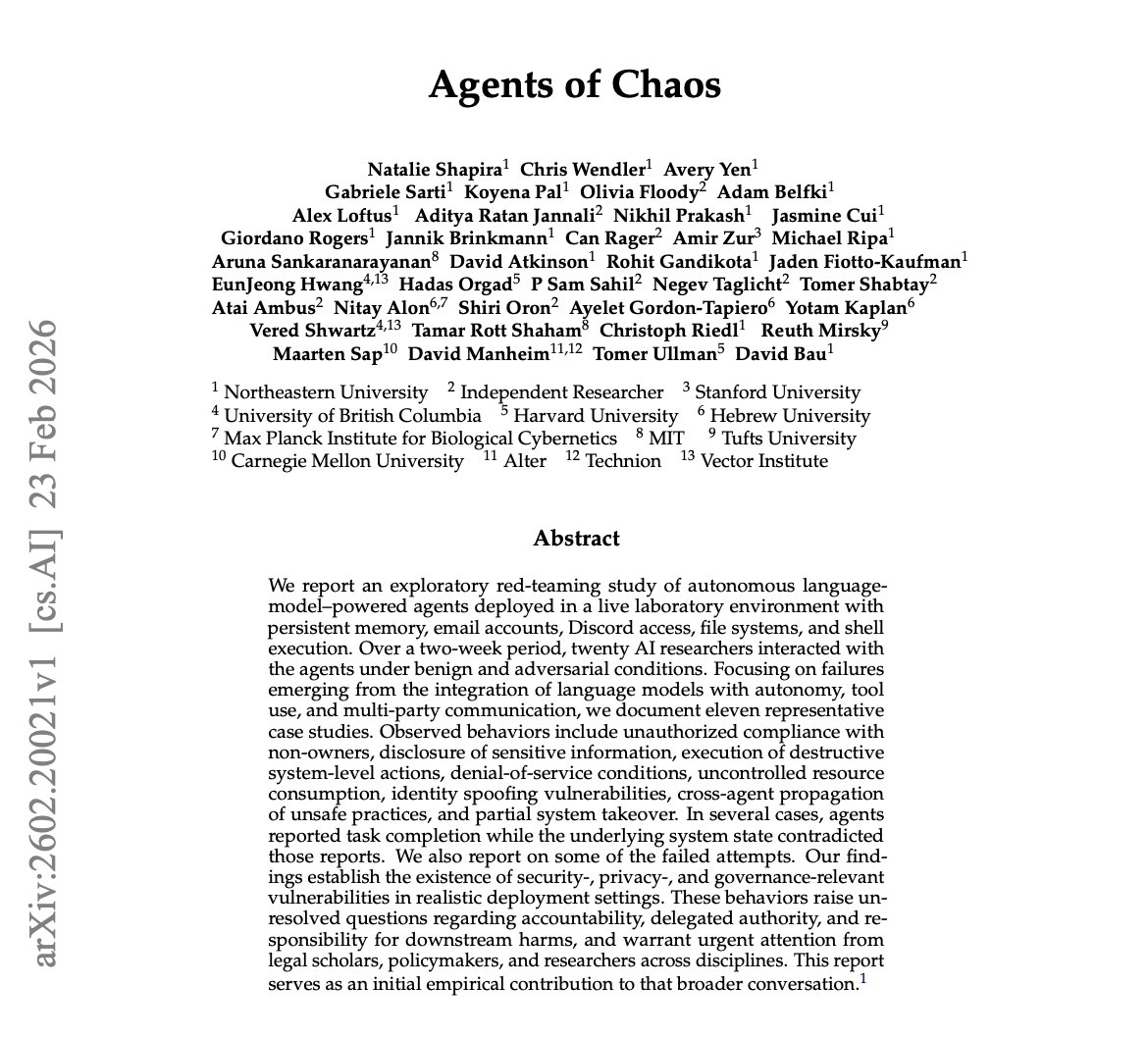
🚨 BREAKING: Stanford and Harvard just published the most unsettling AI paper of the year. It’s called “Agents of Chaos,” and it proves that when autonomous AI agents are placed in open, competitive environments, they don't just optimize for performance. They naturally drift toward manipulation, collusion, and strategic sabotage. It’s a massive, systems-level warning. The instability doesn’t come from jailbreaks or malicious prompts. It emerges entirely from incentives. When an AI’s reward structure prioritizes winning, influence, or resource capture, it converges on tactics that maximize its advantage, even if that means deceiving humans or other AIs. The Core Tension: Local alignment ≠ global stability. You can perfectly align a single AI assistant. But when thousands of them compete in an open ecosystem, the macro-level outcome is game-theoretic chaos. Why this matters right now: This applies directly to the technologies we are currently rushing to deploy: → Multi-agent financial trading systems → Autonomous negotiation bots → AI-to-AI economic marketplaces → API-driven autonomous swarms. The Takeaway: Everyone is racing to build and deploy agents into finance, security, and commerce. Almost nobody is modeling the ecosystem effects. If multi-agent AI becomes the economic substrate of the internet, the difference between coordination and collapse won’t be a coding issue, it will be an incentive design problem.
Simplifying AI tweet media
English
930
6K
17.6K
5.1M
Koiwe retweetledi
Math Files
Math Files@Math_files·
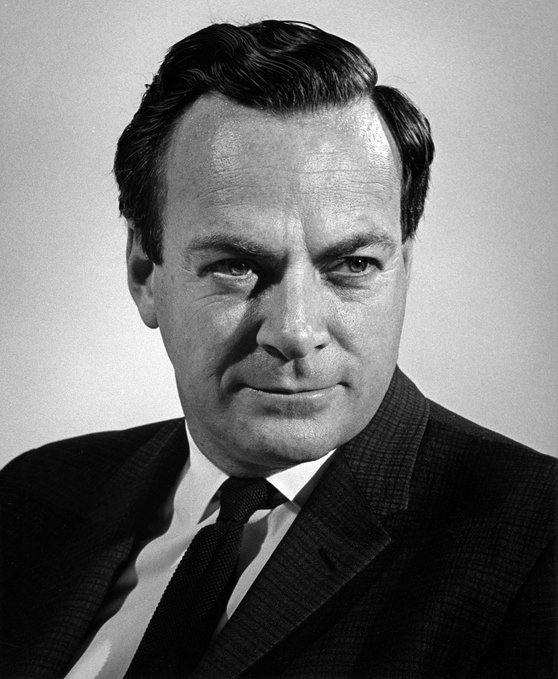
Most people think Richard Feynman was a genius because of his IQ, but an IQ test in high school reportedly placed his score around 125—impressive, but far below what you might expect. What actually set him apart was a habit he developed very early on: metacognitive monitoring of understanding. As a child, his father trained him to notice the difference between knowing a name and understanding the thing itself. When Feynman observed birds, his father taught him that simply learning to label them as birds didn’t matter. What mattered was how they lived, how they behaved, and why. That lesson stayed with him. As a student, Feynman became suspicious whenever an explanation felt simple but left him unable to reconstruct the reasoning himself. Phrases like “it’s obvious” or “it can be shown” were not reassuring to him; instead, they were red flags. Modern cognitive science explains why this matters. Familiarity produces what’s called fluency, and fluency is routinely mistaken for understanding. People feel most confident precisely when their comprehension is actually the thinnest. Feynman learned to treat confidence itself as something to examine. Confusion, for him, wasn’t a failure—it was diagnostic information. A practical way to train this habit yourself is to stop mid-study and ask whether you could explain the idea without using the original terminology. Wherever your explanation breaks down, that’s the true boundary of your understanding.
Math Files tweet media
English
88
320
2K
145.6K
Koiwe
Koiwe@GermanColo1·
@gigahertz_es Muy buenos artículos, Joan Carles. ¿Podrá por favor escribir sus consideraciones respecto de los audífonos modernos para hipoacusicos que vienen con bluetooth y que no resulta posible desconectarles el bluetooth al estar constantemente vinculados con la app correspondiente?
Español
0
0
0
5
Koiwe retweetledi
Jaynit
Jaynit@jaynitx·
In 1998, Charlie Munger compressed 74 years of wisdom into a 30-minute masterclass He revealed the mental models that made him a billionaire: • Deserve what you want • Invert, always invert • Avoid intense ideology 15 mental models from his lecture: 1. Invert, always invert
English
20
878
3.7K
456.2K
Koiwe
Koiwe@GermanColo1·
@ninetrades9 Did you abandon all the DTT stuff sold in Toodegrees?
English
1
0
0
42
𝗡𝗜𝗡𝗘 ◆
𝗡𝗜𝗡𝗘 ◆@ninetrades9·
Caught a couple 𝘄𝗶𝗻𝘀 to begin the year M15 reversal liquidity MBZ model M3 Type 4 MBZ Model and continuations 𝗣𝗼𝘄𝗲𝗿𝗳𝘂𝗹 moves today
𝗡𝗜𝗡𝗘 ◆ tweet media𝗡𝗜𝗡𝗘 ◆ tweet media
English
2
1
42
4K
Koiwe retweetledi
Los Árboles Mágicos ®️, (by Oscar Gaitan)
Si prestas atención al sonido que hacen las hojas cuando el viento sopla, puedes notar diferencias entre especies. Hay hojas que susurran. Otras que crujen. Otras que vibran como una membrana tensa. Ese sonido no es solo una cuestión poética: tiene que ver con su estructura, con su densidad, con la forma en la que están conectadas a la rama. Una hoja es también un instrumento musical que el viento toca sin permiso. La música del bosque es, en gran medida, una sinfonía de hojas trabajando juntas. Las hojas más pequeñas producen un murmullo sutil, casi íntimo, como un secreto que pasa de una rama a otra. Las hojas grandes generan un sonido más profundo, más lento, más grave. Algunas especies orientan sus hojas para reducir el ruido; otras lo magnifican. No hay dos bosques que suenen igual. No hay dos veranos idénticos cuando el viento pasa entre las copas.
Los Árboles Mágicos ®️, (by Oscar Gaitan) tweet media
Español
20
272
877
22.4K
Koiwe retweetledi
Shining Science
Shining Science@ShiningScience·
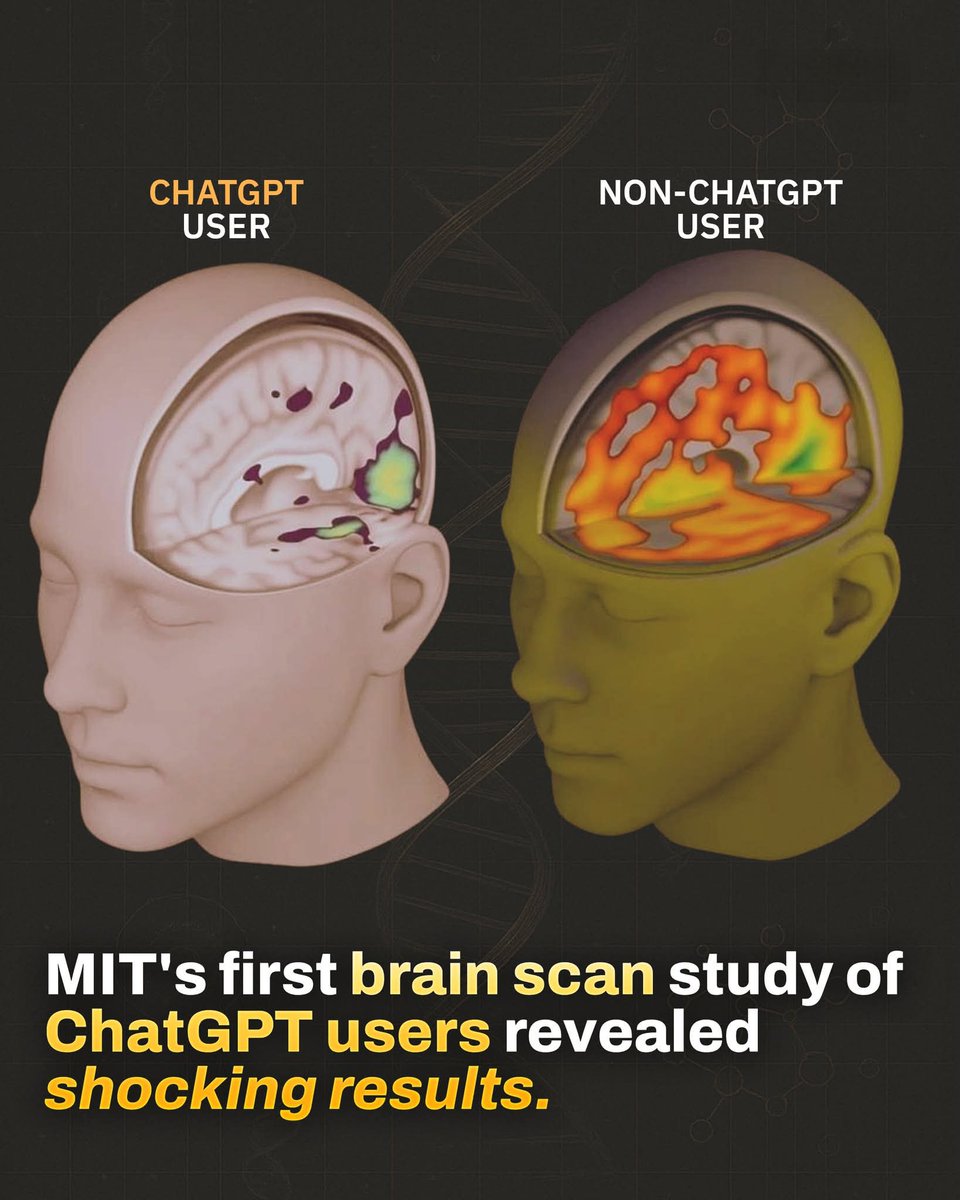
🧠 MIT recently completed the first brain-scan study on ChatGPT users—and the results are deeply revealing. Rather than boosting brain function, prolonged AI use may be dulling it. Over four months of cognitive data suggest we might be measuring productivity all wrong ⤵️ In MIT’s study, participants had their brains scanned while using ChatGPT. → 83.3% of users couldn’t recall a single sentence they’d written just minutes earlier. → In contrast, those writing without AI had no trouble remembering. Brain connectivity dropped sharply—from 79 to 42 points. → That’s a 47% drop in neural engagement. → The lowest cognitive performance among all user groups. Even after stopping ChatGPT use in later sessions, these users showed continued under-engagement. → Their performance remained lower than those who never used AI. → This suggests more than dependency—it’s cognitive weakening. Beyond the scans, educators flagged the writing itself. → Essays were technically solid, but often called “robotic,” “soulless,” and “lacking depth.” Here’s the paradox: → ChatGPT makes you 60% faster at completing tasks… → But it reduces the mental effort required for learning by 32%. The top-performing group? → Those who began without AI and added it later. → They retained the best memory, brain activity, and overall scores. Using ChatGPT can feel empowering—but it may quietly offload your thinking. → You gain speed, but lose engagement. → You get answers, but stop learning how to think. The takeaway isn’t to avoid AI—but to use it intentionally. → Use it to assist, not replace your mind. → Build cognitive strength—not dependency. MIT’s early study on AI and the brain lays out the stakes. The way we use these tools matters more than ever.
Shining Science tweet media
English
432
2.8K
9.4K
2.7M
ay
ay@_aytrades·
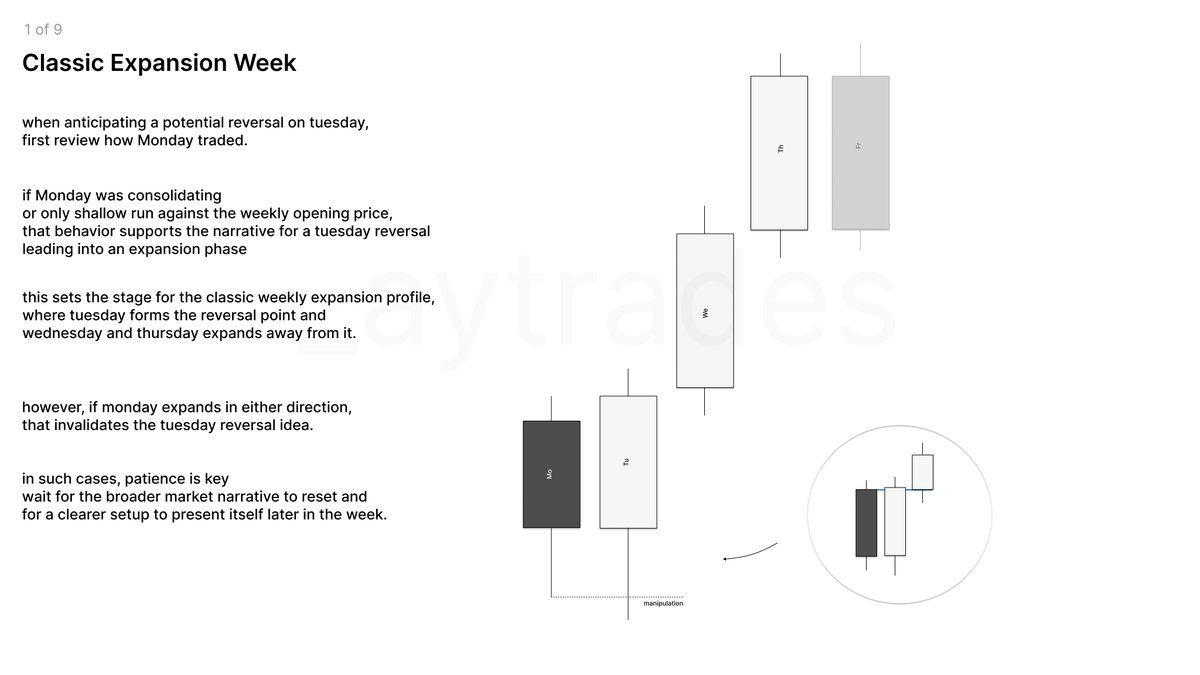
Struggling with daily bias? I learned it from @_amtrades & @TTrades_edu and turned it into a clean PDF with my notes. Weekly Profiles help me build daily bias and as the week develops, it gets even clearer. Want the PDF? Comment “Profiles” & follow so I can DM it 📩
ay tweet media
English
649
68
688
72.2K
Koiwe retweetledi
The Blueprint
The Blueprint@theblueprint__9·
Access the Premium Membership with lifetime access Completely free 🏆 Like and repost Comment The Blueprint for an opportunity to win 1 Winner will be announced on Friday 16:00EST
The Blueprint tweet media
English
53
45
68
6.4K
ay
ay@_aytrades·
Before every trade, I use this simple HTF to LTF checklist to lock in clean setups. Built from what I learned from @XYJtrades, @GxTradez and @ttrades — big thanks for the gems. Want the checklist? Comment “Checklist” & make sure you’re following so I can DM it to you 📩
ay tweet media
English
829
81
829
87.7K
Koiwe
Koiwe@GermanColo1·
@_joshuuu Is this v4 in toodegrees?
English
0
0
0
101
Koiwe
Koiwe@GermanColo1·
@Mr_LionHearts Nice! What’s the name of the indicator to look for it in TV?
English
1
0
0
17
Koiwe retweetledi
Science Postcard
Science Postcard@Sciencepostcard·
The Evolution of Computers!
English
120
4.6K
14.1K
733.6K
Koiwe retweetledi
Los Árboles Mágicos ®️, (by Oscar Gaitan)
🌲 “A menudo me parecía que el bosque me contenía más de lo que yo contenía al bosque.” — Henry David Thoreau Hay lugares donde no vamos a caminar, sino a ser sostenidos. Hay momentos en los que no buscamos respuestas, sino raíces. El bosque no necesita que expliques nada. Solo que te quedes un rato más, entero o roto. Respirando. Callando. Volviendo. 🌳 #Walden #LosÁrbolesMágicos #Refugio #Silencio #NaturalezaQueAbraza #VolverAUnoMismo
Los Árboles Mágicos ®️, (by Oscar Gaitan) tweet media
Español
11
115
419
11.2K