
Sabitlenmiş Tweet
GregCostigan 📈
20.8K posts

GregCostigan 📈
@Greg_Costigan
Head of Growth at The Build Fellowship. Increasing the number of skilled immigrants in the US benefits everyone.
Orange County, CA Katılım Nisan 2011
825 Takip Edilen698 Takipçiler

The next wave of 'Global Resilience' startups won’t look like defense
With a portfolio across Anduril, Nominal, Helsing, Valinor, Saronic, Castelion..
"It's not just about defense tech"
@generalcatalyst's Paul Kwan says we need to think bigger.
GC is looking for what comes next — companies rebuilding industrials, energy, healthcare, & government.
“There's so many ways to contribute to this reindustrialization.”
Paul Kwan, Managing Director of General Catalyst at Hill & Valley Forum 2026 (@HillValleyForum)
Molly O’Shea@MollySOShea
BREAKING: Paul Kwan, Managing Director of @generalcatalyst's Global Resilience Team: "Capital does not equal contracts" "There's a ton of energy. There's a line out the door just to get in. It's amazing the awareness in the focus on this space, defense, industrial power, but we kind of have to not conflate that contracts & capital are different. We have a lot of capital, private capital, & public capital, but that's not the same as contracts. Capital does not equal contracts. We need to have the follow through on contracts to companies to keep the flywheel going." Say more.. "An example I give you is like NATO did a ton of work to put together this NATO innovation fund a few years ago. They raised $1 billion dollars of capital from all the nations to invest in defense tech. And my thought would've been, instead of spending a billion dollars investing, it should just bought a billion dollars of contracts that would've led to $5 or $6 billion of VC funding. Instead, a few years later, they're just winding the whole thing down and didn't have the impact. So to me. Again, we have all this private capital coming into the ecosystem, it's great, and public capital, but if we don't have the contract follow through from the DOW on these programs, then you don't get the revenues, you don't get the commercial flywheel to go build all the stuff we need to build. Hill & Valley Forum 2026 (@HillValleyForum)
English
@StevenMCole2 @mcuban @DrDiGiorgio There are valid arguments against the US system - especially if one doesn’t have insurance.
But it’s not a binary issue - shoot there’s even private care options people pay out of pocket for in Canada.
English
@StevenMCole2 @mcuban @DrDiGiorgio I do think there are valid arguments for both systems.
But the Canadian system is not objectively better. Different system, more average, more “equal”. Less upside - shoot all the top doctors leave for the US.
Canadians should be objective not defensive in their analysis.
English

Mark, you are getting close to understanding why single payer cannot work. But I fundamentally disagree with the idea that we could ever just "know" costs well enough to make it work. Hayek was right about this. The relevant knowledge is too dispersed, too local, and too dynamic to ever be gathered and priced correctly by central planners.
Take basketball.
Imagine single payer basketball. The government is the only purchaser of basketball entertainment in all its forms.
Fans are not allowed to just buy a ticket to the Mavs game. Instead, a central office decides who gets to attend and hands out tickets based on "need." The central planners also handle the TV deals, merchandising, concessions, and every other revenue stream. Everything goes through the government, with no out of pocket cost to any consumer.
Now teams no longer compete for fans on price, experience, convenience, or innovation. They submit cost reports to Washington explaining what it allegedly costs to run a game.
But here is the problem. If there is no market price for tickets, media rights, parking, merchandise, or concessions, how exactly do you decide what the game is worth? How do you decide what players should be paid? How do you know whether a courtside seat is underpriced, overpriced, or priced just right? You do not. You are guessing.
So bureaucrats step in and decide the approved reimbursement for a regular season game, a playoff game, courtside access, halftime entertainment, parking, and concessions.
What happens next?
If the approved rates are too low, teams do not magically become leaner and more innovative. They cut where fans can feel it. Fewer games. Worse arenas. Less staff. Delayed upgrades. Lower quality. Longer waits. Less access. Maybe smaller market teams shut down altogether.
If the approved rates are too high, you do not get efficiency either. You get lobbying. Every team hires consultants to prove that its fan base is poorer, sicker, more rural, more complex, or otherwise deserving of special payment adjustments. Soon the league is no longer about basketball. It is about coding, compliance, modifiers, subsidies, carveouts, and political influence. Teams make money not by pleasing fans, but by persuading Washington that their costs are uniquely deserving of reimbursement.
And once government is the only buyer, there is no real price discovery left. There is only political bargaining disguised as pricing. The Knicks get one deal. Rural teams get another. Old arenas get subsidies. Favored constituencies get carveouts. Every interest group insists that without one more special adjustment the whole sport will collapse.
Fans are told this is fair because nobody has to pay at the gate.
But of course they still pay. They pay through taxes. They pay through rationing. They pay through fewer choices. They pay in lower quality. They pay by being told which arena they can use, which game they qualify for, and how long they have to wait.
That is the key point. Knowing the accounting cost of hosting a basketball game does not tell you the right price of a ticket. Price is not cost. Price emerges from supply, demand, scarcity, quality, preference, and competition.
A central planner can know what it "costs" to turn on the lights, pay security, and clean the arena. That still tells him nothing about what a seat is worth to fans, what kind of experience teams should offer, which franchises are efficient, or where new arenas should be built.
Healthcare is even less suited to central planning than basketball. It is more heterogeneous, more personal, more local, and far more dependent on dispersed knowledge. The fantasy is always the same: if only the people at the top had better data, they could set the right prices. No, they could not. They would still be guessing, just with nicer spreadsheets.
Mark Cuban@mcuban
Single payer COULD cut cost and improve care but there are 2 fundamental issues. 1. All plans proposed have placed the Sec of HHS in charge of the program. You can't have a political appointee in that position and it's hard to de-politiicize HC in this country 2. They assume that they can get providers and specialists to accept whatever rates they set. You are talking about organizations that in most cases, don't even know their costs. Why ? They don't want to know their costs. For lots of reasons to long to dig into here Proponents of M4A have to first get hospitals to the point where they can define all their costs and do a Bill of Materials for procedures. You can't negotiate a price for all Americans if you don't know what your costs are It's Shark Tank 101. So we get a stalemate. Politicians don't do the work needed. Hospitals and providers avoid the work needed Other countries started on their path to universal care decades and decades ago. When healthcare was much simpler technically and fiscally. If senators won't support the Break Up Big Medicine Bill or anything comparable , there is no chance of getting to single payer. Our politicians don't have the backbone to do what is needed. You can call out all but Hawley and warren. No one else has uttered a syllable in support
English
@ChrisParry @StevenMCole2 @mcuban @DrDiGiorgio Lived both places. I disagree. See my other comments.
English

English
English

@Greg_Costigan @StevenMCole2 @mcuban @DrDiGiorgio I love when Americans tell us how our health care system is working 🙄
English

Government must deliver for working people—and every dollar in our budget should work as hard as they do.
That’s why I directed every agency to cut waste and help close our budget gap.
Here’s some of what we found.
English

Bernie Sanders and Alexandria Ocasio-Cortez' AI Data Center Moratorium Act contains a moratorium on all US datacenter upgrading and construction, as well as a ban on the export of all US-origin GPU's. Press conference this afternoon.

bryan metzger@metzgov
INBOX: @BernieSanders and @AOC will introduce the “AI Data Center Moratorium Act” at a 4 pm press conference on Capitol Hill today.
English

INBOX: @BernieSanders and @AOC will introduce the “AI Data Center Moratorium Act” at a 4 pm press conference on Capitol Hill today.

English

I like this analogy a lot. Strongly agree. Let’s build.
TBPN@tbpn
Sequoia’s @shaunmmaguire says Silicon Valley is undergoing a "Copernican" shift and waking up to the fact that it revolves around a set of much larger industries, not the other way around: "In Silicon Valley, [there's] almost this Copernican principle — where people used to believe that the world revolved around the Earth, then realized that it revolves around the sun." "There's a Silicon Valley parallel where people think that all of technology, all of industry, revolves around Silicon Valley, but it's actually kind of the opposite." "Silicon Valley is Earth, and there are these much bigger forces and bodies, which include energy, the chemical industry, these giant supply chains, and the semiconductor industry, which has been around for a very long time. It was pretty advanced, and people in Silicon Valley forgot about it." "I don't like the language of other industries pivoting into AI. I actually think it's the opposite." "I think it's like Silicon Valley is waking up from its toddlerhood and realizing that there were these giant industries that we underestimated, and they're actually really freaking good at what they do. And we can all benefit by working together."
English
GregCostigan 📈 retweetledi

Sequoia’s @shaunmmaguire says Silicon Valley is undergoing a "Copernican" shift and waking up to the fact that it revolves around a set of much larger industries, not the other way around:
"In Silicon Valley, [there's] almost this Copernican principle — where people used to believe that the world revolved around the Earth, then realized that it revolves around the sun."
"There's a Silicon Valley parallel where people think that all of technology, all of industry, revolves around Silicon Valley, but it's actually kind of the opposite."
"Silicon Valley is Earth, and there are these much bigger forces and bodies, which include energy, the chemical industry, these giant supply chains, and the semiconductor industry, which has been around for a very long time. It was pretty advanced, and people in Silicon Valley forgot about it."
"I don't like the language of other industries pivoting into AI. I actually think it's the opposite."
"I think it's like Silicon Valley is waking up from its toddlerhood and realizing that there were these giant industries that we underestimated, and they're actually really freaking good at what they do. And we can all benefit by working together."
English

Why does it cost less to build a base on the moon than high speed rail from sf to la
Kalshi@Kalshi
JUST IN: NASA announces $20 billion plan to build permanent moon base
English
GregCostigan 📈 retweetledi

🚨Breaking: Tesla is hiring a Terafab Program Manager to own the end-to-end program from concept through execution, ramp-up, and production readiness.

English
GregCostigan 📈 retweetledi
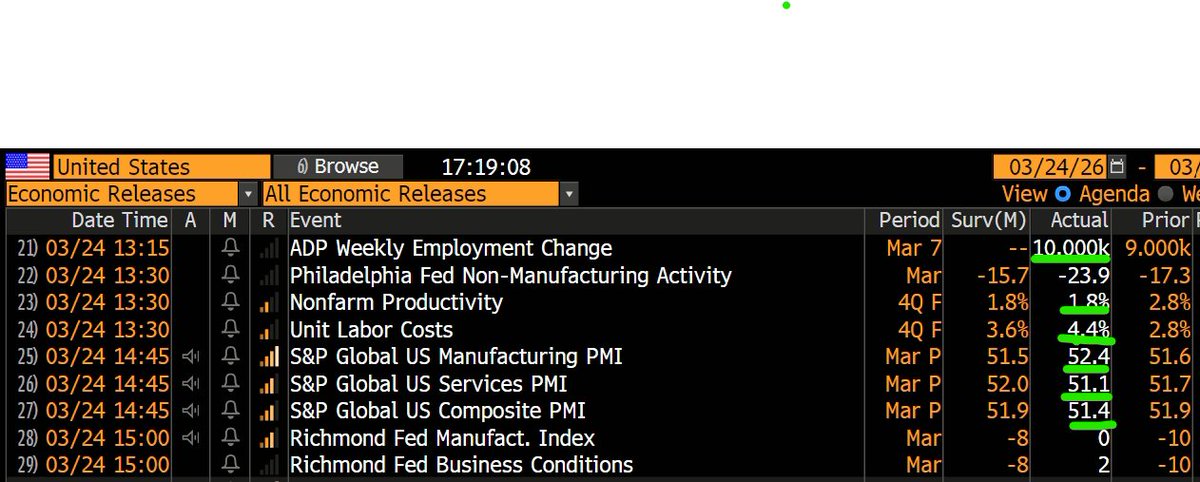
United States manufacturing activity expands at the fastest pace in months. Both manufacturing and services are in clear expansion.
US business confidence and profit outlook rise, and real net wages are rising.
via SP Global, Bloomberg
English

Jensen Huang just explained why China is winning the technology race in two sentences.
Huang: “Our country’s leaders… they’re mostly lawyers. Most of their leaders are incredible engineers.”
One country sends engineers to lead. The other sends lawyers.
One builds. The other regulates what was already built.
Huang: “They showed up at precisely the time when technology is going through that exponential.”
China did not stumble into the AI era. They arrived engineered for it.
The education system produces engineers at a scale the West refuses to match. The competition is not tough. It is Darwinian.
The culture rewards builders.
Not commentators. Not consultants. Builders.
Then the accelerant. Open source.
When your talent pool runs that deep and that hungry, you do not hoard breakthroughs. You release them.
The community multiplies everything. What costs American companies a quarter, Chinese teams finish in weeks.
Not because they are smarter. Because the entire system points one direction. Zero friction between idea and execution.
No committee. No review board. No eighteen-month compliance process.
Then Huang said the part that should terrify Washington.
Huang: “Their country was built out of poverty.”
Comfort makes nations careful. Poverty makes nations relentless.
When you built everything from nothing, you do not slow down to protect it. You accelerate because you still taste what nothing felt like.
America built its dominance with engineers.
The highways. The moon landing. The semiconductor. The internet.
Then it handed the keys to the lawyers.
Compliance departments. Regulatory bodies. Oversight committees. Review processes for the review processes.
Every layer of protection is a layer of friction.
And friction is a luxury you cannot afford when your competitor rides an exponential curve.
Fridman: “It’s a builder nation.”
Huang: “Yeah, it’s a builder nation.”
No pushback. No qualifier.
The West is not being outspent. It is being out-structured.
Engineers ask how do we build this faster. Lawyers ask how do we build this without getting sued.
One of those questions wins the century. The other writes a detailed report about why it lost.
English

Canada keeps getting poorer, our fiscal situation is worse, the investment climate remains uncompetitive, projects we need aren’t happening
nationalpost.com/opinion/what-h…
English
Need more skilled immigration ASAP
Dan Nystedt@dnystedt
Tesla’s TeraFab has launched a talent war in Taiwan via job postings seeking senior chip experts (Process Integration Engineers) with over 10-years of experience, media report, adding its 2nm fab plan aims directly at TSMC. Chip engineers are already in short supply in Taiwan – like nearly everything chip related – and industry insiders worry the ‘Musk Halo Effect’ will draw local talent. More: Deep expertise in FinFET, GAA, BSPDN, and across all stages of chip building: FEOL, MOL and BEOL. $TSLA $TSM $UMC $ASX #semiconductors #semiconductor money.udn.com/money/story/56…
English