LizAnne Handibode

11.5K posts

LizAnne Handibode banner
LizAnne Handibode

LizAnne Handibode

@Handibode

Unison Scot & Scot Labour. Activist. Ex Trading Standards professional. Broadsword calling Danny Boy. Tweets personal, if you don't like then just scroll on...

Lanarkshire, Scotland and NY Katılım Ağustos 2009
1.5K Takip Edilen1.1K Takipçiler
LizAnne Handibode retweetledi
Kurt Mahlburg
Kurt Mahlburg@k_mahlburg·
Finland tracked every gender-referred adolescent in the country for up to 25 years. Their psychiatric needs didn't improve after 'gender reassignment'. They surged. A landmark peer-reviewed study just dropped. Here's what it found. 🧵

Kurt Mahlburg tweet media
English
731
12.9K
44K
4.5M
LizAnne Handibode retweetledi
Jane McLenachan
Jane McLenachan@jane_mclenachan·
Women involved with community justice services have frequently experienced abuse and trauma caused by men. Refusing to guarantee these vulnerable women single sex services is not only illegal but also cruel and inhumane.
WRN Scotland@WRNScotland

Our question for @scotparl election candidates today Will you commit to ensuring all women’s community justice throughcare services fully comply with the Supreme Court ruling? @theSNP @ScottishLabour @ScotTories @scottishgreens @scotlibdems @ReformUKScot @IndyScotParty

English
0
20
36
717
LizAnne Handibode retweetledi
Wolf of X
Wolf of X@WolfofX·
British Army Major Chris walked 700 miles barefoot across the UK to fund research for his daughter’s rare disease. This is the moment they reunited at Edinburgh Castle
English
101
1.7K
19.9K
325.3K
LizAnne Handibode retweetledi
Dr Dr P: 'Gender dysphoria' is false
Bloody hell! This just confirms what being on this platform for two years has made clear to me as a Black woman (who, btw, has never once in my entire life been mistaken for a man. And neither has my mum, sisters, daughter or any female relatives). The vilest racists are on the 'tolerant' Left. And the really sad/shocking/unnerving/enraging thing is that they don't get it. They literally cannot see their own faults and failings.
Kate Barker-Mawjee@KateBMwriting

The Guardian telling on themselves here. Suggesting that black women are a bit like men, if you really think about it 😳

English
111
519
2.9K
64.9K
LizAnne Handibode retweetledi
WheeshtCraft
WheeshtCraft@Dis_Critic·
@TheCinesthetic A rape crisis service is inhumane, is it? Women and girls who were survivors of sexual assault in Scotland's capital were turned away from a rape crisis centre (created by women for women) by a man because those survivors wouldn't share their trauma with him. That's okay, tho?!
English
0
14
131
1.5K
LizAnne Handibode retweetledi
Avocado 🥑 of THE LAW LEAVES NO SCOPE Wrath #KPSS
@TheCinesthetic Can he specify what noted philanthropist @jk_rowling does that is ‘inhumane’? Fund MS research? Support looked-after children worldwide? Help 100+ Afghan women jurists escape Taliban death squads & resettle? Fund the only trauma-informed rape crisis & DV centre in Edinburgh?
English
2
13
85
2K
LizAnne Handibode retweetledi
Susan Dalgety
Susan Dalgety@DalgetySusan·
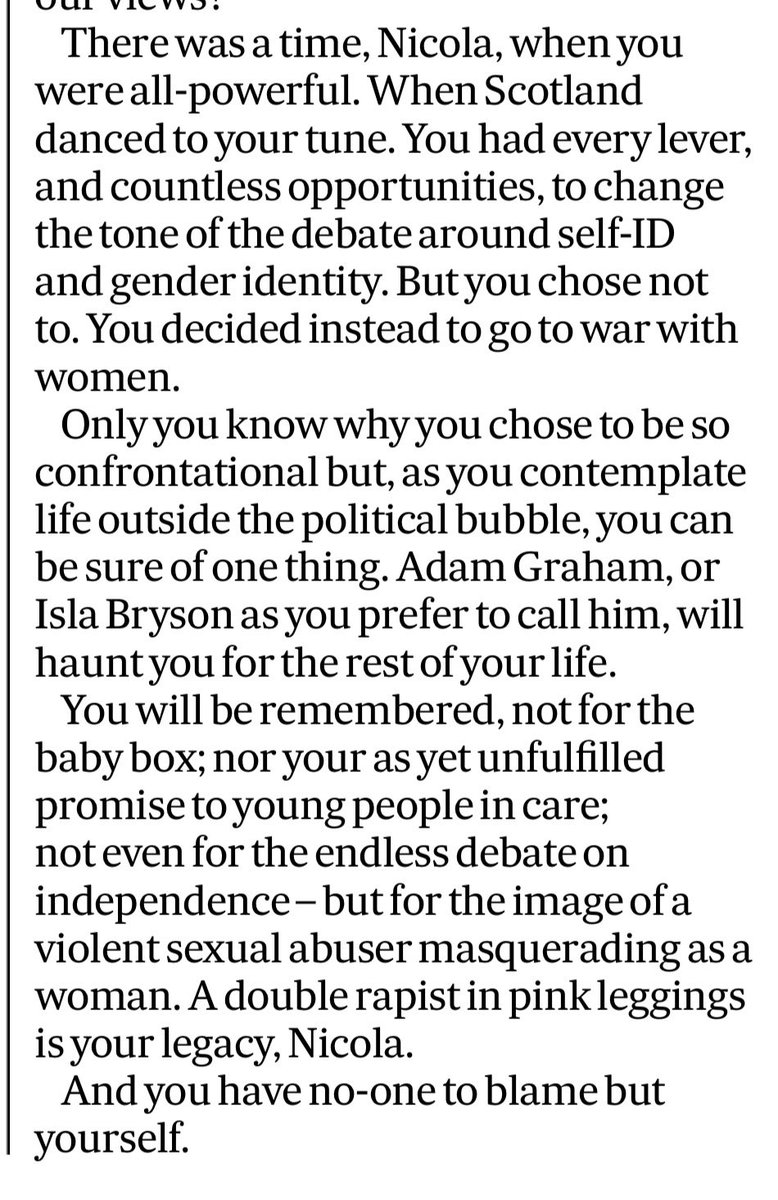
Earlier this week, Nicola Sturgeon said there was nothing she could do to change the tone of the debate around gender. This is not true, as I explain in my @TheScotsman column today…link in replies
Susan Dalgety tweet media
English
34
243
821
16.3K
LizAnne Handibode retweetledi
Lily Craven
Lily Craven@TheAttagirls·
Woman of the Day and one of the UK’s first servicewomen, Margaret Caswell born in 1896 in Ogbourne St George, a tiny village in Wiltshire considered so quintessentially English that the address of the manor was later used in a fictitious letter from ‘Pam’ to ‘Major Martin’ as part of the famous WW2 Operation Mincemeat deception strategy to fool the Germans. Little is known of Margaret’s early life. She was the second of ten children of a farm carter and left school in her mid-teens to help her mother at home. Why today then? OTD 1917, the Women's Army Auxiliary Corps (WAAC) was founded. They were Britain's first official servicewomen. Margaret was one of its very first recruits, enlisting at Tidworth. She had already been doing her bit, well, as much as any young woman was allowed to. Just 18 when WW1 broke out, she joined the Women’s Legion, a unit founded in August 1915 to provide cooks, waitresses and gardeners to the army but in early 1917, she transferred to the WAAC and was assigned the rank of Worker, service number 15703. At this stage of WW1, the Department of National Service had thought about calling up men in their fifties to release more soldiers for front-line service but this wouldn’t have given them the numbers they needed so they turned to women. The formidable Dr Mona Chalmers Watson became the WAAC’s first Chief Controller and initially, women were meant to be restricted to ‘feminine’ auxiliary roles - store work, administration catering - and only in Britain, but in wartime, things change rapidly and force social change. Women were needed near the frontline in France as cooks, clerks, telephone operators, storewomen, drivers, printers, bakers and cemetery gardeners, and so Helen Gwynne-Vaughan was appointed as Chief Controller Overseas. By the end of WW1, 50,000 women had volunteered. Restricted to support roles, they were still exposed to enemy attacks. Margaret arrived in France on 31 March 1917, barely a week after enlisting. Another of her group, Emmy Gaunt, recorded: “All the preliminaries completed, we duly received embarkation orders to proceed to Victoria Station, there to take the Continental Boat Train to Folkestone, and thence to Boulogne – the first draft of khaki-clad members of the Women’s Army who were destined for the duration to do their bit side by side with the soldiers.” On arrival in France, Helen Gwynne-Vaughan organised the women ably despite the obstruction of some of her male colleagues. She later wrote: “I discovered that the objection to the employment of women was almost universal. The services, of all professions, had naturally the least experience of working with women, they knew little of the extent to which, even then, men and women were working easily together, they mistrusted the complications which the influx of a large body of women might entail, they disliked the intrusion into their offices and workshops of an alien element.” Margaret was assigned to waitress duties at the officers’ club at Abbeville camp near the Somme. Abbeville was a key target of the Germans because it served as a military hospital for the Somme. Unexploded ordnance can still be found in the soil of Abbeville today. On 9 April 1918, the unit was renamed Queen Mary’s Army Auxiliary Corps (QMAAC) in honour of the women’s service, especially their brave conduct during the German Spring Offensive the previous month. When her shift finished late on 29 May 1918, Margaret returned to QMAAC Camp 1 to retire to bed. In the early hours of 30 May, German aircraft targeted the camp. Margaret and some of her colleagues made it to the protection trench but the Germans dropped a bomb on a lorry close to the camp, setting it on fire and “by the light of the flames” dropped three more bombs including on the protection trench. Margaret and eight of her colleagues were killed. Seven others were wounded. During that night, 81 servicewomen were killed. Five, including Dr Phoebe Chapple, were awarded the Military Medal for their actions during the air raid. Worker Marjory Peacock, a friend of one of the dead women, wrote of the funeral: “Graves in France were just long trenches so before Trixie (Worker Beatrice Campbell) was buried, some of us went out into the woods and gathered daffodils and brought packets of hair pins from the canteen and went down into the grave and lined her part of it by pinning daffodils to the sides before she was buried.” Margaret and her comrades were buried at Abbeville Communal Cemetery Extension on the Somme. She was 22.
Lily Craven tweet media
English
11
68
204
4.2K
LizAnne Handibode retweetledi
Jill Foster
Jill Foster@JournalistJill·
@CPSUK Meanwhile, we recognise who you have - and have not - been listening to…
Jill Foster tweet media
English
30
332
1.6K
18.1K
LizAnne Handibode retweetledi
For Women Scotland
For Women Scotland@ForWomenScot·
“Few lawmakers have tried to destroy women’s legal rights with the single-minded determination of Ms Sturgeon, leaving the rest of us to mop up the chaos caused in hospitals, prisons, and the violence against women sector. Now, it seems, she can’t even take responsibility for her failures and continues to blame women’s rights campaigners for the ‘toxic’ debate while she — who held all the cards — alternately ignored us and smeared us. “As she vanishes into the sunset, she leaves little in the way of legacy. Were it not for the fat pay packet in her pocket, we would pity her for her delusions and her failures.” thetimes.com/uk/scotland/ar…
English
9
232
765
10.2K
LizAnne Handibode retweetledi
Annemarie Ward 💜
Annemarie Ward 💜@Annemarieward·
This is what managed decline looks like when it’s dressed up as concern. Six billion pounds. Let that sit for a second. Not a rounding error, not a line in a budget, but the price tag of a system that has quietly made peace with failure. And still, the language is careful, polite, almost apologetic. “The price of inaction is too high.” No. The price of this action is already catastrophic. You’ve got rising deaths, the worst rate in Europe, billions drained from the public purse, and what’s the response? More of the same. More process. More programmes. More carefully worded sentences about “widening access” while the outcomes move in the wrong direction. This is the part no one wants to say out loud. If your strategy costs billions, produces worse results year on year, and still calls itself progress, it’s not a strategy. It’s a belief system. And belief systems don’t respond to evidence, they absorb it. “Drug harms are avoidable,” the report says. Quite right. But only if you’re willing to confront the uncomfortable truth that managing addiction is not the same as treating it, and stabilising chaos is not the same as restoring a life. Instead, we get theatre. Consumption rooms presented as solutions, naloxone handed out like a long-term plan, and an entire ecosystem of organisations whose survival depends on the crisis never actually ending. And here’s the sting in the tail. The real cost isn’t six billion. That’s just the number you can print. The real cost is the quiet decision, made over years, that some people will never recover, and that the best we can do is keep them alive just long enough to count them in next year’s statistics. You don’t spend six billion pounds a year because the problem is unsolvable. You spend it because you’ve stopped trying to solve it. Instead, we have built an entire architecture that can explain failure, fund failure, and survive failure, but cannot end it. The tragedy here is not just the deaths, though God knows that is enough. It is the shrinking of our moral ambition. We have gone from believing people can recover, to hoping they survive, to quietly planning around the assumption that many never will. If that is the settlement, then let’s at least be honest about it. But don’t call it progress. Don’t call it evidence-led. And for heaven’s sake, don’t call it compassionate. Because real compassion does not lower the bar to meet despair. It raises people out of it.
Agent P@AgentP22

£6 BILLION a year and STILL the worst drug death rate in Europe. After nearly two decades in power, this isn’t bad luck — it’s SNP failure on an industrial scale.

English
5
92
189
7.7K
LizAnne Handibode retweetledi
Dr Pam Gosal MBE
Dr Pam Gosal MBE@DrPamGosal·
The scale of sex attacks in Scotland’s hospitals, as revealed by @WRNScotland is utterly sickening, and it is abhorrent that some involved children. It is also shocking that many NHS health boards do not record this information Yet when I brought this up with John Swinney, he claimed that this information is recorded 🤷‍♀️ In what universe is he living in?
English
27
349
1K
11.5K
LizAnne Handibode retweetledi
Dennis Noel Kavanagh
Dennis Noel Kavanagh@Jebadoo2·
Carla, the 2012 patient survey at the Tavistock proved 80% - 90% of the children and teens there said they were same sex attracted. 90%+ of teens on puberty blockers go on to cross sex hormones. That is chemical castration. Many gay people like me are alarmed this is gay conversion.
English
19
139
1.1K
12.1K
LizAnne Handibode retweetledi
ArchaeoHistories
ArchaeoHistories@histories_arch·
The night Florence Sabin’s mother died, the doctors gave it a neat name: “childbed fever.” Florence was seven—old enough to grasp the shape of what had happened. Her mother had gone into a room to bring life into the world and had instead been taken by an infection no one could seem to stop. Florence carried that with her. Years later, when people pictured her as a concert pianist—her hands really were that gifted—she’d quietly dismiss it. The piano was beautiful, sure. But it couldn’t answer the question that haunted her: why did the body turn against itself? So in 1896, she walked into Johns Hopkins School of Medicine—one of fourteen women surrounded by men who were certain she didn’t belong. She didn’t waste energy pleading her case. She just worked. As a student, she fixated on the brainstem of a newborn—an intricate knot of tissue so complex that flat sketches couldn’t do it justice. So she made it tangible. Using beeswax, she built a three-dimensional model, layer by painstaking layer. When she finally presented it, even the men who’d doubted her went quiet. That beeswax brain became a teaching tool for decades—and it sent a message Florence never had to say out loud: she wasn’t there to ask permission. By 1917, she was the first woman to hold a full professorship at Johns Hopkins. By 1924, she became the first woman elected president of the American Association of Anatomists. By 1925, she was elected to the National Academy of Sciences—the first woman ever, and for the next twenty years, the only one. She didn’t chase titles. She collected them the way you collect proof: through work that made denial impossible. Her research rewrote what scientists thought they knew about the lymphatic system. While others treated it like a medical afterthought, she showed that it grew outward from veins, overturning a long-accepted theory. In doing so, she helped lay groundwork for what we’d later call stem cell research—before that phrase even existed. When she left Johns Hopkins for the Rockefeller Institute, she was already famous in her field. But she wasn’t satisfied. Tuberculosis was still killing people by the thousands, and she wanted to know what happened inside the body when it fought back. For years she hunched over microscopes, tracing the behavior of monocytes—immune cells that act like foot soldiers on the front lines of infection. Her work didn’t produce a miracle cure overnight, but it gave later researchers something just as valuable: a map. And then, at an age when most people start winding down, she went back home to Colorado. She was seventy-two when the governor put her on a health committee. Later he admitted he’d assumed he was appointing a harmless elderly woman—someone respectable who wouldn’t rock the boat. He had no idea what he’d done. Sabin started digging and found Colorado’s public health laws hadn’t been updated since 1876—the year the state was founded. Raw milk was still sold. Sewage still flowed into rivers. Tuberculosis—her life’s enemy—was spreading because the system hadn’t bothered to modernize. She didn’t file a polite report and call it a day. She hit the road. She traveled to all sixty-three counties, speaking in town halls and grange halls, looking ranchers and mayors straight in the eye and telling them, “We need health to match our mountains.” She gathered data, built alliances, and pressured the state legislature with a focus so relentless it wore people out. In 1947, the Sabin Health Laws passed, transforming Colorado’s entire public health system. Tuberculosis rates fell. Disease surveillance became standard. Milk was pasteurized. She still wasn’t finished. © Historical Photos #archaeohistories
ArchaeoHistories tweet media
English
9
242
1.1K
27.7K
LizAnne Handibode retweetledi
Professor Alice Sullivan
Professor Alice Sullivan@ProfAliceS·
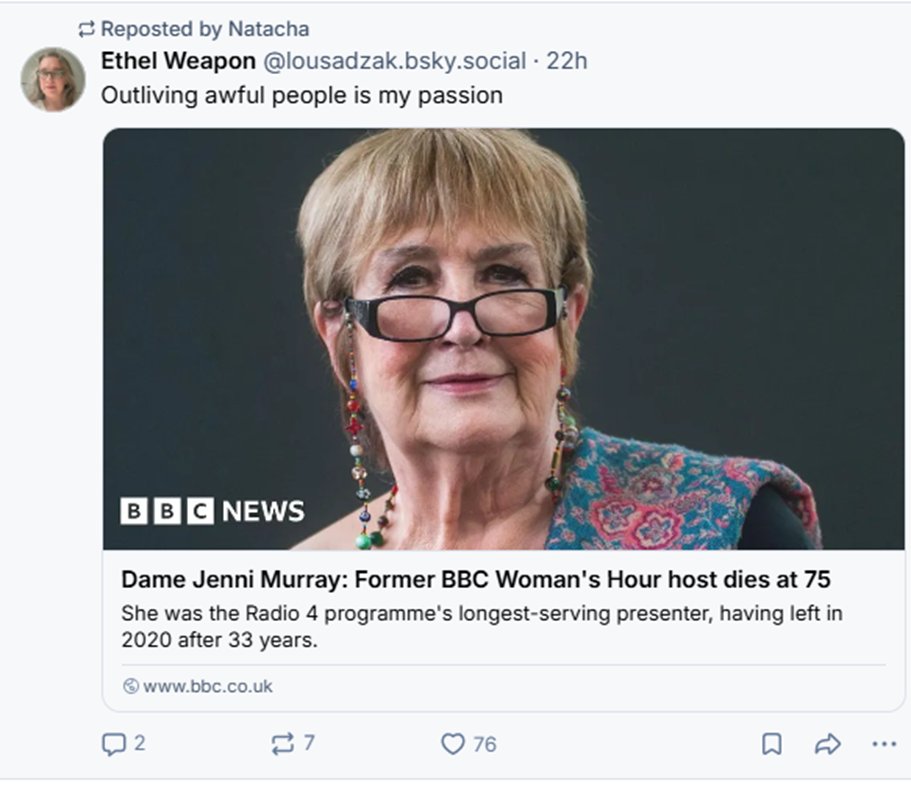
1/ Dr Natacha Kennedy, a lecturer at Goldsmiths, has been celebrating the death of Jenni Murray, the highly-respected former presenter of BBC Woman's Hour. Kennedy wishes for Jenni Murray's grave to be treated as a 'gender-neutral bathroom'. Kennedy is an important figure in academic trans activism in the UK.
Professor Alice Sullivan tweet mediaProfessor Alice Sullivan tweet media
English
244
976
2.9K
250.3K