M

6K posts

M banner
M

M

@HedgeBlade

investor

Katılım Eylül 2023
116 Takip Edilen143 Takipçiler
M retweetledi
Ramin Nasibov
Ramin Nasibov@RaminNasibov·
The Matrix was right about human civilization peaking in 1999
English
129
827
8.5K
147.3K
M retweetledi
Ethan Kho
Ethan Kho@ethanrkho·
"I haven't seen a real new idea in trading in at least 15 years." Tom Costello (@tcoste110) ran money at Tudor, Moore Capital, and Caxton. Built one of the first NLP-driven equity systems in 2003. 20 years managing capital, never had a down year. "Comparing what a retail trader does to what a quantitative hedge fund does is like comparing driving a bus on the New Jersey Turnpike to winning a Formula One race." We cover: - His hot take: no genuinely new trading idea in 15 years — only better people doing the same things faster - Why everyone in quant finance is a genius — and why that makes you ordinary, not special - Crypto is "super smart guys cosplaying at finance" — built for retail, which is exactly why it's the easiest money in finance right now - Why AGI won't beat the hedge fund industry — all the readily-capturable alpha is already captured - The status trap: why the path that made Paul Tudor Jones a billionaire won't work for the kid trying to copy it in 2026 - His friend the investment banker who'd quit it all to run a 10-employee ambulance supply company worth $150M - Why excitement is "wildly overbid" in finance — and why wanting an exciting trading job is itself a disqualifier - The most honest end of the financial industry — and why the media has it exactly backwards Thanks so much to Tom for coming on Odds on Open! Highlights: 00:00 Intro 01:18 Building institutional credibility for early-stage managers 03:01 The Pareto distribution of hedge fund returns 04:25 Applying the Unified Field Theory of Finance to fair value 08:14 Trading against human incentives in a deterministic market 13:54 Why allocators don’t steal alpha from prospective PMs 25:16 Evaluating career edge in quantitative finance for 2026 30:48 Paul Tudor Jones and the art of game selection 33:42 Analyzing the economic viability of starting a new fund 35:16 Identifying common retail pitfalls: Mean reversion and arbitrage 38:55 Why there hasn't been a new trading idea in 15 years 50:33 Managing tail risk: Physics vs. deterministic financial distributions 59:10 Career pathing for PMs after a fund blow-up 1:07:53 SBF and FTX: Credibility vs. the "Founder-Genius" archetype 1:13:44 Establishing proof-of-concept through audited multi-year returns
English
28
113
1K
587.8K
M
M@HedgeBlade·
@myfirstmilpod Past performance doesn’t guarantee future returns, same applies here
English
0
0
1
348
My First Million
My First Million@myfirstmilpod·
If you bought the S&P in late 2024 betting on 8-10% returns, you're about to lose a decade of your financial life. Billionaire investor Howard Marks on the JP Morgan chart everyone's ignoring: At the end of 2024, the S&P was at a P/E of 23. Historically, every single time the market hits a P/E of 23, the next 10 years returned between 2% and -2% annualized. NO exceptions. What this means: if you invested $100K at the end of 2024, by 2034 you'll have between $82K and $122K. Best case (2% annualized): you barely beat inflation Worst case (-2% annualized): you lose 18% of your money Either way, high-yield savings beats your "aggressive" portfolio This isn't a bearish prediction. It's a historical certainty based on the price you chose to pay. @thesamparr @ShaanVP
English
295
216
1.7K
722.4K
M retweetledi
Nik
Nik@cointradernik·
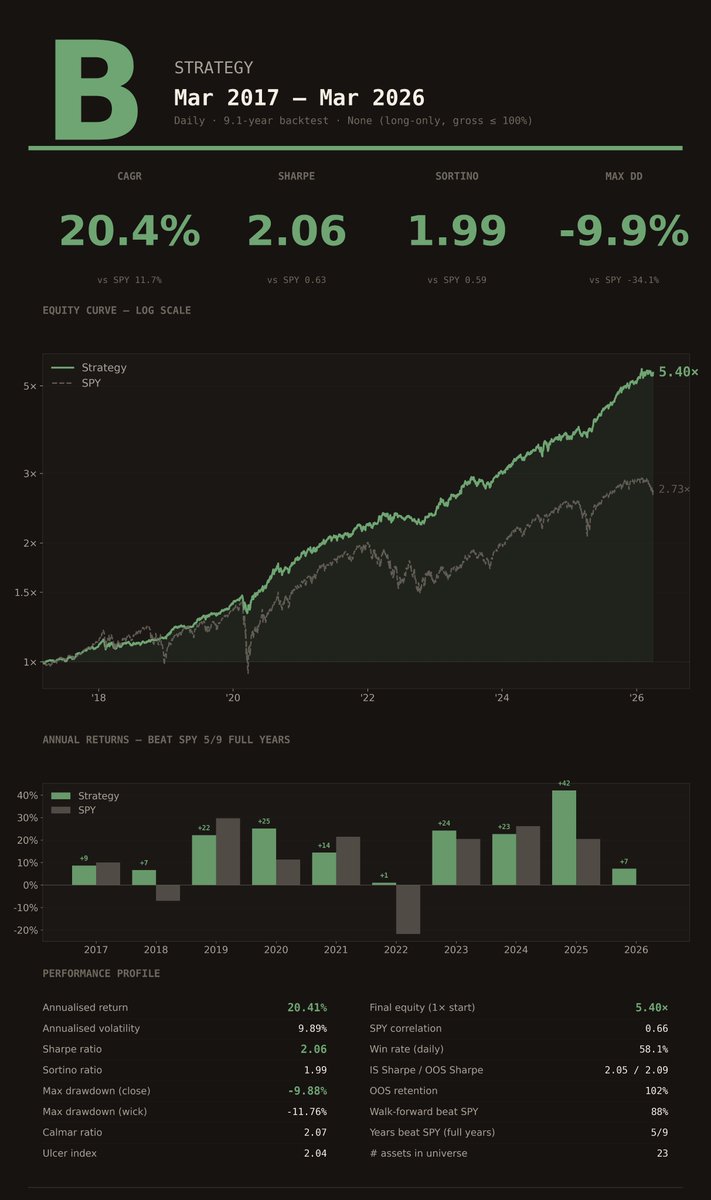
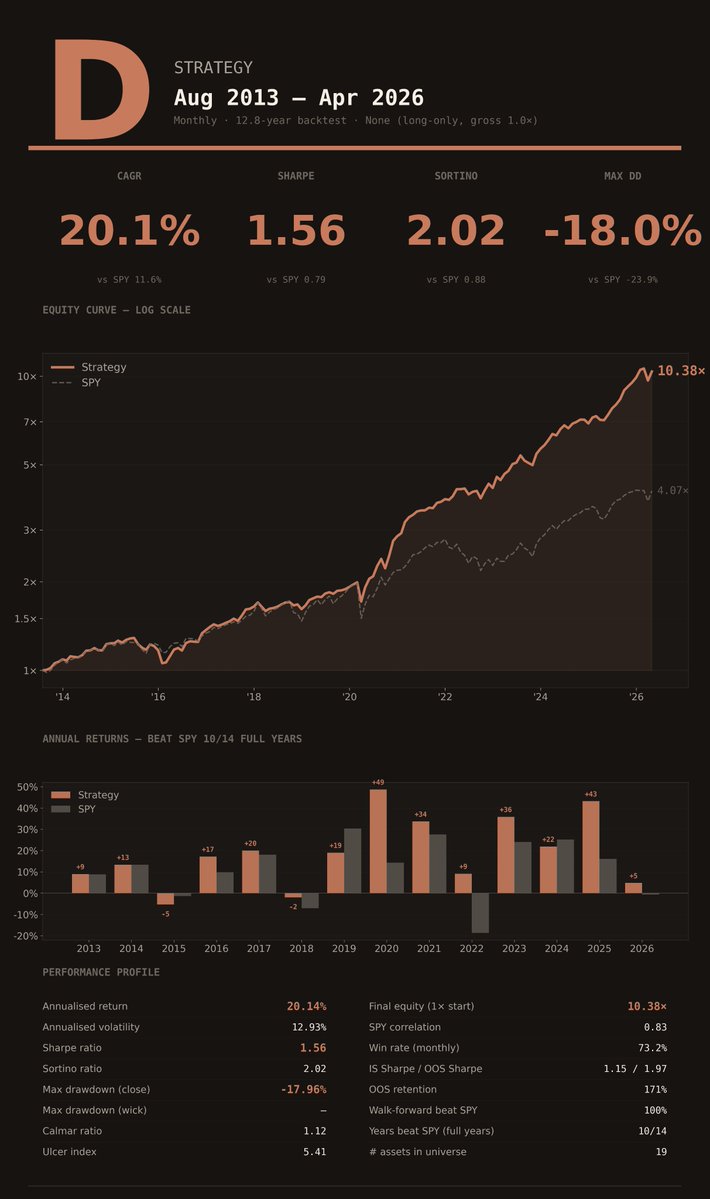
Okay, will share more on the free strategy over the next few days: There are four variants I am considering releasing, each with its strengths and weaknesses. Let me know which you'd prefer and that will help inform the decision! The sole purpose of this is to (with some luck) replace your passive investing for long-term compounding. This is not a get-rich-quick strategy. No leverage. No perps. Just ETFs and long-only. These have gone through every possible robustness test you can conjure but obviously past performance does not equal future results... Will publish everything periodically to X and to Substack, so depending on your preference either check in every month on here or just subscribe at cointradernik1.substack.com 🤝
Nik tweet mediaNik tweet mediaNik tweet mediaNik tweet media
Nik@cointradernik

So - would any of you want this strategy for free? (though you are welcome to buy me a Guinness) Beats buy-and-hold SPY with significantly less vol and shallower drawdowns. Unlevered & long-only. I am not offering this purely out of the goodness of my heart but because I am already employing *much* stronger iterations of this and feel like many are paying absurd monthly fees for levered beta (although also a little out of the goodness of my heart) If there is interest, I'll publish allocations/signals wherever is preferable

English
13
5
133
18.7K
M retweetledi
Matias Scalbi
Matias Scalbi@MatiasScalbi·
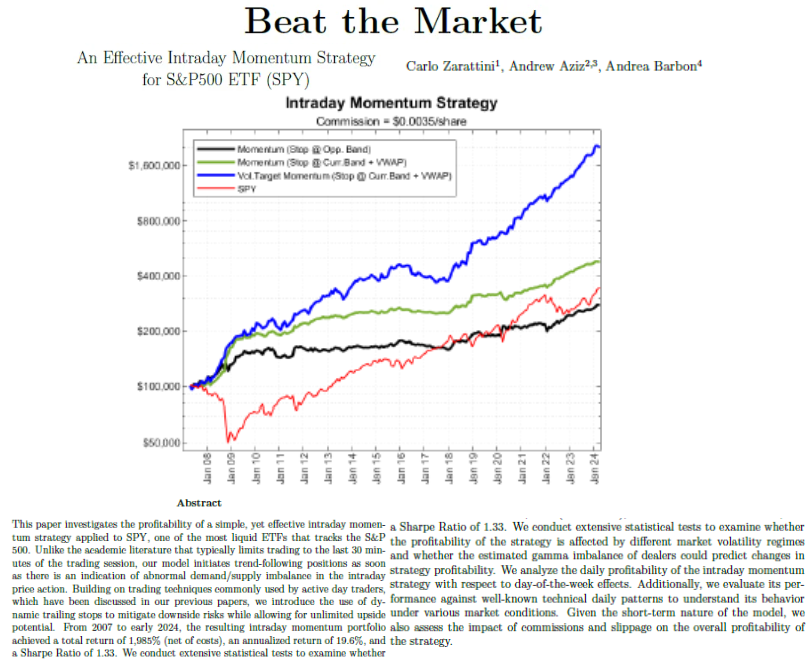
🔥 "Beat the Market" Estrategia de momentum intradía aplicada al SPY que multiplica por 9 el retorno del buy and hold La idea es simple: al inicio de cada día calculan una "Noise Area" alrededor del precio de apertura usando la volatilidad histórica. Si el SPY rompe la banda de arriba se ponen long, si rompe la de abajo se ponen short. Stop con VWAP y sizing dinámico según volatilidad Lo más jugoso es la progresión que muestran. La versión básica con stop en la banda opuesta da 178% en 17 años, peor que el SPY. Pero cuando le suman stop con VWAP el retorno salta a 380% con Sharpe 1.24. Y cuando le agregan sizing dinámico para apuntar a 2% de vol diaria, la cosa explota: 1.985% de retorno total, Sharpe 1.33, max drawdown 25% Comparen contra el buy and hold del SPY en el mismo período: 227% de retorno con Sharpe 0.45 y drawdown del 56%. La estrategia activa multiplica casi por 9 el retorno con la mitad del drawdown Lo testean además en 33 mercados globales (commodities y equity indices) entre 2007 y 2024. El portfolio diversificado con todos los activos da Sharpe 1.65. Solo 2 instrumentos de los 33 dieron retorno negativo Link al paper en el primer comentario
Matias Scalbi tweet media
Matias Scalbi@MatiasScalbi

🔥 "Leverage for the Long Run" Ganador del Charles H. Dow Award 2016, este paper rompe todo lo que pensás sobre apalancamiento Analizan qué pasa si en lugar de hacer buy and hold del S&P 500 desde 1928, usás leverage SOLO cuando el mercado está arriba de la media móvil de 200 días, y te vas a bonos del tesoro cuando está abajo Lo más interesante es que rompe el mito de que los ETFs apalancados se van decayendo con el tiempo por naturaleza. Lo que mata al leverage no es el tiempo, es la volatilidad alta y los mercados en serrucho. Cuando aplicás leverage en zonas de baja volatilidad con rachas de días positivos seguidos, pasa todo lo contrario a lo que la gente cree El número es una locura: $10.000 metidos en 1928 con buy and hold del S&P 500 te quedan en $39 millones. La misma guita con la estrategia 3x leverage rotation te termina en $28 billones, con drawdowns más chicos y mejor Sharpe La clave es simple: arriba de la 200 MA, leverage on. Abajo, cash. Nada más Link al paper en el primer comentario
Español
4
26
276
38K
M retweetledi
World of Statistics
World of Statistics@stats_feed·
Women initiate around 70% of divorces - rising to ~90% among college-educated couples.
English
397
1.3K
13.5K
1.7M
M retweetledi
Lucky Chart Ape
Lucky Chart Ape@luckychartape·
"The problem is that if you buy the S&P at this current valuation, the 10-year forward return is negative when you buy the S&P with a PE of 22. That's what history shows" People look at me like im crazy when I talk about a 10 year bear market
English
32
28
290
35.7K
M
M@HedgeBlade·
ZXX
0
0
0
0
M retweetledi
Patrick OShaughnessy
Patrick OShaughnessy@patrick_oshag·
Paul Tudor Jones says the US is more dependent on equity prices than ever, and explains what a 35% correction would trigger in the economy: "We're 252% of stock market cap to GDP. In 1929 we were 65%. In 1987 we got to ~85-90%. In 2000, 170%. If you think about the periodicity of significant bear markets. Since 1970, we get a mean reversion about every 10 years. Let's say mean revert to the past 25 or 30-year PE. That would be a 30, 35% decline. Well, 35% on 250% of GDP is 80, 90% of GDP. 10% of our tax revenues are capital gains, they go to zero. So you can see the budget deficit blowing up. You can see the bond market getting smoked. You can see this kind of negative self-reinforcing effect. In the stock market, we're over-equitized as a country. We have the highest individual equity weightings in the history of the country. And then the real problem is if you look at private equity in 2007-2008, that was about 7% of institutional portfolios. Now it's about 16% of the institutional portfolios. We're so much more illiquid than we were in 2008. The problem is that if you buy the S&P at this current valuation, the 10-year forward return is negative when you buy the S&P with a PE of 22. That's what history shows. So yes, the S&P is spectacular long-term, if you have a hundred-year view. But that's because that's an average of a hundred years, including times when the S&P 500 PE was 6, 7 and 8, or one third of what it is right now. Valuation matters a lot, and the stock market's really high and it's gonna be really hard to make money from here with any kind of long-term view."
Patrick OShaughnessy@patrick_oshag

My guest today is Paul Tudor Jones (@ptj_official), one of the greatest macro traders of all time. He correctly predicted the 1987 stock market crash and shorted the Japanese bubble in 1990. For over 40 years, his flagship fund has had a negative correlation to the S&P 500. 100% of his returns are alpha. He says today's market has so many similarities to 2000, "the easiest bear market I've ever seen in my whole life." He makes the case for going long dollar-yen, why Bitcoin beats gold as an inflation hedge, and why he was wrong about Warren Buffett. But what I'll remember most from this conversation is Paul's zest for life. He's 71 and still wakes at 2:30 every morning to trade the London open. He works out for two hours a day. He walks with his wife every evening. He travels the country chasing peak spring and peak fall. He's so excited about the songs picked for his funeral that he wishes he could be there to hear them. Paul has lived five lifetimes in one. He's one of the most entertaining and interesting people I've met, and the conversation will leave you searching to be as passionate about what you do as he is about what he does. Enjoy! Timestamps: 0:00 Intro 1:00 The Kindest Thing 13:19 Trading vs. Investing 17:33 Lessons from Warren Buffet 22:24 The Existential Risks of AI 29:54 The Nature of Trading 31:46 Bitcoin 35:55 Bubbles 42:08 A Day in the Life of PTJ 46:00 Information Overload 47:07 Passion for Markets 50:49 The Robin Hood Foundation 54:18 The Workless World 56:03 Journalism 1:00:00 Principal Components of a Great Life 1:05:06 Kill Them With Kindness

English
289
1.4K
8.1K
2.3M
M retweetledi
Nicholas J. Stelzner
Nicholas J. Stelzner@stelzner_n1150·
A 40% decrease in home prices is good for the country.
English
494
141
3.2K
400.8K
M
M@HedgeBlade·
@Hedgeye Now do this to America
English
0
0
1
41
Hedgeye
Hedgeye@Hedgeye·
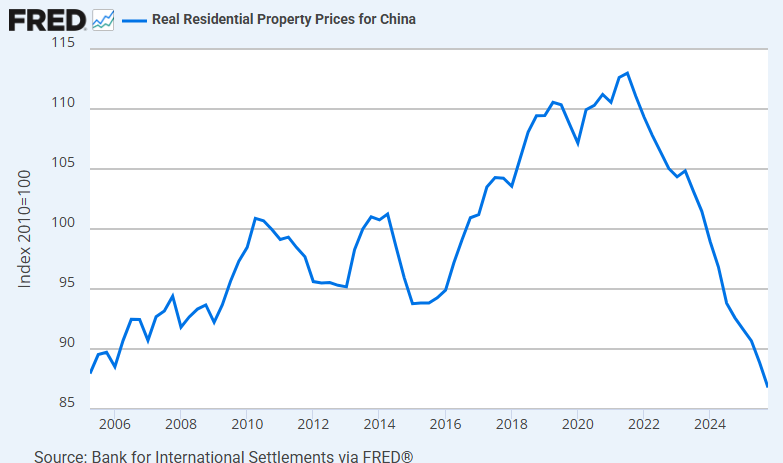
🚨 China's Real Estate Market has erased all gains from the last 20 years

Hedgeye tweet media
English
949
2.1K
11.9K
9.1M
M retweetledi
Mark Palmer
Mark Palmer@MarketPalmer_·
Salary needed to be in the... Top 5% in the United States: $210,000 Top 4% in the United States: $250,000 Top 3% in the United States: $300,000 Top 2% in the United States: $320,000 Top 1% in the United States: $450,000 Top 0.1% in the United States: $2,800,000 There is rich...and there is ultra-rich.
English
116
87
1.3K
343.8K
M retweetledi
Wimar.X
Wimar.X@DefiWimar·
🚨 BREAKING CHINA’S REAL ESTATE MARKET JUST CRASHED TO A 20-YEAR LOW, LOSING A 1/4 OF ITS VALUE. SOMETHING EXTREMELY BAD IS HAPPENING…
Wimar.X tweet media
English
959
3.1K
13.2K
3.7M
M retweetledi
VIEW
VIEW@viewsoff·
Mount Fuji, Japan
VIEW tweet media
English
66
1.3K
13.3K
142.8K
M retweetledi
Michael J. Kramer
Michael J. Kramer@MichaelMOTTCM·
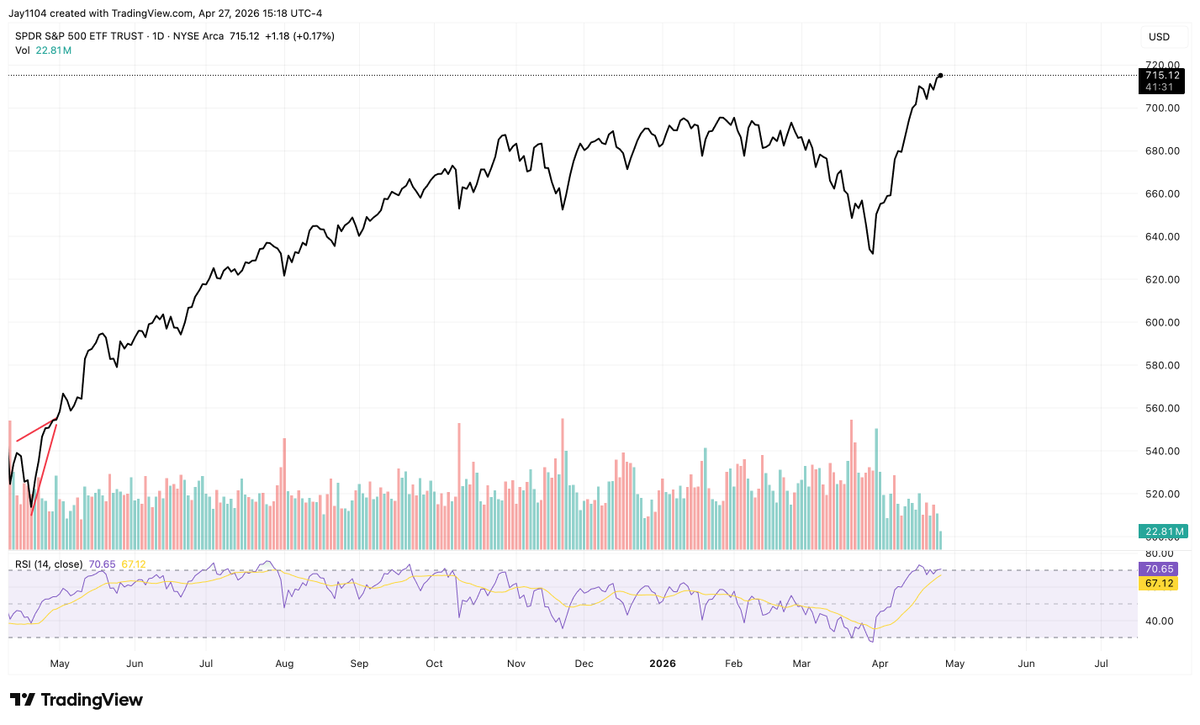
The volume is just melting away.
Michael J. Kramer tweet media
English
76
68
839
126.3K
M retweetledi
Physics In History
Physics In History@PhysInHistory·
"We are like butterflies who flutter for a day and think it's forever." - Carl Sagan, in Cosmos (1980)
English
140
1.7K
8.2K
253.6K
M retweetledi
bee🐝
bee🐝@0xbeehive·
S&P 500 IS RALLYING ON EMPTY VOLUME And that's exactly the problem When price goes up but volume stays low - it means there's no real conviction behind the move We saw this exact setup in early 2025: 1. Low volume rally - price goes up, nobody's really buying 2. Volume picks up - first warning sign, distribution begins 3. High volume sell-off - that's when it gets ugly Right now the same picture is forming again I'm not saying the dump is guaranteed, but when volume finally returns to this market, it won't be buyers leading the charge Save this. Let's see who's right!
bee🐝@0xbeehive

S&P 500 IS NOT AS STRONG AS IT LOOKS The price keeps going up - awesome! BUT The RSI is in a downtrend, as well as the OBV And this gap between the price and the actual state of affairs is exactly what distribution looks like before a significant peak forms From here I expect distribution with a possible bounce to $7,300 to trap the last buyers Either way, the final result is flush crash just like in October 2025

English
75
164
970
484.3K
M retweetledi
Prime Tate
Prime Tate@primetateHQ·
Andrew Tate goes off on feminists for saying a man should be monogamous: “I had to go through hell to get on this yacht. You got on a yacht with an Instagram DM, I had to buy it. And now you’re telling me I need to f*cking settle down?”
English
35
234
2.2K
83.4K
M retweetledi
illuminatibot
illuminatibot@iluminatibot·
TUCKER: “How much does it matter what Americans think?” HUCKABEE: “It matters every bit.” TUCKER: “80% oppose war with Iran.” HUCKABEE: “We don’t live in a world where polls dictate policy.” TUCKER: “Oh, I thought you said it matters what Americans think.”
English
1.2K
16.8K
145.9K
3.6M