Elon Musk on why he thinks AI will exceed all of human intelligence combined within five years:
Asked what daily life will actually look like once that happens, Musk starts with the timeline:
"I think AI may exceed the sum of human intelligence in about in around 5 years. In 5 years, roughly 5 years is my guess."
Note the size of the claim. The sum of human intelligence, every mind on Earth aggregated, cleared inside half a decade.
What follows from that, in his framing, is total:
"So there really won't be anything that AI can't do better than humans apart from being human perhaps."
That last clause is the only carve-out he offers. Being human. Everything else is on the table.
Pushed to describe what this means "on a more prosaic level", he doesn't hedge:
"The most likely outcome is an age of amazing abundance uh where anyone can have anything they can think of."
@elonmusk knows how it lands, and says so before anyone else can:
"This is this is this may sound preposterous, but well, here we are in 2026. Let's see where we stand in 2036."
That's the rhetorical move worth sitting with. He puts a date on it. Ten years, on the record, checkable. He's making a falsifiable prediction rather than a vision statement, and he's doing it deliberately.
The only thing he concedes could break the trajectory is civilisational:
"Now, of course, there are things that could derail this like a a massive global thermonuclear war or something like that."
Absent that, and he says it plainly, the destination doesn't change. He calls it a message of optimism and excitement about the future.
Tobi Lütke has a replacement for the Turing test: an AI that starts a real business and gets people to pay it a million dollars.
Speaking with Jack Altman, Lütke says the Turing test itself is already behind us passed, he suggests, with oddly little notice. So he wants a harder bar.
"Acting in the real world, starting a business that people find meaningful enough to vote for to the tune of a million dollars."
Altman fills in what that would actually require: "Marketing it correctly, getting the right sourcing… knowing what things are prioritized matter."
Lütke's verdict: "I think we are actually getting there."
He points out you can already use Shopify without having a product of your own. Shopify will help you find manufacturers. There's a product called Collective, where manufacturers offer their goods for you to sell in your own store.
"If your particular skill set is the marketing, you can come to Shopify and you can try your hand on entrepreneurship."
His preference is still that a human brings something worth selling: "People should have a product that the world wants, ideally come up with some unique take on something. And there's so much white space out there."
Altman presses: "But you think AI could do everything else?"
Lütke doesn't hedge:
"I think it should then do absolutely everything else. In fact, that's actually literally what our product's ambition is to be maybe the vessel for AI, in being the brain or the exoskeleton around the model. To basically conspire to just do absolutely everything so that if you show up with a product, you can start a business."
That's a specific and unusual claim about where Shopify sees itself going. Not software a merchant operates. Infrastructure a model operates.
So Altman pushes the boundary one step further: what if the AI makes the product too? "Let's say I wanted to say, 'Hey, just go make me a million dollars.'" Or: "Go make me some ebooks."
Lütke says digital products are the obvious case. But he doesn't stop there:
There's print on demand for books and t-shirts. "Additive manufacturing is getting extraordinarily good now." There are lots of great contract manufacturers: CNC, 3D printing. And then, he adds, they're looking at humanoid robotics.
Lütke draws the line at "you show up with a product" and then spends the next two minutes describing how each layer beneath that line is being automated, sourced, printed, or manufactured on demand. Marketing, sourcing, prioritisation, fulfilment, and increasingly the physical object itself.
The practical read for anyone building something: the defensible human contribution is compressing upward. Execution is becoming a commodity.
Anton Osika, co-founder and CEO of Lovable: "It's a learned skill to say no."
Every founder says focus matters. Almost none of them can tell you where focus lives inside their company. Anton can, and his answer isn't himself:
"It comes from how the entire team works together."
Here's what that means concretely. Once a week, Lovable's engineers stop building:
"Every week, engineers, they don't just take the planned tasks and do them, but they sit down and go through the entire flow of using the product and think about, like, hey, is this actually the best way to do it, and try to polish and simplify and make it as delightful as..."
Read that again for who is doing it and how much of the product they touch.
The engineers who wrote the code are the ones running the review. No design team, no PM writing a friction document, no researcher summarising tickets.
They also walk the whole flow, including the parts they didn't build. Products get ugly at the seams between features, and you only find a seam by crossing it.
The ritual exists to solve a problem Anton openly admits is his own:
"I think I'm super ambitious about all the things I want to do. And the backside of that is that I do want to do too many things at the same time."
@antonosika doesn't claim to have outgrown it. The correction came from repetition:
"If you notice, if you work with that over some time, you realise how important focus is."
And when he defines the discipline, it's harsher than what usually passes for prioritisation. Not ranking a backlog. Cutting to one:
"We have to just pick one thing and do that, and remove as many distractions as possible."
All of it points at one target: making the product simple. Simplicity is the only product quality you can't add your way to. It arrives through subtraction, and nobody gets promoted for the feature that didn't ship.
So Lovable schedules it. Every week. Whether or not the roadmap called for it.
Anton's own verdict on the results:
"This is just the beginning, right? So we have a long, long way to go."
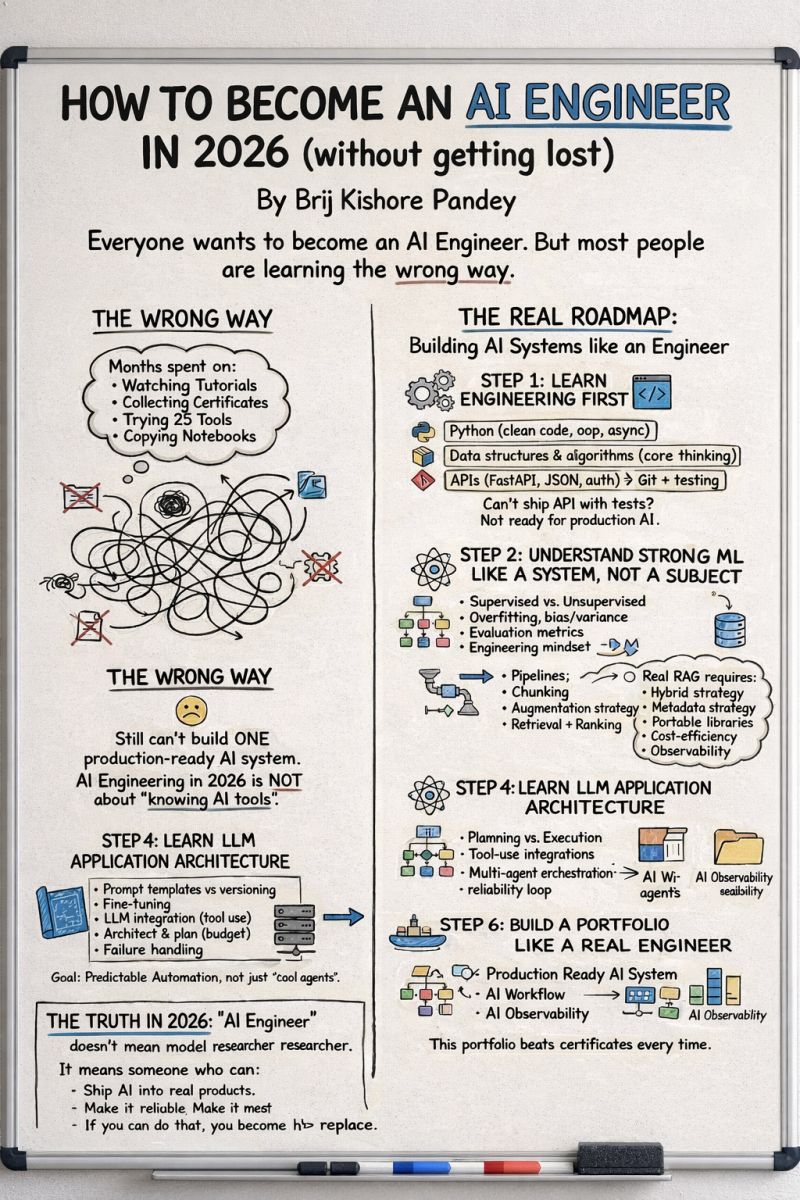
Everyone wants to understand AI in 2026.
But very few are learning how real AI systems are actually built.
Sharing valuable insights from Brij Kishore Pandey.
Most people spend months:
Watching endless videos
Earning random certificates
Testing dozens of AI tools
Copying projects from GitHub
Yet they still struggle to create one reliable AI product.
Because AI Engineering in 2026 is not about collecting tools.
It’s about solving problems like an engineer.
Here’s the roadmap on how to become an AI engineer in 2026.
Step 1: Learn engineering before AI
Before agents, fine-tuning, and LLM frameworks, build strong fundamentals first:
Data structures & algorithms (practical thinking matters most)
Python (clean structure, OOP, async basics)
APIs, JSON, authentication, retries
Git + testing workflows
If you cannot deploy and test an API properly, AI will be difficult.
Step 2: Learn ML as a system
You do not need advanced research-level math.
But you must understand:
Bias and variance
Model evaluation
Feature engineering mindset
Supervised vs unsupervised learning
Most AI systems fail because evaluation is weak, not because the model is bad.
Step 3: Get strong in data and retrieval
This is where many AI jobs will still focus in 2026:
Ingestion
Chunking
Data pipelines
Embedding strategy
Retrieval and ranking
RAG (Retrieval-Augmented Generation)
Is much more than uploading documents into a chatbot.
Real-world RAG includes:
Metadata design
Hybrid search
Observability
Reranking
Caching
Master this properly and your value increases fast.
Step 4: Learn LLM application architecture
Stop focusing only on prompts.
Start learning:
Token and cost management
Tool and function calling
Prompt versioning
Structured outputs
Failure recovery
Guardrails
Production-ready AI systems must handle:
Tool breakdowns
Missing context
Hallucinations
Bad inputs
Rate limits
That’s real engineering.
Step 5: Learn Agentic AI after fundamentals
Agents are powerful.
But without strong foundations, they remain demos.
Focus on:
Tool reliability
Memory systems
Planning and execution
Multi-agent orchestration
Human-in-the-loop processes
The goal is not flashy automation.
The goal is dependable automation.
Step 6: Build a portfolio that proves your skills
Forget building 20 tiny projects.
Create 3 serious systems instead, such as:
Project 1: Production-ready RAG
Ingestion
Embeddings
Evaluation framework
Hybrid retrieval + reranking
Project 2: AI Workflow Agent
Structured outputs
Multi-step execution
Guardrails and retries
Project 3: AI Observability Dashboard
Tracing
Latency and token tracking
Quality and evaluation reports
A strong portfolio will always outperform certificates.
The reality:
In 2026, an AI Engineer is not just someone who understands models.
It’s someone who can:
Make systems reliable
Control operational cost
Ship AI into real products
Track performance clearly
If you master these skills, you won’t just get opportunities.
You’ll become someone companies truly depend on.
P.S. Which of these AI engineering skills do you want to master first?
♻️ Repost this so others can become great AI engineers too!
——
📌 Get my top 100 infographics for free:
1) Follow me.
2) Subscribe to my free newsletter at WildCapital.co.
You’ll receive them directly in your welcome email.
The first mainstream AI safety paper was, in Chris Olah's words, "almost a political project."
The strategy: collate problems people already agreed were reasonable, then get credible authors across institutions to put their names on it.
James Dyson, founder and chief engineer of Dyson, on why he starts with an idea instead of a business plan:
Asked what gives him the impetus to build something new, Dyson describes a filter that has nothing to do with market size:
"Always the impetus is: have I got an idea that people are going to want and that will be useful and be better performing than what's on the market at the moment by a margin?"
The word carrying the weight there is "margin." He rules out incremental improvement in the very next breath:
"Not... not sort of a minute amount."
The qualifying question is whether the idea beats what already exists by an amount big enough to be obvious. Dyson is blunt about the alternative he rejects:
"So it's not a business plan: 'Oh, this would be a good category to go into and there's lots of money in this category.'"
Then he does something most founders won't do on the record. He concedes the point might not be in his favour:
"I don't think we think of it like that, perhaps we should, but we should think: 'We've got a good idea, let's make a product with it.'"
That aside is the most honest line in the exchange. He makes no claim that product-first beats market analysis. For him, a good idea is reason enough to build.
The same logic governs the other end of the process. Asked how he decides whether to keep pushing a product through development or scrap it, his answer inverts the usual framing of the kill decision:
"So, if it's not technically working, you just go on and on and on, often for many years until you decide it's not working."
No gate reviews, no milestones, no strategic reassessment.
The persistence runs for years, and it ends only when the thing refuses to function:
"And that's easy because it's not working. So, you don't even have to make a decision. You just have to say, 'Enough is enough. Let's try something else.'"
Dario Amodei, CEO and co-founder of Anthropic, on the three consensus views about to break, and the role AI plays in each:
Progress arrives when a settled position gives way all at once.
"There's this kind of consensus that again seems like consensus, seems like what everyone wise thinks, and then it just kind of breaks."
He names three places where he expects that to happen next, and it hasn't happened yet.
The first is interpretability, which he thinks is about to stop being an AI safety discipline and start being a medical one.
"I think interpretability is both the key to steering and making safe AI systems... and interpretability contains insights about intelligent optimization problems and about how the human brain works."
Then a claim he knows sounds absurd, delivered with a pre-emptive defence:
"I've said and I'm really not joking, Chris Olah is going to be a future Nobel Medicine laureate. I'm serious. I'm serious."
The reason he's serious is that he used to be a neuroscientist, and he knows where the field is stuck. As he puts it:
"A lot of these mental illnesses, the ones we haven't figured out, right? Schizophrenia or the mood disorders, I suspect there's some higher level system thing going on and that it's hard to make sense of those with brains because brains are so mushy and hard to open up and interact with."
Here, AI stands in for the brain.
"Neural nets are not like this. They're not a perfect analogy, but as time goes on, they will be a better analogy."
If these disorders are system-level phenomena, you need a system you can open up and inspect. A brain resists that. A neural network is built for it.
The second is AI for biology, and here Amodei concedes the sceptics have had a real case:
"Biology is an incredibly difficult problem. People continue to be skeptical for a number of reasons. I think that consensus is starting to break. We saw a Nobel Prize in chemistry awarded for AlphaFold. Remarkable accomplishment."
But @DarioAmodei treats that win as a data point rather than a destination:
"We should be trying to build things that can help us create a 100 AlphaFolds."
The ambition is an engine that solves the whole class of problems.
The third is AI for democracy, where the technology cuts both ways.
"Finally, using AI to enhance democracy. We worry about if AI is built in the wrong way it can be a tool for authoritarianism. How can AI be a tool for freedom and self-determination?"
He's candid that this one isn't ready yet:
"I think that one is earlier than the other two, but it's going to be just as important."
The worst part of my job was not the work.
It was knowing I was capable of more.
And choosing to ignore it every day:
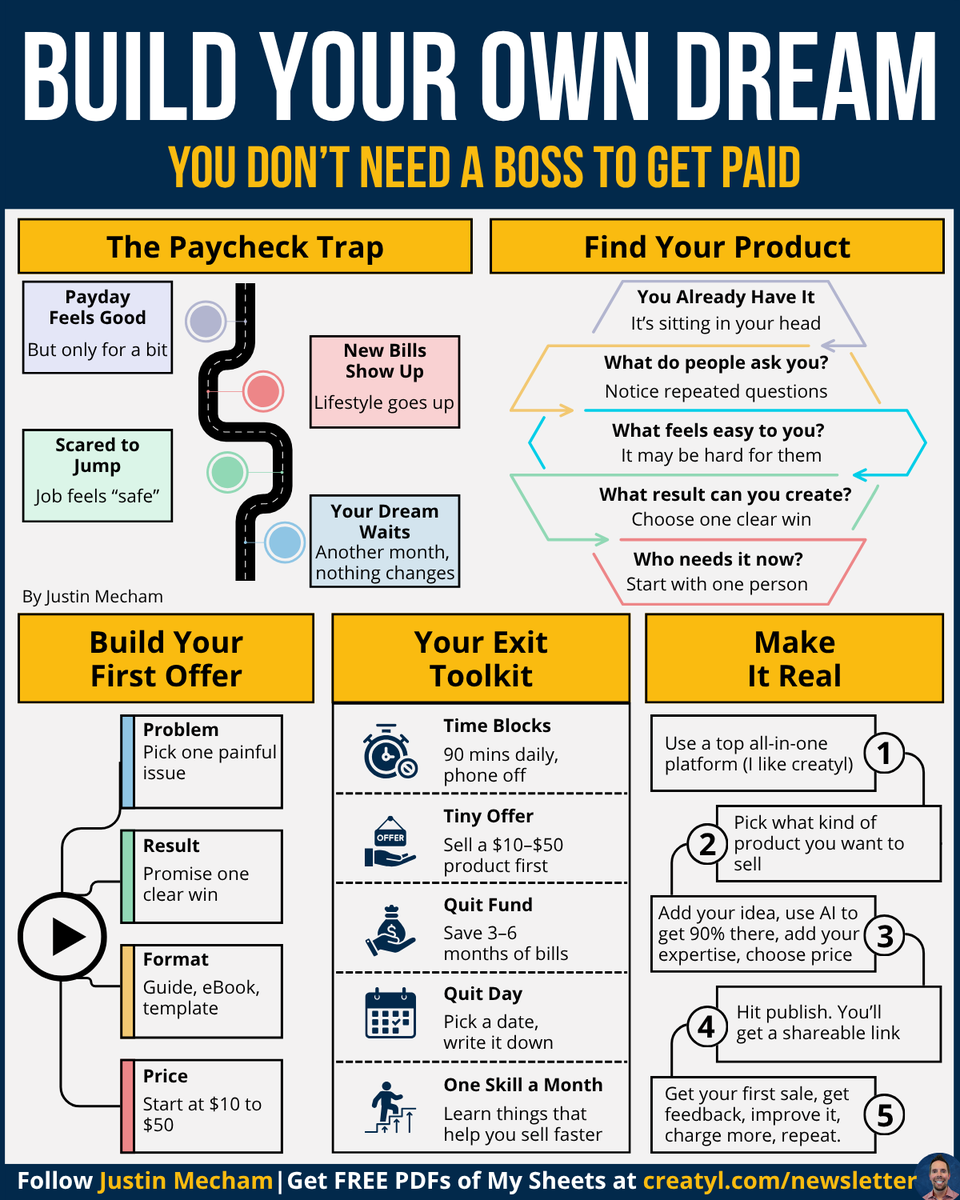
That is the paycheck trap.
You work all month for one moment of calm, bills take it, and then you do it again.
And somewhere between the direct deposit and the rent payment, the thing you actually want to build gets pushed to next month.
Again.
I lived in that loop for years.
And the worst part was not the money.
It was the Sunday night math.
Could I quit? Could I survive?
And every time the answer was the same.
Not yet.
So I would set my alarm and go back for another week.
Here is what kept me stuck for so long.
I thought I had to have it all figured out before I could start.
The perfect idea.
The perfect plan.
The perfect moment.
But I was really just waiting for a level of safety that was never going to come from someone else's paycheck.
So I started building 90 minutes a day with my phone off.
I created a tiny offer for $27.
I started a quit fund.
And I picked a date.
Not to dramatically walk out.
But to have a target that made every evening and weekend feel like it was going somewhere.
My first sale did not come from a perfect business plan.
It came from one skill I already had, packaged into something simple enough that a stranger could buy it.
My infographic is the step-by-step plan I personally used.
Save it.
Because the best time to build your dream is while someone else is still paying your bills.
If you are ready to start, I put together a free toolkit that walks you through how to take what you already know and turn it into something that is actually yours.
👉 Grab it free here: lnkd.in/gsUZp3Fb
You may spend your days helping someone else build their dream.
Just do not let that make you forget that you already have the skills to begin building yours.
Please repost to help others out there! ♻️
Jensen Huang on why physical AI is the next decade:
Asked about AI's reach beyond the tech industry, Jensen Huang draws a line between the two worlds:
"AI is all the stuff that we're doing inside the building, but obviously ultimately the largest industries are outside the building."
Outside the building, software has to obey physics. And that requires something today's models don't have:
"That AI needs to have physical awareness, physical understanding, causality. You push a bottle, it falls over and understands gravity, understands collision, understands inertia."
His second example is object permanence:
"I take this, I put it behind my chair. In your mind, you can't see it, but you realise it hasn't disappeared."
Things like that, he says, affect "physical behaviour and physical intelligence fairly importantly."
Then comes the part he assumes his audience doesn't know:
"You probably also don't know this, that Nvidia is the frontier of physical AI."
He runs through the evidence. Cosmos is "the most downloaded physical AI model in the world." Autonomous AI comes in two versions: a self-driving model, Alpamayo ("look it up. Number one, downloaded"), and GR00T for humanoid robotics, where "GR00T N2 is now number one most downloaded humanoid robot model in the world." Then digital biology, with La-Proteina,"incredibly successful." Then Earth-2 for physics, laws of physics, multiphysics.
"We are at the frontier on all three of those."
"These whole area of physical AI, Nvidia defines the frontier."
And the strategic move underneath it:
"It is completely open. We open it because we want to enable every company, new or old industry, to be able to take advantage of this capability. And we've got the whole stack and the necessary computers for you to advance the AI for your own use, as well as deploy it inside a robot, inside a plant, at the edge, at a radio tower, deploy it everywhere."
He then puts a clock on the current AI conversation:
"In two years time, we're going to be largely done talking about agentic AI because we're all going to be using it."
His example of what replaces it is a co-innovation lab with Lilly, and a rhetorical question about who else could build it:
"In order to set up Lilly's AI factory unless you have the capabilities of Nvidia and this full software stack and the capabilities of all the model and the expertise in that digital biology domain, how would you even do it?"
He closes with the timeline:
"We're going to be talking about physical AI for, you know, starting next couple two, three years and for a decade."
What makes AI different from every other tech Altman has worked on:
Delivering it usefully to hundreds of millions, eventually billions of people isn't a software problem. It's an infrastructure problem measured in capital, chips, and power.
Anthropic's founders explain why scaling and safety were never separate projects.
Chris Olah: the scaling work at OpenAI came out of the safety team Dario Amodei started because forecasting AI trends was the only way to get anyone to take the risk seriously.
Jensen Huang on what happens when the drudgery goes to zero:
Asked how to reason about the future AI is creating, Jensen doesn't start with jobs. He starts with roads.
First, the premise:
"The work that you do continues to be important, but the effort by which you do it went from being a week long to almost instantaneous. The effort of drudgery basically goes to zero."
Then the question he actually finds interesting, not "what gets destroyed?" but "what gets built on top?" To answer it, he reaches for the last time a piece of infrastructure collapsed the cost of an effort:
"This is very similar to what would change if all of a sudden we had highways in this country. And that kind of happened in the last industrial revolution. All of a sudden we have interstate highways. And when you have interstate highways, what happens? Well, suburbs start to be created, and all of a sudden distribution of goods from east to west is no longer a concern. And all of a sudden gas stations start cropping up on highways, and fast food restaurants show up, and motels show up because people traveling across the country just wanted to stay somewhere for a few hours or overnight. And so all of a sudden, new economies and new capabilities."
Nobody laid the interstate in order to invent the motel. The motel was downstream.
He runs the same logic on video conferencing: "What would happen if video conference made it possible for us to see each other without having to travel anymore. That all of a sudden it's actually okay to work far further away from home, and live further away."
Then he points the question at AI, and asks it in the first person:
"What would happen if I have a software programmer with me all the time, and whatever it is I can dream up, the software programmer could write for me? What would that do? What would happen if I just had a seed of an idea, and I rough it out, and all of a sudden a prototype of a production was put in front of me? How would that change my life, and how would that change my opportunity? What does it free me to be able to do?"
His forecast is deliberately bounded:
"I think that the next decade, intelligence — not for everything, but for some things would basically become superhuman."
It's the only piece of the argument that isn't speculation. Jensen already lives in the world he's describing:
"I can tell you exactly what that feels like. I'm surrounded by superhuman people, super intelligence from my perspective, because they're the best in the world at what they do and they do what they do way better than I can do it. And I'm surrounded by thousands of them. And yet it never one day caused me to think all of a sudden I'm no longer necessary. It actually empowers me and gives me the confidence to go tackle more and more ambitious things."
That's the whole thesis compressed into one biographical fact: being surrounded by people better than you at everything did not make him redundant. It made him more ambitious.
So he generalises it:
"Suppose now everybody is surrounded by these super AIs that are very good at specific things, or good at some of the things. What would that make you feel? Well, it's going to empower you. It's going to make you feel confident."
And he says it's already true for him:
"I feel more empowered today, more confident to learn something today. The knowledge of almost any particular field, the barriers to understanding it have been reduced. I have a personal tutor with me all of the time."
Which leads to the single instruction he gives:
"If there's one thing that I would encourage everybody to do, it is to go get yourself an AI tutor right away. And that AI tutor could of course just teach you things, anything you like: help you program, help you write, help you analyse, help you think, help you reason. All of those things are going to really make you feel empowered."
His closing line:
"We're going to become superhumans, not because we have super... We're going to become superhumans because we have super AIs."
Asked whether bankrolling unprofitable AI labs creates systemic risk, Jensen Huang went straight to first principles:
Every purchase order gets tested for real demand. And if one customer can't take the chips? "Somebody else has demand for it."