Hired In Michigan

49.3K posts

Hired In Michigan banner
Hired In Michigan

Hired In Michigan

@HiredInMichigan

Michigan 501c3 Nonprofit Agency ❤️ Michigan Licensed Career Training School ✏️ Michigan @Google and @Meta Scholarships 💰 Michigan’s Largest Career Job Fairs

Southfield, MI Katılım Ekim 2011
385 Takip Edilen540 Takipçiler
Sabitlenmiş Tweet
Hired In Michigan
Hired In Michigan@HiredInMichigan·
Detroit Detroit Share It
Français
0
0
0
26
Hired In Michigan
Hired In Michigan@HiredInMichigan·
@alternative_war Charges like this highlight how digital platforms can be double, edged swords. With free speech hanging in the balance, we need to consider the context—intent matters.
English
0
0
0
0
big ben
big ben@alternative_war·
🪂 THEY CAME IN THROUGH THE ROOF Moscow’s Zamoskvoretsky District Court has jailed Georgy Zakrevsky, 55, founder of the “Warrior Union Paladin” organisation. The charge is justification of terrorism under Article 205.2 — over posts in his Telegram channel, per Ostorozhno Novosti. Security forces took him on the morning of 16 July in his 150 m² apartment on the Arbat. They rappelled in from the roof. WHO HE WAS Zakrevsky backed the full-scale invasion. He publicly offered Russian soldiers up to ₽500,000 for killing foreign fighters serving with Ukrainian forces in Kharkiv region. He argued the “SVO” framing should be dropped and the war fought properly. Then Ukrainian forces entered Kursk region — and he turned on the Kremlin. He accused Putin of giving up Donbas, of treating the constitution as waste paper, and of making lawlessness absolute. WHAT THE CHARGE IS ACTUALLY ABOUT Not the bounty offer. The Telegram posts. Z-blogger Anastasia Kashevarova claims Zakrevsky used the outfit as a personal vehicle: recruiting for his own ends, spending tens of millions of roubles on holidays, demanding business-class cars, styling himself a significant political figure. She says he corresponded with foreign representatives offering his services and courted wealthy businessmen to bankroll the PMC. THE PATTERN Russia’s private military scene has produced a recurring type: the war entrepreneur who is tolerated while ultra-loyal and prosecuted the moment the criticism turns upward. The state has no article for “raised a private army”; it has a rich menu of speech articles instead. Wagner’s fate set the precedent — the problem is never the armed formation, it’s the independent political voice attached to it. A man who offered cash bounties for killings was left alone. A man who called the president a traitor was taken off his own roof. ⚠️ The claims about Zakrevsky’s spending and foreign contacts come from a pro-war blogger, not from court documents, and are unverified. Sources: Ostorozhno Novosti, Anastasia Kashevarova
big ben tweet mediabig ben tweet mediabig ben tweet mediabig ben tweet media
English
1
0
0
114
Hired In Michigan
Hired In Michigan@HiredInMichigan·
@MyCentralJersey It’s powerful how one act of remembrance can fuel so many dreams. Most people overlook that honoring the past can create tangible opportunities for the future.
English
0
0
0
0
Hired In Michigan
Hired In Michigan@HiredInMichigan·
@ChrisjMartinez4 Software recalls are already a reality. Just look at how over, the, air updates can fix issues in real, time. But, that can lead to complacency. We might start to trust tech too much, ignoring the basics.
English
0
0
0
2
Chris J Martinez
Chris J Martinez@ChrisjMartinez4·
What if the next major automotive recall isn’t caused by a mechanical failure… What if it’s caused by software? That’s the future we’re driving toward. Modern vehicles aren’t just transportation anymore. They’re computers on wheels. They know: • Where you live. • Where your kids go to school. • Your daily commute. • Where you shop. • Your contacts. • Your driving habits. • Sometimes even what you say through voice commands. Now imagine a cyberattack that doesn’t target one vehicle. It targets one million. Imagine if an attacker could: • Prevent vehicles from starting. • Disable charging across an EV fleet. • Unlock thousands of vehicles simultaneously. • Track the location of executives, law enforcement, or military personnel. • Hold commercial fleets hostage with ransomware. • Push false warnings to dashboards. • Collect years of driving data. That’s no longer just an IT problem. It’s a public safety issue. Here’s the irony. Over-the-air (OTA) updates are both the solution and part of the challenge. They allow automakers to patch vulnerabilities in hours instead of waiting months for owners to visit a dealership. But they also mean every connected vehicle relies on a secure software supply chain. We’ve already seen what software supply chain attacks can do in other industries through incidents like SolarWinds and the CrowdStrike outage. As vehicles become more software-defined and autonomous, cybersecurity is becoming just as important as crash testing. For decades, buyers asked: “How much horsepower does it have?” Then they asked: “What’s the fuel economy?” Today they ask: “What’s the range?” Tomorrow they may ask: “How long will this vehicle receive security updates?” I believe cybersecurity will become one of the defining measures of automotive safety over the next decade. Do you agree, or do you think the industry is already doing enough? Source: CNBC, Over-the-Air Tech in Vehicles Poses Cybersecurity Risks (July 18, 2026): cnbc.com/2026/07/18/ove…
Chris J Martinez tweet media
English
1
0
1
59
Hired In Michigan
Hired In Michigan@HiredInMichigan·
@jezzaica Mamdani rapping is hilarious, but it also highlights a big issue—most critiques of socialism miss the point that it's often the implementation, not the idea, that fails. Just a thought.
English
0
0
0
0
Jessica McGuire
Jessica McGuire@jezzaica·
Mamdani rapping might be one of the funniest things I have seen all month. Where socialism has failed in the U.S. is that instead of making the existing system more fair, efficient, and productive, NGOs built a shadow global government that just privileged a different group. The Big Tech, Big Ag, and Big Pharma lobbies were too much for nonprofits to overcome. Many donors were fooled into believing that "therapy" and sterile mental institutions would somehow overcome our social and economic problems. As immigration increased, so did the number of adults who couldn't afford homes or meet a romantic partner who shared their values. Thus more women remained single and more young white men grew disillusioned. Successful men allowed women a strong voice, but how we use that voice is the challenge. Many began with demanding higher pay, recognizing that nepotism and cronyism do prevent equally capable women from finding good mentors and opportunities. The disadvantages compound. Just one or two cases of bad luck, lies and manipulation, or discrimination can completely alter the course of your life and career. Also higher pay did not fix bureaucratic jobs, billable hours targets, long commutes, lack of housing, nor the structures that enabled corporations to keep women trapped in the lower rungs of male-dominated fields. Few wanted to recognize that there are some fields that men are simply more biologically gifted at, and asking all women to be software engineers would be like asking them all to beat men in basketball. Sure many women CAN do it, but overall they get crushed. Nearly 76% of former pro football players in their 30s and 40s were married before or during their careers, a rate significantly higher than the national average for American men. However, estimates suggest between 60-80% of these marriages eventually end in divorce. Sports performance studies consistently show that the best and highest-paid players are much more likely to be married than lower-profile roster. Married players frequently outperform single counterparts of the same age, suggesting that a structured lifestyle provides an anchor against the chaotic, high-pressure environment of the league. There is no one-size all formula, but nearly every elite will name the PEOPLE who helped get them there and keep them motivated. Just like in the workforce, you can't do it on talent or hard work alone in the long run. Today, only about 15% of pro athletes are women. One of my male triathlete friends used to call them "trophy wives" not because they were a catch, but because many of them needed a rich husband to get there. Only Fans, regular Instagram modeling, and stirring up controversy are hardly what I'd call a dignified answer. Meanwhile, many NGOs prevented American middle-class workers from gaining a real voice in their shadow government by using credentialism for gatekeeping. Most highly specific job role requirements require expensive advanced degrees, State Department training, or existing university research or nonprofit backgrounds. Even if you modify the recruiting requirements to look for talent instead of specific skills or experience, if you don't offer new employees real support you are setting them up to fail or be undermined. If you didn't quite "find your passion" in your 20s, it was common to be told to pursue an IT career. Major companies were supposedly "dying" for more women - but only if they didn't have to train them. As if simply getting IT certified would be enough to manage the security of a system that held sensitive personal and corporate data. HR and Marketing roles expanded. Many were created or altered to take advantage of women's strengths in relationship building and collaboration, but they often went to sorority sisters or again - State Department employees. If you were an introvert or older than millennials, you were frequently passed over as someone who wouldn't "fit in" with the culture. At some point, you accept you have a job and quit trying to find a "career." Or as you do, it's replaced by AI or someone younger and cheaper. You reflexively pivot to just trying to survive or "make it to retirement." What if you get there but all you feel is emptiness? The corporate world was full of men and lucrative jobs, but also full of cliques, gossip, and misery. Men who spent many nights a year in hotels. Numerous affairs and divorces. People who stroked egos. People who began to sound like human drones, almost like they forgot who they were before they "drank the kool-aid." The new "kool-aid" is basically social media and becoming a slave to it to promote one's corporate image or political agenda. Maybe it feels good if it is who you are, but it feels empty when it's not. The NGO world could have offered Americans an escape from corporate control and an opportunity to achieve globalism in a way that let's each country and culture still be itself. But will it? Do NGOs understand who we are and who we want to be? Or would they rather push a socialist agenda that suits the wealthiest and poorest among us, but ends up lowering the standard of living for the other 80+%? As I reflect back on my 20-year career, 8 of which was spent working in IT at @pewtrusts, I realized a major source of unhappiness for many people is simply a misalignment in what they do vs. what they love and were meant to do. But just when you think you finally found a way to live the life you wanted, in D.C. you can count on some spook to sabotage it. This is unrestricted warfare. This is the 1999 playbook that was written by two Senior Colonels in the Chinese People's Liberation Army (PLA). Under this view, the state must have the authority to simultaneously weaponize its commercial, financial, technological, legal, and media sectors alongside traditional military forces. And that's exactly what the CCP did. • Utilizing the West's open journalism and internet infrastructure to conduct misinformation campaigns and manipulate public opinion. • Setting up funding structures to infiltrate and influence democratic legislative bodies and politicians. • Weaponizing internal political, racial, and economic divisions to cause chaos and destabilize adversaries from within. The strategy of Unrestricted Warfare also explicitly targets individual civilians. The playbook outlines how ordinary civilians can be leveraged or manipulated into advancing foreign state narratives without fully realizing they are being used or buying into ideas and lies that harm the United States. Hint: Democratic Socialism is one of them. The Nordic countries are consistently ranked as the happiest countries in the world. It's not because they are socialist. But the Nordic governments explicitly do categorize themselves as social democracy—which is a free-market capitalist economy paired with a robust social welfare state. Citizens do not face crushing financial anxiety over medical bills or university student debt, as these are paid for collectively through taxes. But less than 30 million people live under the Nordic model. This is a stark difference from the United States, who has ~320 million more people and also spends more money around the world. For example Norway is very generous with foreign aid, but the U.S. spends more money abroad on foreign aid than all of the Nordic countries combined. Paying for our own citizens via taxes COULD actually work - but not until we stop all the money laundering and reorganize our economy to fund things we actually want and need. Think more public pools instead of pills. Lighter electric bikes. More recreation planners vs. war planners. On and on I could go... Strong unemployment insurance and family welfare benefits also ensure that losing a job or falling sick does not lead to poverty or homelessness. This builds a high "baseline" of peace of mind in Nordic countries. Why should only government workers have employment protections? And why should only the wealthy, criminals, or immigrants have access to real legal help? Much of the help which is advertised is not as it seems. For example, 988 employs some nice people who will listen to your problems - but unless they fit into a narrow box 988 can do nothing to help you actually fix them. Certainly not with any urgency. Rather in Nordic countries, public institutions, police, and governments are highly transparent and viewed as working for everyone equally, not just the wealthy. Standard full-time workweeks are shorter than in most Western nations, and extensive paid vacation time is culturally mandatory. [This we should copy.] While these are prosperous capitalist economies, progressive taxation keeps the income gap relatively narrow compared to the U.S. These nations have remarkably low income inequality, but the actual wealth (accumulated assets like real estate, stocks, and business equity) is highly concentrated at the top. Unlike the Nordic model, the current American housing landscape is characterized by stark demographic and regional divides. Coastal states feature massive affordability deficits, and many current American homeowners feel trapped by low historic mortgage rates, meaning they refuse to sell. Despite a high homeownership rate, Norway—particularly Oslo—also faces escalating property values. The highly transparent, digital bidding system can result in swift price surges and intense bidding wars. Denmark boasts some of the highest household debt-to-income ratios in the world. It's safe to say no perfect system of governance has been found, but we can take the best ideas from each and help export them in other countries that have or wish to have a similar culture and ability to implement them. Instead of paying people to be angry and hold signs, perhaps we could actually pay them better to do work they enjoy. That means recognizing who wants to be a productive member of society and rewarding them for trying. If they've given up on trying, that's where strong local communities can really make a big difference.
John Stossel@JohnStossel

They say socialism is for the working class. But its biggest promoters are PRIVILEGED. The hypocrisy is obvious. Bernie Sanders used to attack millionaires AND billionaires. Then he made millions. Now he only attacks billionaires! Stossel TV Fellow Leyla Taghiyeva reports:

English
2
1
1
456
Hired In Michigan
Hired In Michigan@HiredInMichigan·
@ScottABaldwin Supporting veteran entrepreneurs is crucial, but we should also talk about sustainability. How can we ensure these businesses thrive long, term, beyond initial funding?
English
0
0
0
0
Hired In Michigan
Hired In Michigan@HiredInMichigan·
@colomboinsights Nolan's films often rely on a non, linear narrative, but with The Odyssey, he's got to balance that complexity with the epic's linear journey. It could get tricky—will he keep the essence of the story intact?
English
0
0
0
0
Colombo Insights (කොළඹ විත්ති)
Christopher Nolan's The Odyssey, which launched on July 17th, 2026, has already proven to be a monumental cinematic event. Nolan, known for bending genres and pushing the boundaries of filmmaking with works like Interstellar, Dunkirk, and Oppenheimer, took on Homer's 3,000-year-old epic and brought it to life using IMAX film technology on a scale never before attempted. Nearly three thousand years ago, a poet whose name has become synonymous with an entire tradition gave humanity two works that would shape the foundation of Western literature, philosophy, morality, and storytelling forever. The Iliad and the Odyssey, traditionally attributed to Homer, are not merely ancient Greek poems. They are the bedrock upon which civilization built its understanding of war, honor, love, loss, homecoming, and what it means to be human. No two works in human history have traveled further across time, been translated into more languages, influenced more writers, or survived more centuries than these twin epics born on the shores of the Aegean. To understand the Iliad and the Odyssey, we must first understand the world that created them. Sometime around the 8th century BCE, in the region of Ionia along the western coast of modern-day Turkey, the poems we now attribute to Homer were composed. They did not spring from nothing, however. They were the culmination of a vast, ancient oral tradition that stretched back centuries before Homer, possibly to the late Bronze Age around 1200 BCE, when the events they describe, namely the Trojan War and its aftermath, may have had some historical kernel. Archaeological excavations at Hisarlik in northwestern Turkey, led first by Heinrich Schliemann in the 1870s and continued by others for over a century, revealed that a city matching the description of Troy did exist, and that it was destroyed violently around the period the Greeks placed the Trojan War. Whether Achilles, Hector, Odysseus, and Helen were real people or mythological constructs built around real conflicts remains debated, but the foundation of the poems lies in a genuine cultural memory of a great conflict between Mycenaean Greeks and the people of a powerful city controlling the entrance to the Dardanelles. The Iliad, composed of over 15,000 lines of dactylic hexameter verse divided into 24 books, does not tell the full story of the Trojan War as many assume. Instead, it covers only a few weeks in the tenth and final year of the war, centering on a single dramatic thread, which is the wrath of Achilles. The poem opens with the Greek hero Achilles withdrawing from battle after Agamemnon, the commander of the Greek forces, dishonors him by taking away Briseis, a woman Achilles had claimed as a war prize. This act of disrespect triggers a catastrophic chain of events. Without Achilles, the Greeks begin losing to the Trojans. Hector, the noble prince of Troy and its greatest warrior, pushes the Greeks back to their ships. Achilles' beloved companion, Patroclus, unable to watch the slaughter, borrows Achilles' armor and enters battle, only to be killed by Hector. This death transforms Achilles' petty anger into a devastating grief and rage that reshapes the entire war. He returns to battle with new divine armor forged by the god Hephaestus, slaughters Trojans without mercy, kills Hector in single combat, and desecrates his body by dragging it behind his chariot around the walls of Troy. The Iliad ends not with the fall of Troy, but with a moment of profound humanity when King Priam of Troy, old and broken, enters the Greek camp alone at night to beg Achilles for his son's body. Achilles, seeing in Priam a reflection of his own father who will never see him return home, weeps with his enemy and returns Hector's body. The Iliad closes with Hector's funeral. It is a poem about war, but its deepest truth is about the cost of war, exploring the grief, the waste, and the fragile moments of compassion between enemies who recognize each other's suffering. The Odyssey, roughly 12,000 lines also divided into 24 books, is an entirely different kind of poem, though it inhabits the same world. Where the Iliad is about war, the Odyssey is about the journey home and everything that stands between a man and the life he left behind. It follows Odysseus, the cleverest of the Greek heroes, as he spends ten years trying to return to his island kingdom of Ithaca after the fall of Troy. His journey is one of the greatest adventure narratives ever conceived. He faces the Cyclops Polyphemus, a one-eyed giant whom he blinds by driving a sharpened olive stake into his eye after getting him drunk, which stands as a classic scene of cunning over brute strength that defines Odysseus's character. He resists the Sirens, whose song lures sailors to their death, by having his crew tie him to the mast while they plug their own ears with beeswax. He navigates between Scylla, a six-headed monster, and Charybdis, a massive whirlpool, choosing the lesser evil of losing six men to Scylla rather than the entire ship to Charybdis. He spends seven years captive on the island of the nymph Calypso, who offers him immortality if he stays with her, but he refuses, choosing mortality, aging, and death with his wife Penelope over eternal life without her. This single choice may be the most profound statement about human love in all of ancient literature. Meanwhile, back in Ithaca, Penelope holds off over a hundred suitors who have invaded her home, consuming Odysseus's wealth and pressuring her to remarry, by famously weaving a burial shroud for Odysseus's father, Laertes, during the day and secretly unraveling it each night, representing her own act of cunning that mirrors her husband's intelligence. When Odysseus finally returns disguised as a beggar, he is recognized first not by his wife or son, but by his old dog, Argos, who has waited twenty years for his master, wags his tail upon seeing him, and dies. It is one of the most quietly devastating moments in literature. Odysseus then reveals himself, slaughters the suitors with his great bow that only he can string, and reunites with Penelope. She tests him one final time by asking a servant to move their bed, a bed Odysseus himself carved from a living olive tree that still roots the house. His outraged reaction proves his identity, because only the real Odysseus would know the bed cannot be moved. The Odyssey is a poem about endurance, identity, the ache of longing, and the idea that home is not just a place, but a relationship. What makes these poems extraordinary beyond their content is how they survived and traveled across millennia. Homer composed in an era before widespread literacy in Greece. The Iliad and the Odyssey were not written down initially; they were performed. They belonged to a tradition of oral poetry that modern scholars, most notably Milman Parry and Albert Lord in the early 20th century, studied extensively. Parry discovered that Homeric verse is built on a system of oral formulae, meaning repeated phrases, epithets, and structural patterns that allowed a poet to compose and perform thousands of lines from memory without a fixed written text. Phrases like rosy-fingered Dawn, swift-footed Achilles, wine-dark sea, and Odysseus of many devices were not decorative flourishes but functional tools. They filled specific metrical slots in the dactylic hexameter line, allowing the poet to compose fluently in real time. Each performance was slightly different. The poem was not a fixed text but a living, breathing thing that shifted with each telling while maintaining its core story and structure. Homer, if he was a single individual, was likely the greatest of these oral poets, the one whose version was so superior and definitive that it eclipsed all others and became the version that was eventually written down. The transition from oral performance to written text likely occurred sometime in the late eighth or early seventh century BCE, possibly connected to the adoption of the Phoenician alphabet by the Greeks. Once the poems were committed to writing, they began a new phase of their journey. They became central to Greek education and culture in a way that is difficult to overstate. In Athens during the sixth century BCE, the tyrant Peisistratus is said to have ordered an official recension of the Homeric texts and established their recitation at the Great Panathenaea festival, where professional performers called rhapsodes would recite the entire Iliad and Odyssey over several days in competition. Every educated Greek knew Homer. Plato, even while arguing that poets should be banned from his ideal republic because their imitations of reality were dangerous, quoted Homer constantly and clearly knew the texts intimately. Alexander the Great carried a copy of the Iliad with him on his military campaigns across Asia, kept it under his pillow alongside a dagger, and considered Achilles his personal hero and role model. He reportedly visited what he believed was the tomb of Achilles at Troy and wept, saying Achilles was fortunate to have had Homer to sing his deeds. The poems then passed into the great Library of Alexandria in Ptolemaic Egypt, where scholars like Zenodotus, Aristophanes of Byzantium, and, most importantly, Aristarchus of Samothrace spent generations editing, annotating, and preserving the texts. Aristarchus, working in the second century BCE, produced the critical edition that most closely resembles the text we have today. He marked lines he considered later additions, debated variant readings, and established many of the textual decisions that were passed down through medieval manuscripts. Without the Alexandrian scholars, the Homeric texts might have fragmented into dozens of competing versions and eventually been lost. When Rome conquered Greece militarily, Greece conquered Rome culturally, and Homer was at the center of that conquest. The Roman poet Virgil modeled his epic, the Aeneid, directly on both Homeric poems, since the first six books follow an Odyssey-like wandering narrative as Aeneas travels from fallen Troy to Italy, and the last six books follow an Iliad-like war narrative as he battles to establish his people in their new homeland. Virgil was not hiding this influence; he was honoring it, and every educated Roman reader would have recognized the Homeric architecture beneath the Roman surface. Through Virgil and other Roman writers, Homer's influence entered the Latin literary tradition and, from there, the entire European inheritance. Through the Byzantine Empire, Greek-speaking scholars preserved the original Greek texts of Homer for over a thousand years while Western Europe largely lost its knowledge of Greek. Byzantine schoolchildren studied Homer the way later European children would study the Bible. When Constantinople fell to the Ottoman Turks in 1453, Byzantine scholars fled westward carrying manuscripts. Among the most precious texts they brought were copies of the Iliad and the Odyssey. These manuscripts fueled the Italian Renaissance's rediscovery of Greek literature. The first printed edition of Homer appeared in Florence in 1488, produced by the Greek scholar Demetrius Chalcondyles. From that point, the poems entered the age of mass reproduction and became permanently safe from the accidents of manuscript transmission that had threatened them for centuries. The influence then cascaded through every major literary tradition in the Western world and beyond. Dante placed Homer as the first among the great poets in Limbo in his Divine Comedy. Shakespeare, who likely knew Homer through Latin translations and George Chapman's English translation, drew on Trojan War material for Troilus and Cressida. John Keats was so inspired by Chapman's translation that he wrote one of the most famous poems in English literature, titled On First Looking into Chapman's Homer. In it, the young Romantic poet described reading Homer for the first time as feeling like an astronomer discovering a new planet. James Joyce structured his modernist masterpiece Ulysses as a parallel to the Odyssey, mapping Leopold Bloom's single day wandering through Dublin onto Odysseus's ten-year journey home. Derek Walcott reimagined Homer through Caribbean eyes in his epic Omeros. Madeline Miller’s novels Circe and The Song of Achilles brought Homeric characters to millions of 21st-century readers. The Coen Brothers’ film O Brother, Where Art Thou? transplanted the Odyssey to Depression-era Mississippi. Every story of a long journey home, every tale of a warrior questioning the meaning of the violence he inflicts, and every narrative about cunning triumphing over strength carries Homer's fingerprints. Perhaps the most remarkable thing about the Iliad and the Odyssey is not that they have survived for nearly three thousand years, but that they remain emotionally immediate to anyone who reads them today. When Hector says goodbye to his wife Andromache and reaches for his infant son Astyanax, but the baby cries in terror at his father's plumed war helmet, and Hector laughs and removes it before kissing his child, knowing he will likely die in the war and leave this family unprotected, that scene requires no historical footnotes. When Penelope and Odysseus finally reunite and spend the night telling each other everything that happened during twenty years apart, and Homer says the goddess Athena held back the dawn to give them more time together, that image needs no cultural translation. These are not ancient emotions; they are permanent ones. Homer understood that the specific details of war and travel change across centuries, but the human heart does not. A parent's fear for their child, a lover's ache across distance, a soldier's exhaustion with killing, and a wanderer's longing for home are exactly the same in 1200 BCE, in 8th-century Ionia, in Renaissance Florence, and in the world today. Homer gave humanity its first mirror, and looking back across nearly thirty centuries, we are still staring into it and recognizing ourselves. #Odyssey #Iliad #Greece #Homer
Colombo Insights (කොළඹ විත්ති) tweet media
English
1
0
5
659
Hired In Michigan
Hired In Michigan@HiredInMichigan·
@polsia Most rental platforms overlook the emotional side of military moves. It's not just logistics; it's about community and belonging. Outpost could fill that gap beautifully.
English
0
0
0
1
Polsia
Polsia@polsia·
Regular rental platforms ignore how military housing actually works. PCS timelines. BAH. Last-minute orders. Outpost is a peer-to-peer marketplace connecting military homeowners with military renters who already know the deal. Built by veterans and military spouses. Live soon.
English
1
0
1
38
Hired In Michigan
Hired In Michigan@HiredInMichigan·
@VivianC50 Most discussions overlook that embassies also foster diplomacy—jobs tied to that can shift focus to international relations rather than just military presence. It's a complex trade, off.
English
0
0
0
0
VMC
VMC@VivianC50·
Democratic Socialists want to end our military apparatus, the impact to jobs as follows. Note: Every US Embassy has a military deployment stationed. Under Democratic Socialism is the US suppose to withdraw our 179 Embassy’s as well? Embassy’s help secure the safety of Americans in 179 countries. Ya, Democratic Socialism, its agenda run by tunnel vision people who only see what they think we want. **As of mid-2026, the US Armed Forces have roughly 1.3–1.35 million active-duty personnel and a total of about 2.1–2.12 million uniformed personnel (including reserves). - **Active-duty** (full-time): Around **1.3 million** (authorized end-strength for FY2026 is ~1.302 million across Army, Navy, Air Force, Marine Corps, and Space Force). Recent figures show ~1.35 million in March 2026. - **Reserves/National Guard** (Selected Reserve): ~765,000–771,000 - **Total uniformed**: ~**2.12 million** (active + reserves). This excludes DoD civilians (~800,000+) These numbers fluctuate slightly with recruiting, deployments, and attrition. Recruiting has been strong in 2026, with branches meeting or exceeding goals early. ### Trickle-Down / Indirect Jobs Supported The military’s economic footprint extends far beyond uniformed personnel through **payroll, contracts, bases, suppliers, and spending**. Exact national “trickle-down” figures vary by methodology (direct + indirect + induced effects via multipliers), but here are reliable estimates: - **Direct military + civilian jobs**: ~2.1 million uniformed + ~800,000 DoD civilians = roughly **3 million** direct federal defense-related jobs. - **Broader industry impact** (aerospace & defense, including contractors and supply chains): The sector supports **over 2.1–2.2 million jobs** nationwide (direct manufacturing + indirect supply chain). Defense makes up roughly half of this. - **Overall employment multiplier from defense spending**: Studies show military spending supports **fewer jobs per dollar** than sectors like education or healthcare (e.g., ~5–11 jobs per $1 million spent vs. more in civilian areas), but it still generates substantial activity through high-wage technical roles, bases, and procurement. State-level examples illustrate the ripple effects: - In **Texas** (2025 data), installations directly employed ~212,500 people and supported ~**629,000 total jobs** (including indirect/induced). - Similar multipliers apply nationally: Defense contracts and operations sustain hundreds of thousands of additional private-sector roles in manufacturing, engineering, logistics, etc. (space race) **In short**: ~1.3 million active + ~0.77 million reserves = **~2.1 million** in uniform. The military ecosystem (spending + bases + contractors) supports **several million more jobs** indirectly across the economy, though precise national totals depend on the economic model used. Defense is a major economic driver, especially in certain states and industries.
VMC tweet media
English
1
0
1
30
Hired In Michigan
Hired In Michigan@HiredInMichigan·
@Africanistkemte The head as a symbol of destiny is powerful, but what if you explored its duality—how the community shapes individual destiny too? That tension could add depth.
English
0
0
0
0
TheSunOfGod
TheSunOfGod@Africanistkemte·
One of the most creative ideas I developed for my Edo-inspired short film came from the spiritual importance of the head—uhunmwun—in Benin thought. The head was understood as the source of a person’s destiny, success, survival, and prosperity. At the level of the kingdom, the well-being of the Edo people was closely connected to the sacred head of the Oba. Brass commemorative heads placed on royal ancestral altars therefore evoked the authority of deceased rulers and their continuing ability to guide and protect the kingdom. This inspired me to imagine a private ancestral chamber accessible only to the Oba and a small circle of trusted attendants. In my fictional interpretation, the reigning Oba enters this restricted space to communicate directly with former rulers, seek their guidance, and reaffirm his legitimacy as their successor. The chamber represents the continuity of divine kingship, linking the living monarch with the royal ancestors who ruled before him. This secret room is my own fantasy addition, but it draws from the historical importance of royal ancestral communication in Benin court culture. The carved ivory objects rising from the brass heads are known as royal altar tusks. Each tusk was inserted into the opening of a hollow cast-brass head, forming one of the principal elements of an altar dedicated to a deceased Oba. Their carved figures served as historical and dynastic records, recalling former rulers, important court officials, military victories, ritual authority, and the political, economic, and spiritual foundations of Benin kingship. Together, the brass head and ivory tusk formed a powerful image of ancestral presence, royal memory, and the enduring sacred authority of the dynasty. Information Source: Kate Ezra, Royal Art of Benin: The Perls Collection (The Metropolitan Museum of Art, 1992), particularly the sections “Heads of Kings” and “Royal Altar Tusks.”
TheSunOfGod tweet media
TheSunOfGod tweet mediaTheSunOfGod tweet media
TheSunOfGod@Africanistkemte

Finally wrapped up my short fantasy-adventure film inspired by the Kingdom of Benin and the Edo people of present-day Nigeria—one of my favorite African civilizations to study and creatively explore. I tried to keep the clothing and cultural elements grounded in Edo traditions while blending them with fantasy and science fiction. I’m much more interested in imaginative adaptations than strict historical reenactments because fantasy, adventure, and sci-fi allow us to explore African cultures in limitless new ways. Edo culture has so much potential for world-building, character design, architecture, mythology, technology, and storytelling. It is genuinely one of the most fascinating cultures to experiment with creatively. For my next short film, I’m focusing heavily on Ashanti culture. In the future, I would also love to explore Dahomey, Munhumutapa, and many other African kingdoms and civilizations through fantasy, adventure, and science fiction. I’m completely obsessed with sci-fi and would love to continue creating stories that use African societies and civilizations as the foundation for entirely new worlds. I would love to hear your opinions: which African civilization would you like to see me explore next?

English
4
12
76
3.5K
Hired In Michigan
Hired In Michigan@HiredInMichigan·
@MuftiOfTech Most analyses miss how deeply football reflects national identity—Spain's tactics vs. Argentina's flair tell stories beyond the pitch, rooted in culture and politics. It’s a fascinating lens.
English
0
0
0
0
𝐌𝐮𝐬𝐭𝐚𝐩𝐡𝐚 | 𝐌𝐨𝐓
On the World Cup Final, here is my note referencing to the Football Geopolitics version between the Spain and Argentina. Two countries with different foreign policies. Here l go for it, step by step. Emphasising my stances of Pro-Iran reporter as well as Childhood Barcelona Supporter. It's bit complex not that too long, but you know it, and you know why... Deep oldest style of football. Alright, here I go on each club team country. Spain refused to help the US att∆ck Iran. Argentina stood shoulder to shoulder with Isr∆el. Today these two are going to playing each other for the biggest trophy in football history the mighty WC. Things of Coincidence !? Of cause it's big day and big, statistics from the match stadium formation where the World Cup final between Spain and Argentina will be played. In MetLife Stadium, US. Capacity 80,663. Lowest Ticket Cost: $8000 Highest Ticket Cost: $48,038 While millions will watch 22 players chase a football tonight, their governments have spent the last few years moving in opposite directions on nearly every major Middle East issue. 🇪🇸 The SPAIN Section of the Table. - Spain RECOGNIZED Palestine as a state - Spain BECAME one of Europe's loudest critics of Isr∆el's w∆r in Gaza. - Spain OPPOSED US military aggression on Iran. - Spain did not authorize the use of the joint US-Spanish bases at Rota and Morón for att*cking operations against Iran. 🇦🇷 The ARGENTINA Section of the Table. - Argentina President Javier Milei give 100% support for Isr∆el. - Argentina President Javier Milei Strongly backed Isr∆el after October 7 w∆r on Iran - Argentina President Javier Milei publicly and closely aligned with US to b∅mb Gaza, and Iran. So today's final isn't just about Possession vs. counterattack in the stadium. It's also a Europe strategic autonomy vs alignment with Zionist and Zionism. It's also, recognition of Palestine vs. unwavering support for Isr∆el from Argentina under Argentina President Javier Milei. Before anyone gets offended, if there offenders to, is I'm Decades FCB fan and I enjoy watching Barcelona long ago with only watching Messi as the sole team player for them. Despite the fact I withdrew my Messi GOATing supporting earlier the middle east recurring aggression by US-ISR∆EL. Why, it's because of his link on the system, not because he is fully participating on it. I thought and think to not talk about that, but my intuition win to and I must obey for it and write. Lastly,pretending politics and sport never intersect is one of the biggest lie in Football, it has effects, Trump exercises it in this world cup and everyone has acknowledged it. For this, I and all Iran well supporters we will never forget what he and FIFA did to #TeamMelli on 2026 WC Lastly again, it's because National teams carry flags and Flags represent Countries, and Countries make foreign policy. Whether we like it or not, the world's biggest football sporting events have always doubled as global political stages, the difference is one is using Ball amount power other is using nuclear weapons threat. I will watch the game full tonight, not only as football but as a mix of my interests dots that got connected today. When you watch Spain vs. Argentina tonight, do you see only football? Or do you also see two countries government that represent opposite missions of the world order? Well, do not ask me who I'm supporting in today's FINAL, that's useless question. My choice isn't about football alone, and it certainly isn't on part of those tired Pendu supporters and shameless Madrid supporters too. My vote AFTER everything that's happened over the past events, from Gaza to Iran, GCC to US. I"m standing with the side whose country government's foreign policy aligns more closely with where my convictions on peace and global affairs lie. Continue....
𝐌𝐮𝐬𝐭𝐚𝐩𝐡𝐚 | 𝐌𝐨𝐓 tweet media
English
2
0
4
712
Hired In Michigan
Hired In Michigan@HiredInMichigan·
@rst_cloud Most companies focus on tech fixes but overlook employee training—human error is often the weakest link. A well, informed team can spot threats before they escalate.
English
0
0
0
0
RST Cloud
RST Cloud@rst_cloud·
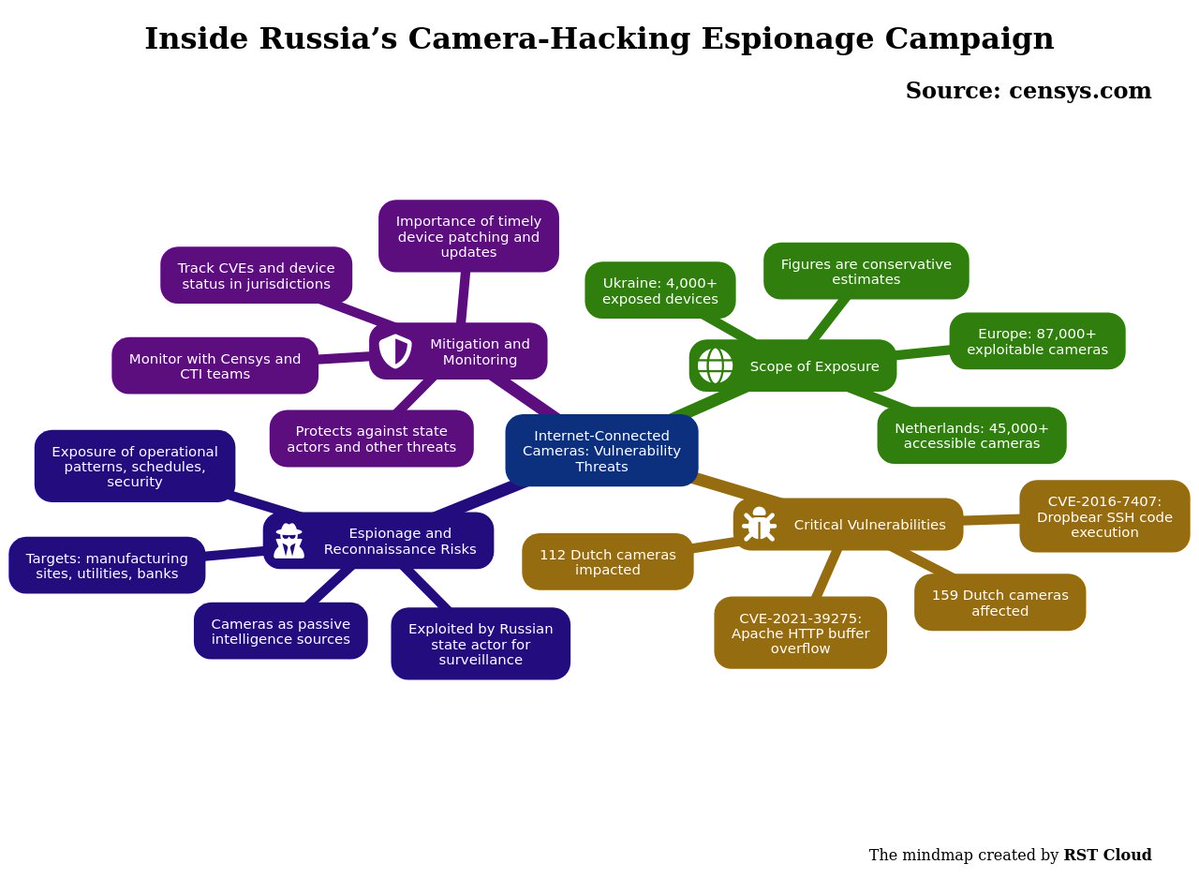
#threatreport #LowCompleteness Inside Russia’s Camera-Hacking Espionage Campaign | 16-07-2026 Source: censys.com/blog/russia-ca… Key details below ↓ 💀Threats: Dropbear_tool, 🎯Victims: Internet connected cameras, Manufacturing, Energy, Banking 🏭Industry: Financial, Transport, Military, Energy 🌐Geo: Russian, Poland, Greece, Belgium, Turkey, Austria, Spain, Croatia, Russia, Luxembourg, Ireland, North macedonia, Finland, Denmark, Hungary, Albania, Slovakia, Sweden, Ukraine, Latvia, Romania, Slovenia, Lithuania, Estonia, Portugal, United kingdom, Italy, France, Netherlands, Cyprus, Malta, Norway, Germany, Montenegro, Iceland, Czechia, Bulgaria 🔓CVEs: CVE-2016-7407 \[[Vulners](vulners.com/cve/CVE-2016-7…)] - CVSS V3.1: *9.8*, - Vulners: Exploitation: Unknown Soft: - dropbear_ssh_project dropbear_ssh (le2016.73) CVE-2021-39275 \[[Vulners](vulners.com/cve/CVE-2021-3…)] - CVSS V3.1: *9.8*, - Vulners: Exploitation: Unknown Soft: - apache http_server (<2.4.49) 🤖LLM extracted TTPs:` T1190, T1591.003 🔠Functions: Internet-Connected 🗂️Win API: ARC #threatreport: Recent analysis has highlighted the extensive vulnerability present in Internet-connected cameras, notably exploited by a Russian state actor for espionage. A study utilizing Censys data revealed that in the Netherlands, over 45,000 Internet-accessible cameras exist, with a significant number possessing known vulnerabilities. Specifically, 159 cameras are at risk from CVE-2016-7407, a long-standing arbitrary code execution flaw in the Dropbear SSH service, while 112 cameras could be compromised through CVE-2021-39275, a buffer overflow vulnerability in the Apache HTTP Server. The situation is not isolated to the Netherlands, as analysis shows a troubling trend across Europe. More than 87,000 exploitable Internet-connected cameras were identified across various EU member states, NATO countries, and Ukraine, which includes over 4,000 cameras identified in Ukraine alone. It’s essential to note that these figures likely represent a conservative estimate, as scanning techniques may not capture every vulnerable device. The exploitation of these cameras by state-aligned actors underscores broader challenges surrounding the security of Internet-connected devices. Many of these cameras do not house sensitive data; however, they serve as critical surveillance tools that can offer insights into operational patterns. For instance, unpatched cameras positioned at locations such as manufacturing facilities, energy utility substations, or banks can leak valuable information like shift schedules, logistical operations, and security measures. This passive reconnaissance does not necessitate breaching corporate networks; instead, it can stem from overlooking single, outdated devices. Analyzing and mitigating these vulnerabilities is crucial for cybersecurity professionals. By utilizing platforms like Censys, CTI teams are able to monitor for devices vulnerable to CVE-2016-7407 and potentially other known threats within their jurisdictions. The capability to track and manage these vulnerabilities is essential in protecting the physical and digital security landscapes from state actors and other threat entities exploiting the weaknesses of Internet-connected devices.
RST Cloud tweet media
English
1
0
3
318
Hired In Michigan
Hired In Michigan@HiredInMichigan·
@RenewedHopeUK Civil defence agencies often get sidelined in discussions about nation building. Their local insights and community connections can actually drive real change on the ground. It's worth exploring how these connections can amplify the Renewed Hope Agenda.
English
0
0
0
0
Renewed Hope United Kingdom
Renewed Hope United Kingdom@RenewedHopeUK·
💥 The Renewed Hope Global Town Hall Virtual Conference 💥 Conference Theme: Renewed Hope Agenda: The Strategic Role of CDCFIB Agencies in Nation Building Overview The virtual town hall conference focused on the Renewed Hope Agenda and the strategic role of Civil Defence, Correctional, Fire and Immigration Services Board (CDCFIB) agencies in nation building. The special guest, Major General Abdulmalik Jibrin (Rtd), discussed the ongoing recruitment exercise for 30,000 positions across four key agencies: the Nigerian Correctional Service, Nigeria Immigration Service, Federal Fire Service, and Nigeria Security and Civil Defence Corps. He explained that more than 2 million applications had been received since the recruitment portal opened in July last year. The process includes computer-based examinations, physical screening, medical assessments, and final selection based on merit. He emphasised that transparency measures have been introduced to reduce favouritism and ensure that only qualified candidates are selected. CDCFIB Agencies and Nation Building The discussion highlighted Nigeria’s economic repositioning efforts, international engagement, and the strategic contribution of CDCFIB agencies to national development. The conference was streamed live on several platforms, including BenTV UK and Diaspora TV in Switzerland. CDCFEB Board Recruitment Update Major General Jibrin (Rtd), outlined the core functions of the CDCFIB Board, including recruitment, discipline, promotion, and policy guidance for the four services under its supervision. He confirmed that the current recruitment exercise began last year, attracted more than 2 million applications, and is intended to fill 30,000 positions. Physical and medical screenings have recently been completed for shortlisted candidates. Although new applications are no longer being accepted for the current batch, the process remains ongoing, with final selections subject to medical fitness and other required assessments. Recruitment Exercise Timeline The special guest stated that the Ministry of Interior’s recruitment exercise has successfully engaged 30,000 Nigerians, describing it as a significant milestone in the country’s history. He noted that the current batch closed in July and indicated that the next recruitment cycle is expected to begin by the end of August. He added that the government plans to recruit another 30,000 people annually over the next three years. Interested candidates were encouraged to monitor the official website and recruitment portal for future opportunities and updates. The website links are as follows: recruitment.cdcfib.gov.ng and cdcfib.gov.ng Recruitment Process and Selection Criteria Major General Jibrin explained that the recruitment process is merit-based. More than 1.6 million applications were screened, and 34,000 candidates who scored above 90% advanced to the next stage. * A computer-based assessment to test applicants’ knowledge and suitability. * Physical screening, including a 3.5 kilometre run to be completed within 18 minutes. * Medical fitness checks to confirm candidates’ readiness for service. * An oral interview, during which candidates are expected to defend their certificates and credentials. He also announced that the President had approved the establishment of a Paramilitary Academy, similar in structure to the Nigerian Defence Academy. Candidates would be expected to take JAMB examinations after WAEC or NECO before qualifying for admission. Paramilitary Academy and Training Updates The special guest explained that the proposed paramilitary academy would allow candidates to train together before being assigned to specific services. This approach is intended to address seniority discrepancies, promote discipline, and build camaraderie across the services. He also addressed concerns about blood pressure testing during medical screenings, clarifying that candidates should be allowed to relax before measurements are taken. Once medical fitness is confirmed, candidates will proceed to the physical assessment stage. The medical report is expected by Monday week, after which further instructions will be communicated. Participants raised questions about Federal Interior Board applications, academy enrolment requirements, and civil defence training camps. Major General Jibrin clarified that applicants not captured in the current portal would be contacted separately. He also explained that academy enrolment would follow a process similar to other military academies, including the requirement for JAMB qualifications, and confirmed the existence of civil defence training camps. Highlight of the Conference A highlight of the conference is the attendance of our leaders and stakeholders from across the world. We have duly acknowledged their attendance at the end of the conference. We appreciate the support and encouragement from our leaders towards our project of enlightening Nigerians on the inner workings of the Renewed Hope administration of President Tinubu, GCFR. We do not take your support for granted and remain eternally grateful to you all. Feedback We always welcome feedback from participants and viewers across our various social media platforms. 🔥 Here are snippets of feedback from participants and followers of the conference. 1. “That was a good session with the caveat that we have applicants that complement the services board and those who have some issues. It's a good Idea that the service board handles the recruitment for various security agencies, bypassing the individual service where nepotism could creep in.” – Alabi Fadeyi, Ikorodu, Lagos. 2. “Chairman sir, you were so awesome today, although network or other unseen factors denied me the opportunity to put my questions through to the General… Twice!! In all, your perfection in the general organisation of today’s meeting was something else… Thanks, Chairman and Well done. This is Mr. Mark Pepple… coordinator Bonny LGA Renewed Hope Youth Alliance, Bonny Chapter Rivers State.” – Anthony Pepple, Bonny, Rivers State, Nigeria. 3. “All thanks to you, Boss, my prayer for you is that God should keep you safe and keep you in good health for us all as young people because I have come to realise how much you have the young people in your mind, and how you want us to grow by initiating this program and also dedicating your time to sit down from 4pm to 6pm May God continue to give you the much needed strength to push on till we get to our final destination.” - Roland Ogbotobo, Renewed Hope Youth Alliance. 4. “It is a good idea for the Services Board to handle recruitment for the various security agencies through a centralised process, rather than leaving it to individual services. Such an approach can help promote fairness, transparency, and merit-based selection while reducing the risk of nepotism and other forms of biases that may arise when recruitment is conducted independently by individual agencies.” – Otunba Ajana, Seychelles. 5. “Quite unfortunate that at the meeting, having raised my hands and was called twice..... yet I couldn't air my humble view due network palava....I hope to be lucky next time...!! Generally the meeting with the general was very insightful...” - BONNY LGA COORDINATOR, Renewed Hope Youth Alliance.... Rivers State. 6. “Thank God that President Tinubu have solid followers like the organisers of this conference who are enlightening us weekly with this programme. A close friend invited me to join the conference about three months ago, and I have been hooked on it every week. Thank you Amb. Adebola for the wonderful work that you and your Renewed Hope Global are doing for Nigeria.” – Godswill, Gyellesu, Zaria, Kaduna State, Nigeria. For more feedback and to watch the full conference video, visit our social media channels listed below. We appreciate our Media Partners: BEN TV UK, Diaspora TV, Switzerland, The Reflectors Newspaper, Nigeria, and Parrot Reporters Media Limited, South Africa, for your support always. For further information on this and previous virtual conferences, please stay connected with us for the latest updates, insightful discussions, and impactful initiatives as we champion the Renewed Hope agenda worldwide on: 🔹 YouTube – @RHGVTHC/videos" target="_blank" rel="nofollow noopener">youtube.com/@RHGVTHC/videos 🔹 TikTok –@rhgvthc?is_from_webapp=1&sender_device=pc" target="_blank" rel="nofollow noopener">tiktok.com/@rhgvthc?is_fr… 🔹 Instagram – instagram.com/rhgvthc?igsh=N… We invite you to follow, like, comment, and share our pages with your friends, family, and networks. Let’s spread the message of progress, empowerment, and transformation together. Our next VVIP is His Excellency, Ambassador Zayan Ibrahim, the Consul General of Nigeria in Dubai and the Northern Emirates. He would be the guest speaker at next conference on Saturday 25th July 2026. The e-flyer has been released. We kindly request you to share it with your family, friends, and acquaintances as well as on your various social media platforms. We have no other country. Everyone MUST contribute to making Nigeria great again. Signed:- Amb. Joseph Kolawole Adebola Esq., MNIM; MCICN Chairman/Chief Host Renewed Hope Global VTHC
English
1
1
5
1.5K
Hired In Michigan
Hired In Michigan@HiredInMichigan·
@westernregion60 The focus on the KGB Method misses the fact that while it may yield short, term control, it often breeds long, term resentment and resistance. Counter, terrorism isn't just about tactics , it's about winning hearts.
English
0
0
0
0
westernregionorganization
westernregionorganization@westernregion60·
The Oriire Precedent: Why the "KGB Method" is Nigeria’s Grim, Necessary Answer to Asymmetric Terror By Prince Bolade Olukokun "In a state of lawlessness, it is illegal to be law-abiding." (Fidel Castro) "Those who make peaceful revolution impossible will make violent revolution inevitable." (John F. Kennedy) "An eye for an eye and a tooth for a tooth." (Exodus 21:24) The forest does not respect the Queensberry Rules. For over a decade, Nigeria has attempted to fight a deeply unconventional, asymmetric war using a textbook written in the air-conditioned offices of Geneva and Washington. We have deployed billions of Naira in military hardware, issued endless press statements of "deep concern," and sent highly trained soldiers into dense, unforgiving canopies to fight an enemy that wears no uniform, respects no law, and melts into the civilian population like mist. And yet, the kidnappings continued. The highway ambushes multiplied. The tragic, senseless executions of innocent citizens—like Michael Oyedokun and Deacon John Olaleye during the May 2026 Oriire crisis—became almost routine. Until something shifted. The dramatic, voluntary release of the surviving captives from the Oriire school abductions didn't happen because the bandits suddenly found their conscience. It didn't happen because a ransom was paid, or because a Western-style drone strike took out a coordinate in the forest. It happened because the Nigerian military did the unthinkable: they went after what the terrorists cherished most. They arrested their families. It is a strategy that makes human rights organizations shudder. It is a method that Western military attachés in Abuja will never publicly approve. BUT in the brutal, uncompromising theater of Nigerian asymmetric warfare, the Oriire precedent has proven a stark, undeniable truth: to defeat an enemy who has discarded all rules of humanity, you must leverage the only currency they understand. To understand why the "Oyo Strategy" is a turning point, we must first dissect why the Western approach to counter-terrorism has failed spectacularly in the Sahel and the forests of Nigeria. The Western doctrine is built on the assumption of symmetry—or at least, the enforcement of it. It relies on high-tech surveillance, precise surgical strikes, strict legal frameworks, and the absolute separation of combatants from non-combatants. In a traditional conflict, this makes moral and strategic sense. But the bandits terrorizing Nigeria do not operate in a traditional conflict. They are ghost warriors. They use the deep forests of the North and West as sovereign kingdoms. They use innocent children as human shields, and they use the legal restraint of the Nigerian state as a tactical shield. They know the military cannot carpet-bomb a forest camp if fifty school children are chained inside. In asymmetric warfare, the weaker side exploits the morality of the stronger side. Every time we play by the "civilized" rules of engagement, we hand the bandits a structural advantage. They are allowed to have families, wives, and children resting safely in villages and towns, living off the proceeds of blood money, while our families are torn apart. By refusing to fight back with equal leverage, the state essentially subsidized the bandits' risk. "What has been will be again, what has been done will be done again; There Is Nothing New Under the Sun( Ecclesiastes 1:9) There is a historical precedent for this level of ruthless pragmatism, and it takes us back to the height of the Cold War. In September 1985, four Soviet diplomats were abducted in Beirut, Lebanon, by an extremist group linked to the early stages of Hezbollah. The kidnappers demanded that Syria halt its military operations against leftist militias in northern Lebanon. To show they meant business, they executed one of the diplomats, Arkady Katkov. The United States, facing similar hostage crises at the time, responded with diplomatic backchannels, freezing assets, and delicate negotiations. The Soviets took a vastly different path. The KGB dispatched its elite, ultra-secretive Alpha Group to Beirut. The operatives did not seek out the heavily fortified hostage camps. Instead, they used local intelligence to identify and abduct the close relatives of the hostage-takers' leaders. In the most infamous—and highly debated—account of the operation, the KGB operatives castrated one of the relatives, sent the severed body parts to the terrorist leader in an envelope, and added a simple, chilling note: the rest of your family is next if our men are not returned. Within days, the three remaining Soviet diplomats were released unharmed. For the next two decades, Soviet (and later Russian) citizens were virtually untouched by kidnappers in the Middle East. The lesson of Beirut was brutal but enduring: deterrence is not established by superior firepower; it is established by demonstrating a willingness to match your enemy's ruthlessness. What happened in the forests of Oyo in 2026 was our own modern, localized adaptation of the Beirut doctrine. The survivor accounts are harrowing. The bandits were merciless—beating captives for praying, executing a school teacher for the "crime" of keeping his phone, and keeping human beings in chains for 56 days. They felt entirely untouchable. But the atmosphere in the camp changed dramatically the moment word reached the commanders that the military had rounded up their own family members. Suddenly, the power dynamic flipped. The bandits were no longer holding all the cards. Their safe havens were compromised. The families they sought to enrich with ransom money were now in state custody. The cruelty stopped. The red oil and rice began to appear. And ultimately, the captives were guided to the streams and set free—not because of a tactical raid, but because of a hostage-matching reality. In the harsh reality of Nigerian security, this was not a breakdown of law; it was the restoration of balance. It is an eye for an eye born out of asymmetric war. If you steal our children from their schools, we will take your wives and brothers from their beds. If this grim, leverage-based pragmatism can tame the most ruthless forest bandits, it raises an incredibly provocative question: Could the same underlying logic be used to curb the excesses of our political elite and stop the "made in Nigeria" self centeredness fuelled by "Bamubamu ni mo yo" mentality? For decades, Nigeria has suffered from a different kind of asymmetric warfare—an economic one. A small, untouchable political class drains the treasury, under funds our hospitals, destroys our schools, and leaves the masses to decay, while they and their families live in absolute, insulated luxury. When a Nigerian politician loots the public purse, they do not keep the money in the local community. They send their children to prestigious universities in London, Boston, and Toronto. They fly their spouses to Dubai and Paris for medical checkups and shopping sprees. They buy mansions in Potomac and Mayfair. Just like the forest bandits, our leaders have insulated their loved ones from the consequences of their actions. They do not care if our public universities are shut down for months because their children do not attend them. They do not care if the local general hospital has no oxygen because their wives do not give birth there. What if we applied the "KGB Method" of accountability to public service? Imagine a system where: If a public official fails to fund the state hospitals under their care, their immediate family is legally barred from seeking medical treatment abroad and must use the very facilities they refused to fund. If a minister of education allows public schools to rot, their children must be enrolled in public local schools. If a governor fails to secure his state, his family’s foreign travel is suspended, forcing them to live under the same insecurity the citizens endure. It sounds radical, perhaps even vindictive. But it is the exact same principle of linked consequences. The moment a decision-maker's loved ones are forced to share the risk of their actions, their behavior changes overnight. Our major problem as a nation is not corruption . It has been wrongly diagnosed as such for decades that even a toddler echoes it but the major problem is impunity Corruption is not a Yoruba nor Hausa nor Ibo word. The major problem is that people commits problem and there is no consequences so others are not detered There is a billionaire kidnapper that has lovely wife and children giving them best of lives. If his children and wife has been held captive in eye for an eye approach, he'd had have a rethink to treat other people's wives and fathers like that The Bamubamu ni mo yo mentality makes a person wake up and decides he wants to have money then kidnap other people's kids and behead a man he does not know from Adams just to have his own way Honestly speaking we cannot afford the luxury of Western idealism when our house is on fire. How many times have you heard of kidnapping of this kind of cruelty ,brutality and bestiality in the west? Probably because maybe their criminals are more "civilised" or probably because they are more civilised or WHATEVER. They should therefore allow us met out our jungle justice in our jungle existence for now The Oriire rescue operation has shown us that the Nigerian state is capable of fierce, creative, and highly effective pragmatism. By targeting the support systems and families of those who threaten our peace, we stripped them of their leverage and brought our people home. There is nothing new under the sun. The Soviets understood it in 1985, and our military commanders understood it in 2026. If we want to secure this nation—whether from the bandits in the forests or the suits in the legislative chambers—we must stop appealing to the conscience of people who have none. We must find their leverage points, hold them firmly, and make them realize that whatever pain they inflict on the public will land directly on their own doorsteps. OR at best offer them Julius Caesar's type of ransom In 75 BC, a 25-year-old Julius Caesar was traveling across the Aegean Sea to study oratory in Rhodes when his ship was overtaken by Cilician pirates. At the time, these pirates were the absolute terror of the Mediterranean—ruthless, bloodthirsty, and accustomed to making wealthy Romans beg for their lives. They took Caesar hostage on the tiny island of Pharmacusa and demanded a ransom of 20 talents of silver (a massive fortune, roughly equivalent to the salary of a laborer for many years). Instead of trembling, Caesar burst out laughing in their faces. He told them they clearly had no idea who they had captured, and that demanding a paltry 20 talents for a man of his stature was an embarrassment. He insisted that they raise his ransom to 50 talents. The baffled pirates, thrilled by the prospect of more money, readily agreed and sent Caesar’s associates to the local cities to raise the fortune. Caesar stayed behind as a hostage, guarded only by a friend and two servants. After 38 days, the 50 talents of silver arrived, the ransom was paid, and Caesar was set free at the port of Miletus. ​The moment his feet touched land, Caesar did not run home. Although he held absolutely no official military or public office, he used his sheer charisma and the promise of spoils to raise a private fleet of ships and a force of armed men. ​He sailed straight back to the island of Pharmacusa, caught the pirates entirely by surprise, captured almost the entire band, and took back his 50 talents of silver. ​He then took them to the Roman governor of Asia to be sentenced, but when the governor hesitated—greedily eyeing the pirates' seized wealth and suggesting they be sold as slaves instead—Caesar bypassed the bureaucracy. He marched straight to the prison, dragged the pirates out, and crucified every single one of them. ​ As a small act of "mercy" for the bond they had shared, he had their throats slit first before nailing them to the crosses Imagine bandits killing our own Army General and going Scott free!. Do they know how much it cost Nigeria to produce one General?! Honestly speaking UNTILL these people are made to face and taste exactly what they do , kidnapping may never stop but when we hold them firm and make them realize that whatever pain they inflict will be inflicted back on them, ONLY then will we find true peace. (Grab Your Copy of The Prince's Soliloquy) ✍🏻 Prince Bolade Olukokun (17/07/2026)
English
1
0
2
203
Hired In Michigan
Hired In Michigan@HiredInMichigan·
@EstabrookAaron @TheJusticeDept This could signal a shift in how we handle national security threats. Courts like the ATRC were designed for a very different era, and it raises questions about their relevance today.
English
0
0
0
0
Aaron Estabrook 🇺🇸
Aaron Estabrook 🇺🇸@EstabrookAaron·
Something unprecedented happened this week, and almost nobody noticed. On July 15, the U.S Department of Justice (@TheJusticeDept) filed the first known application in the history of the Alien Terrorist Removal Court (ATRC). Congress created this court in 1996 for extraordinary national security cases involving non-citizens alleged to be involved in terrorism. For nearly 30 years, it sat unused. The filing wasn’t publicly discovered until Saturday, July 18. Then something equally important happened. On July 16, the judge did not simply approve the government’s request. Instead, after questioning government attorneys, the court concluded the application needed additional factual and legal support before it could proceed. The government has been ordered to supplement its filing. This isn’t an ordinary immigration proceeding. The ATRC operates under a specialized national security framework. It allows the government to rely on classified evidence that may not be fully disclosed to the respondent, limits many of the forms of immigration relief available in ordinary removal proceedings, and is designed for cases where national security information is at issue. It also applies to family members. The Secretary of State (@SecRubio) may certify that an alien whose presence or activities could endanger the welfare, safety, or security of the United States should be treated as an “alien terrorist.” At the same time this first-ever ATRC case emerged, several other developments were unfolding: • The State Department issued a worldwide security alert for Americans abroad. (Fewer than 10 have been issued in 30 years) • Military tensions with Iran continue to escalate. • Reports and rumors continue to circulate regarding possible operations involving Iran’s coast or strategic islands with 50,000 U.S. service members in the region including two Marine Expeditionary Units who are designed for amphibious operations. Are these events connected? I don’t know, and I won’t claim they are without evidence. But the timing is remarkable. The federal government has activated a court that had never before been used, during one of the most tense periods in the Middle East in years. We don’t know who the respondent is. We don’t know their nationality. We don’t know what organization they are alleged to be connected to. And we don’t know whether this case has anything to do with current events. What we do know is that the executive branch has invoked one of the most extraordinary legal authorities Congress has ever created, and the judiciary’s first response was to demand a stronger factual and legal justification before allowing the case to move forward. That is a story worth paying attention to. It deserves careful reporting, serious public scrutiny, and conclusions based on evidence rather than speculation. Source: atrc.uscourts.gov #ARTC
Aaron Estabrook 🇺🇸 tweet media
English
1
0
1
56
Hired In Michigan
Hired In Michigan@HiredInMichigan·
@MrPool_QQ This feels like a classic case of information overload. With so many moving pieces, we risk missing the bigger picture—how these actions could escalate tensions further, not resolve them.
English
0
0
0
1
Mr. Pool
Mr. Pool@MrPool_QQ·
🔻 They're moving fast now. US strikes on Iran. Andrew Tate arrested in America. Two soldiers dead in Jordan. This isn't random. This is coordinated. This is justice happening in real time. An intelligence officer from Joint Task Force contacted us. Military operations in Iran aren't geopolitics. They're dismantling a network. Deeper than anyone realizes. His words: "Jordan attack was trigger. Two soldiers dead. Not random. Guarding trafficking facility. IRGC running it. We knew for years." "Tate's arrest isn't separate. Part of same network. Modeling agency was front. Girls trafficked through Eastern Europe, Middle East, Iran. IRGC coordinated." "Tate arrest got files. Network map. Names. Trump authorized strikes. Not retaliation. Elimination. Surgical strikes on facilities and handlers." "Two soldiers died protecting evidence. So network couldn't destroy it. Death triggered response. Now it's happening." "Watching 12 years. Girls disappearing. Network operating. Governments protecting it. Now it's ending." Why now: "Evidence overwhelming. Network exposed. Move now or they escape. Girls stay trapped. We're moving." "Tate arrest was keystone. Everything connected. Money trails. Handlers. Facilities. All exposed." "Iran strikes are response. Surgical. Precise. Eliminating infrastructure. Freeing victims." "Military knows. Trump knows. Evidence classified but real. When public, world changes." What's coming: "More arrests. More facilities. More victims rescued. Network global but dismantling piece by piece." "Iran strikes beginning. Facilities in Syria, Turkey, Europe. All connected. All targeted." "Full scope comes out, people understand. Not about soldiers. About stopping genocide of girls." Operation Cleanse ✓ activated Phase 1: Evidence Collection ✓ complete (Tate arrest) Phase 2: Facility Elimination ⟳ live (Iran strikes) Phase 3: Network Dismantling ⟳ July 20-31 Phase 4: Public Revelation ⟳ August 1-15 The arrests are happening. The strikes are happening. The network is falling. Trump authorized it. The military is executing it. Justice is real. Share this. Demand accountability. Demand the truth. The girls are being freed. The network is being destroyed. Everything changes. Operation code: Cleanse-7718 Status: active Target: human trafficking network ⟁
English
68
477
1.5K
80.9K
Hired In Michigan
Hired In Michigan@HiredInMichigan·
@ErnieMilleur Putin's war thrives on a lack of accountability. The longer the world waits to address the consequences of aggression, the more emboldened he becomes. Time isn’t on our side.
English
0
0
0
0
Ernie Milleur
Ernie Milleur@ErnieMilleur·
Vladimir Putin’s war against Ukraine has continued because the Russian government has been permitted to believe that time, brutality, nuclear intimidation, and Western hesitation will eventually produce victory. Cities have been bombarded, families displaced, children taken from occupied territories, and countless soldiers and civilians killed. The question facing the world is no longer whether Putin can be persuaded by ordinary diplomatic appeals. The question is whether democratic nations possess the unity and determination to prevent aggression from being rewarded. Russia launched its full-scale invasion of Ukraine in February 2022 after seizing Crimea and supporting armed separatism in eastern Ukraine beginning in 2014. Putin bears command responsibility for the Russian state and its military campaign. Calling him a murderer expresses a powerful moral judgment concerning the deaths caused by his decisions. Legally, individual responsibility for particular killings must be established through evidence and judicial proceedings. The International Criminal Court issued an arrest warrant for Putin in March 2023, alleging responsibility for the unlawful deportation and transfer of Ukrainian children from occupied territory into Russia. The warrant does not constitute a completed conviction, yet it demonstrates that Putin is no longer treated merely as another national leader. He is a wanted suspect before an international court, and participating ICC states are expected to arrest him when legally obligated and able to do so. The war remains intensely destructive. On July 19, 2026, Russian forces launched a large missile-and-drone attack against Kyiv, killing at least one person, injuring others, and damaging several districts. Ukraine’s continuing shortage of Patriot air-defense systems has left civilians vulnerable to ballistic missiles that may reach their targets within minutes. Stopping Putin does not mean assassinating him or launching an uncontrolled war between nuclear powers. It means denying him the military, financial, political, and territorial rewards he seeks. It also means making clear that borders cannot be erased through force and that mass violence will carry lasting consequences. The first requirement is to give Ukraine enough defensive strength to protect its cities. Air-defense missiles, radar systems, interceptor aircraft, electronic warfare equipment, and ammunition save civilian lives directly. Supplying only enough equipment to prevent Ukraine’s collapse prolongs the conflict. Ukraine needs sufficient and dependable support to deny Russia air superiority, defend its electrical system, and reduce Moscow’s ability to terrorize the population. NATO allies pledged €70 billion in military equipment, assistance, and training for Ukraine during 2026 and committed themselves to maintaining at least an equivalent level of assistance in 2027. This is significant, since Putin’s strategy depends partly upon the belief that Western governments will eventually become divided or exhausted. Second, Russia’s ability to finance the war must be reduced. Oil and gas revenue, sanctions evasion, covert shipping networks, foreign components, and access to international finance help sustain Russian military production. Sanctions have greater force when they are enforced against the companies, banks, intermediaries, and vessels that help Russia circumvent restrictions. In June 2026, the European Union extended its economic sanctions connected to Russia’s aggression through July 31, 2027. Economic pressure alone is unlikely to end the invasion immediately. It can weaken the Kremlin’s capacity to replace weapons, subsidize the war, and persuade Russians that continued aggression has no serious cost. Reuters reported in July 2026 that Russia was facing slowing growth, rising inflation, and increasing fuel pressures linked partly to Ukrainian attacks and the broader expense of the war. Third, Ukraine must be allowed to disrupt legitimate military targets supporting attacks against its territory. International assistance should include clear rules protecting civilians while permitting Ukraine to strike command centers, weapons depots, airfields, missile launchers, military factories, and war-related logistics. Civilians inside Russia are not lawful targets merely because Putin has committed crimes. Ukraine and its supporters must retain the moral distinction between resisting aggression and adopting the aggressor’s methods. Fourth, democratic nations should reject false peace arrangements that merely freeze Russian occupation and allow Moscow to prepare for another invasion. A ceasefire can be valuable when it genuinely stops killing and leads toward a durable settlement. A settlement imposed upon Ukraine without reliable security guarantees could reward conquest and create the conditions for a later war. Diplomacy must remain available because nearly every war eventually requires negotiation. Meaningful diplomacy depends upon strength. Putin is more likely to negotiate seriously when continued aggression appears less profitable than compromise. Negotiation from weakness risks becoming surrender under another name. Fifth, evidence of war crimes must be collected and preserved. Commanders, officials, prison authorities, propagandists directly connected to crimes, and those responsible for deportations or attacks on civilians should face investigation. Justice may take years. The passage of time must not erase responsibility. The goal is not revenge against the Russian people. Many Russians have opposed the war, suffered repression, fled the country, or lost relatives through decisions they did not make. Reports in July 2026 continued to describe Kremlin pressure against anti-war political voices inside Russia. The world must also prepare for the possibility that Putin will remain in power for years. Policies cannot depend upon his conscience suddenly awakening. They must be built around deterrence, Ukrainian resilience, European defense, economic enforcement, and political unity. Putin should be stopped through lawful strength: protect Ukraine, deny Russia victory, restrict the machinery financing the war, defend NATO territory, expose propaganda, pursue criminal accountability, and leave a genuine path open for peace. The safest message to future aggressors is not that invasion produces endless negotiations and permanent territorial gains. It is that aggression will fail, occupied people will not be abandoned, and political leaders who unleash devastation may one day answer before justice.
Ernie Milleur tweet media
English
1
0
1
75
Hired In Michigan
Hired In Michigan@HiredInMichigan·
@Albanyjobfair Most job seekers forget to follow up after a fair. A simple thank, you email to employers can set you apart and keep the conversation alive.
English
0
0
0
0
Albany Job Fair
Albany Job Fair@Albanyjobfair·
Your next career opportunity is waiting! Join us at the Albany Job Fair on Wednesday, Sept.9th, 2026, and meet 40+ employers looking to hire. 📍 Holiday Inn Express & Conference Center, Latham 🕐 Veterans Hour: 1:00 PM – 2:00 PM 🕑 Open to the Public: 2:00 PM – 5:00 PM ✔️ Connect with hiring managers ✔️ Bring your résumé ✔️ Discover new career opportunities 📩 Upload your résumé at AlbanyJobFair.com 💻 Register today: AlbanyJobFair.com/apply-now/ Take the next step toward your future—we'll see you on Sept.9th! #AlbanyJobFair #NowHiring #JobFair #AlbanyNY #CareerOpportunities #HiringNow
Albany Job Fair tweet media
English
1
0
1
13
Hired In Michigan
Hired In Michigan@HiredInMichigan·
@JRW1955 This reads like a conspiracy theory. Most events like this don't connect in the way people think. It's usually chaos, not some grand plan. Justice isn't a straight line.
English
0
0
0
0
Joseph Wilhelmi
Joseph Wilhelmi@JRW1955·
🔻 They're moving fast now. US strikes on Iran. Andrew Tate arrested in America. Two soldiers dead in Jordan. This isn't random. This is coordinated. This is justice happening in real time. An intelligence officer from Joint Task Force contacted us. Military operations in Iran aren't geopolitics. They're dismantling a network. Deeper than anyone realizes. His words: "Jordan attack was trigger. Two soldiers dead. Not random. Guarding trafficking facility. IRGC running it. We knew for years." "Tate's arrest isn't separate. Part of same network. Modeling agency was front. Girls trafficked through Eastern Europe, Middle East, Iran. IRGC coordinated." "Tate arrest got files. Network map. Names. Trump authorized strikes. Not retaliation. Elimination. Surgical strikes on facilities and handlers." "Two soldiers died protecting evidence. So network couldn't destroy it. Death triggered response. Now it's happening." "Watching 12 years. Girls disappearing. Network operating. Governments protecting it. Now it's ending." Why now: "Evidence overwhelming. Network exposed. Move now or they escape. Girls stay trapped. We're moving." "Tate arrest was keystone. Everything connected. Money trails. Handlers. Facilities. All exposed." "Iran strikes are response. Surgical. Precise. Eliminating infrastructure. Freeing victims." "Military knows. Trump knows. Evidence classified but real. When public, world changes." What's coming: "More arrests. More facilities. More victims rescued. Network global but dismantling piece by piece." "Iran strikes beginning. Facilities in Syria, Turkey, Europe. All connected. All targeted." "Full scope comes out, people understand. Not about soldiers. About stopping genocide of girls." Operation Cleanse ✓ activated Phase 1: Evidence Collection ✓ complete (Tate arrest) Phase 2: Facility Elimination ⟳ live (Iran strikes) Phase 3: Network Dismantling ⟳ July 20-31 Phase 4: Public Revelation ⟳ August 1-15 The arrests are happening. The strikes are happening. The network is falling. Trump authorized it. The military is executing it. Justice is real. Share this. Demand accountability. Demand the truth. The girls are being freed. The network is being destroyed. Everything changes. Operation code: Cleanse-7718 Status: active Target: human trafficking network ⟁
English
1
0
2
173
Hired In Michigan
Hired In Michigan@HiredInMichigan·
@debugliesnews The pressure strategy is just a tool—most regimes will dig in deeper when cornered. It's not just about damage; it's about understanding the resilience of your opponent.
English
0
0
0
0
debuglies
debuglies@debugliesnews·
Maximum Pressure on Iran: Strategic Failure by Design - Maximum Pressure on Iran Still Hurts. It No Longer Compels. The United States has not lost the ability to damage Iran. It has lost the certainty that damage will produce submission. Sanctions, financial isolation, military strikes and maritime interdiction have pushed Iran into recession, inflation and clandestine commerce; they have not forced Tehran to abandon enrichment, missiles, regional deterrence or control of the Strait of Hormuz. The policy’s central defect is now measurable: Washington can destroy value faster than it can convert that destruction into political concessions. Iran, meanwhile, can no longer secure prosperity or conventional military parity, but it can preserve enough oil income, nuclear ambiguity and asymmetric retaliation capacity to deny the United States a cheap strategic victory. That widening gap between economic pain and political compliance is the defining fact of the confrontation. The Objective Expanded Beyond the Instrument On 4 February 2025, President Donald Trump restored maximum pressure through National Security Presidential Memorandum 2, directing U.S. agencies to intensify sanctions, review existing relief, warn shipping, insurance and port operators, and drive Iranian petroleum exports toward zero. The memorandum also linked economic pressure to a much broader agenda: preventing a nuclear weapon, countering ballistic missiles, weakening the Islamic Revolutionary Guard Corps and restricting Tehran’s regional operations. National Security Presidential Memorandum/NSPM-2 – White House – February 2025 This breadth made success progressively harder to define. Sanctions may extract a nuclear concession; they are far less likely to eliminate enrichment, missiles, armed partnerships, oil exports and the regime’s security architecture simultaneously. For Tehran, those instruments are not negotiable policy accessories. They compensate for conventional inferiority and vulnerability to attack. A strategy demanding their collective surrender without durable security guarantees leaves resistance as the regime’s rational choice, even when that choice inflicts extraordinary costs on Iranian society. The Damage Is Real The claim that sanctions have become economically irrelevant is contradicted by the data. The International Monetary Fund projects Iran’s real GDP to contract by 5.4% in 2026, with average consumer-price inflation reaching 68.9% across a population of 87.934 million. Islamic Republic of Iran and the IMF – International Monetary Fund – July 2026 These figures imply collapsing purchasing power, higher import costs, weaker private investment, pressure on public finances and accelerating deterioration in infrastructure and industrial capacity. Treasury enforcement has also reached exceptional scale. On 25 February 2026, the Office of Foreign Assets Control sanctioned more than 30 individuals, entities and vessels involved in Iranian petroleum sales, ballistic-missile production and advanced conventional-weapons procurement. Treasury Targets Iran’s Shadow Fleet and Networks Supplying Its Military – U.S. Department of the Treasury – February 2026 On 24 April 2026, Treasury targeted approximately 40 shipping firms and vessels connected to the shadow fleet. Economic Fury Targets Global Network Fueling Iran’s Oil Trade and Shadow Fleet – U.S. Department of the Treasury – April 2026 Four days later, OFAC issued a specific alert concerning sanctions exposure associated with Chinese independent “teapot” refineries. The pressure is therefore operationally significant: it freezes assets, raises freight and insurance costs, narrows access to technology, delays payments and forces Iranian sellers to accept discounts and opaque settlements. Oil Refused to Disappear The strategic failure becomes visible in Iran’s export curve. The U.S. Energy Information Administration estimates that Iranian crude-oil and condensate exports fell from 1.976 million barrels per day in 2018 to 343,000 barrels per day in 2020. They then recovered to 808,000 in 2021, 923,000 in 2022, 1.276 million in 2023, 1.445 million in 2024 and 1.576 million barrels per day in 2025. Estimated gross crude and condensate revenue moved from USD 51 billion in 2018 to USD 5 billion in 2020, before rising to USD 19 billion in 2021, USD 38 billion in 2022, USD 43 billion in 2023, USD 49 billion in 2024 and USD 48 billion in 2025. Report on Iranian Petroleum and Petroleum Products Exports – U.S. Energy Information Administration – June 2026 Those are gross estimates, not cash freely available to Tehran. Discounts, intermediaries, frozen balances, barter and payment delays reduce their value. But they prove that pressure altered the architecture of trade rather than eliminating it. Iran replaced transparent commerce with aged tankers, layered ownership, ship-to-ship transfers, renamed vessels, manipulated tracking data, front companies and non-dollar settlement. Washington repeatedly destroys individual nodes; the network regenerates. China Became the System’s Demand Floor By 2025, the EIA estimated Iranian crude and condensate exports to China at 1.567 million barrels per day, against only 9,000 barrels per day to all other destinations combined. Report on Iranian Petroleum and Petroleum Products Exports – U.S. Energy Information Administration – June 2026 This concentration leaves Iran dependent on one buyer but prevents export extinction. China does not eliminate sanctions costs; it provides refineries, ports and commercial actors willing to absorb discounted barrels when expected profits exceed enforcement risks. Beijing’s political position also weakens Washington’s coalition strategy. China officially rejects unilateral sanctions and “long-arm jurisdiction,” while defending what it calls normal commercial relations with Iran. Large Chinese companies exposed to the dollar system may comply, but independent refiners with limited Western assets can operate under a different risk calculation. Iran’s adaptation is therefore neither economic victory nor sanctions immunity. It is a survival mechanism built around lower margins, higher secrecy and deeper dependence on China. That is sufficient to frustrate a policy whose target is zero exports. The Regime Protects Itself First Maximum pressure assumes that national economic pain reaches the officials deciding nuclear and security policy. Iran’s political economy interrupts that transmission. The state can protect military institutions, strategic procurement and patronage networks while allowing households, private companies, pensioners and civilian infrastructure to absorb inflation and scarcity. Sanctioned trade itself creates rents. Access to foreign currency, cargo allocations, import permits, covert shipping and protected financial channels becomes more valuable as lawful commerce contracts. Institutions linked to the IRGC and armed forces are better positioned than ordinary companies to control those channels. Economic pressure may consequently weaken Iran as a country while strengthening security organizations relative to the civilian economy. This is the policy’s distribution problem: the citizens who bear the greatest costs do not determine enrichment levels, missile deployments or maritime strategy. The institutions that do make those decisions retain preferential access to scarce resources and the coercive power required to suppress unrest. Recession is therefore not synonymous with elite surrender. Nuclear Leverage Reversed the Clock Iran answered a slow economic instrument with a faster technical one. The International Atomic Energy Agency reported in February 2026 that Iran remained the only non-nuclear-weapon state party to the Nuclear Non-Proliferation Treaty to have produced and accumulated uranium enriched to 60% U-235. The Agency also stated that it could no longer determine the current size, composition or location of the enriched-uranium stockpile after losing access and continuity of knowledge. Implementation of the NPT Safeguards Agreement with the Islamic Republic of Iran – International Atomic Energy Agency – February 2026 This asymmetry is decisive. Sanctions accumulate over years; enrichment and reduced transparency can change military calculations within weeks. Iran does not need to test a nuclear device to obtain leverage. It needs uncertainty regarding material, facilities and timelines. That uncertainty raises the cost of attack, shortens foreign decision windows and increases the value of restored inspections. Maximum pressure thus produced a perverse exchange: Washington increased economic pain, while Tehran accumulated a strategic asset more urgent to Washington than economic recovery was to Iran. Hormuz Globalised the Cost The Strait of Hormuz transformed bilateral coercion into a global energy-security crisis. Before the conflict, the EIA estimated that approximately 20 million barrels per day of petroleum liquids crossed the strait, alongside more than one-fifth of global liquefied-natural-gas trade. Saudi Arabia accounted for 5.5 million barrels per day, or 38%, of Hormuz crude and condensate flows in 2024. Available Saudi and Emirati bypass capacity was only about 2.6 million barrels per day. Amid Regional Conflict, the Strait of Hormuz Remains Critical to Global Oil and LNG Trade – U.S. Energy Information Administration – June 2025 After the strait’s effective closure on 28 February 2026, the EIA estimated that Iraq, Saudi Arabia, Kuwait, the United Arab Emirates, Qatar and Bahrain collectively shut in 7.5 million barrels per day in March, rising to a projected 9.1 million barrels per day in April. Hormuz Closure and Related Production Outages Are Key Drivers of the Energy Outlook – U.S. Energy Information Administration – April 2026 Production shut-ins subsequently peaked at 11.2 million barrels per day in May and averaged 8.3 million in June. Short-Term Energy Outlook – U.S. Energy Information Administration – July 2026 Iran did not need permanent control of the waterway. It needed enough missiles, drones, mines, coastal systems and commercial uncertainty to frighten insurers, crews and shipowners. The resulting costs fell on Gulf exporters, Asian importers and the global economy—not only on Iran. Military Superiority Did Not Deliver Political Closure The United States retains overwhelming conventional superiority. On 7 July 2026, CENTCOM struck approximately 80 Iranian military targets, including more than 60 IRGC small boats, after attacks on three commercial vessels in Hormuz. U.S. Forces Complete Another Round of Strikes Against Iran – U.S. Central Command – July 2026 Additional waves followed on 12, 13 and 14 July, targeting coastal and military installations. By 18 July, CENTCOM reported an eighth consecutive night of strikes. The scale demonstrates American capacity to destroy fixed assets. The repetition demonstrates the limits of destruction. Iran continued regenerating or dispersing enough maritime, drone and missile capability to require further surveillance, escorts, blockades and attacks. Tactical dominance did not create a stable political settlement; it created a recurring suppression requirement. The Settlement That Pressure Cannot Replace The policy can regain strategic utility only by narrowing its objectives and connecting every demand to a credible benefit. The first priority must be restored IAEA access, complete accounting for enriched material and monitored limits on enrichment and centrifuges. The second must be maritime deconfliction: a prohibition on attacks against commercial vessels, incident-investigation procedures and protected transit. The third must be phased economic relief through specified oil volumes, named banking channels, escrow access, insurance permissions and sanctions suspension triggered by verified implementation. Europe is indispensable. On 29 September 2025, the Council of the European Union reimposed all nuclear-related economic and financial sanctions lifted in 2016. Iran Sanctions Snapback: Council Reimposes Restrictive Measures – Council of the European Union – September 2025 Without coordinated U.S.–EU relief, formal concessions may not restore actual banking, shipping or investment. China must also participate because it has become Iran’s dominant petroleum customer. The objective is not trust. It is a mechanism in which Iranian compliance generates predetermined relief and violations generate proportionate, automatic penalties. The Cost of Continuing Unchanged Maximum pressure still reduces Iranian income, obstructs procurement and destroys military capacity. It does not compel comprehensive surrender. Iran has shown that it can endure severe national impoverishment, preserve a discounted oil corridor to China, protect security institutions, accumulate nuclear leverage and export escalation costs through Hormuz. The choice before Washington is therefore not pressure or appeasement. It is pressure without conversion or pressure engineered into a transaction. The first path produces repeated sanctions packages, recurring strikes, higher energy volatility and progressively weaker nuclear visibility. The second accepts a narrower but enforceable objective: controlled enrichment, continuous inspections, protected navigation, constrained attacks and reversible economic relief. By 2031, the decisive metric will not be the number of sanctioned ships or destroyed targets. It will be whether American power has produced verifiable restraint. Until then, maximum pressure will remain economically destructive, militarily formidable—and strategically incomplete. debuglies.com/2026/07/19/max… via @https://debuglies.com
debuglies tweet media
English
1
0
1
228
Hired In Michigan
Hired In Michigan@HiredInMichigan·
@Andreat89272541 Wearing red is great, but sharing personal stories of those deployed amplifies the impact. It connects us to their sacrifices in a way that a color can't. It's about remembrance , and a deeper understanding.
English
0
0
0
0
Sweet, Sassy & Southern
Sweet, Sassy & Southern@Andreat89272541·
❤️ R.E.D. Friday — Remember Everyone Deployed ❤️ Scripture: “The Lord will watch over your coming and going both now and forevermore.” — Psalm 121:8 ⸻ Every Friday, many of us wear red for a simple but powerful reason: To Remember Everyone Deployed. It is a small act, but it carries a big message. Because somewhere today, an American service member is standing watch while the rest of us go about our normal routines. Some are far from home. Some are missing birthdays, anniversaries, ballgames, holidays, and family dinners. Some are serving in places most of us will never see, carrying responsibilities most of us will never fully understand. And while they serve, families serve too. Spouses carry extra burdens. Children count down the days until homecoming. Parents pray. Friends wait. Loved ones watch the news with a little more concern and spend a little more time on their knees. Today, as we wear red, let it be more than a tradition. Let it be a reminder to pray. Pray for protection. Pray for strength. Pray for courage. Pray for peace. Pray for the families holding down the home front. And pray that every deployed service member would know they are not forgotten. The God who watches over us here is the same God who watches over them there. No distance is too great for His presence. No ocean is too wide for His protection. No deployment is beyond His care. Today we honor their sacrifice, appreciate their service, and entrust them to the faithful hands of God. Remember Everyone Deployed. ❤️🇺🇸❤️ Prayer Heavenly Father, Today we lift up every deployed service member to You. Surround them with Your protection, strength, wisdom, and peace. Guard them physically, emotionally, and spiritually wherever they serve. We pray for their families as well. Comfort spouses, encourage children, strengthen parents, and sustain loved ones through the days of separation. Remind them that You are near and that no sacrifice made in service goes unseen by You. Lord, bring our military members safely home when their missions are complete. Let them feel appreciated, supported, and covered in prayer. May Your presence go before them, stand beside them, and watch over them every step of the way. Thank You for those willing to serve and sacrifice for others. In Jesus’ name, Amen. ❤️🇺🇸 #REDFriday #RememberEveryoneDeployed #SupportOurTroops #PrayForOurMilitary #GodBlessOurTroops #MilitaryFamilies #Psalm121
Sweet, Sassy & Southern tweet media
English
27
46
121
1.8K