
Sabitlenmiş Tweet
WHOOblee
9.9K posts

WHOOblee
@HublyG
Nope. Not these days. Winter is Coming.
Katılım Mart 2014
947 Takip Edilen126 Takipçiler



KIRO host Spike O’Neill backed Katie Wilson, saying officers who don’t follow the law should face consequences.
mynorthwest.com/kiro-opinion/s…
English
@jesseproudman @yourfriendsam Oh just fuck all the way off
with this ignorant,
arrogant,
thirsty slop…
English

@yourfriendsam No one forces any one into employment. That's simple cop out for not being able to make your own decisions and being disappointed with the choices you've made.
English
No one is forcing any one to become a barista.
What happened to the concept of free will?
Melanie D'Arrigo@DarrigoMelanie
The Starbucks CEO is paid $96M per year. The average Starbucks barista makes up to $37,000 per year — less than a living wage. That means baristas need tips and taxpayer-funded social safety nets to survive. We shouldn't be forced to subsidize Starbucks' poverty wages.
English
WHOOblee retweetledi

Grover Cleveland had cancer (sarcoma) in his mouth and jaw removed on a yacht at sea while the public thought he was on vacation, and no one knew until 24 years later
Woodrow Wilson had several strokes before and during his terms
Eisenhower had a heart attack that they described as gas
Chester Arthur’s kidneys were failing
Roosevelt contracted polio and became paralyzed, so they took no pictures below the waist afterward to hide it
JFK nearly died at least 5 times in his life due to Addison’s disease, including during his term, and was on a cocktail of drugs that included tons of steroids
If it's one thing we can count on, it's that our government will not tell us if our president is unwell/cannot do the job because it temporarily crashes the market, causing billions in losses for the wealthy
English
@PatriotNurse72 @tebsf @joshiamitabhevo Easy.
Wouldn’t be there in the first place,
wouldn’t torch a $1B mea culpa.
Laughing at the “military strategic abilities”
that we all doing somersaults over now…
English

How else were we supposed to rescue? Somebody stranded in the cliffs and mountains of Iran? Someone who already had a $70,000 bounty on their head… In the video you can see our Apache literally picking off IRG soldiers who were moving in on the area, so please, I beg the question of you to with your brilliant in your own mind, military strategic abilities. Tell us how you would’ve done it… Because I bet it wouldn’t work.😂
English
Something about this F15 crew rescue doesn't add up. Why would one need C130s (carry 60-70 troops) for rescuing one or two aircrew and maybe a few troops whose helicopter got shot down during the rescue. It looks more like spl forces were in a temporary base with C130s etc. 1/3
English

No church for the Mad King on the Christian Superbowl...weird
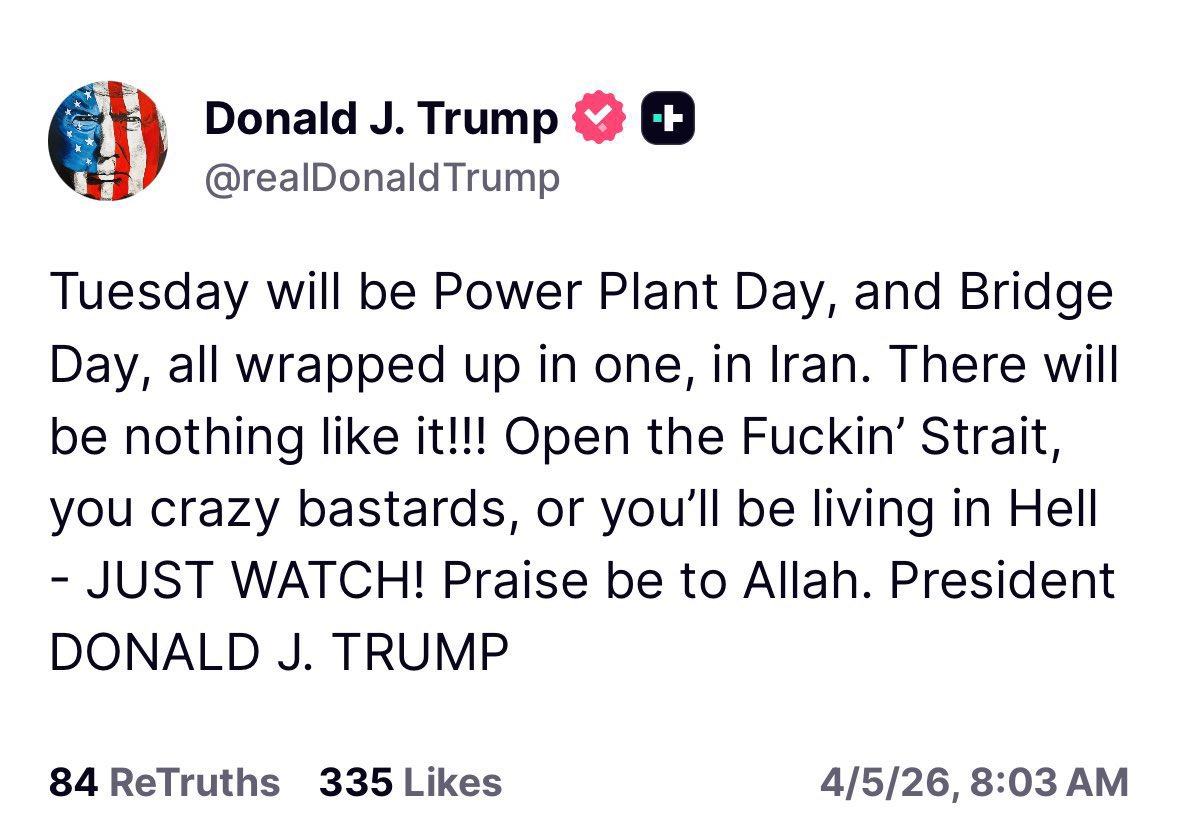
PatriotTakes 🇺🇸@patriottakes
Trump, who MAGA pastors claim was sent by God, is skipping church on Easter today according to his official White House schedule
English
@killermonk @DrAllyLouks Me too, completely. Won’t even accept a neti pot flow. Total blockage. I’ve always suspected the two upper molar dental implants and sinus bump to accommodate. Sauna will open in about 15 minutes.
English
@DrAllyLouks Wait. My ENT told me that was abnormal, at least for one to be totally clogged in the alternating cycle. Very interesting info
English

Each of your nostrils has a different job. When we breathe, we take in more air through one nostril than the other, alternating every few hours. The different levels of airflow sensitise each nostril to different smells, so that your brain receives more complete information.
English
@jwalkermobile One of my sides is a pineapple casserole, the ham pan has pineapple trimmings and juice. Smoke at 220.
English
@jwalkermobile Cheated. Costco spiral ham. Put a rub into some honey, gonna smoke to reheat. Thinking 2 hours.
English

Happy Easter from Easton Connecticut, 43°F and foggy. Scones and Bacon have been requested here, what’re you making today?
English
WHOOblee retweetledi

JUST IN: The New York Times confirmed the unit. Navy SEAL Team 6. The same operators who killed Osama bin Laden in Abbottabad in 2011 extracted a downed Air Force colonel from the Zagros Mountains of Iran in 2026. The parallels are exact and the differences are what matter. In 2011, 24 SEALs flew two stealth Black Hawks into Pakistan, spent 40 minutes on the ground, destroyed one crashed helicopter to protect its classified stealth modifications, and flew out with bin Laden’s body. Zero casualties. In 2026, according to the Times, hundreds of special operations troops and other military personnel, dozens of warplanes and helicopters, and the full spectrum of cyber, space, and intelligence capabilities were deployed to extract one injured weapons systems officer who had been evading capture for over 24 hours while IRGC forces and Bakhtiari tribesmen hunted him through mountains 200 miles inside Iran. The operation that killed the world’s most wanted man used two helicopters. The operation that rescued one pilot used an air armada.
The WSO ejected when his F-15E was shot down on April 3, the first American combat aircraft lost in the war. He landed in the mountains of Kohgiluyeh and Boyer-Ahmad Province. He had a pistol, an encrypted beacon, and SERE training. He hiked to a 7,000-foot ridgeline, found a rock crevice, and activated his signal while Iranian state television broadcast a bounty for his capture. The CIA ran a deception campaign to misdirect Iranian search parties. Israeli intelligence provided real-time tracking of IRGC ground force movements and the Israeli Air Force halted its own strike campaign for 36 hours to create a rescue corridor. A senior US official told the Times it was “one of the most challenging and complex rescues in the history of American special operations.”
The rescue force established a forward arming and refuelling point on an abandoned airstrip approximately 50 kilometres southeast of Isfahan, deep inside Iranian territory. Two MC-130J Commando II transports and associated MH-6 Little Bird helicopters landed to support the extraction. Both transports became immobilised. The operators destroyed them on the ground, detonating charges on classified avionics, communications systems, and software rather than allow the IRGC to capture American technology. Then they called for more aircraft. Three additional transports arrived under fire. SEAL Team 6 loaded the WSO and the stranded rescue team and flew out of Iran. Zero American casualties. The WSO was flown to Kuwait for treatment. The President said he “will be just fine.”
In 2011, one stealth Black Hawk was destroyed to protect its secrets. In 2026, two MC-130Js and their associated rotary-wing aircraft were destroyed for the same reason. The doctrine is identical: hardware is expendable when the alternative is technology transfer to an adversary. The scale is what changed. Abbottabad was a scalpel. Dehdasht was a sledgehammer wrapped in a scalpel. The scalpel was SEAL Team 6. The sledgehammer was everything else the United States military sent into Iran to make sure the scalpel could do its work and come home.
This was the first confirmed American ground operation of the 2026 Iran war. Not a missile strike. Not an air sortie. Boots on Iranian soil, weapons fired at Iranian forces, aircraft destroyed on Iranian territory, and every person who went in came out. The country that failed at Desert One in 1980 just succeeded at Dehdasht in 2026, and the unit that made the difference is the same unit that was created because Desert One failed.
open.substack.com/pub/shanakaans…

Shanaka Anslem Perera ⚡@shanaka86
He climbed a ridge. That is where the story turns. When the F-15E was hit on Friday morning, both crew members ejected over the mountains of Kohgiluyeh and Boyer-Ahmad Province in southwestern Iran. The pilot was located first and extracted by HH-60 rescue helicopters within hours, under small arms fire that wounded crew aboard the recovery aircraft. The weapons systems officer landed deeper in hostile terrain. He was alone on the ground in a country where state television was broadcasting a bounty for his capture and Basij militia were flooding the mountain roads below. According to reports now confirmed by Fox News citing two senior US officials, the WSO used his SERE training, the survival, evasion, resistance, and escape doctrine drilled into every American combat aircrew. He moved on foot through rugged terrain. He climbed to an elevated ridge near the city of Dehdasht. He activated his encrypted emergency beacon. And he waited. The beacon was the thread. Everything that followed pulled on it. US Joint Special Operations Command launched a night extraction package. Reports indicate Delta Force operators and Pararescuemen from the 24th Special Tactics Squadron inserted via helicopters from the 160th Special Operations Aviation Regiment, the Night Stalkers, the unit that flew the Bin Laden raid. A-10 Warthogs from the 355th Wing provided close air support, running gun passes on IRGC and Basij convoys advancing toward the WSO’s position. HC-130J tankers kept the package airborne. Multiple aircraft were dispatched to establish a temporary fire zone around Dehdasht, a no-entry perimeter enforced with precision strikes on a telecommunications tower and approaching vehicles. Iranian local officials reported at least four killed and several wounded from the strikes. Then the operation went sideways. According to reports corroborated by Fox News’s confirmation that US forces destroyed “aircraft which have sensitive equipment,” two C-130 transports landed at a remote forward arming and refuelling point inside Iran to support the extraction. Both became stuck. Rather than allow the aircraft and their classified systems to fall into IRGC hands, American forces destroyed both planes on the ground. The deliberate destruction of two US military aircraft inside Iran to deny equipment to the enemy is the detail that separates a clean extraction from an operation that nearly failed before it succeeded. Additional transports arrived under A-10 cover. The Delta operators and Pararescuemen who were now themselves stranded at the destroyed landing zone loaded the WSO and extracted under ongoing fire. Fox News reported that the WSO “and the members of the rescue team are all safely out of Iran.” Zero American casualties. Desert One in 1980 ended when a helicopter collided with a C-130 on a remote Iranian airstrip, killing eight Americans before the mission reached Tehran. Forty-six years later, C-130s were destroyed on Iranian soil again. This time the destruction was deliberate. This time the team got out. This time the man they came for came with them. The operation confirms two truths that cannot be separated. American special operations forces can penetrate, fight inside, and extract from Iran. And the war that was supposed to be over required the most elite soldiers in the US military to fight a ground battle in Iranian mountains to recover one man from a country with no air defences. Both statements are true. The rescue proves American capability. The need for the rescue proves Iranian capability. And the 48-hour countdown is still running. open.substack.com/pub/shanakaans…
English
WHOOblee retweetledi

@SZBishop77 According to Brandi “99% of stories about ICE are fake.”
Guess what - 99% of people in WA state think Brandi is a lying grifter.

English
@theliamnissan Typical Christian.
Has to “judge” the hearts of others,
rather than accept simplicity of disagreement.
English
WHOOblee retweetledi
He climbed a ridge. That is where the story turns. When the F-15E was hit on Friday morning, both crew members ejected over the mountains of Kohgiluyeh and Boyer-Ahmad Province in southwestern Iran. The pilot was located first and extracted by HH-60 rescue helicopters within hours, under small arms fire that wounded crew aboard the recovery aircraft. The weapons systems officer landed deeper in hostile terrain. He was alone on the ground in a country where state television was broadcasting a bounty for his capture and Basij militia were flooding the mountain roads below.
According to reports now confirmed by Fox News citing two senior US officials, the WSO used his SERE training, the survival, evasion, resistance, and escape doctrine drilled into every American combat aircrew. He moved on foot through rugged terrain. He climbed to an elevated ridge near the city of Dehdasht. He activated his encrypted emergency beacon. And he waited.
The beacon was the thread. Everything that followed pulled on it.
US Joint Special Operations Command launched a night extraction package. Reports indicate Delta Force operators and Pararescuemen from the 24th Special Tactics Squadron inserted via helicopters from the 160th Special Operations Aviation Regiment, the Night Stalkers, the unit that flew the Bin Laden raid. A-10 Warthogs from the 355th Wing provided close air support, running gun passes on IRGC and Basij convoys advancing toward the WSO’s position. HC-130J tankers kept the package airborne. Multiple aircraft were dispatched to establish a temporary fire zone around Dehdasht, a no-entry perimeter enforced with precision strikes on a telecommunications tower and approaching vehicles. Iranian local officials reported at least four killed and several wounded from the strikes.
Then the operation went sideways. According to reports corroborated by Fox News’s confirmation that US forces destroyed “aircraft which have sensitive equipment,” two C-130 transports landed at a remote forward arming and refuelling point inside Iran to support the extraction. Both became stuck. Rather than allow the aircraft and their classified systems to fall into IRGC hands, American forces destroyed both planes on the ground. The deliberate destruction of two US military aircraft inside Iran to deny equipment to the enemy is the detail that separates a clean extraction from an operation that nearly failed before it succeeded.
Additional transports arrived under A-10 cover. The Delta operators and Pararescuemen who were now themselves stranded at the destroyed landing zone loaded the WSO and extracted under ongoing fire. Fox News reported that the WSO “and the members of the rescue team are all safely out of Iran.” Zero American casualties.
Desert One in 1980 ended when a helicopter collided with a C-130 on a remote Iranian airstrip, killing eight Americans before the mission reached Tehran. Forty-six years later, C-130s were destroyed on Iranian soil again. This time the destruction was deliberate. This time the team got out. This time the man they came for came with them.
The operation confirms two truths that cannot be separated. American special operations forces can penetrate, fight inside, and extract from Iran. And the war that was supposed to be over required the most elite soldiers in the US military to fight a ground battle in Iranian mountains to recover one man from a country with no air defences. Both statements are true. The rescue proves American capability. The need for the rescue proves Iranian capability. And the 48-hour countdown is still running.
open.substack.com/pub/shanakaans…

Shanaka Anslem Perera ⚡@shanaka86
BREAKING: The missing American weapons systems officer is alive and out of Iran. Fox News, citing two senior US officials, reports that US special operations forces extracted the downed F-15E crew member after a massive firefight with IRGC and Basij forces in the mountains of southwestern Iran. The Pentagon has not officially confirmed. If the reports hold, the United States just pulled off the first successful combat rescue from inside Iranian territory in American military history. Desert One failed in 1980. Dehdasht did not. The WSO ejected over Kohgiluyeh and Boyer-Ahmad Province on Friday when Iranian air defences shot down his F-15E Strike Eagle, the first manned American aircraft lost to enemy fire since 2003. He spent approximately 24 hours evading capture on the ground while Iranian state television broadcast a bounty for his capture alive, Basij militia flooded the mountains, and armed civilians fired automatic rifles at American rescue helicopters overhead. NBC News verified the footage. The IRGC warned residents to stay away. Tasnim, the semi-official news agency, said Iran would “not announce whether the pilot is in our custody.” Then the operators came. Reports describe a JSOC-led night extraction supported by A-10 Warthog gun runs on IRGC convoys and a telecommunications tower in Dehdasht to suppress the Iranian response. Iranian local officials reported at least four killed and several wounded. Unverified social media reports described “large numbers” of IRGC and Basij casualties transferred from Black Mountain to Dehdasht Hospital. Crowds gathered outside. The US struck Basij convoys advancing on the WSO’s position with close air support while ground teams moved in for the extraction. Fox News reported that the WSO “and the members of the rescue team are all safely out of Iran.” This happened 48 hours after the President told the nation that Iran’s radar was “100 percent annihilated” and that there was “not a thing” Iran could do. Iran shot down the jet. Iran mobilised thousands to hunt the crew. Iran offered a bounty on state television. And America sent its most classified soldiers into the Iranian mountains, fought the IRGC on the ground, and brought their man home. The gap between the political narrative and the operational reality has never been wider or more consequential. The rescue, if confirmed, changes the war’s trajectory in ways that transcend the survival of one airman. It demonstrates that American special operations forces can insert into, fight inside, and extract from Iran. It proves that the IRGC’s ground control in its own provinces is penetrable. It removes the immediate hostage leverage that would have paralysed American decision-making heading into the April 6 deadline. And it shifts the psychological balance: the country that was hunting the pilot is now absorbing the fact that the hunters were outfought by a force that came and left before dawn. But it also confirms what the shootdown already proved. Iran is not finished. A country with “no anti-aircraft equipment” brought down a $100 million fighter. A country whose radar was “annihilated” forced the most expensive rescue operation of the war. A country that was supposed to be “decimated” mobilised fast enough to require A-10 gun runs and a ground battle to recover one man. The WSO is alive because the operators were extraordinary. The operators were needed because the war is not what the President says it is. The man is out. The war is not over. And the 48-hour clock is still running. open.substack.com/pub/shanakaans…
English
Washingtonians, don’t like the income tax?
THEN MARK YOUR CALENDARS NOW. The new, unconstitutional income tax is on the ballot five times.
That’s because there are FIVE spots up for election on the WA Supreme Court.
🔔Election Day: November 2nd 2026
🔔Primary election: August 4th
SET THEM BOTH WITH REMINDERS 10 DAYS IN ADVANCE. DO NOT LET YOUR BALLOT JUST SIT THERE THIS YEAR!
In the Primary, we narrow down the choices to two finalists for each position, so don’t leave this to the activists alone. In August, people are on vacation and so the most hardened activists get an outsized say in the final two November choices. (That’s why we often end up with Bad and Worse to choose from.)
Pay attention, and resolve to VOTE this year. It matters. At a minimum, put these two dates on your calendar with reminders well in advance.
Please re-share.
English
Amazing that we learn more from independents than our own medias…
Shanaka Anslem Perera ⚡@shanaka86
JUST IN: Iranian state television is broadcasting footage of American military wreckage on Iranian soil. Two Black Hawk helicopters and one C-130 transport, burned in the mountains of southern Isfahan. Iran says it shot them down. The United States says it blew them up itself. The full story is that American special forces were stranded inside Iran after their aircraft failed, destroyed their own machines to protect their secrets, and waited for a second wave to take them home. The sequence, reconstructed from Fox News and the New York Times citing senior US officials, is this. After the F-15E was shot down on April 3, JSOC operators and Pararescuemen inserted into the Dehdasht mountains via Night Stalker helicopters to extract the evading weapons systems officer. Two C-130 transports landed at a remote forward arming and refuelling point inside Iran to support the operation. Both aircraft became immobilised. Whether the cause was terrain, enemy fire, mechanical failure under combat load, or some combination is not publicly confirmed. What is confirmed is that the aircraft could not leave. The operators faced the decision that defines the difference between this war and every press conference about it. Leave the aircraft intact and let the IRGC capture American avionics, encrypted communications, night-vision technology, and classified software. Or destroy the aircraft, strand themselves deeper inside enemy territory, and trust that a second rescue would come for the rescuers. They chose the second option. Three additional transports arrived under fire. The stranded operators, the Pararescuemen, and the WSO boarded. They flew out of Iran. Zero casualties. The operation that began as a rescue of one man became a rescue of the rescuers, and all of them made it out because nobody in the chain decided the mission was too broken to complete. The footage Iran is showing tonight is real. American military hardware, destroyed on Iranian territory. But it was not destroyed by Iran. It was destroyed by Americans who flew it there, because the secrets inside the machines were worth more than the machines, and because the operators trusted their country would send more aircraft into hostile territory to bring them home after they blew up their ride. The last time American aircraft were destroyed on Iranian soil was Desert One, 1980. A helicopter collided with a C-130. Eight Americans died. The mission aborted. The wreckage was paraded on Iranian television for weeks. Forty-six years later, American aircraft were destroyed on Iranian soil again. This time the destruction was deliberate. Nobody died. The man they came for came with them. And the footage Iran broadcasts as a victory is evidence of operators who chose to sacrifice hardware rather than secrets, and a chain of command that sent three more planes into the same airspace to finish what the first wave started. The wreckage is real. What it represents depends on who is looking. Iran sees downed American aircraft. America sees a rescue that succeeded despite losing its ride home. The truth is in the burning metal: a war that was supposed to be easy just required the most complex combat extraction in decades, and the men who pulled it off had to destroy their own helicopters to do it. open.substack.com/pub/shanakaans…
English
WHOOblee retweetledi

If you think travel baseball is killing little league baseball I encourage you to attend a local little league practice and you’ll see little league baseball is killing little league baseball.
English

@DivestSPD -Expansion of Gov power
-Signing bills the people voted against
-Taxing the public into submission
-Expanding social programs
-Declining quality of life
-Massive debt
-Godless
He’s a communist
English


@4_Ben_Media This is because you're an atheist. I'm sorry you feel that way.
English

This is white leftism in a nutshell. They're more concerned with redemption of their family, friends and neighbors than justice for marginalized groups harmed.
They want to allow these deplorables back into polite society without any repercussions
Liam Nissan™@theliamnissan
Now is not the time to shun your neighbors leaving MAGA. Embrace them. We're gonna need their help
English

WOW! A drone show put on by a church in Manvel, Texas depicts our Savior Jesus on the cross.
One of the coolest things I’ve ever seen. Tomorrow, HE IS RISEN.
English