Isak Hüllert retweetledi
Isak Hüllert
1.3K posts

Isak Hüllert
@IHullert
Reporter based in Nuuk, Greenland I @columbiajourn alum I [email protected] I Signal: ihullert.22
Nuuk via NY Katılım Kasım 2017
4.9K Takip Edilen587 Takipçiler
Isak Hüllert retweetledi

Frygt for likvidering, undersøgelse af hans virke som påvirkningsagent samt planer om overtagelse af Canada og samarbejde med Saudi-Arabien.
Her er pensionisten, som turnerer rundt med en hjemmelavet folkeafstemning i Grønland.
@IHullert
knr.gl/da/nyheder/ame…
Dansk
Isak Hüllert retweetledi

Min kollega @IHullert og jeg mødte den amerikanske pensionist, Clifford Stanley, som turnerer rundt med en hjemmelavet folkeafstemning om, hvorvidt Grønland skal tilhøre USA.
De kommende dage offentliggør vi en række informationer på KNR. Følg med.

Dansk

Profiled @OJoelsen -- one of Greenland’s leading activist voices -- for the island's public broadcaster: knr.gl/da/nyheder/jeg…
English
Isak Hüllert retweetledi

“I feel like he’s solved multiple murders,” @jiatolentino tells @Jonesieman about @praddenkeefe. nytimes.com/2026/04/02/sty…
English
Isak Hüllert retweetledi

The NYT’s @ShawnMcCreesh, who has a knack for finding a path into the biggest stories, says he went to South Dakota yesterday, hoping to convince Kristi Noem’s husband to talk.
Then today’s Daily Mail photos happened.
Another classic McCreesh piece.
nytimes.com/2026/03/31/us/…
English
Isak Hüllert retweetledi

"A statue of Jefferson Davis still holds pride of place inside the Capitol a mile or two from where we are meeting. “I mean, are there statues of Hitler in Berlin?” Stevenson asks." Lunch with Bryan Stevenson - one of the most remarkable people I've met. ft.com/content/4c1723…
English
Isak Hüllert retweetledi

Incredibly fascinating and well-written NYT obit of Robert Mueller here: nytimes.com/2026/03/21/us/…
English
Isak Hüllert retweetledi

(3/4) Taub received the Whitman Bassow Award for the best reporting on international environmental issues, for an article about how climate change is endangering the traditions and livelihood of polar-bear hunters in a remote area of Greenland. newyorker.com/magazine/2025/…
English
Isak Hüllert retweetledi

Congratulations to @ColumbiaJournMA alum Ben Taub (MA Politics '15), who received @opcofamerica's Whitman Bassow Award for the best reporting on international environmental issues for his @NewYorker/@pulitzercenter story "The Big Ice is Sick." newyorker.com/magazine/2025/…
English
Isak Hüllert retweetledi

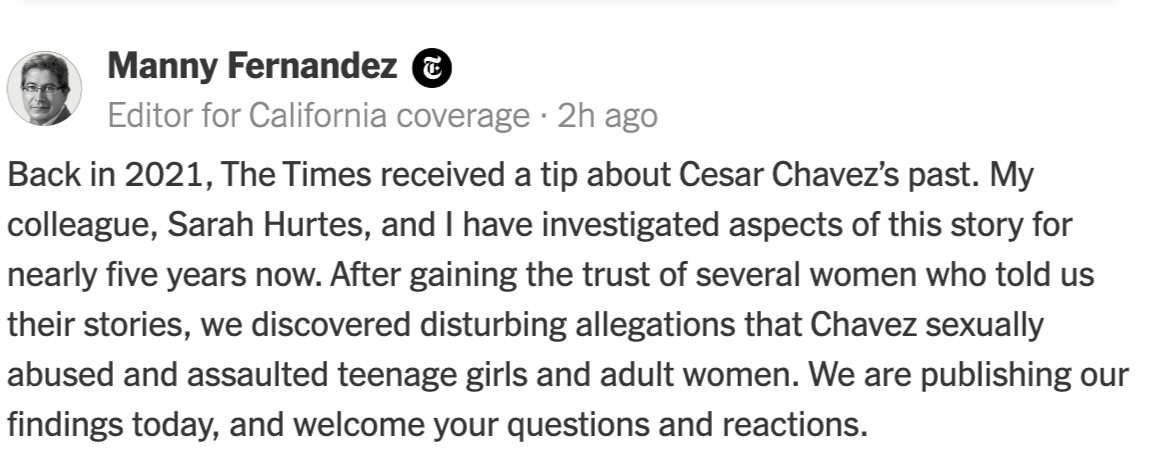
"Nearly five years."
Investigative journalism takes years and years. The investment is immense, and always worth it, and, in the era of "hot takes" and ephemeral "content," rigorously reported journalistic work is needed more than ever. We must keep supporting investigative journalism.
From @mannyNYT, lead reporter of the blockbuster piece on Cesar Chavez ⤵️

English
Isak Hüllert retweetledi

As Trump prepared to take out Maduro, the CIA asked Chevron’s man in Venezuela for advice.
Take out the entire regime and install an opposition led by María Corina Machado and you’ll create a quagmire, he told them.
That concern landed on Trump’s desk. wsj.com/world/americas…
English
Isak Hüllert retweetledi

While Donald Trump’s Arctic representative defended the administration’s Greenland policy at a conference in Rome, a hall full of researchers sat stunned. According to one participant, the session provided a disturbing insight into the Greenland crisis.
Last week, researchers, politicians, and officials from around the world gathered for the Arctic Circle Forum in Rome.
On the final day of the conference, a plenary session featured a panel debate titled “The New American Arctic.”
Although it was the last event on the program, it was far from uneventful.
According to one attendee, it was an uncomfortable and deeply troubling session to witness.
“It was truly painful to sit in the audience and listen to how the representative of the Trump administration justified their interests in Greenland,” wrote Johanna Ikävalko, director of the Center for Geopolitics, Peace and Security at the Arctic University of Norway, afterward on LinkedIn.
On stage, the two poles of the struggle over Greenland were represented by Thomas E. Dans, chairman of the U.S. Arctic Research Commission — adviser to the president and Congress on Arctic research goals.
He is known as Trump’s “true man in the Arctic” and as someone who routinely defends the American president’s ambition to take control of Greenland.
At the other end of the spectrum was another American with a very different perspective: David Balton, senior fellow at Harvard University’s Belfer Center Arctic Initiative.
For many years he has served several U.S. administrations as a senior official dealing with Arctic affairs.
The panel debate lasted about 45 minutes and was moderated by former Icelandic prime minister Katrín Jakobsdóttir.
According to Johanna Ikävalko, who attended the debate, Thomas E. Dans presented numerous explanations for the Americans’ interest in Greenland, including that it concerns “humanitarian” assistance.
At one point he said that “the United States has done the rest of the world a great service by making everyone understand that people live in Greenland,” Johanna Ikävalko recalled.
David Balton then presented his view.
He stated that countries no longer buy or take over other countries, and that the international community today respects sovereignty and the right of peoples to self-determination — rules that the United States itself helped establish, he reiterated to KNR.
He told Thomas E. Dans that Greenland has rejected the United States’ overtures, and that this should close the entire discussion.
He also emphasized that the Trump administration’s concerns that Russia or China might be ready to take over Greenland had no basis in reality.
Finally, he pointed out that the Americans’ claimed security concerns can be addressed under the existing defense agreement and do not require taking control of the island.
But according to Balton, he failed to persuade Thomas E. Dans.
Dans simply replied that there are “different perspectives” on the situation surrounding Greenland, Balton explained.
“It was surreal,” said Johanna Ikävalko.
“He (Thomas E. Dans) was like a cat on a hot stove.”
—KNR
English
Isak Hüllert retweetledi

Breaking News: New video adds to evidence that a U.S. missile likely hit an Iranian school where 175 people, many of them children, were reportedly killed.
nyti.ms/4ls4WMr
English
Isak Hüllert retweetledi

Tehran’s 10 million residents now risk exposure to “highly dangerous and acidic” rain, in addition to fuel shortages, after Israeli bombing of 3 fuel depots unleashed clouds of noxious smoke over the city. By @Najmeh_Tehran via @FT as.ft.com/r/449e729b-0e0…
English
Isak Hüllert retweetledi

Isak Hüllert retweetledi

As the first media outlet in the Kingdom, KNR spoke with Donald Trump’s special envoy to Greenland, Jeff Landry. This article is the first in a series based on that interview, and Landry — who is also the governor of the U.S. state of Louisiana — spoke by telephone from the southern United States about the hospital ship that President Trump announced last weekend was on its way to Greenland.
Landry acknowledged that no ship is currently on its way because of sea ice, but he insisted the idea has not been abandoned. The Americans have “bought themselves time” to examine the mission more closely, he said. Recently, he met with the head of the U.S. Army, Daniel P. Driscoll, and plans to discuss the mission with senior generals in the Department of Defense.
Landry told KNR that the Greenlandic population can expect aggressive efforts to ensure that healthcare is delivered to remote parts of Greenland. He said an official announcement from either the White House or the Secretary of Defense is expected soon. Trump, Landry said, wants to get the ship to Greenland and work is underway to determine how to do it.
According to Landry, an American hospital ship would be necessary because healthcare in smaller towns and settlements in Greenland is insufficient — partly due to “transport challenges” and a lack of hospitals and treatment types. He added that before Trump spoke about Greenland’s needs — first during his initial term and again later — no one had been talking about them, and that the U.S. simply wants a chance to help those who need assistance.
Landry also said that beyond the hospital ship, the United States has other means of delivering healthcare services, but he did not specify what those are.
However, Naalakkersuisut (the Greenlandic government) and the Danish government rejected the idea that Greenland’s healthcare system needs help from outside. Both governments reiterated that healthcare services in Greenland are free and accessible to all residents.
Still, some citizens and politicians acknowledge challenges in the Greenlandic health system related to geographic distance and a shortage of personnel. Anna Wangenheim, the minister for health and persons with disabilities, and other Greenlanders have pointed out these issues.
Specialized treatments are carried out in Denmark, and patients are flown there free of charge for things like radiation therapy or kidney transplants. This sometimes delays treatment, though everyone can receive the care they need, according to Kjeld Møller Pedersen, professor emeritus of economics and chair of the Greenland Health Council, which advises Naalakkersuisut.
Pedersen said he believes the hospital ship idea is not an urgent health problem in Greenland and called the mission a “poor” and “incomprehensible idea.” Recruiting and retaining healthcare personnel has been a long-standing challenge, he noted, but that does not mean Greenland needs disaster relief.
An American hospital ship, Pedersen said, could create more problems than solutions — such as surgical errors, confusion in patient records, and dispensing medication not available in Greenland, potentially causing legal issues.
Maritime expert Hans Otto Holmegaard Kristensen of the Danish Society of Engineers, with over 20 years’ experience, agreed it would create massive logistical challenges. Sending one of the U.S. hospital ships to Greenland would be a logistical nightmare, he said, and if such a ship hit an iceberg, “you have the recipe for a Titanic-style disaster.”
Kristensen called the mission a “crazy idea” with no practical basis. Nuuk is the only port in Greenland where such a ship could dock, and merely supplying thousands of crew members would require extensive planning. Auxiliary vessels would be needed to transport patients, and Arctic weather conditions would complicate operations.
🧵1/2
English

Spoke to Trump's Greenland envoy Jeff Landry about the president's hospital ship announcement and wrote about the conversation (in Danish) for Greenland's public broadcaster: knr.gl/da/nyheder/eks…
English
Isak Hüllert retweetledi

Too Much Ice and Too Little Draft: The Harsh Reality Facing a U.S. Hospital Ship Mission to Greenland
❄️ Too much sea ice in Arctic.
🏗️ Too little draft in Greenlandic ports.
🚢 No USCG icebreaker available for escort.
@mercoglianos
gcaptain.com/too-much-ice-a…
English