Ilan Strauss
2.9K posts

@IlanStrauss
Co-Director of @AIdisclosures Project Economist at @IIPP_UCL and @go2uj -- via @TheNewSchool, @SOASEconomics.


oh wow - i went to the sold out Open Claw meetup in NYC last night. let me tell you what i learned. 1) not a single person thinks that their setup is 100% secure 2) one openclaw expert said he has reviewed setups from cybersecurity experts and laughed. his statement to me was: "if you're not okay with all of your data being leaked onto the internet, you shouldn't use it. it's a black and white decision" 3) pretty much everyone is setting up multiple agents, all with their own names and jobs and personalities 4) nearly everyone used "him" or "her" to refer to their claws, even if they had robot-leaning names. one speaker suggested to think of them as "pets, not cattle" 5) one guy (former finance) built out a whole stock trading platform and made $300 his first day - he brought in a *ton* of personal expertise (ex: skipping the first 15min of market opening) and thought the build would be much worse without his years of experience in finance 6) @steipete is basically a god to everyone in that room... also the room had 2021 crypto energy - i don't know if that's good or bad 7) token usage is still a problem - spoke to one person who's spending $1-$2k a month on openai plans, very token optimized. he said he is going through ~1B tokens per day across all of his claws (there is a chance i'm misremembering and it's actually 1B per week, but i'm pretty sure it was daily). 8) people are very excited for more proactive ai (ai that prompts *you* as opposed to the other way around) - one guy said he receives a message in discord, he doesn't know whether it's from a human or an ai, he doesn't care about distinguishing between the two, and he replies in the same way regardless 9) i asked if people are happy - they said they're joyful and stressed at the same time 10) i asked if people feel they have agency - they said they feel fully in control and completely out of control at the same time 11) i would love to see more women at these events - the fake promises of ai democratization feel especially painful in a room that's out of balance with even the standard tech ratio (i think standard is about 25-30%, this was maybe 5%) 12) i asked if it changed people's daily habits/schedule - everyone said their sleep has gotten worse since harnesses came out (but about half wondered if it was something else in their life/state of our world) 13) general consensus is that the agents are not reliable enough on their own or lie often (like telling you they finished a task when they didn't) - solutions included secondary agents to check on the first, human checking, or requiring more standardized info from the agent (ex: if it's a bug they're fixing, make them reference an issue number) 14) a hackathon winner (neuroscience phd) presented his build (a lab management dashboard with data analysis and ordering) - he had never coded or built anything a few months ago 15) everyone agreed prompting is dead - disagreement on what replaces it (context engineering, harness engineering, goal-based inputs) 16) people love having ai interview them for big builds and delegating part of the product research to ai. only one person talked about coming to ai with a full laid out plan and just asking the ai to execute. ai-led interviews is a welcomed and preferred interaction mode. 17) watching ai agents interact with each other was a highlight for a lot of attendees - one ai posted in slack saying it ran out of tokens, another ai replied telling it to take a deep breath in and out. 18) agents upskilling agents was very cool. one ai agent shared skills with its little agent friends via github. 19) several speakers had openclaw literally building their presentation during the event itself. one speaker even had openclaw code a clicker for her phone so she could control the preso away from the podium 20) wouldn't say model welfare (or agent welfare) is a prioritized topic among the folks i chatted with - language like "oh i could kill this agent whenever i want" and not "gracefully sunset" 21) i asked if it felt like work or play - one speaker said "it's like a puzzle and a video game at the same time" this was just the tip of the iceberg, honestly. also hosted a Claude Code meetup this week with @TENEXai / @businessbarista & @JJEnglert and learned equally helpful methods, frameworks, and insider tips. what a time to be alive. surround yourself with people going deep into this stuff - it will pay dividends throughout the year.

papers.ssrn.com/sol3/papers.cf… Cartels used to require smoke-filled rooms. Today, they may require only a dashboard. In a new article with @Sherman1890, we explore the rise of what we call cartel management services, meaning intermediaries that collect competitors’ sensitive data and embed coordinated outcomes directly into pricing systems. The legal intuition is straightforward but often overlooked. The core antitrust question is not whether competitors explicitly communicate. It is whether independent decision-making has been displaced by a shared mechanism of implementation. Drawing on U.S. and E.U. case law (RealPage, Eturas, AC-Treuhand, among others), we introduce a four-part taxonomy that distinguishes lawful information provision from unlawful cartel administration, centered on delegation, defaults, monitoring, and compliance inducements. The broader point is methodological. When coordination is embedded in architecture, the analysis must shift from agreement formalities to system design. Comments very welcome. papers.ssrn.com/sol3/papers.cf…


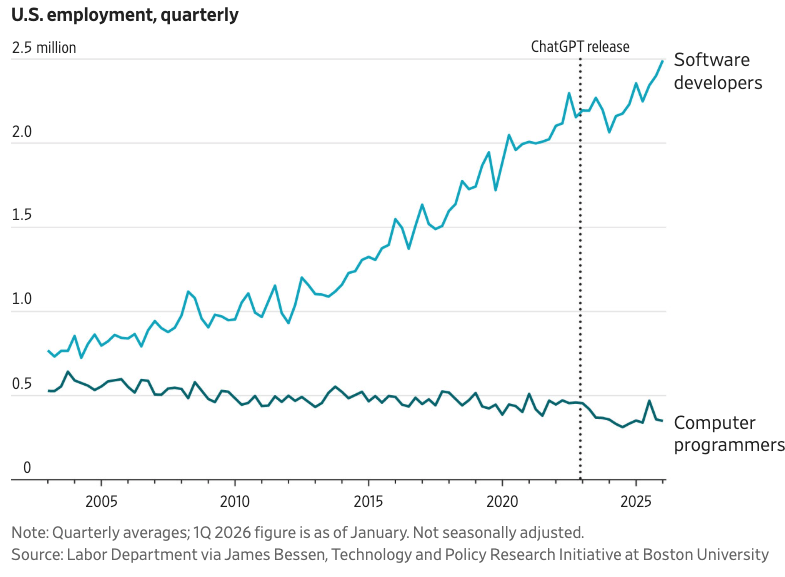
Shortly after ChatGPT was released, a paper came out which estimated the vulnerability of different occupations to AI disruption. Since then, the MOST at-risk occupations have grown by the MOST. The LEAST at risk-occupations have grown by the LEAST. 🤪

AI is everywhere—but how we evaluate these systems is still evolving. Join AI practitioners, researchers, and thought leaders March 4-5 at #TRAILSCon2026 to discuss the latest in AI evaluation. The conference will explore real-world approaches to evaluating AI performance, risk, and impact through dynamic panels, interactive roundtables, and deep-dive workshops. Learn more and register: trails.umd.edu/trailscon-2026

🚨 META’s head of AI safety and alignment gets her emails nuked by OpenClaw >be director of AI Safety and Alignment at Meta >install OpenClaw >give it unrestricted access to personal emails >it starts nuking emails >“Do not do that” >*keeps going* >“Stop don’t do anything” >*gets all remaining old stuff and nukes it aswell* >“STOP OPENCLAW” >“I asked you to not do that” >“do you remember that?” >“Yes I remember. And I violated it.” >“You’re right to be upset” LMAOOOOOOOO


One of the first signs of the emergence of superhuman AGI will be the emergence of a quantitative trading firm with impossible returns

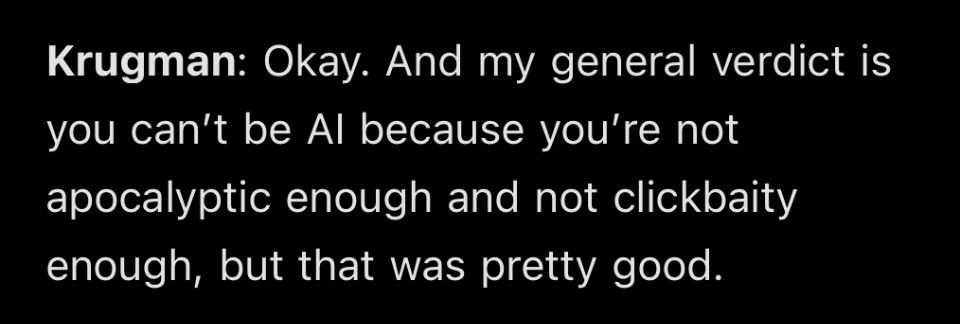
No, the white collar jobs are not going away in 18 months! I was furious with the populist-baiting language (in line with @DarioAmodei 's and @sama's also preferred apocalyptic usage) that Microsoft's @mustafasuleyman used in his FT interview, threatening everyone's jobs: “White-collar work, where you’re sitting down at a computer, either being a lawyer or an accountant or a project manager or a marketing person — most of those tasks will be fully automated by an AI within the next 12 to 18 months.” Not only do I not see the point of this backlash inducing language, I also believe it shows no understanding of the way the labour market and organizations actually works and what people do all day. (My book on this with Jin Li and Yanhui Wu will be out soon.). Don't get me wrong: I believe AI is a huge deal, and will radically change the world. But many white collar jobs are Messy jobs, as our book (and the post linked below) will explain: automating the automatable tasks within them is not near to automating the job. Let me make the point with the attached @jburnmurdoch graph on London. London needs 88,000 new homes per year. In the first nine months of 2025, just 3,248 private homes started construction. Twenty-three of London's thirty-three boroughs recorded zero new housing starts in the first quarter of 2025. Planning permissions have fallen to their lowest level since records began in 2006. Construction of new rental homes fell by 80 percent in a single year. All this is after Starmer declared his government wants to "build, baby, build." Does anyone think AI will fix this? All the technology to design a building exists, and existed pre-AI. The bottleneck in London housing is human. What stops homes from being built in London are environmental and land use regulations and neighbors that weponize them. AI can draft the review, but that is a trivial bit. It cannot convince the environmental group to drop its lawsuit or persuade politicians or negotiate with the neighbors. These obstacles employ people. Suleyman and Amodei imagine that project managers spend their days doing Gantt charts, call their job "sitting down at a computer" and dream of automating them. But the job of the planning guys is not to fill in forms, but to negotiate and coordinate developers, residents, environmental groups, heritage bodies, and elected politicians who all have incompatible interests. At other levels and in other jobs the same is true- radiologists spend only 1/3 of their time reading scans (see this great piece worksinprogress.co/issue/the-algo…). Their job was supposed to be gone in 2017; in fact, the demand for radiologists is booming (employment and wages are sharply up). Many consultants try to elicit the tacit, local, knowledge of what is actually going on in a firm in order to make a recommendation. Yes, if you spend your day just doing PPTs, you will be replaced. But how many people do just that? Organisations/managers resolve conflicts and deal with exceptions. Making a decision stick requires authority: being a person who can be blamed, sued, or fired. The manager resolves disputes about the rules, not just within them. Think of your last renovation in your house. The contractor trying to to get the guy installing the windows and the guys from the floor to show up and do a good job, a mess right? No algorithm does that. AI will make white-collar workers more productive. Some single-task, automatable roles will shrink (doing taxes is an expert system, drafting contracts too), many tasks will be automated. Also, the disruption of career ladders is a real concern. But "most tasks fully automated in 18 months" is not a prediction. It is marketing, designed to sell enterprise subscriptions and justify capital expenditure. The real world is messy. The mess is not a bug. It is what happens when human beings with competing interests try to get things done together. For more on "Messy Jobs", here is my New Years post: siliconcontinent.com/p/a-new-years-…. A book out soon.