James (Jake) Gearon

897 posts

James (Jake) Gearon banner
James (Jake) Gearon

James (Jake) Gearon

@JakeGearon

Post-Doctoral Researcher, Global Hydro Lab @ UNC Chapel Hill. Looking at sand from space. I also like LLMs. opinions are my own. email: [email protected]

Chapel Hill, NC Katılım Temmuz 2020
2.5K Takip Edilen620 Takipçiler
Sabitlenmiş Tweet
James (Jake) Gearon
James (Jake) Gearon@JakeGearon·
🚨 New Paper Alert!🚨: Excited to share my latest work in @Nature on river avulsions—catastrophic shifts in river courses that threaten millions worldwide. We've uncovered new rules that govern when and where avulsions occur. nature.com/articles/s4158… 🧵(1/12)
English
6
22
71
9.2K
James (Jake) Gearon
James (Jake) Gearon@JakeGearon·
It really is true that claude code is such a joy to work with, but codex just handles business, which usually means cleaning up claude's (large) mistakes...
English
0
0
0
48
James (Jake) Gearon
James (Jake) Gearon@JakeGearon·
I think opus is the best harness governor because it has the most realized sense of self. A nice byproduct of Anthropic's approach and maybe why claude code is so preferable to interact with even though codex is by far the better coder
English
0
0
0
46
James (Jake) Gearon
James (Jake) Gearon@JakeGearon·
@kyle_e_walker I agree, and the geospatial space is lagging slightly behind in this arms race, such a good time to build
English
0
0
1
183
Kyle Walker
Kyle Walker@kyle_e_walker·
With Claude Code as my dev partner, I'm getting close to releasing the most technically impressive geospatial package I've ever created. This one will have both R and Python bindings - I think you'll like it. It is an incredible time to be building things.
English
9
13
311
13.8K
James (Jake) Gearon
James (Jake) Gearon@JakeGearon·
git worktrees are a little wacky to intuit. But use them. It will change how you see your codebase and your workflow gets faster, takes a week or so to feel comfortable with them (nasty merge conflicts so be careful!) really enjoying dmux by @jpschroeder
English
1
0
0
113
James (Jake) Gearon retweetledi
Ujaval Gandhi
Ujaval Gandhi@spatialthoughts·
Google #EarthEngine announced a big change in non-commercial access and implemented quota tiers. See the new post on what this means for you, along with resources and tools to monitor your quota consumption. spatialthoughts.com/2026/02/09/gee…
English
3
13
110
8.1K
James (Jake) Gearon retweetledi
Benjamin De Kraker
Benjamin De Kraker@BenjaminDEKR·
The Singularity will be written in Markdown and YAML
English
16
4
109
14.7K
James (Jake) Gearon retweetledi
BURKOV
BURKOV@burkov·
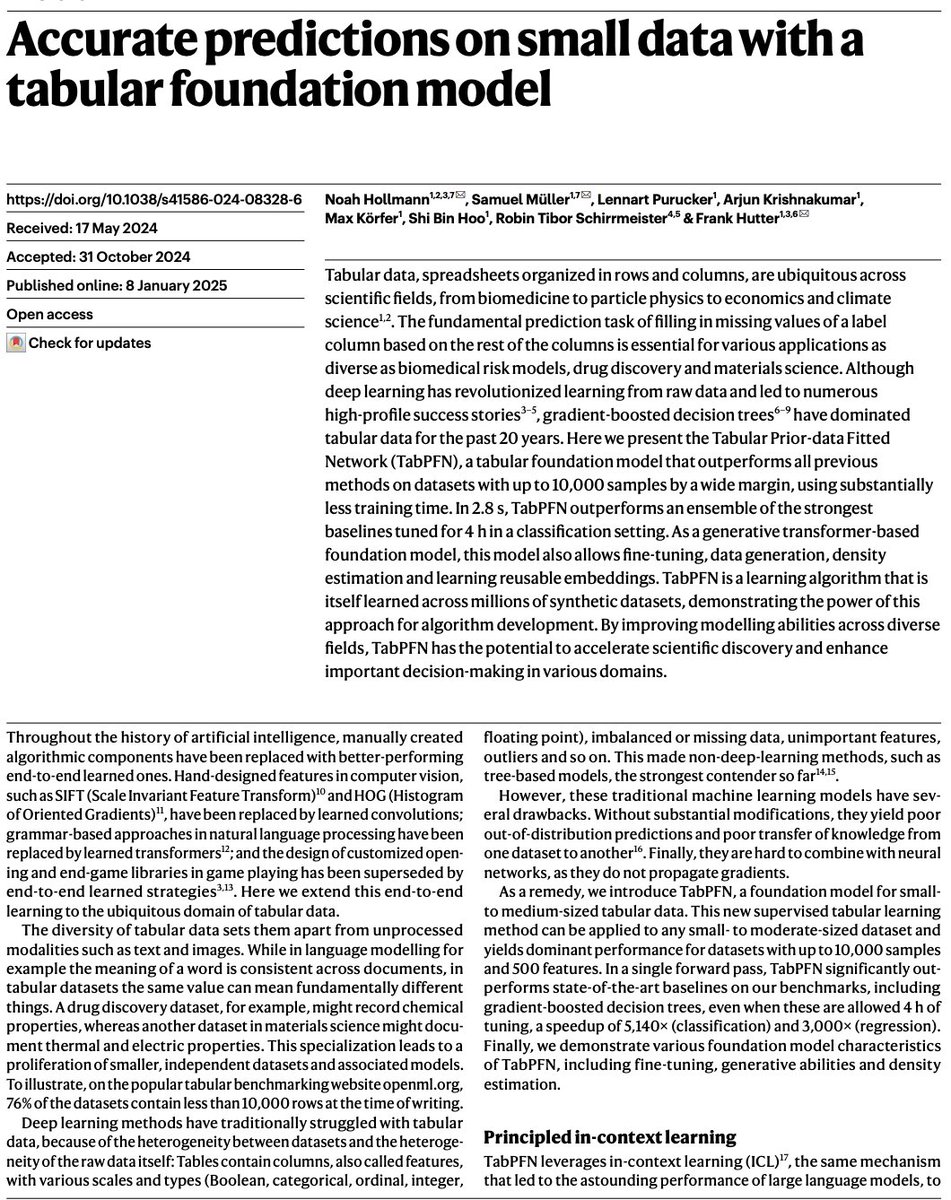
This paper really is groundbreaking. It solves a long-standing embarrassment in machine learning: despite all the hype around deep learning, traditional tree-based methods (XGBoost, CatBoost, random forests, etc) have dominated tabular data—the most common data format in real-world applications—for two decades. Deep learning conquered images, text, and games, but spreadsheets remained stubbornly resistant. This paper's (published in Nature by the way) main contribution is a foundation model that finally beats tree-based methods convincingly on small-to-medium datasets, and does so very fast. TabPFN in 2.8 seconds outperforms CatBoost tuned for 4 hours—a 5,000× speedup. That's not incremental; it's a different regime entirely. The training approach is also fundamentally different. GPT trains on internet text; CLIP trains on image-caption pairs. TabPFN trains on entirely synthetic data—over 100 million artificial datasets generated from causal graphs. TabPFN generates training data by randomly constructing directed acyclic graphs where each edge applies a random transformation (using neural networks, decision trees, discretization, or noise), then pushes random noise through the root nodes and lets it propagate through the graph—the intermediate values at various nodes become features, one becomes the target, and post-processing adds realistic messiness like missing values and outliers. By training on millions of these synthetic datasets with very different structures, the model learns general prediction strategies without ever seeing real data. The inference mechanism is also unusual. Rather than finetuning or prompting, TabPFN performs both "training" and prediction in a single forward pass. You feed it your labeled training data and unlabeled test points together, and it outputs predictions immediately. There's no gradient descent at inference time—the model has learned how to learn from examples during pretraining. The architecture respects tabular structure with two-way attention (across features within a row, then across samples within a column), unlike standard transformers that treat everything as a flat sequence. So, the transformer has basically learned to do supervised learning. Talk to the paper on ChapterPal: chapterpal.com/s/a1899430/acc… Download the PDF: nature.com/articles/s4158…
BURKOV tweet media
English
77
394
2.6K
330.7K
Yohan
Yohan@yohaniddawela·
@JakeGearon Yup they also managed to address trees!
English
1
0
1
51
James (Jake) Gearon retweetledi
Yohan
Yohan@yohaniddawela·
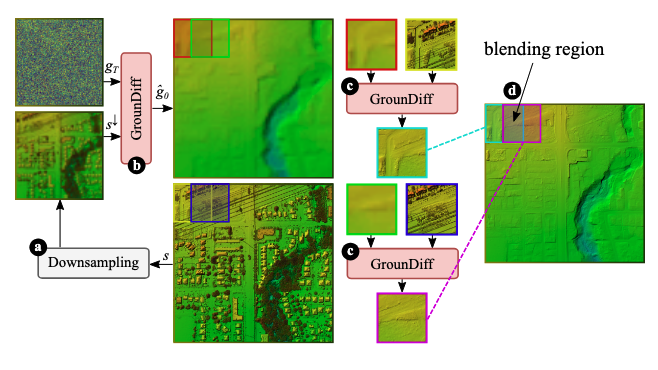
Extracting the bare earth from satellite or aerial imagery is surprisingly tough. Sensors give us the surface (trees, buildings), but we often need just the ground. Now, a new diffusion-based AI model solves this by treating buildings as "noise". Here's the breakdown:
Yohan tweet media
English
3
7
77
6.6K
James (Jake) Gearon
James (Jake) Gearon@JakeGearon·
I'm late of course, but I had no idea that @duckdb could do raster files now??? 😍
English
0
0
0
67
James (Jake) Gearon
James (Jake) Gearon@JakeGearon·
If you're looking for a job in the geospatial software engineering space, consider applying for this position under my friend Clarke DeLisle at EVS, Inc. You will get to do a lot of great work and Clarke is a great mentor! evs.wd108.myworkdayjobs.com/en-US/evsengin…
English
0
0
1
86
James (Jake) Gearon retweetledi
geosociety
geosociety@geosociety·
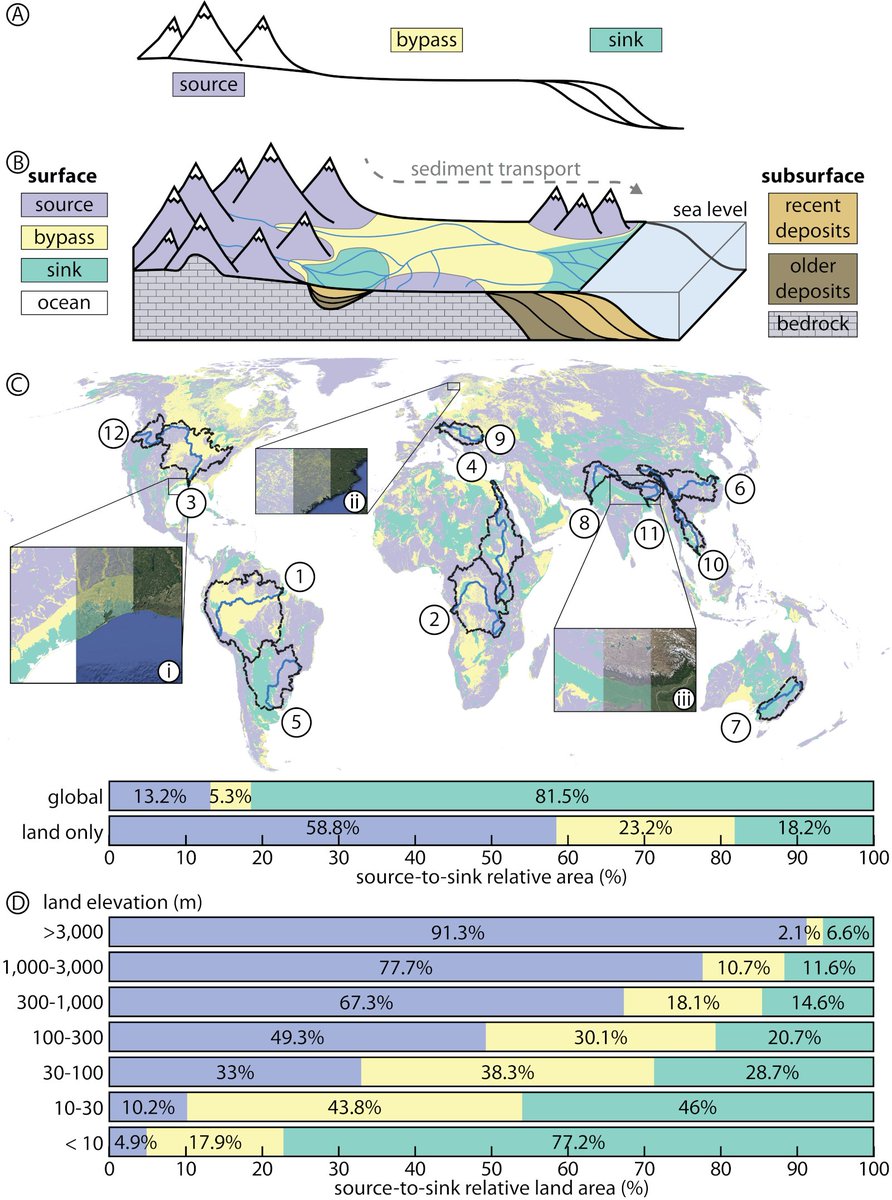
One of the first diagrams Earth Science students are shown is the source-to-sink diagram of Earth's surface. And yet this framework has never been tested across the modern Earth surface—until now. In their new #Geology article, Caltech researchers Martin and Lamb harmonized global data products to make a global database of Earth's sediment sources, bypass zones, and sinks. Read the full study here: geosociety.co/3UZcCte #GSAPubs #EarthScience
geosociety tweet media
English
1
54
253
9K
James (Jake) Gearon retweetledi
Tian Y. Dong, PhD
Tian Y. Dong, PhD@TDgravel·
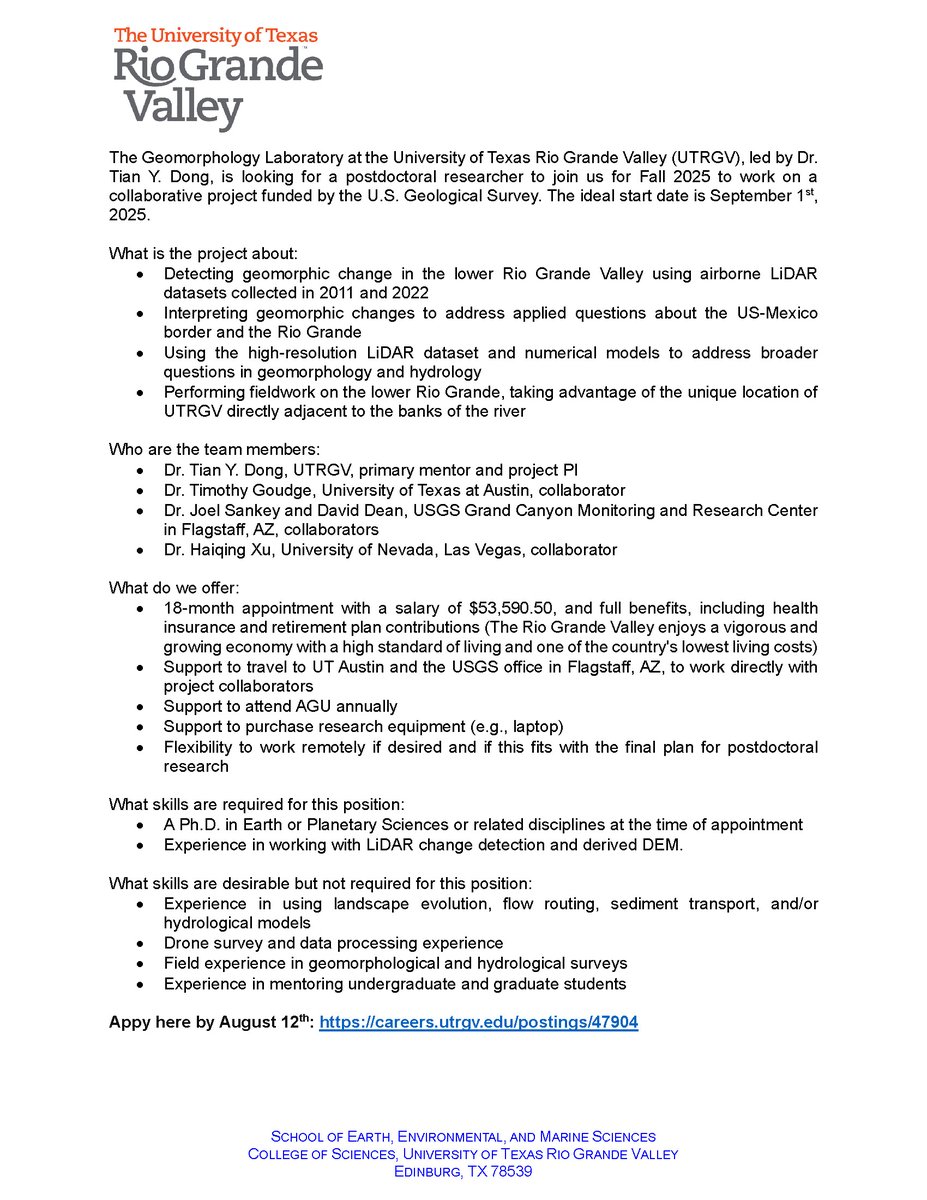
I am looking for a postdoc; see below for details. Come work with me, @timgoudge, Haiqing, Joel, and David
Tian Y. Dong, PhD tweet mediaTian Y. Dong, PhD tweet media
English
0
7
13
1.2K
James (Jake) Gearon retweetledi
Yuan Li
Yuan Li@yuannli·
A bit of a late announcement, but excited to share that our work on how braided rivers move is out and featured in AGU's Eos! 🌊We analyzed 400+ scenes of satellite images, and found there is coherent motion of the channel threads. Grateful for the spotlight on this research!
AGU's Eos@AGU_Eos

The behavior of this river in Bangladesh may be more predictable than previously thought. New @JGREarthSurface research from @yuannli & @ajaybrianlimaye of @uvaevsc eos.org/research-spotl…

English
0
1
3
277
James (Jake) Gearon retweetledi
Logan Kilpatrick
Logan Kilpatrick@OfficialLoganK·
Say hello to the @geminicli, a local CLI to help you build and maintain software with 1,000 free Gemini 2.5 Pro requests per day : )
Logan Kilpatrick tweet media
English
426
639
8.7K
1.4M
James (Jake) Gearon retweetledi
Vantor
Vantor@vantortech·
Built on @SkyfiApp's infrastructure and powered by Maxar’s MGP Pro API, Maxar Connect gives academic teams, R&D groups, and mission-focused users direct access to Maxar's high-resolution imagery and 3D data—no subscription required. 🛰️ Task 30 cm-class imagery 💵 Pay-as-you-go pricing ⚡ Fast, self-serve ordering 🔬 Purpose-built for R&D and field operations Get the same trusted data, now with even more flexibility for specific missions. 🔗: maxar.skyfi.com
Vantor tweet media
English
4
10
42
23.7K