James Morrone

3.1K posts

James Morrone banner
James Morrone

James Morrone

@James_morrone

Energy policy analyst at Americans for Prosperity Die hard Isles fan, tortured Jets fan, and content Yankee fan.

Katılım Ocak 2012
306 Takip Edilen138 Takipçiler
James Morrone retweetledi
Russ Greene
Russ Greene@GreenPlusAnE·
Democrats think they can make electricity cheaper by discouraging electricity use (e.g. banning data centers). But they already tried this approach, and it backfired.
Russ Greene tweet media
English
11
23
99
7.8K
James Morrone retweetledi
Christopher Hooks
Christopher Hooks@cd_hooks·
Giants once walked the earth.
Christopher Hooks tweet media
English
37
76
1.1K
83.7K
James Morrone
James Morrone@James_morrone·
I bet these two would have banned electricity, the airplane, the combustion engine, the internet, or any other technical or technological marvel. Such idiocy at the higest levels.
bryan metzger@metzgov

INBOX: @BernieSanders and @AOC will introduce the “AI Data Center Moratorium Act” at a 4 pm press conference on Capitol Hill today.

English
0
0
0
33
James Morrone retweetledi
Justin Bourne
Justin Bourne@jtbourne·
Still crazy, and maybe the biggest compliment to him of all, is that up 1 in a massive game, 5v6 w/ goalie out, after a timeout with a minute to go, Islanders put out their 18yo D … and he makes 4 good plays to ice the game.
English
10
23
453
22.6K
James Morrone retweetledi
U.S. Department of Commerce
U.S. Department of Commerce@CommerceGov·
NEW U.S.-JAPAN DEAL GE Vernova Hitachi SMRs (BWRX-300) 📍 Tennessee + Alabama ⚡️ Small Modular Nuclear Reactors 💰 Up to $40B 🔌 3 GW 🏭 Operator: GE Vernova Hitachi
U.S. Department of Commerce tweet media
English
154
446
1.6K
205.3K
James Morrone retweetledi
Thomas Hochman
Thomas Hochman@ThomasHochman·
Today, @joinFAI and @ShopFloorNAM have a new joint report outlining the permitting barriers to manufacturing in America. We sent a survey out to NAMs 14,000 member companies. The result is a trove of new data and detail on the national permitting picture. 🧵 on findings:
Thomas Hochman tweet media
English
1
25
56
21.3K
James Morrone retweetledi
Samuel Roland
Samuel Roland@Allinallnotbad·
If you're wondering how data centers can improve on their current (woeful) efforts to sell themselves, the below is a fantastic example. Data centers bring a huge amount of tax revenue to host communities, but people need to know how that money helps them personally.
Delegate Daniel Linville@DelegateDaniel

I want every West Virginian to understand what's at stake with data center development — so I built a tool to show you. Plug in any county. Slide the project size. Watch what happens to school funding, emergency services, and your personal income taxes. This is what economic development looks like. This is why I'm fighting for it. Try it for yourself 👇 🔗 linvilleforwv.com/datacentertool


English
2
4
23
2.7K
James Morrone retweetledi
Tahra Hoops
Tahra Hoops@TahraHoops·
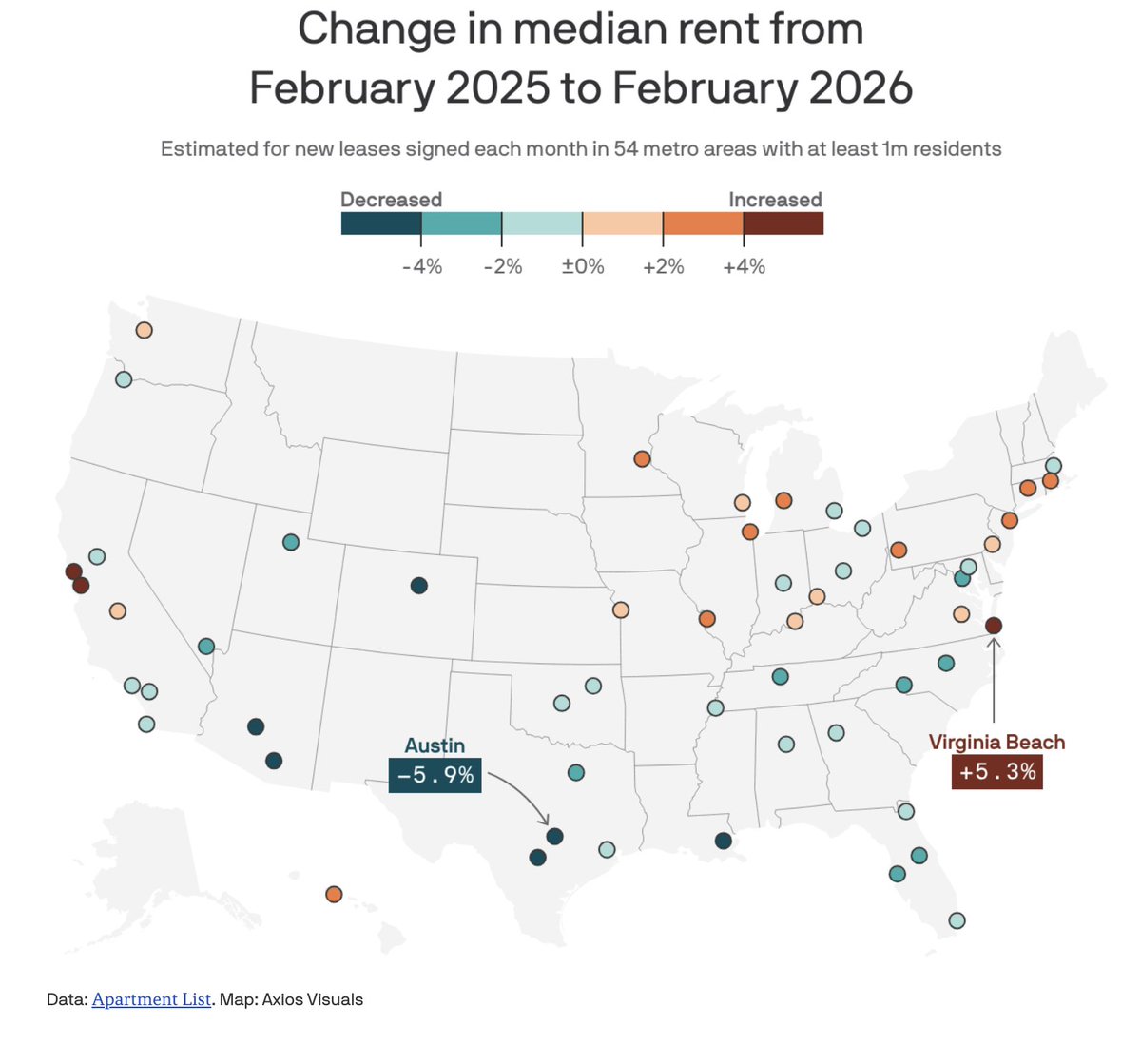
Median rent in Austin dropped 5.9% in the past year. Famously, the city that has been pushing for supply increases and building more units in the past couple of years. Time and time again, this shows us the key to bringing down housing costs!
Tahra Hoops tweet media
English
9
18
108
20.4K
James Morrone retweetledi
Steven Fiorillo
Steven Fiorillo@stevenfiorillo·
My post on Friday regarding the estate tax proposal in New York got 600,000+ views, so clearly this struck a nerve. Some individuals asked me to back up what I said so I am going to discuss what happens when states push tax policy past the breaking point. Here is what the data shows and it’s worse than most people realize. According to IRS migration data, New York has lost $111 billion in net adjusted gross income over the last decade from residents moving to other states. That’s not hypothetical, that’s $111 billion in taxable income that used to fund schools, subways, police, and infrastructure that is now funding those things in Florida and Texas rather than New York. California lost $102 billion over the same period. Florida gained $196 billion. Texas gained $54 billion. That’s not a coincidence, it’s a pattern. Between 2018 and 2024, 561 companies relocated their headquarters across the country. The San Francisco Bay Area lost 156 corporate headquarters. Los Angeles lost 106. New York City lost 27. Meanwhile Dallas alone gained 100, Austin gained 81, and Nashville gained 35. This didn’t come to a halt in 2025 or 2026. Palantir $PLTR which was the largest publicly traded company in Colorado, announced in February that it was moving its headquarters from Denver to Miami. It was PLTR’s second move in six years after leaving Silicon Valley in 2020. The governor of Colorado said he found out through a social media post. ExxonMobil’s $XOM board unanimously recommended that shareholders approve reincorporating the company from New Jersey to Texas after 144 years at the vote in May. Exxon has physically operated out of Texas since 1989, and its CEO said Texas has created a policy environment that allows them to maximize shareholder value. Chevron $CVX completed its move from California to Houston. In-N-Out Burger is opening a 100,000-square-foot eastern headquarters near Nashville and is leaving California. These aren’t outliers anymore as this is becoming the new normal. It’s not just corporate headquarters moving. Entire financial ecosystems are relocating. Citadel, one of the most profitable hedge funds in the world, moved its headquarters from Chicago to Miami in 2022 and has been building out aggressively ever since. They’re constructing a massive new waterfront headquarters in Miami’s Brickell financial district. Elliott Management moved to West Palm Beach. Carl Icahn moved Icahn Enterprises from New York to Sunny Isles Beach. Cathie Wood’s ARK Investment Management relocated to St. Petersburg. Goldman Sachs $GS is building a $500 million campus in Dallas designed to house over 5,000 employees. JPMorgan Chase $JPM and Wells Fargo $WFC have both invested hundreds of millions into massive new campuses in the Dallas-Fort Worth area. Wells Fargo is also moving its wealth management division from San Francisco to West Palm Beach. NYSE Texas a reincorporation of the 143-year old Chicago Stock Exchange officially launched in Dallas in early 2025. The Texas Stock Exchange which is a brand new national securities exchange backed by over $160 million from BlackRock $BLK , Citadel Securities, and Charles Schwab $SCHW is set to begin trading by the end of this year. Nasdaq has also expanded its Texas presence with operations in Irving. When you have that level of financial infrastructure being built in a single metro area, that’s not a trend it’s an ecosystem being constructed from scratch to compete directly with New York. Each of these moves represents not just a company but thousands of high-paying jobs, billions in local economic activity, and a signal to every other firm still on the fence that states with competitive rather than restrictive policy are creating enticing operating environments. Currently over 1 million residents have left New York for other states since 2020 according to the latest Census estimates. International immigration has partially offset the population headcount, but it hasn’t replaced the tax base. The people leaving earn significantly more on average than the people arriving. Almost 1,700 millionaires changed their address out of New York in 2024 alone. Millionaires paid 44.6% of all personal income tax collected in the state last year. The proposed response to this fragility is to drop the estate tax threshold from $7.1 million to $750,000, raise the top rate to 50%, add a new 2% income tax surcharge on millionaires, increase corporate taxes, and add a capital gains surcharge. Under these proposals, the combined federal, state, and city top marginal rate on high earners in New York City would approach 54%. That’s a policy framework that ignores everything the last decade of data has told us. The Dallas mayor just publicly predicted an “avalanche” of NYC financial firms heading to Texas under these policies. Florida realtors are seeing a surge of inquiries from wealthy New Yorkers. Cities like Miami, Austin, and Nashville are building entire ecosystems including schools, cultural centers, and financial services clusters which are designed specifically to attract the people New York is pushing out. Ken Griffin and Stephen Ross just launched a $10 million campaign called “Ambitious Accelerated” to recruit more businesses to what they’re calling Florida’s “Tech Gold Coast.” They’re not waiting for New York to figure it out. They’re actively recruiting our talent, our capital, and our tax base. That’s what makes this moment so critical. We are in the middle of the most competitive environment for jobs, businesses, and investment that this country has ever seen. States are actively building infrastructure to attract employers and high earners. This is the time to compete, not to double down on the same policy approach that has been pushing wealth and businesses to lower-tax states for a decade. Texas entered its latest legislative session with a $24 billion surplus while having no personal or corporate income tax. Think about that for a moment, no personal or corporate income tax and they have a $24 billion surplus. Florida added more new businesses than any other state in 2024, with over 266,000 formed in a single year. These states didn’t create an attractive business landscape out of thin air. They made deliberate policy choices to create environments where businesses want to operate, where employers want to hire, and where working people can actually build something without the ground shifting underneath them every budget cycle. This matters because of what it means for everyday people. When a company relocates its headquarters, it doesn’t just move a sign, the entire company leaves, from the executive team to the support staff. It doesn’t stop there because that's only internal. Externally, all of the trades that may do work for the company will no longer receive those phone calls. The restaurants will no longer see those repeat customers. The tax revenue from those paychecks won’t be collected, and future job growth in the community from that company will cease to exist. When Dallas gained 100 corporate headquarters over six years, that meant tens of thousands of new jobs, new residents spending money, new homes being purchased, new small businesses opening to serve those people. That’s how local economies actually grow. That’s how neighborhoods stay alive, and when a corporate headquarters leaves a city, the exact opposite happens. The jobs thin out, the spending dries up, the small businesses that depended on that foot traffic start closing, and the tax base that funded public services shrinks. New York has every natural advantage in the world. The talent, infrastructure, culture, and institutions are all here, but it won’t be enough if the policy environment drives away the employers and investors who create opportunities for everyone else. The states that are growing right now aren’t growing by accident. They made a decision to be competitive. They kept tax burdens manageable, they created regulatory clarity for businesses, and they built an environment where employers want to expand and hire. New York has every tool to do the same thing. The question is whether the people making the decisions recognize that we’re in a competition and right now, we’re not acting like it. Here’s the part nobody in Albany wants to hear. The people who leave don’t just take their tax returns with them. They take their fundraising networks, philanthropy, job creation, and spending to a new economy. A city that once attracted the world’s most ambitious people risks becoming a place they leave once they’ve made it, or worse, a place they never lay down roots. That’s not ideology. It’s an economic reality that the IRS, Census, and corporate relocation data have been telling us. I said it in my first post, and I’ll say it again. When you tax people past the point where the math makes sense, they leave. When they leave, the burden falls on everyone who doesn’t have the resources to relocate. It’s time to take a common-sense approach to policy and make the great state of New York competitive again. New York has a decision to make. Either it continues down this path and alienates more taxpayers or it becomes more competitive. I love this state, but I am extremely worried for it’s future. We should be building a thriving ecosystem with an abundance of opportunities for New Yorkers, but instead we are pushing entrepreneurs and businesses to states that are more competitive with policy. Is this really the path we want to take not only for the current residents but for the next generation? @amitisinvesting @basispointpod @chamath @Jason @BillAckman @kevinolearytv @patrickbetdavid @PBDsPodcast
English
266
780
3.3K
793.8K
James Morrone retweetledi
Dominic Pino
Dominic Pino@DominicJPino·
The Jones Act, a law supposedly necessary to help America during times of war, is being suspended during a time of war because its higher costs are only affordable in peacetime. A+ Washington logic. bloomberg.com/news/articles/…
English
10
113
381
43.6K
James Morrone retweetledi
Spittin' Chiclets
Spittin' Chiclets@spittinchiclets·
Matthew Schaefer’s presence is changing the Islanders franchise where players actually are being drawn to.
English
22
91
1.2K
288K
James Morrone retweetledi
NHL
NHL@NHL·
The @NYIslanders are 10-0 in overtime games this season — here's every single one! 🤯
English
27
275
1.8K
153.1K
James Morrone retweetledi
Josh Smith
Josh Smith@smithtjosh·
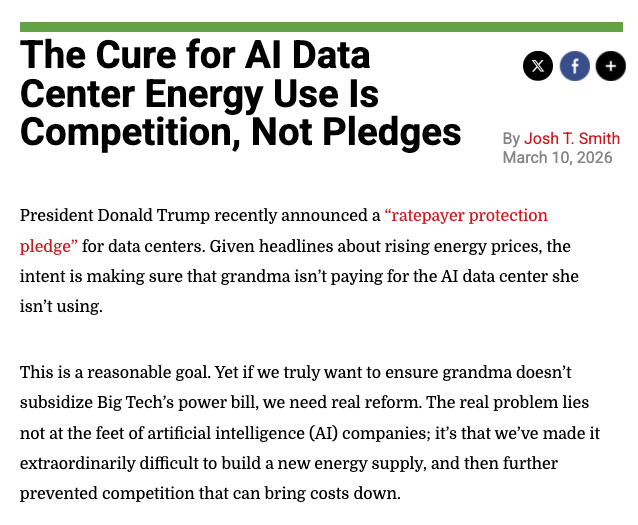
It's March. How is your New Year's Resolution going? And that's about how confident you should feel about last week's ratepayer protection pledge. Competition > Cheap Talk
Josh Smith tweet media
English
1
2
11
338
James Morrone retweetledi
Jeff Dennis
Jeff Dennis@EnergyLawJeff·
I recently participated in an event with local governments in the DMV, and learned a ton about Loudon County and data centers. They represent half the county's tax base. Roughly $1.3b per year. The county has never offered tax abatement to a data center. 1/
John Arnold@johnarnold

The data center buildout has allowed Loudoun County to lower property tax rates by 38% since 2010, translating to average savings of about $3,400 per year for homeowners.

English
3
5
29
6.1K