Janey at Evidence Based Autism

6.6K posts

Janey at Evidence Based Autism banner
Janey at Evidence Based Autism

Janey at Evidence Based Autism

@JaneyPlanet

AuDHD, Co-Founder https://t.co/VGXHwvnCMA Wrote ASD/Gender Identity report for @Transgendertrd. 48% of kids ref'd to GIDS have ASD @evidencedautism

Out there looking for evidence Katılım Haziran 2018
1.1K Takip Edilen2K Takipçiler
Sabitlenmiş Tweet
Janey at Evidence Based Autism
Something forgotten in the discourse about BAFTAs & disability, is the fact that disabled children will see it & be hugely affected. They need protecting from the worst excesses of adult online opinion. Please add this to your responses to this ⬇️ 🙏 gov.uk/government/new…
English
0
0
1
187
Janey at Evidence Based Autism
In the Equality Act, Woman means Female. Now @LibDems and @mariecgoldman want to revise it, because a minority of men want our rights as well as their own. @EdwardJDavey and his party are scared of upsetting them, but couldn’t care less about upsetting 51% of the population.
teresa smith@treesey

Well done @RosieDuffield1 for eliciting NEWS from the @LibDems MP Marie Goldman who says they WANT TO AMEND the Equality Act. Did @LibVoice4Women know this? Also stay to the end of this clip for some disgraceful comments from Ms Goldman about women’s experience of male violence

English
0
0
1
32
Janey at Evidence Based Autism retweetledi
Patrick🕸
Patrick🕸@STILLTish·
I did not know this. Share. Especially with young women.
English
26
474
888
24K
Janey at Evidence Based Autism
Yet another young woman, struggling through childhood & adolescence, feeling isolated and othered. Instead of investigating for the Autism & ADHD that she clearly had, she was funnelled down a gender identity/transition pathway & given cross-sex hormones. mol.im/a/15716249
English
0
2
7
356
Janey at Evidence Based Autism retweetledi
Sara
Sara@SeeRedWoman1·
I can’t stop looking at all the wonderful photos and videos of speeches from across the U.K. and Europe yesterday. I spent a lot of time over the last few days wondering what Magdalen Berns would’ve said. Although we will never know but I can bet she would’ve been raging. We owe that warrior woman so much. #OneYearLater @acts_grassroots
Sara tweet media
English
31
103
661
10.6K
Janey at Evidence Based Autism
@SwipeWright If, as a teacher/tutor, you identify as queer, you are automatically placed at the bottom of the power pyramid, because you’re oppressed. So by definition any ability to coerce, manipulate, or exercise power over possibly naive and inexperienced young adults is nullified? Okay.
English
0
0
0
26
Colin Wright
Colin Wright@SwipeWright·
This academic book chapter asks an unbelievable question: universities adopted rules against professor-student relationships to protect students from coercive power imbalances, “but should queer professor–student relationships be subject to the same scrutiny?” It looks at cases where “queer female professors were accused of sexual harassment by graduate students” and then sympathetically reviews arguments against such rules, including that they “disregard students’ consent,” “advance anti-queer and erotophobic agendas,” “require and reinforce fictions of female vulnerability,” and even “perpetuate neoliberal ideologies.” The author concludes that if there is ANY problem at all with queer professor–student relationships, it's supposedly “not exclusively or even primarily sexual” but “pedagogical.” Instead of simply saying professors should not sleep with their students, this chapter attempts to reframe the issue when the professor identifies as “queer.” Basically, everything is excused if you're “queer.”
Colin Wright tweet media
English
114
293
1.6K
42K
Janey at Evidence Based Autism
‘A known problem, a clear remedy, a minister unwilling to act because the political cost of action outweighs, in their private calculation, the human cost of delay’ And stuck in the middle are the legal rights of #Autistic & #LearningDisabled women & girls who suffer real harm
Jim Chimirie 🇬🇧@JChimirie66677

Ambition Before Duty. The Minister Who Put Her Career Ahead of the Law. Next Wednesday marks one year since the Supreme Court ruled, unanimously and without ambiguity, that sex under the Equality Act means biological sex. One year since the law was settled. One year since the Equality and Human Rights Commission drafted its code of practice setting out what that ruling requires of hospitals, schools, gyms and public bodies. One year since Bridget Phillipson received that code and chose to sit on it. What has changed in twelve months is not the law. The judgment stands. The code is ready. What has changed is the credibility of the minister charged with implementing it. Baroness Falkner, who led the EHRC until November and oversaw the drafting of that code, has now said plainly what many had suspected: Phillipson is withholding guidance not because it requires further work, but because publishing it would cost her politically. The activist MPs whose votes she needs for promotion would not forgive her. So women wait, and the minister keeps her powder dry (Martin, 2026). That is a specific accusation, made by a specific person with direct knowledge of the process. It is not a political opponent guessing at motive. Falkner submitted the code. She watched it stall. She knows what ready looks like, and she knows the guidance is ready. Her conclusion, that personal ambition is the operative factor, carries weight that no government spokesman can easily dismiss. The Labour response, that Falkner had demeaned the office she once held, did not address the substance. It attacked the witness. Which leaves the charge unanswered. Consider what the title Secretary of State for Women and Equalities actually represents. Not a departmental portfolio in the ordinary sense, but a stated commitment, a promise woven into the office itself. To hold that title while deliberately withholding the legal protections owed to the women you nominally represent is a contradiction so stark it requires no elaboration. The office makes the accusation. Falkner supplies the motive. The anniversary provides the measure. Falkner went further still, and her wider observation deserves to be heard. She drew a parallel with the grooming gangs scandal, noting that this government has a pattern of institutional inaction driven by fear of upsetting particular constituencies. The comparison is uncomfortable precisely because it is not new. The structure is familiar: a known problem, a clear remedy, a minister unwilling to act because the political cost of action outweighs, in their private calculation, the human cost of delay. Those doing the waiting are never the ministers. Starmer's position is untenable on its own terms. He told Parliament the ruling must be implemented in full. His minister is arguing for a case-by-case approach that restores the incoherence the court rejected. He is a lawyer. He knows what a unanimous Supreme Court judgment means. He also knows what his backbenchers want. The gap between those two things is where women's rights currently reside. The government's rebuttal speaks of sober leadership and treating everyone with dignity. Fine words. But dignity is not delivered by a code of practice that lives in a ministerial drawer. Protection is not real if it exists only in statute while the guidance that would make it operational is suppressed for career reasons. The court has done its work. The EHRC has done its work. One minister has not done hers. "Phillipson is withholding guidance not because it requires further work, but because publishing it would cost her politically."

English
0
2
5
109
Janey at Evidence Based Autism
Everything @KishwerFalkner went through at @EHRC is dreadful. So many MPs & organisations are hiding behind this notion of EHRC guidance as a holy grail, instead of just following the law. They’re failing #Autistic #Disabled #LearningDisabled women & girls with their cowardice.
Rosie Duffield MP@RosieDuffield1

A story all too familiar to many of us, but still shocking to read. @KishwerFalkner always highly professional and brave whilst enduring this... Baroness Falkner: Trans activists threatened me and my family telegraph.co.uk/gift/956cf5b81…

English
1
1
4
90
Janey at Evidence Based Autism
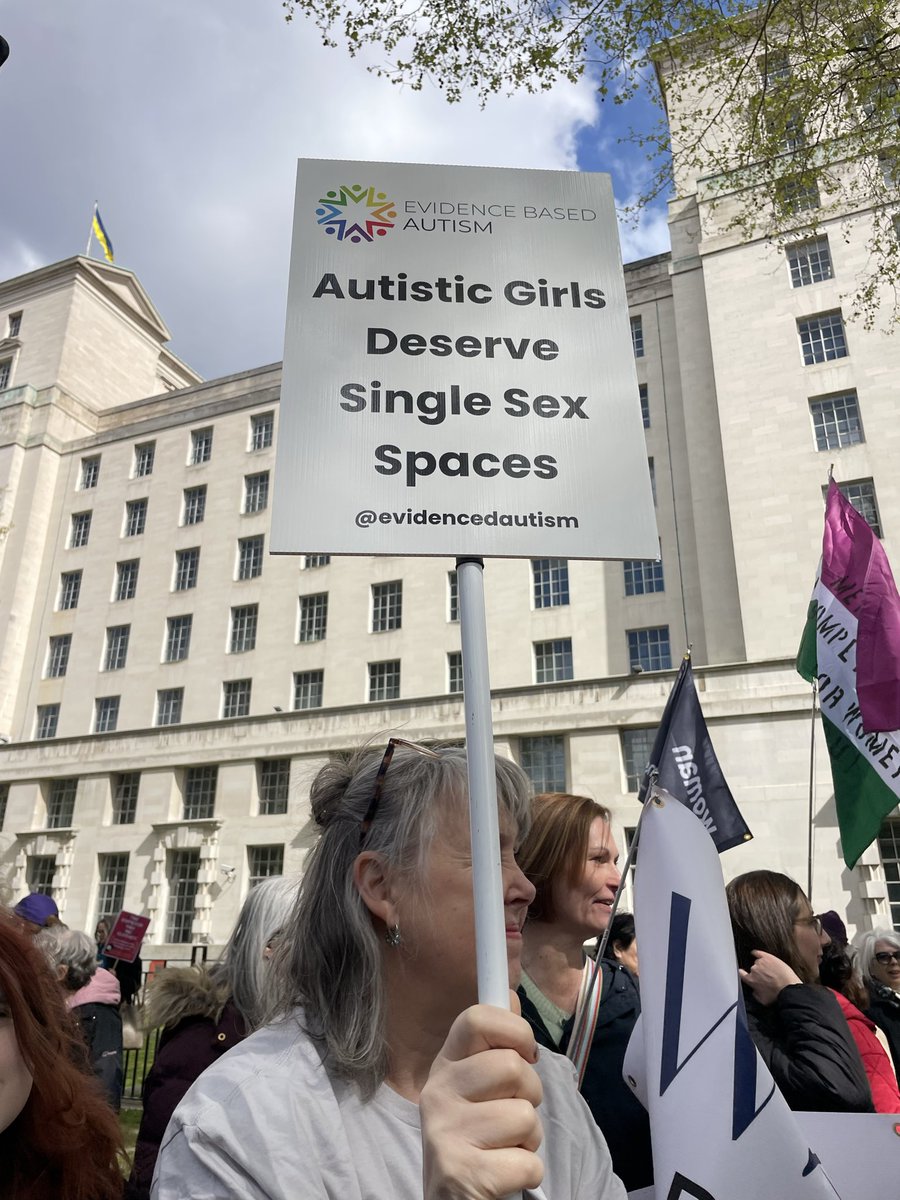
A brilliant breakdown by @SexMattersOrg of the abject failure of government to take the Supreme Court ruling seriously. Also a great template letter to send to your MP. It’s time to take action! #ItsNotOptionalItsTheLaw #Autism #OneYearLater
Sex Matters@SexMattersOrg

The law is clear: why are women waiting? Why are women protesting around the country #OneYearLater following the Supreme Court judgment? Read how the government's delay in acting to follow the Equality Act is harming women and girls. sex-matters.org/posts/updates/…

English
0
1
6
101
Janey at Evidence Based Autism
At this point, *everyone* should be following @prof_curiosity1 This ongoing series of detailed & informative tweets, drills down into the history & psychology of child development, takes apart the concept of the ‘trans child’. Essential reading.
Read some Piaget please!@prof_curiosity1

The test we didn't know we were taking There are moments when a society's institutions are asked to do something difficult. Not difficult in the sense of requiring resources or technical expertise, but difficult in the sense of requiring them to hold a position under social pressure, to say that the evidence is not yet sufficient, that caution is warranted, that the wellbeing of children requires a slower and more careful response than the prevailing mood demands. Those moments reveal something about the institutions that ordinary times conceal. The response to gender identity claims in children has been one of those moments. And the institutional record, taken as a whole, is not a comfortable one. What was required was not complicated. It was the ordinary application of the standards that paediatric medicine applies in every other context. Evidence of efficacy before widespread adoption. Assessment of long term outcomes before irreversible intervention. Serious engagement with comorbidities before treating the presenting claim as the primary clinical focus. Safeguarding frameworks robust enough to withstand the pressure of a persuasive and emotionally compelling advocacy movement. These are not high bars. They are the baseline. In this case, across a significant range of institutions and over a significant period of time, they were not met. Medical royal colleges adopted position statements endorsing the affirmative model without conducting the systematic evidence reviews that would normally precede such endorsements. Professional bodies responsible for the regulation of clinical practice allowed a generation of practitioners to be trained in an approach whose evidence base was, as the Cass Review would later confirm, weak, and whose long term outcomes were unknown. Universities adopted policies, revised guidance, and rewrote safeguarding frameworks in response to advocacy rather than evidence. Schools were asked to implement social transition protocols for children without parental knowledge or consent and largely complied. The press, with honourable exceptions, treated clinical scepticism as a culture war position rather than a legitimate scientific stance for the better part of a decade. The mechanism was not primarily corruption or bad faith. It was something more insidious and in some ways more troubling. Institutions signalled virtue by their compliance and were rewarded for it. Dissent was reframed not as a clinical or evidential position but as a moral failing, as bigotry, as a refusal to accept the humanity of vulnerable children. The costs of speaking carefully were immediate and social. The costs of not speaking carefully were deferred and clinical, and fell on children who were not in the room when the decisions were made. This dynamic is not unique to this debate. It is recognisable from other episodes in which institutions abandoned their ordinary epistemic standards under social pressure. What is distinctive here is the specific population that bore the consequences. The children who passed through the Tavistock Gender Identity Development Service during its years of unrestricted operation were among the most psychologically vulnerable children in the country. The Finnish national register data, the most methodologically rigorous evidence available, shows that psychiatric morbidity in gender referred young people rose after clinical intervention. The gap between them and their peers did not narrow. It widened. The institutions that should have been most alert to that risk were among those most captured by the framework that obscured it. The legal record is part of this picture. Bell v Tavistock in 2020 found that it was highly unlikely a child under sixteen could give informed consent to puberty blockers, a finding that raised immediate and serious questions about what had been happening in practice. The response of the relevant institutions was not a pause for reflection. The Court of Appeal overturned the ruling on procedural grounds the following year and practice continued largely unchanged until the Cass Review forced a reckoning that the institutions themselves had not been willing to initiate. None of this is an argument that everyone who supported the affirmative model was acting in bad faith. Many were not. Many were responding to what appeared to be a genuine humanitarian imperative, to children in distress, to families seeking help, to a clinical framework that presented itself as settled and evidence based and was endorsed by bodies whose authority they had reason to trust. The failure was not primarily one of individual moral character. It was one of institutional structure, of the mechanisms that are supposed to ensure that advocacy does not substitute for evidence, that social pressure does not override safeguarding, that the interests of children are not subordinated to the reputational interests of the institutions claiming to serve them. That is a harder failure to face because it implicates systems rather than individuals, and because the systems that failed are the ones that a functioning society depends on to get difficult questions right. Medical regulation, clinical training, academic publishing, legal oversight, press scrutiny, parliamentary accountability. Each of these has a role in the ordinary functioning of epistemic and safeguarding standards. In this case each of them, to varying degrees and with honourable exceptions, did not perform that role adequately. The Cass Review, the Scandinavian clinical restrictions, the HHS systematic review, and the changing regulatory landscape represent a belated correction. They are welcome. They are also, for the children who went through the system during the years when the correction was most needed, too late to matter. A moral litmus test is only useful if you read the result. The result here is legible. The question now is whether the institutions that failed it are capable of understanding why, and of building the structural safeguards that would make a comparable failure less likely next time. That work has not yet seriously begun.


English
0
2
5
72
Janey at Evidence Based Autism retweetledi
Lily Craven
Lily Craven@TheAttagirls·
UK history has been recorded since before the Domesday Book. Men could be awarded university degrees in 1230. Cambridge finally capitulated and awarded degrees to women in 1948. Men first took seats in Parliament in 1265. Women had to wait till 1918. Men could vote in 1832. Women had to wait till 1918. Men were legally persons in their own right. Women were chattels (the property of fathers or husbands) until coverture was finally knocked on the head in 1991. That’s not a typo. 1991. It is true that one of us is certainly silly and historically illiterate. I leave it to serious historians to decide which…
English
63
435
2.5K
47.6K
WWBD
WWBD@whtwldbabsdo·
@JournalistJill @helenstaniland I was quite perturbed. Mostly because she said she works with autistic children and young people. These people think they are kind. They are doing enormous harm.
English
2
2
57
789
Helen Staniland
Helen Staniland@helenstaniland·
In Cardiff at the #OneYearLater event. Women are discussing their needs for single sex spaces whilst a man in a dress is shouting 'have you ever seen a TERF with any style' through a loudhailer. The difference in the seriousness of the message is extremely stark.
Helen Staniland tweet media
English
556
1.2K
5.7K
333.4K
Janey at Evidence Based Autism retweetledi
#199 Days Later
#199 Days Later@acts_grassroots·
📣 Attention: London Protesters: For anyone coming to the London #OneYearLater protest the Circle and District lines are not stopping at Westminster tube on Saturday. However, the Jubilee line is still stopping there, or it's a 10-minute walk from Victoria.
#199 Days Later tweet media
English
3
53
94
4.8K