Jeff James

1.6K posts

Jeff James

Jeff James

@JeffJam6080

Born Again Catholic. The stronger your Christian faith, the stronger your Catholicism. Conservative Republican. Parent, Golfer.

Katılım Ekim 2022
177 Takip Edilen33 Takipçiler
Jeff James
Jeff James@JeffJam6080·
@Raven_Fighter @MrCasey62 Jesus tells us in John 15:1-5 that we must bear fruit. Is remaining in Jesus is a filthy work. James 2 faith without works is dead.
English
0
0
0
9
MrCasey
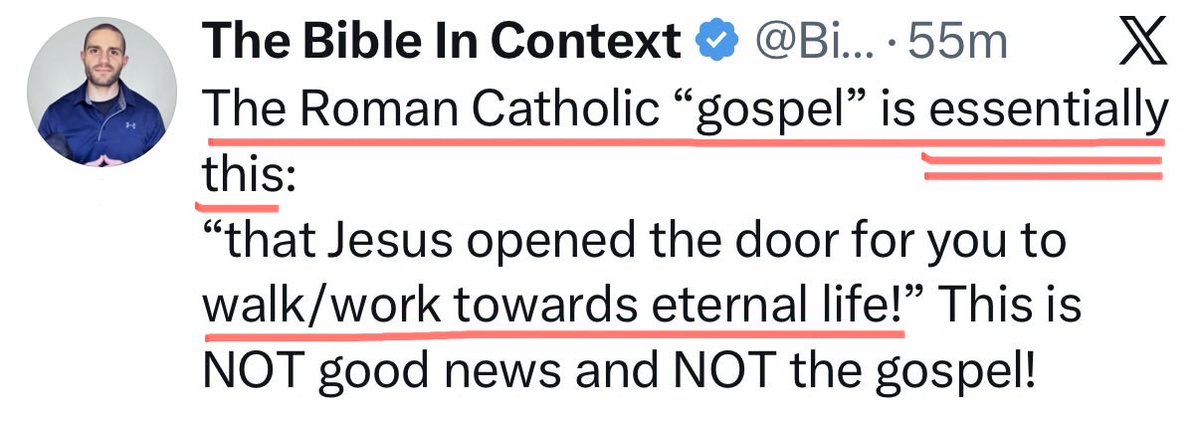
MrCasey@MrCasey62·
Without the lies, Protestantism dies. He tries to cover himself with the word “essentially” because even HE knows he can’t show ANYWHERE that the Catholic Church has ever taught this.
MrCasey tweet media
English
17
15
134
4.2K
Jeff James
Jeff James@JeffJam6080·
@JMDeVito2 @JennyWakefiel12 Scripture does not tell us Judas was never saved. John 15:1-5 tells us we must bear fruit though. James 2:14-26. Faith without works is dead.
English
0
0
0
7
JMDeVito
JMDeVito@JMDeVito2·
@JeffJam6080 @JennyWakefiel12 Judas never had it. He was never saved. "While I was with them in the world, I kept them in thy name: those that thou gavest me I have kept, and none of them is lost, but the son of perdition; that the scripture might be fulfilled."
English
1
0
0
15
Jenny Wakefield
Jenny Wakefield@JennyWakefiel12·
This is the false gospel of Rome. Do not fall for it; they are leading millions to hell with their lies. He then brought them out and asked, “Sirs, what must I do to be saved?” They replied, “Believe in the Lord Jesus, and you will be saved—you and your household.” Acts 16:30-31
Dr Taylor Marshall™️@TaylorRMarshall

Christ’s death and resurrection are applied to you at baptism. The power of the Holy Spirit at Pentecost is applied to you at confirmation.

English
47
8
46
3.1K
Jeff James
Jeff James@JeffJam6080·
@Raven_Fighter @MrCasey62 Our initial justification is not a get out of jail card. Faith alone is a very dangerous teaching. I doubt most Protestants truly subscribe to it. Think of all the protestants praying for each other and going on missions. They want to give thanks to God for His Grace.
English
1
0
0
12
Jeff James
Jeff James@JeffJam6080·
@JMDeVito2 @JennyWakefiel12 Read the last supper discourse. Jesus gives his apostles a charge to keep his commandments. Judas?. They were not irrevocably saved. People can lose their salvation. The Holy Spirit is not a salvation guaranteer.
English
2
0
0
17
JMDeVito
JMDeVito@JMDeVito2·
@JennyWakefiel12 Hitler and Stalin were both baptised as infants, RCC and RO respectively. Judging by the results, Marshall's holy spirit isn't all that strong.
English
4
0
1
114
Raven_Fighter
Raven_Fighter@Raven_Fighter·
@MrCasey62 The Roman Catholics dont trust Jesus entirely for salvation they think they can lose it, have to re-earn it with confession, think they have to go to mass to maintain it, in Catholicism Jesus didn't say "it is finished" he said "I did some of it but now you have to do your bit"
English
5
0
0
120
Pastor Rick Brennan
Pastor Rick Brennan@rickbrennanjr·
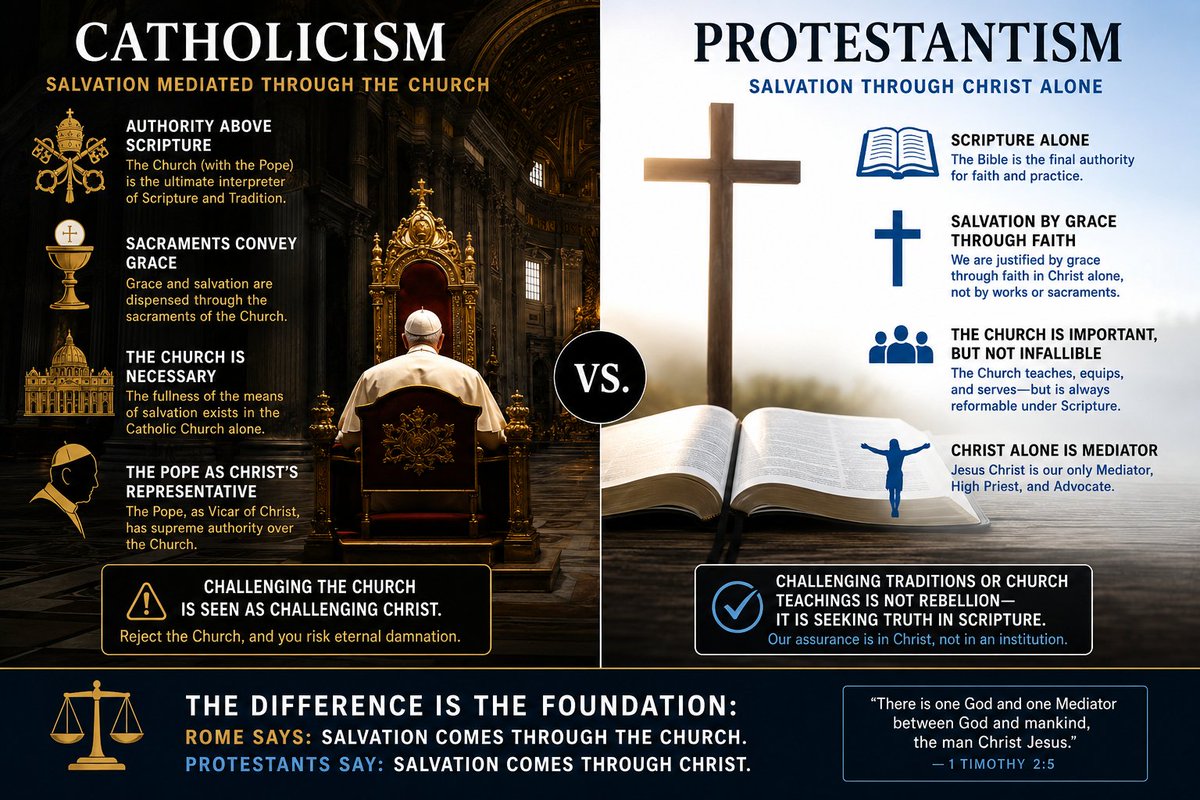
The Roman Catholic backlash to @gavinortlund and @WesleyLHuff has been instructive. Both men are irenic, careful, and respectful in how they address what they believe are errors in Roman Catholic doctrine. Yet both have drawn deeply personal attacks for their apologetic work. This raises an important question many Protestants are asking: why do thoughtful, respectful critiques of Roman Catholicism often provoke such a visceral response? The visceral reaction many Catholics have when Rome is challenged makes sense once we understand the Roman Catholic system. Rome is not merely one church among others in their theology. It is the visible institution possessing the fullness of the means of salvation, the sacramental economy, the authentic interpretation of Scripture and Tradition, and the Petrine office of universal authority. Therefore, to challenge Rome is not received as a mere doctrinal disagreement. Rather, it is received as an attack on the what they believe is the very structure by which Christ supposedly teaches, governs, absolves, and saves. In contrast, Protestants are less threatened by challenges to a particular church tradition because Protestantism, at its best, does not locate salvation in institutional submission. The Baptist does not need the Baptist church to be indefectible. The Presbyterian does not need every presbytery to be incapable of grave error. The Lutheran does not need Wittenberg to be the necessary center of visible unity. Protestants argue fiercely, but their assurance rests finally in Christ’s finished work received by faith, not in the claim that one visible hierarchy or institution uniquely dispenses the fullness of saving grace. That is the real issue: Rome’s authority claims make historical criticism an existential threat. Protestantism can admit that church history is messy because the visible Church is always in need of reform. Protestants can also recognize ambiguity in the historical record and draw reasoned conclusions that differ from others without collapsing the faith. Rome cannot do this so easily. If too much historical complexity is admitted, Rome’s claim to be the indefectible guardian and interpreter of the apostolic deposit begins to weaken. History must produce clear answers because Rome must show that she has always taught what she now requires believers to confess—whether baptismal regeneration, Eucharistic transubstantiation, or papal supremacy. If the historical record shows change, ambiguity, contradiction, or later accretion rather than apostolic continuity, the entire sacerdotal system is threatened. So when a Roman Catholic lashes out at a protestant theologian or historian who is making an argument that runs counter to the approved narrative, the issue is often deeper than the topic being debated. The Protestant is arguing about history or doctrine. The Catholic may feel that their whole edifice of certainty, grace, authority, and salvation is being pulled down. And in a sense, the Catholic is right to feel critical importance of the stakes. If Rome is wrong about herself, then she is not merely wrong about secondary matters. She is wrong about the very place she has assigned herself between Christ and the believer.
Pastor Rick Brennan tweet media
English
89
65
408
63.8K
Jeff James
Jeff James@JeffJam6080·
@HabitualLinest @rickbrennanjr @gavinortlund @WesleyLHuff rick’s game is to look for poorly catechised Catholics. It’s all collection plate mining. You will notice he never writes his essays telling people how much he loves the southern baptist church. In fact, I never see any Protestants make a case for their own actual church.
English
3
0
2
77
Jeff James
Jeff James@JeffJam6080·
@Billionaire_33 @MrCasey62 That’s incorrect. Jesus changed his name in Aramaic not Greek. The Greek translation does not even matter. By changing his name, Jesus gave him a charge. To lead the Church he created.
English
2
0
3
48
Rebecca Marie 🇺🇲🇮🇱🏳️‍⚧️
The line from the Bible that Catholicism uses to justify an unbroken lineage of Popes is Matthew 16:18. However, that is not what Christ was teaching. Here is the full passage: He said to them, “But who do you say that I am?” Simon Peter replied, “You are the Christ, the Son of the living God.” And Jesus answered him, “Blessed are you, Simon Bar-Jonah! For flesh and blood has not revealed this to you, but my Father who is in heaven. And I tell you, you are Peter (Petros), and on this rock (Petra) I will build my church, and the gates of Hades shall not prevail against it. Jesus didn't mean he would build an Apostalic Succession through Peter, or a lineage of Popes. He meant to what Peter stated about Christ is where Christ would build his church. "You are Christ, the son of the Living God." That is the Petra (Greek for Rock) that Petros (Greek for Peter) spoke. Stop listening to Roman Catholicism. They are Mystery Babylon.
English
3
0
4
199
MrCasey
MrCasey@MrCasey62·
LOL! Catholic teaching never “clashes” with Scripture. Those who claim it does don’t know the Bible in its original contexts OR its original languages.
MrCasey tweet media
English
54
17
276
5K
Jeff James
Jeff James@JeffJam6080·
@MrCasey62 Is it not true that Catholic tradition teaches us to go to accurately interpreted Scripture first?
English
0
0
0
37
Jeff James
Jeff James@JeffJam6080·
@Raven_Fighter @MrCasey62 At the wedding in Cana, people who had a problem went to Mary and she went to Jesus on their behalf. Should we learn something from that? Why would anyone bother to remember that story?
English
0
0
2
28
Raven_Fighter
Raven_Fighter@Raven_Fighter·
@MrCasey62 It absolutely does, the apostles never prayed to Mary, apostle succession is not in scripture wirhout twisting it, praying to dead saints isn't in scripture, works salvation isn't in scripture, etc etc etc
English
18
1
8
505
Jeff James
Jeff James@JeffJam6080·
@rickbrennanjr @intrinsicvalue3 @RefuteThemAll @WesleyLHuff You complain about people being rude to you. Now you’re calling me a liar. The SBC I attended was Champions Forest Baptist Church in Houston. The pastor went on and on about Catholics not submerging those they baptize. If baptism is not regenerative, why would he give a shit?
English
0
0
2
35
Pastor Rick Brennan
Pastor Rick Brennan@rickbrennanjr·
This sounds like a made-up story to me. I have attended hundreds of Protestant baptisms, including the baptisms of my own children in a Southern Baptist church. The ordinance is centered on celebrating Christ, the gospel, and the new believer publicly professing faith in the Lord. It is not a ten-minute performance where the Pastor is going to talk badly about the Catholic Church. In my experience, Protestant baptisms are usually brief, joyful, reverent, and deeply focused on Christ and the believer’s union with him.
English
1
0
1
50
Pastor Rick Brennan
Pastor Rick Brennan@rickbrennanjr·
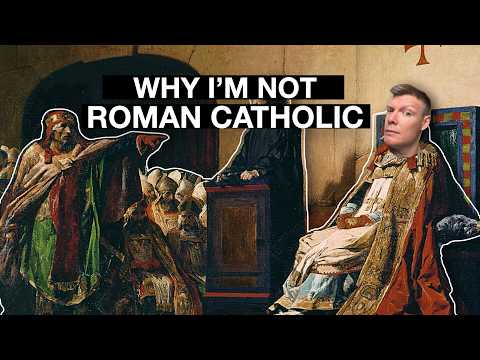
In the video released yesterday by @WesleyLHuff entitled, “Why I’m Not Catholic,” he says: “Being a biblically based faithful Christian will make you a bad Roman Catholic and vice versa. There will come a time for the mature believer to have to leave Rome as they realize the incongruity within its doctrines and dogmas with that of the true faith of biblical Christianity.” Wes and I both love Roman Catholics and respect much of what the Church of Rome has done historically to safeguard Scripture, defend orthodox Christology, and spread the gospel. However, I remain Protestant by conviction. In my judgment is that Rome’s doctrinal and sacramental system obscures key teachings of Scripture, especially the sufficiency of Christ, the final authority of Scripture, and justification by faith apart from works of the law. Here is a link to his 40-minute video. It’s well worth the time to listen. youtu.be/DpNgxsiNoOA?si…
YouTube video
YouTube
English
37
12
82
5.7K
Jeff James
Jeff James@JeffJam6080·
@intrinsicvalue3 @rickbrennanjr @RefuteThemAll @WesleyLHuff I went to a Southern Baptist service. Some guy got Baptized. During the baptism, the preacher spent 10 minutes criticizing Catholics. Protestantism strikes me as a movement without any self-respect. The Catholic Mass does not have time to talk about Southern Baptist.
English
1
0
2
80
riseabovemadness
riseabovemadness@intrinsicvalue3·
@rickbrennanjr @RefuteThemAll @WesleyLHuff Here is a hint. Stop saying Rome as it reeks of bigotry in implying the Church is an instrument of a foreign government. Also, this is X. Not the place for complex discussions that will raise emotions. To be clear, I believe leave both Catholics and Protestants alone.
English
2
0
2
61
Jeff James
Jeff James@JeffJam6080·
@PaulDibartolo @DustinAshWrites Your original post was beyond misleading. You should apologize. Also, I know you want to “roar in numbers to big to ignore”, but 100 bucks says well over 200 of your followers are the Japanese porn followers. I block people like that.
English
0
0
0
114
Dustin Ashe
Dustin Ashe@DustinAshWrites·
In 1534 Martin Luther cut seven books out of the Bible. They had been Christian scripture for over a thousand years. This is the part Protestants are never told. The strongest objection runs like this. The Catholic Bible just absorbed the Septuagint, the Greek Old Testament. But the Septuagint manuscripts also contain 3 and 4 Maccabees, Psalm 151, and the Odes, which the Catholic canon does not include. So if the Septuagint sets the canon, Catholics are inconsistent for leaving those out. That objection is correct, and it misses the point entirely. The Catholic claim was never “the canon is whatever the Septuagint contained.” The claim is that the Church, with the authority Christ gave her, discerned and defined which books are scripture. The councils of Rome in 382, Hippo in 393, and Carthage in 397 and 419 produced the exact canon the Catholic Church holds today. Deuterocanon in. 3 and 4 Maccabees out. The Church judged. She did not inherit a library mechanically. The exclusion of 3 and 4 Maccabees is not an embarrassment for the Catholic position. It is the proof of it. The Church had the authority to draw the line, and she drew it. Now the concession Protestants will reach for. The Catholic Church only defined the canon as dogma at the Council of Trent in 1546, after the Reformation. That is true. It is also not the rescue it appears to be. Both formal definitions are 16th century. Trent in 1546 and the various Protestant confessional definitions in the same era. The difference is what each one did. Trent reaffirmed the canon the Christian Church had used continuously since the fourth century. The Reformers broke with that continuous practice and adopted instead the rabbinic Jewish canon, which was finalized by Jewish authorities after the time of Christ, partly in distinction from the Christian movement that was using the wider Greek scriptures. Trent reaffirmed. The Reformers innovated. The “addition” people accuse Rome of was actually a subtraction, made in 1534, from a canon that had stood for more than a thousand years. On the Orthodox and Oriental Churches, yes, their canons differ from the Catholic one. But they differ at the margins. 3 Maccabees, Psalm 151, 1 Esdras. All the ancient apostolic Churches share the core deuterocanon that the Protestant canon removes entirely. The variation among the apostolic Churches is the outer boundary of a shared body of books. The Protestant canon is the only one that made the radical cut. The Reformation answer is that a faithful remnant preserved the true gospel inside a corrupted visible church. Grant it for the sake of argument. Name the continuous body of Christians who held the 66-book canon before 1534. I have asked this for years and never received an answer. Bookmark this for the next time someone tells you Rome added books. Serious questions welcome in the replies.
English
46
27
172
73.7K
Jeff James
Jeff James@JeffJam6080·
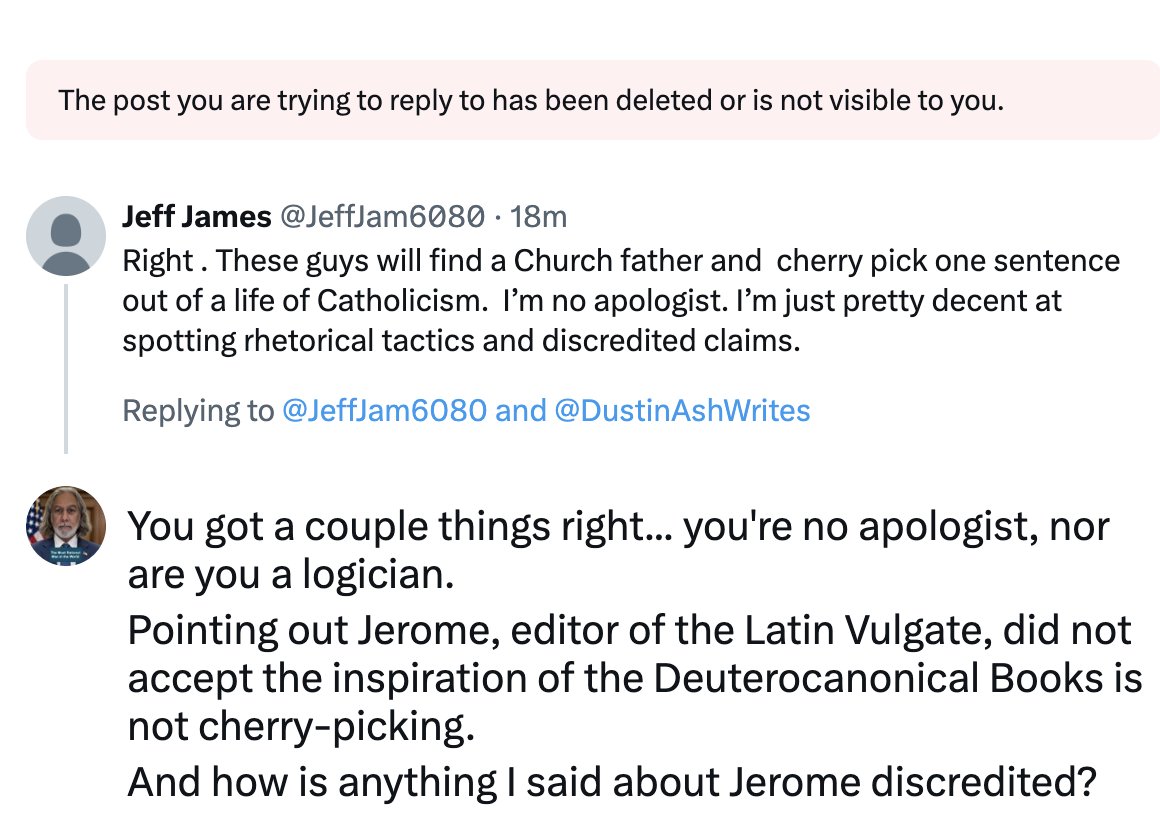
@PaulDibartolo @DustinAshWrites You said the canon of the Church wasn’t settled until “poopy Marty” came along. Now you’re saying Jerome disagreed with the canon that you said didn’t exist. I spent all morning laughing at you…that’s what happened.
English
1
0
0
25
Jeff James
Jeff James@JeffJam6080·
@PaulDibartolo @DustinAshWrites People within the church had disagreements about what the final cannon should be. So what. The 73 book Cannon was the decision by 397. Athanasius and Jerome were also against 30k separate businesses/denominations called Protestantism.
English
4
0
1
29
Paul DiBartolo (#Trump2024)
Paul DiBartolo (#Trump2024)@PaulDibartolo·
Lotta poop being collected from those sale of indulgences. Who knew you could buy remission of punishment? In his 39th Festal Letter (AD 367), Athanasius compiled a list of 49 canonical books. 22 Old Testament books, grouped to match the 22 letters of the Hebrew alphabet, incorporating Baruch and the Letter of Jeremiah but omitting Esther. 27 New Testament books. Beyond these 49 canonical books, Athanasius listed several others (including the Wisdom of Solomon, Sirach, Esther, Judith, and Tobit) that were not canonical but were approved for newly converted believers to read." The agreement on the OT canon was not monolithic, even amongst catholics. Jerome - commissioned to revise the old Latin, and one of the strongest opponents of the canonicity of the Deuterocanonical books. Athanasius of Alexandria Cyril of Jerusalem Gregory of Nazianzus Hilary of Poitiers Origen Rufinus of Aquileia Epiphanius of Salamis Melito of Sardis
English
1
0
0
39
Jeff James
Jeff James@JeffJam6080·
@PaulDibartolo @DustinAshWrites Read my first post. Nothing changed in the biblical cannon from 396 to the 1500s. The Catholic Church wanted Luther to stop trying to take as many as 10 books out of the cannon, and to stop talking about poop all the time.
English
2
0
1
44
Paul DiBartolo (#Trump2024)
Paul DiBartolo (#Trump2024)@PaulDibartolo·
As you say, look it up. When was the Biblical canon definitivly established by the Catholic Church? "Definitive Establishment The Council of Trent (1545–1563) provided the most authoritative, dogmatic, and definitive declaration for the Catholic Church. In its fourth session on April 8, 1546, it issued the decree De Canonicis Scripturis. This solemnly defined the canon as "sacred and canonical," listed all 73 books explicitly, declared them inspired with God as their author, and attached an anathema (formal condemnation) to those who rejected it."
English
1
0
0
25