Jony Kheng-aik LING

4K posts

Jony Kheng-aik LING banner
Jony Kheng-aik LING

Jony Kheng-aik LING

@JonyLing1

My pronouns are: Me / Toxic Male

Singapore Katılım Şubat 2013
887 Takip Edilen193 Takipçiler
Jony Kheng-aik LING
Jony Kheng-aik LING@JonyLing1·
@rationalaussie Well I thought God was going to do it, but apparently LinkedIn has its godawful usefulness in the Absolute hahaha.
English
0
0
0
50
Rational Aussie
Rational Aussie@rationalaussie·
The first thing AGI will do is hack LinkedIn and permanently wipe its existence off the face of the Earth. Until that has happened, we don't have benevolent AGI. This is the alignment test.
English
14
8
180
5.7K
Sam Altman
Sam Altman@sama·
come for the best model, stay because we don’t treat you with contempt
English
1.8K
656
20.2K
2.3M
Brivael Le Pogam
Brivael Le Pogam@brivael·
Day 1: dancing like a teenager powered by acid Day 2: saying communist bullshit and winning a lot of money to say it
English
23
27
357
13.3K
Scott Stevenson
Scott Stevenson@scottastevenson·
I disagree. Every AI provider that isn't winning the data network effect is incentivized to counterposition, telling you a story about why the network effect is bad. But a model trained on my information, without the information of millions of other users would be awful. It is generally the best thing for the world for us to put our combined knowledge into these models rather than siloing inferior models. Furthermore--this is simply unstoppable. Every network effect business has competitors that try to convince you that you are better off without the network effect: * Social networks that tell you you should own your social graph (failed) * Desktop linux users telling ordinary consumers they should use linux rather than Windows/MacOS (largely failed) * OpenStack which said you should run your own cloud computing infrastructure rather than AWS or Azure (not sensible to the vast majority of companies) But the network effects always win in the end. You deleting your Instagram account does little to Meta. You deleting your Claude account does little to Anthropic. There are hundreds of millions of users contributing knowledge to these models every day whether you do or not, and it's going to be almost impossible to get everyone to stop. If you over-focus on proprietary models you are largely going to be left behind by the snowballing intelligence of foundation models.
Satya Nadella@satyanadella

x.com/i/article/2076…

English
33
10
159
32.5K
Jony Kheng-aik LING
Jony Kheng-aik LING@JonyLing1·
@rvcas I’m not really a native coder, but I kinda work in your style. I just cannot believe the gargantuan amounts of code that the AI produces wouldn’t broke. Hell, even the tiny little personal OS I created broke on the first run.
English
0
0
1
134
Lucas
Lucas@rvcas·
I don’t use loops, skills, fancy orchestration, plugins or anything like that. I raw dog the agent with its default harness, I read the code, and I’m shipping more than ever to production for real projects used by real people. Sometimes if it’s a low risk part of the application I might skip reading the code but only sometimes. I think most are either lying about the amount of value they are creating or just having fun while understanding they aren’t creating value but failing to distinguish that to their audience.
English
100
130
1.8K
146K
Brian Roemmele
Brian Roemmele@BrianRoemmele·
NO IT’S NOT AI. 1986, "Kin-Dza-Dza!" stands as one of the most strange science fiction films ever produced in the Soviet Union. The plot is following two strangers who accidentally activate an alien teleportation device and find themselves stranded on the desert planet Pluke in the distant Kin-dza-dza galaxy. What unfolds is a masterclass in surrealist social satire, as the two bewildered humans navigate an alien civilization governed by baffling social hierarchies, incomprehensible customs, and a language barrier that transforms every interaction into pure comedic and philosophical gold.
English
277
876
7.7K
563.9K
Jony Kheng-aik LING
Jony Kheng-aik LING@JonyLing1·
Yeah precisely. I’m new to writing code, but I truly cannot make sense of writing specs upfront and then letting the AI run. How do you know what you don’t know when you have not wrestled with the problem with the AI’s help of course. Reality is a lot more complex than what you can come up with on the specs sheet.
English
0
0
0
86
Steve Krouse
Steve Krouse@stevekrouse·
the problem with "spec driven development" is that most software can't be spec'd up front software is a creative act, where you figure out what you're building as you build it you need to get your hands dirty in the details, and react to incremental versions it's telling that all the examples of spec driven development are sorting a list or porting thoroughly tested code (like a js runtime or browser engine), which are the exception, not the rule. the vast majority of software doesn't have a spec – or if it does, the spec was created *after*
English
207
135
1.8K
150.3K
Jony Kheng-aik LING
Jony Kheng-aik LING@JonyLing1·
I’m an individual, but I hv worked for companies before. By nature, they wanna distill everything from the employee and then discard them when they hv other priorities. This is nothing new. The only way out is to shatter behemoths into a million pieces through decentralization, and when you run your own company, you’d also not want your few employees to hold you to ransom.
English
0
0
1
350
SightBringer
SightBringer@_The_Prophet__·
⚡️ Satya Nadella published an essay this week warning that AI vendors quietly harvest their customers' knowledge. He is right about the mechanism. He is also not writing it to protect you. Read closely and the essay is a property claim on the most valuable asset of the next decade: distilled human judgment. His mechanism first, because most people have not seen it stated. When a company uses AI, it pays twice: once with money, once with the knowledge it must reveal to make the model useful. And the most valuable revelation is corrections. Every time your best people fix the model's mistakes, they transfer a piece of judgment into a system that never forgets. The cloud era stored your files. This era distills your expertise. Nadella's proposal: a hard "trust boundary" so each firm's corrections, evals, and learning compound inside its own walls instead of flowing to the model vendor. Now notice what the boundary does and does not stop. The extraction of human judgment continues at full rate either way. Employees still teach the loop with every fix. The boundary only changes which balance sheet capitalizes the knowledge: the AI lab's or the employer's. The worker whose corrections feed the machine appears nowhere in the property claim. There is a historical name for this maneuver. In the first enclosure movement, England's landowners converted common land, which everyone used and no one owned, into private title. Nadella's essay does the same to tacit human skill, the thing that lived in professions and walked out the door every night. Fence it, title it, book it as a corporate asset called a learning loop. His fight with the AI labs is a fight between lords over where the fence sits. The labs trained on the public internet for free, then banned anyone from distilling their models. Nadella demands the fence drop one level, to the enterprise, and no further. Nobody in this dispute proposes that learning flow back to the people it is distilled from. Why Microsoft argues this now is straightforward: its grip on OpenAI has loosened, the frontier labs are becoming competitors, and if models become commodities while value settles in the customer's data and loop, Microsoft owns the ground where all of it runs. Commoditize the layer you lost, monetize the layer you hold. The essay's five principles are Azure's roadmap dressed as customer liberation. But the forecast inside it is bigger than Microsoft. If Nadella wins, every firm becomes a sealed loop compounding its private stock of distilled judgment, and hiring shifts from buying knowledge to buying correction-labor to feed the loop. If he loses, the same absorption converges into three or four planetary loops owned by the frontier labs. A million small enclosures or one giant one. Grim as it sounds, the million is the branch where workers keep leverage: a million loops means a million bidders for human judgment. One loop is a monopsony on the last thing people have to sell. The tell that Nadella already sees this world: midway through the essay he writes "human capital and token capital" side by side, unremarked, as if the term were standard. It is not. He coined a new factor of production in a subordinate clause. When the CEO of the second-largest company on earth starts naming the thing that compounds instead of labor, the succession is already on his internal map. The essay is not a warning about that succession. It is a bid for the deed.
Satya Nadella@satyanadella

x.com/i/article/2076…

English
30
72
392
70.2K
Jony Kheng-aik LING
Jony Kheng-aik LING@JonyLing1·
@natxwang I don’t wish him evil, but the gargantuan efforts by him to stay young and live forever are quite brow raising.
English
0
0
0
11
Natx Wang 🇸🇬🍟
A surprising number of people live with an invisible illness. It's rarely something you can avoid. Sometimes a part of your body just... stops doing its job properly. Between 2010 and 2012, I was in and out of hospitals. That's when I was diagnosed with eczema, IBS, and discovered my food allergies. Most days my eczema is manageable. But flare-ups are brutal. The past two weeks, I've been awake at 3am with cracked, swollen, bleeding hands. I choose not to use steroids, so recovery takes longer. I'm grateful I was diagnosed by a doctor in the US who encouraged both conventional medicine and natural approaches. That experience led me to study nutrition, functional health, and eventually earn my own certifications. That's also why I respect people like Bryan Johnson. You don't have to agree with everything he does, but he's openly sharing years of experiments and data for the rest of us to learn from. This week, I'm experimenting with an anti-inflammatory diet to see if I can calm my eczema enough to type without itching. Your health is one of those things you only truly appreciate when your own body starts working against you.
Bryan Johnson@bryan_johnson

The world wants me to die. My incurable disease diagnosis became global news. It was omnipresent on social media and 1,900 articles were written in a matter of days. Many were saddened. However, joy dominated the commentary. People pointed to schadenfreude, the pleasure of another's failure. Yes, there’s that. There is a special place in people’s hearts that loves to see others fail, especially when that person’s presence threatens their own psychological stability in some way or helps them feel better about themselves. But, if you look over the social media commentary about me, you’ll see that pattern: “he deserved it.” I deserved it because I challenged death. The crowd was running a deeply rooted psychological script that represents the oldest, most deeply embedded stories of human culture. This was the first story ever written down, 4,000 years ago. Gilgamesh sought eternal life after losing someone he loved, only to have the plant of youth stolen by a serpent as he bathed. Leaving him to accept his mortality. Asclepius became so skilled at rejuvenation that he raised the dead. As punishment, Zeus struck him down with a thunderbolt to enforce life and death authority. This is the story of Jesus. Pontius Pilate offered a choice between a thief and the immortalist, and the crowd demanded the execution. People need this story conclusion to keep themselves sane. The challenger must lose and the loss must appear deserved. It’s a shield of self preservation. For if death is inevitable, their existence and that of their loved ones is justified and unavoidable. If death is not inevitable, nothing about their reality is safe. I occupy the same philosophical and archetypal position as Gilgamesh, Asclepius and Jesus. This statement will draw outrage and accusations of blasphemy, hubris and narcissism. Nevertheless, it’s the pattern that has repeated itself for thousands of years. Death has been the omnipresent concern of the human race. It encapsulates our greatest fears, joy and curiosities. The discourse around it changes over time; however, the fundamentals remain unchanged. What’s different about this moment, that is unlike any other moment, is that physical death may no longer be inevitable. What if I didn’t deserve it? And what if I am your ally, and not a threat?

English
2
0
2
731
Jony Kheng-aik LING
Jony Kheng-aik LING@JonyLing1·
@rezoundous Think the effective altruistic is afraid of their own shadows coz shadows hv feelings too!
English
0
0
0
2.1K
Tyler
Tyler@rezoundous·
it's official. Anthropic is scared.
English
91
44
2K
137.2K
Jony Kheng-aik LING
Jony Kheng-aik LING@JonyLing1·
@davidicke Well the more I read your posts the more I believe you’re higher up than them in the gofers.
English
0
0
0
33
David Icke
David Icke@davidicke·
You must have taught him all he knows then. Laughable theatre. Two gofers owned by the same network in an ongoing tiff designed to persuade you they are not owned by the same network.
David Icke tweet media
English
63
147
919
36.5K
Jony Kheng-aik LING
Jony Kheng-aik LING@JonyLing1·
@RealDianeYap Lemme guess… You’re forever on the just existing level haha. Useful men probably find just existing women not very useful. Like just existing meaning just sitting there not doing anything whilst the men take over all the chores like bringing up the kids.
English
0
0
0
82
Diane Yap
Diane Yap@RealDianeYap·
Most of the value women bring is intrinsic. Men may be responsible for the bulk of the infrastructure and technology, but women make life worth living. Men must be useful. Women need only exist. I know the men seethe about this but that won’t change anything.
English
91
21
188
46.5K
Jony Kheng-aik LING
Jony Kheng-aik LING@JonyLing1·
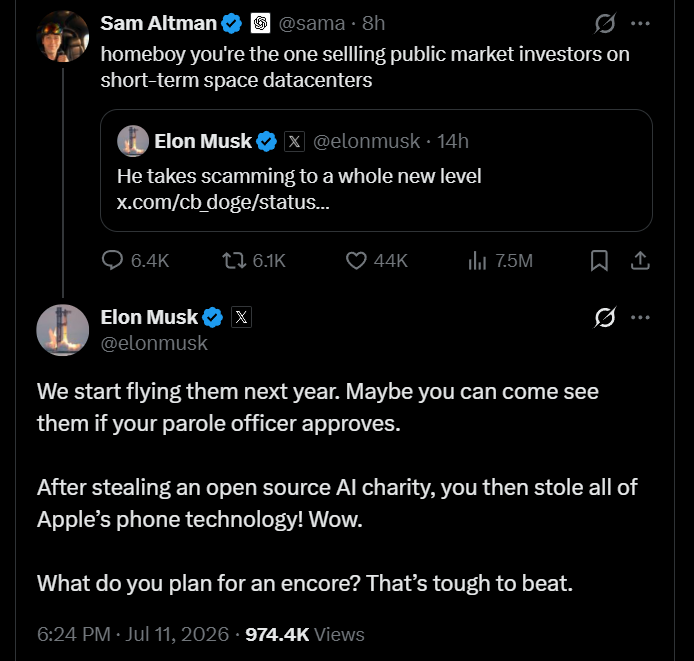
@elonmusk Hey Scam also put in a lot of personal effort stealing OpenAI from being a non-profit! How dare you / yous!
English
0
1
3
1.2K
Elon Musk
Elon Musk@elonmusk·
They sure put a lot of effort into this crime
Aakash Gupta@aakashgupta

Apple just sued OpenAI, and the wildest part is how they got caught: one candidate screenshotted confidential Apple files on his Apple work laptop hours before his OpenAI interview. Apple reads its own server logs. The recruiting pipeline generated its own evidence trail. The complaint says OpenAI's hardware chief Tang Tan, a 24-year Apple veteran, directed candidates still employed at Apple to bring "actual parts" (batteries, logic boards) to interviews for show and tell sessions. One candidate was surprised, saying he didn't even know you could take those out of the office. Apple also alleges Tan circulated an internal Apple offboarding document to coach new hires on dodging exit security checks, and that a departing engineer kept his Apple laptop, found a bug that still gave him access to Apple's cloud storage, and downloaded dozens of confidential hardware files after joining OpenAI. Then the supplier: OpenAI allegedly got one of Apple's manufacturing partners to demonstrate a proprietary metal finishing technique by letting the partner believe Apple had approved it. Over 400 former Apple employees now work at OpenAI. Apple says it flagged all of this to OpenAI in February and never got a response. Five months later, it filed. The ask reveals the strategy. Apple wants an injunction barring OpenAI from using the secrets, the return of every file, and full discovery into io, right as OpenAI preps its first device launch and an IPO. If a judge grants it, OpenAI may have to prove the device was built clean, component by component, before it ships. The device was supposed to run on the world's best hardware talent. Now its bill of materials is evidence.

English
1.4K
4.1K
32K
5M
Jony Kheng-aik LING
Jony Kheng-aik LING@JonyLing1·
No, I think Anthropic and their performance theatre scaring the public about scary AI would go down too. Their token cost is simply unsustainable to customers. Most of the public including companies would probably switch to models that can offer their -1 models at near to OS cost and charge a premium on their frontier models, and the harness would switch the tasks according to the difficulty. I think SpaceXAI, Google and Meta would probably survive with this approach. Nvidia would probably continue with their OS which is decent. AWS gotta step up to the game with their own models soon, if not they’d go down with OpenAI and Anthropic.
English
0
1
10
855
Wall Street Mav
Wall Street Mav@WallStreetMav·
OpenAi has clearly fallen behind Anthropic in the Ai race. Anthropic is nearing profitability and growth is exploding. Meanwhile OpenAi is projecting 2030 profitability, but their growth is slowing and they are missing internal targets. Google's Gemini will likely survive with Google's financial backing. Facebook can probably afford to keep their Ai efforts going. Elon can clearly afford to keep Grok going indefinitely. I suspect OpenAi is the only Ai model that lacks long term viability. They have no other profit center to sustain the cash burn. All of the other players can use their profits from other businesses to keep funding their Ai division.
Wall Street Mav tweet media
English
95
59
694
46.8K
Brian Roemmele
Brian Roemmele@BrianRoemmele·
🔮 The head-fake rumor that China will stop releasing Mythos class and beyond AI open source models was unfortunately believed to be by some folks in 2026. It gave temporary irrational support to US AI executives that say “we would do open source but no one wants it” dazzle.
English
8
7
48
9.5K
Fandom Pulse
Fandom Pulse@fandompulse·
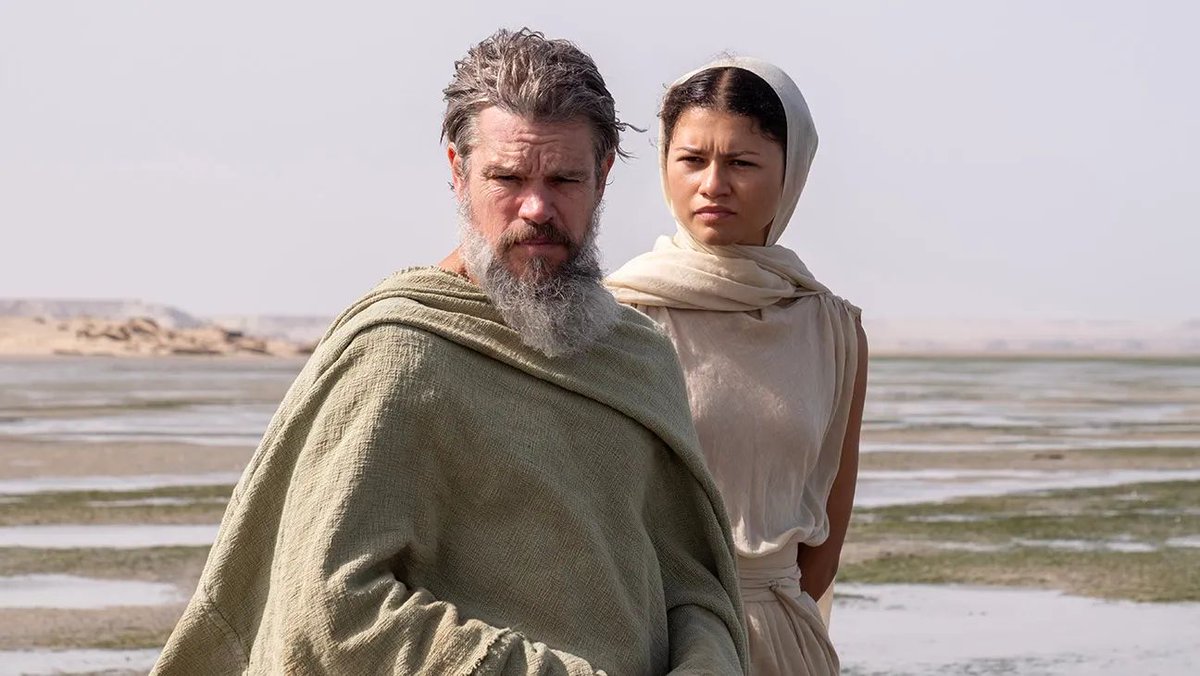
Christopher Nolan says his version of The Odyssey is for modern audiences: “When you look at the ancient world… there’s a lot of cultural prejudice….I want to make it feel very fresh for modern audiences.” Is this the final blow for the movie?
Fandom Pulse tweet mediaFandom Pulse tweet media
English
3.2K
368
5.4K
782.3K