Compute Capital

837 posts

Compute Capital

Compute Capital

@JoshInvestsAI

The AI Revolution Is Here - $IREN Bull 🐂

Katılım Mayıs 2020
112 Takip Edilen2.3K Takipçiler
Compute Capital retweetledi
Compute Capital
Compute Capital@JoshInvestsAI·
$IREN is a once in a lifetime buying opportunity at $40. Zoom out, if you did your homework and research it’s quite obvious it is not hype. All of this marketing on X recently shows the global footprint $IREN is going for and I believe their Australia footprint will start to come into the picture quite soon.
𝐀𝐠𝐫𝐢𝐩𝐩𝐚 𝐈𝐧𝐯𝐞𝐬𝐭𝐦𝐞𝐧𝐭𝐬@Agrippa_Inv

It’s always funny to see Wall Street completely fumble hyper-growth stocks. The street is expecting $IREN to make ~$8.4b in revenues by FY 2030, with EBITDA margins of just ~68%. Analysts are completely mispricing $IREN's 4.5 GW site-portfolio and multi-GW pipeline beyond that. I went ahead and modelled out my own near-term projections for the coming 2 years, using the following assumptions: Childress: 300 MW: MSFT Deal 450 MW: air-cooled (B300), fully ramped by Q3 2027 British Columbia: 160 MW: Mostly air-cooled, fully ramped by Q1 2027 Sweetwater 1: 600 MW: Vera Rubin (VR200) fully ramped by Q1 2028 Results: 👉 2027 = ~$8.3b (Rev) / ~$6.6b (EBITDA) 👉 2028 = ~$12.7b (Rev) / ~$10.3b (EBITDA) One of Wall Street’s problems is that they only price what’s directly in front of them. My 2027 revenue estimates are basically Wall Street’s 2030 projections. 🤦🏻‍♂️ And to be honest, my assumptions are actually very sensible. For the air-cooled deployments across Childress & BC, I used revenues BELOW management’s guidance. For exact modelling inputs and FCF / net income projections up to 2030, refer to my new $IREN deep dive on Substack. To be clear, I’m much more confident in my 2028 projection, since Sweetwater’s ramp could be more heavily skewed toward H2 2027 and H1 2028 instead of the simplified linear ramp approach I used. However, the point remains: Wall Street is completely dropping the ball on this one. What do you think will happen once $IREN announces its next hyperscaler deals at Childress and Sweetwater? → Massive re-rate incoming, as Wall Street scrambles to upgrade their idiotic projections.

English
6
5
132
19.4K
Mid-Level Cruiser
Mid-Level Cruiser@midlevelcruiser·
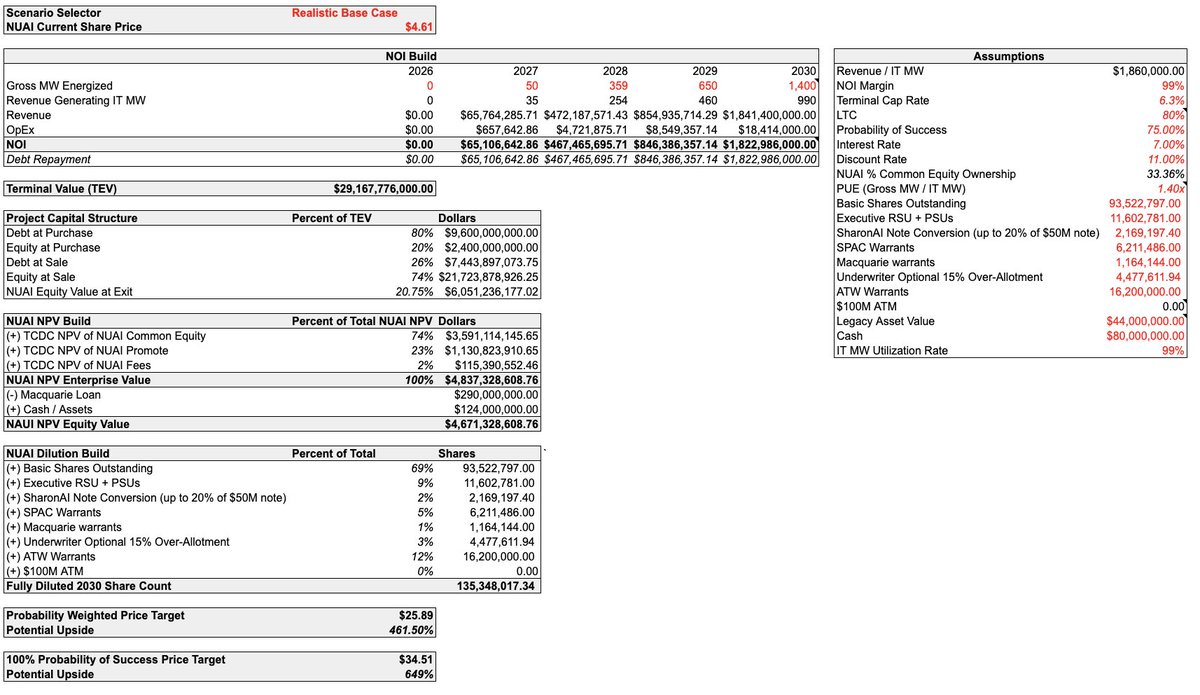
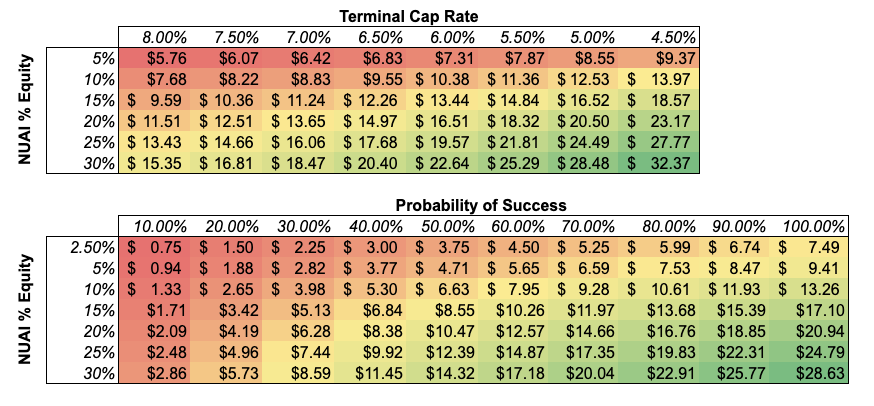
Reading comments today and it still seems many people don’t understand $NUAI ‘s midstream energy sector financial model, or how this is different than every other neocloud, or how it prevents dilution. Retail sees a 8+ GW pipeline, 1GW TCDC campus and incorrectly assumes there will be massive dilution, which is understandable considering the pattern across the sector to date. $NUAI is not running the same model as $NBIS, $IREN etc., who fund their builds through: convertible notes, ATM offerings and secondary equity raises. Yes, in those businesses every MW of new capacity means more shares or more corporate debt. Shareholders eat the dilution with the bet it will be accretive through time. That’s just how it works when you fund everything on the parent balance sheet. $NUAI is doing something different. They’re using the same GP/LP structure that built the entire midstream energy pipeline sector. Each project sits in its own SPV. $NUAI sits on top as the GP — the developer, owner, and manager. $NUAI develops the site and signs a hyperscaler to a long-term NNN lease. That contracted cash flow from a Microsoft/Meta/Oracle-tier credit is about the most bankable revenue stream in infrastructure right now. That lease is what attracts project-level financing — infra funds, project finance lenders, pensions line up to fund the build against that contract. The capital never touches NUAI’s balance sheet. No shares issued. It’s like a real estate developer. They don’t fund the building. They find the site, lock in the tenant, bring in capital partners, and earn dev fees, management fees, performance incentive (known as a “promote”) etc. Yes — $NUAI gives away more economics per project this way. The GP doesn’t keep 100%. They keep a minority. But do the math on a microcap trading at $ 300MM. Would you rather own 100% of a project you can barely finance, or earn fees and promotes across a multi-GW portfolio where someone else’s balance sheet funds the build? At this size, the platform value of being the GP across 8+ GW dwarfs trying to self-fund site after site and dilute yourself into the ground doing it. $NUAI already owns 438 acres at TCDC. That land goes into the SPV as their co-invest — LP returns on an asset at cost basis while collecting GP fees on the same project. And the whole thing is designed to repeat. If you read the presentation from last night and believe in the plan (I do), a standardized modular design means each new campus is faster and cheaper than the last. The market is currently pricing $NUAI like a dilution machine that needs to issue stock to survive. Also, realistically it is also still pricing in the idea that there is no tenant and the entire company is a scam. I’m very comfortable at this point that the market is mispricing $NUAI on both points. I added significantly this morning around $5. If you believe that every available MW will be consumed by AI, $NUAI is the least dilutive / most levered bet you can take on this thesis right now. You just have to get comfortable with the team, which I personally am, even more so knowing that Ted Warner has signed on to bring them across the finish line.
English
15
9
79
5.2K
𝐀𝐠𝐫𝐢𝐩𝐩𝐚 𝐈𝐧𝐯𝐞𝐬𝐭𝐦𝐞𝐧𝐭𝐬
Why I’m Not Invested in $NBIS First of all, let me make one thing clear: contrary to what you might think, I’m not an $NBIS bear. But then again, I’m not invested either… and for good reason. Nebius positions itself as a holistic cloud platform with superior software technology that caters to AI-native start-ups and enterprise clients. That in and of itself isn’t a problem, but it means they're directly competing against the largest hyperscalers in the world, who are also targeting that exact cohort with their own set of software solutions (Google Cloud, Microsoft, etc.). Nonetheless, if $NBIS can successfully differentiate itself with its core offerings, it could gain some pricing power, which is the company’s best shot at one day becoming profitable. The problem is, $NBIS is VERY far away from that… Looking at the last quarterly filing, the company’s gross expenses + depreciation equaled ~110% of its revenues. In other words, these two cost categories exceeded the value of the underlying revenues ($249.2m vs. revenue of $227.7m). To be fair, last quarter Nebius still used a 4 year depreciation schedule on GPUs, which is rather short and overstates depreciation. Adjusting for a 5 year depreciation schedule (industry standard) leads us to $144.6m of depreciation. Then, adding gross expenses of $68.5m on top gets you to $213.1m, which equals 93.5% of revenues. And keep in mind, this figure does NOT include the hundreds of millions in costs spent on SG&A, R&D, and financing (interest). So what’s my point with this? The problem is, these are STRUCTURAL costs, the kind that scale with revenue, meaning you can’t easily grow out of them through sheer scale. My point is that $NBIS' pricing power is nowhere to be seen, at least not relative to its costs. Now, most $NBIS investors would probably argue that we are still "early" and that pricing power will show up eventually. My problem with that argument is that the company seems to be allocating a very large chunk of its pipeline towards servicing hyperscalers through bare metal offerings, the kind of “bulk” service that does NOT command significant pricing power. That means, fundamentally speaking, $NBIS is likely very far away from actually becoming profitable. And while right now everyone is focused on headline figures like ARR, the market’s patience will run out eventually... it ALWAYS does for every company. One day, the market will demand to see real profits flow down to the bottom line, and I’m not sure if $NBIS is structurally positioned to deliver on that any time soon. To make matters worse, investors can’t even model out the economics of these large hyperscaler deals, because management provides absolutely 0 information on anything except headline figures. We don’t even know the CapEx associated with these deals, or at the very least, the number of GPUs they have to purchase to fulfill their end of the bargain. Contrast that with a company like $IREN, which gives you all the necessary information to build an entire P&L and cash flow model over the full course of the contract length, which is exactly what I’ve done extensively for our subscribers on Substack. I have a VERY good idea of how much actual post-tax net income $IREN is making in every year of their hyperscaler contract. There are other reasons that further point in the same direction, but I won’t get into them right now. If they fix their cost structure one day, I’m happy to reconsider my stance. But as of today, their “black box” approach to publishing details on their largest deals makes them uninvestable for me.
𝐀𝐠𝐫𝐢𝐩𝐩𝐚 𝐈𝐧𝐯𝐞𝐬𝐭𝐦𝐞𝐧𝐭𝐬 tweet media
English
146
62
706
215.2K
Dulce
Dulce@litigious_dulce·
$NUAI is down after its investor presentation. I’m not particularly surprised given that no definitive deal was announced. However, the management team described the long-term vision for the company, which I believe is essential for properly understanding the bull thesis. I warn you in advance: the following post is long. And yes, I used Claude to help me research and write it. Executive Summary AI infrastructure demand is compounding faster than the industry can finance it. The binding constraint is not technology—it is capital structure and site access. Most developers are balance-sheet constrained, limiting how much they can build and how fast. NUAI is purpose-built to break through both constraints simultaneously. This document presents the investment narrative across six themes that matter most to investors: why behind-the-meter power is valuable, how NUAI’s GP/LP platform solves the dilution problem, where revenue comes from, how strategic partnerships de-risk execution and accelerate delivery, what makes NUAI’s modular data center product valuable, and why this team is uniquely positioned to win. The main takeaway is obvious: NUAI is not a single-asset data center developer. It is a scalable platform—one that pairs proprietary site access with an unconstrained capital model to meet hyperscaler demand at a pace and scale that no other publicly traded company can replicate. NUAI’s business model enables it to build faster, scale more, and dilute less. 1. Why Behind-the-Meter Power Is Valuable The single most important input to AI infrastructure is power. Electrons are electrons—but the ability to deliver reliable, large-scale power to a data center site within a commercially viable timeline separates viable projects from stranded ambitions. Behind-the-meter power is the key to unlocking that delivery. The Grid Is Not the Answer at Scale Front-of-meter, grid-connected power is genuinely scarce and growing more so. ERCOT is heavily congested, interconnection queues are lengthening, and new regulatory burdens are making grid-connected capacity increasingly difficult and time-consuming to secure. For a hyperscaler that needs power in twelve to twenty-four months, the grid simply cannot deliver at the scale required. Behind-the-meter sites change the equation entirely. One-gigawatt, two-gigawatt, even multi-gigawatt behind-the-meter sites exist—and while they are not easy to find or develop, they are categorically more available than equivalent grid-connected capacity. This is the most abundant category of viable AI compute sites, and it is the category that balance-sheet-constrained, grid-only developers cannot access. Unlocking Hyperscaler Portfolios Hyperscalers need scalability. As their demand for compute grows exponentially, they require larger and larger sites with reliable, long-duration power. Grid-connected sites cannot satisfy that trajectory. Behind-the-meter access opens the aperture: it allows NUAI to offer sites at a scale and speed that directly addresses the hyperscaler’s most pressing bottleneck. This is not a marginal advantage. It structurally expands NUAI’s total addressable pipeline and, by extension, the total addressable pipeline available to its customers. Why It Is So Hard Making a behind-the-meter site as reliable and commercially viable as a front-of-meter site requires deep engineering, significant capital, and commercial sophistication that the vast majority of developers simply do not possess. This skill set typically requires decades of directly relevant experience—experience in power systems, site development, regulatory navigation, and infrastructure engineering simultaneously. It is not a capability that can be acquired quickly or replicated easily. NUAI is, to my knowledge, the only publicly traded company that has made behind-the-meter development its core competency and foundational business model. That distinction matters: it means every dollar of enterprise value is built on a capability that most competitors cannot match. 2. The GP/LP Platform: Solving the Dilution Problem The question investors ask most frequently—after “when is the first deal?”—is how a micro-cap company can finance ten billion dollars or more in data center capital expenditure without diluting shareholders by a commensurate amount. The answer is structural, and it is the single most important design feature of the NUAI platform. The Midstream Analogy For investors familiar with midstream energy, the model will be immediately recognizable. Midstream operators do not fund every pipeline and processing facility from their own balance sheet. They raise project-level capital through limited partnerships, retain GP-level economics, and earn returns that are levered relative to their equity contribution. NUAI applies the same architecture to AI infrastructure. NUAI operates as the General Partner across a portfolio of data center projects. Limited Partners contribute the majority of project equity, while NUAI retains disproportionate economic upside through GP-level carried interest, management fees, and operational economics. This generates levered returns at the GP level—creating enough economic surplus to share with capital partners while preserving meaningful upside for NUAI shareholders. Why This Solves Dilution In a traditional developer model, every new project requires the parent company to raise equity or debt, expanding the balance sheet and diluting existing shareholders in rough proportion to the capital deployed. The GP/LP model breaks that link. Capital grows to match opportunity, rather than the other way around. The parent balance sheet is no longer the bottleneck; LP capital does the heavy lifting, and NUAI shareholders capture returns that are levered to the total capital deployed across the platform. How NUAI Generates Revenue The GP/LP structure creates multiple, distinct revenue streams: GP Carried Interest. NUAI earns a promoted share of profits above LP return hurdles. As each project generates distributable cash flow, the GP’s share is disproportionately large relative to its equity contribution. Management and Development Fees. NUAI charges fees for sourcing, developing, constructing, and managing each project. These provide recurring, predictable revenue from the earliest stages of development. Operational Economics. Ongoing revenue from power procurement, site operations, and infrastructure management flows to NUAI as the operating partner. Land Contributions as Equity. Critically, NUAI can (for theoretically each project) contribute land—rather than cash—as its GP equity stake. This is a powerful lever: land that NUAI acquired for ten to twenty million dollars may be appraised at one hundred fifty million dollars or more at the time of contribution. The result is a dramatically amplified equity position with minimal cash outlay, further reducing the dilution required to fund each project. Taken together, these streams mean that NUAI earns revenue at every stage of the project lifecycle—from sourcing through stabilized operations—while deploying far less cash equity than a traditional developer. The Compounding Flywheel The GP/LP model and behind-the-meter access are not independent advantages. They reinforce each other in a compounding cycle. More viable sites feed the GP/LP model by giving NUAI a continuous pipeline of investable projects. The GP/LP model, in turn, provides the capital to develop those sites without balance-sheet constraints. The result is a pipeline that is not capped by balance-sheet capacity or site scarcity—the two constraints that limit every other player in the space. NUAI’s valuation ceiling is therefore not determined by what the parent company can finance on its own. It is determined by the size of the opportunity itself—which, given behind-the-meter access and an unconstrained capital model, is very large. 3. Strategic Partnerships: De-Risking Execution at Scale A platform model is only as credible as its ability to execute. NUAI has assembled an ecosystem of strategic partners that collectively address every major execution risk in large-scale data center development—from design through commissioning. Why Vertical Integration Cannot Win This Race The scale and speed required to meet hyperscaler demand make full vertical integration impractical. A single company attempting to maintain in-house competency across the entire value chain—site development, power engineering, data center design, modular manufacturing, construction, and operations—will inevitably hit capacity ceilings and talent bottlenecks. The industry is moving too fast and the labor market is too constrained. NUAI’s approach is fundamentally different: best-in-class partners at every stage of the value chain, each contributing deep domain expertise and dedicated production capacity. Ramboll: World-Class Data Center Design Ramboll is a leading data center design firm that brings exceptional engineering talent and a track record of designing high-performance, modern facilities. By partnering with Ramboll, NUAI offloads design risk to a team whose sole focus is creating data centers that meet the exacting standards of hyperscale customers—while compressing the design-review cycle that has historically been one of the longest lead-time items in data center development. RK Mission Critical: Production Capacity at Scale NUAI has partnered with a world-class modular data center manufacturer capable of completing approximately eighty percent of assembly within controlled factory environments. This dramatically reduces on-site construction time, mitigates labor shortage risk, and creates a repeatable production line that can scale output in step with demand. The implications are significant. On-site work is minimized to final integration and commissioning. Supply chain visibility improves because long-lead items can be procured on manufacturing timelines rather than construction timelines. Quality control is tighter in a factory setting. And the model is inherently scalable—additional production lines can be brought online as the pipeline grows. The Ecosystem Effect Many of the hardest problems in data center development—labor shortages, long-lead equipment procurement, supply chain fragility, design iteration cycles—are difficult or impossible for a single entity to overcome alone. Through strategic partnerships, NUAI converts these industry-wide headwinds into manageable workstreams. Each partner contributes specialized capacity; NUAI orchestrates the platform. Importantly, this ecosystem is made possible by the GP/LP model. If there is no margin to share, there is no basis for partnership. The GP/LP structure creates the economic surplus that attracts and retains world-class partners—each of whom benefits from the platform’s scale and the predictability of a repeatable project pipeline. Outsider Returns and Partnership Quality The quality of NUAI’s partnerships is itself a signal of the platform’s strength. Partners do not commit engineering resources, production capacity, and reputational capital to projects that lack economic merit or execution credibility. The willingness of partners of this caliber to align with NUAI reflects their independent assessment of the opportunity and the team’s ability to deliver. 4. The Modular Data Center Product While short-term investor attention naturally gravitates toward the first transaction (TCDC), the long-term value of the platform depends on the ability to replicate that transaction efficiently across a growing pipeline. The modular data center product is the mechanism by which NUAI converts a single project into a standardized, repeatable framework. Why Standardization Matters Hyperscalers are increasingly moving away from bespoke, one-off data center designs. They want a product that is proven, predictable, and deployable at speed—something closer to an off-the-shelf solution than a custom-engineered facility. This preference is driven by hard operational reality: bespoke designs introduce risk at every stage, from procurement through commissioning, and they are inherently difficult to scale. NUAI’s modular product directly addresses this demand. It establishes a blueprint—a standardized template—that can be executed repeatedly with high fidelity and minimal variation. Each deployment refines the template, compresses the timeline, and reduces the cost basis. For prospective customers evaluating NUAI, this means lower execution risk, faster time-to-power, and a track record that compounds with every project delivered. State-of-the-Art Design The modular data center product is designed in partnership with Ramboll and built to the highest contemporary standards by RK Mission Critical. Key attributes include: Modern, High-Density Architecture. Engineered for the power densities and cooling requirements of current and next-generation AI compute workloads. Factory-Built Precision. Approximately eighty percent of assembly occurs in controlled factory environments, yielding tighter tolerances, better quality control, and significantly less on-site labor. Compressed Design-Review Cycle. Because the product is standardized, the design-review cycle—historically one of the most time-consuming phases of data center development—is dramatically shortened. Subsequent deployments benefit from an already-approved template. Rapid Deployment. Minimal on-site construction requirements translate into faster commissioning timelines, which is the single most important variable for hyperscaler customers competing for AI compute capacity. Scalable Production. The manufacturing model supports parallel production of multiple modules, enabling NUAI to scale output in step with demand rather than waiting for sequential construction completions. The Product as Competitive Advantage For existing and prospective customers, NUAI’s modular product offers a proposition that few competitors can match: a proven, repeatable, high-performance data center that can be deployed at scale, behind the meter, with world-class design and manufacturing partners backing every unit. 5. Why NUAI: Moat, Team, and Track Record The natural question—if this opportunity is so large, why isn’t everyone doing it?—has a straightforward answer: this work is extraordinarily hard. There is a reason why a major hyperscaler, a premier design and infrastructure firm like Primary Digital Infrastructure, and a world-class execution partner are choosing to work with NUAI. Not everyone can do this. Proof of Concept: TCDC The Texas Critical Data Center site is the clearest evidence of NUAI’s differentiated capability. TCDC was originally a site that no one wanted to develop. Industry participants considered it impossible to build on—the site required relocating pipelines, addressing legacy wells, and solving a complex web of engineering and regulatory challenges before a single data center module could be placed. Through significant effort and deep domain expertise, NUAI converted TCDC into a viable, multi-gigawatt development site. This is not a trivial accomplishment, and it cannot be glossed over. The ability to take a site that the market had rejected and transform it into one of the most compelling behind-the-meter opportunities in the country is the most tangible demonstration of NUAI’s moat. The Leadership Team NUAI’s leadership combines capabilities that are, to our knowledge, extremely rare and relevant in this industry. Charlie’s Midstream Deal-Making Expertise. A proven track record of brokering and structuring billions of dollars in midstream transactions. This experience is directly transferable to the GP/LP data center model—the same capital structures, the same partnership dynamics, the same levered economics. Charlie brings the institutional knowledge to design and execute these structures at scale. Ted Warner’s Capital Markets Leadership. The soon-to-be-announced CFO brings significant experience raising billions of dollars specifically within the data center sector. This dedicated capital-raising capability—combined with a strong personal track record—positions NUAI to execute the LP fundraising strategy with credibility and speed. Will’s Permian Basin Expertise. Extensive experience as a landman in the Permian Basin, providing the on-the-ground knowledge, landowner relationships, and site-development intuition that are essential to sourcing and securing behind-the-meter opportunities. This is not a skill that can be hired overnight; it is the product of years of direct, on-the-ground work. Taken together, this leadership team spans the three critical dimensions of the business: capital structure and deal-making, institutional capital raising, and physical site origination. Each capability is necessary; together they form a combination that no competitor has assembled. 6. The Platform Thesis NUAI is not a single-deal story. It is a platform designed to compound. Behind-the-meter expertise unlocks the most abundant and scalable category of AI compute sites—sites that the vast majority of developers cannot access. The GP/LP model provides the capital to develop those sites without the parent balance sheet becoming the constraint. Strategic partnerships de-risk execution and enable the speed and scale that hyperscalers demand. A standardized, modular data center product ensures that each project is repeatable, cost-efficient, and fast. And a leadership team with decades of directly relevant experience across deal-making, capital raising, and site origination ties it all together. These advantages are not additive. They are multiplicative. Each one enables and amplifies the others, creating a compounding flywheel that widens NUAI’s competitive advantage with every project delivered. The conclusion is structural: NUAI’s valuation ceiling is not determined by what the parent company can finance. It is determined by the size of the AI infrastructure opportunity itself—which, given NUAI’s behind-the-meter access, unconstrained capital model, and execution ecosystem, is very large indeed.
English
21
18
133
16.6K
Nick Tennant
Nick Tennant@tennant_n·
@JoshInvestsAI @litigious_dulce After the earnings call, I am considering reducing my position in HUT8, which I have held from 2024. I am building positions in a few new companies. I need to do deeper DD on NUAI. Besides the earnings call what else did you dive into?
English
1
0
0
154
Compute Capital
Compute Capital@JoshInvestsAI·
@tennant_n @litigious_dulce I really think you should consider taking a position. I spent the last couple days extensively going over the company and I believe the R/R is too good to pass up on.
English
2
0
1
81
Nick Tennant
Nick Tennant@tennant_n·
@litigious_dulce Dulce, thanks for this. Some really smart people including yourself are quite bullish. I had previously passed on entering a position, but I am going to listen to the call to get an updated feel.
English
1
0
4
540
Compute Capital retweetledi
𝐀𝐠𝐫𝐢𝐩𝐩𝐚 𝐈𝐧𝐯𝐞𝐬𝐭𝐦𝐞𝐧𝐭𝐬
New $IREN Deep Dive: Childress Unlocked I’ve spent the last couple of weeks writing the most important $IREN deep dive I’ve published to date. Air-cooling at Childress is a MUCH bigger deal than the vast majority of investors and analysts realize. Honestly, $IREN price targets across the board should be well above $100 at this point. But Wall Street missing the forest for the trees is nothing new. I’ve extensively modelled out the company’s near-term pipeline using conservative assumptions (below management’s guidance), and it’s clear as day that the market isn’t properly pricing in $IREN's industry-leading earnings power. $IREN is going to make BILLIONS of actual net income over the coming years… not just meaningless EBITDA or top-line figures, but real profits flowing to the bottom line. If anyone is the next hyperscaler, it’s $IREN. Remember, real hyperscalers are actually profitable… At the same time, every investor should be aware of looming industry risks that affect all neo-clouds in the sector and evaluate how they could impact the investment thesis. That’s exactly what I’ve done for all our readers. These are the topics this new report covers: ➞ Breaking down the new GPU orders + new guidance ➞ Implications of air-cooling ➞ Extensive pipeline modelling ➞ Comprehensive analysis of the new $6b ATM ➞ Risks to the investment thesis ➞ + Plenty of bonus topics This 40+ page mega deep dive covers everything $IREN investors should be aware of today. It’s written in a very reader-friendly way, with many graphics & embedded video clips throughout. I chuckle when I read so-called “analysts” on X give their takes on $IREN after doing nothing more than surface-level analysis (at best). Most investors have no idea where this is heading… If you’ve read the new deep dive, I’d love to hear your feedback in the comments. Appreciate all of you, cheers! ✌️ agrippa.investments/p/iren-childre…
English
78
124
959
312.9K
Compute Capital
Compute Capital@JoshInvestsAI·
@Billions777888 Not everything’s about a deal. Revenues will really start to show from AI 2H this year from BC and H1-4. I can’t see a world where the company meets their 3.7B ARR guide EOY and is trading at 12B MCap. A juicy SW deal will only accelerate that.
English
0
0
1
22
Compute Capital
Compute Capital@JoshInvestsAI·
I don’t usually post $NUAI but I just increased my sizing significantly recently. Something huge is brewing. 👀
Dulce@litigious_dulce

$NUAI recently appointed Ted Warner as CFO. (newerainfra.ai/news/new-era-e…) Warner was previously Managing Director and Head of Energy & Power Infrastructure at Northland Capital Markets — the investment bank behind many of the largest financings in the digital infrastructure space. This is a significant hire worth understanding in detail. Warner's track record in data center financing is unusually deep. According to Northland’s own materials, his group originated and executed nearly $7 billion in lead managed financings since he rejoined the firm in 2020, with a heavy focus on digital infrastructure and HPC data center development across the capital stack. The best way to understand what Warner does is to look at his work with Applied Digital ($APLD) — arguably the clearest case study of a single banker helping transform a small-cap power and mining company into a legitimate institutional-grade AI data center platform. When Applied Digital needed $50M in April 2024 to advance its HPC data center in Ellendale, North Dakota, Northland served as sole placement agent on a convertible debenture. (globenewswire.com/news-release/2…) Four months later in August 2024, Northland placed another $53.2M in convertible preferred stock to keep the Ellendale buildout on track. (globenewswire.com/news-release/2…) Then came the deal that changed the company’s trajectory entirely. In January 2025, Northland served as sole placement agent on a $5 billion perpetual preferred equity financing facility with Macquarie Asset Management — one of the world’s largest infrastructure investors managing approximately $634 billion in assets. The deal provided up to $900M for the Ellendale HPC campus and gave Macquarie a right to invest up to an additional $4.1 billion across Applied Digital's future HPC pipeline, supporting over 2 GW of data center development. Goldman Sachs served as senior financial advisor. Citizens JMP, TD Securities, and Needham also provided advisory services. But Northland — Warner's team — was the sole placement agent. (globenewswire.com/news-release/2…) That deal essentially took Applied Digital from a company scrambling to fund a single campus to one with multi-billion-dollar institutional backing to build a national HPC data center platform. The structure — perpetual preferred equity with a 12.75% dividend, 15% common equity interest, and a 1.80x liquidation preference — allowed APLD to retain 85% ownership of its HPC business while recovering over $300M of its existing equity investment. (macquarie.com/us/en/about/ne…) Warner's group didn't stop there. In April 2025, Northland placed a $150M convertible preferred equity facility for continued Ellendale campus development. (globenewswire.com/news-release/2…) By late 2025, they were drawing an additional $787.5M from the Macquarie facility to fund both Polaris Forge 1 in Ellendale and the new Polaris Forge 2 campus in Harwood, North Dakota. (constructionreviewonline.com/applied-digita…) In December 2025, Northland placed yet another facility — a development loan from Macquarie to fund pre-lease development costs for new AI factory campuses, with an initial $100M in draws while Applied Digital negotiated with another investment-grade hyperscaler for multiple additional sites. (ir.applieddigital.com/news-events/pr…) From a $50M convertible to a $5B institutional partnership to a multi-campus national buildout — all with the same placement agent quarterbacking the capital formation. That's the Applied Digital story, and Warner was at the center of it. His group’s reach extended well beyond APLD: Riot Platforms ($RIOT) — In February 2025, Riot announced it had engaged Evercore as financial advisor and Northland Capital Markets to support the evaluation of AI/HPC uses for its Corsicana Facility power assets in Texas. (sec.gov/Archives/edgar…) Bitfarms ($BITF) — Northland acted as sole placement agent on Bitfarms’ conversion of its Macquarie debt facility to $300M in project-specific financing for the Panther Creek 350 MW HPC/AI campus in Pennsylvania. (globenewswire.com/news-release/2…) Bitdeer ($BTDR) — In its March 2025 production update, Bitdeer disclosed it had formalized an engagement with Northland Capital Markets as financial advisor for its HPC/AI data center development strategy. (sec.gov/Archives/edgar…) TeraWulf ($WULF) — Warner personally signed the amendment adding Northland as an agent under TeraWulf’s sales agreement in August 2023, positioning the firm on TeraWulf’s capital markets platform. (sec.gov/Archives/edgar…) Super Micro Computer ($SMCI) — Northland served as co-manager on Supermicro’s follow-on offering of common stock in late 2023, alongside J.P. Morgan, BofA Securities, and Goldman Sachs. (northlandsecurities.com/ncm-co-manager…) Prior to this run, Warner spent 8 years as a founding member of Northland’s energy banking practice, participating in 150+ transactions totaling over $10 billion. He also served as CFO of Fountain Quail Energy Services, a PE-backed oilfield services company. (northlandsecurities.com/team_member/te…) For context on where $NUAI stands today: the company, formerly New Era Helium, pivoted to AI and digital infrastructure in August 2025. Its flagship project is the Texas Critical Data Centers (TCDC), a campus in Ector County, Texas, planned to scale to over 1 gigawatt of capacity on a 490+ acre site. The parallel to Applied Digital’s starting position is hard to ignore. As recently as 2024, APLD was a small-cap company with power assets, a data center thesis, and a need for institutional capital to scale. Warner’s group provided the financing pathway that took them from that starting point to a $5B Macquarie partnership and a multi-gigawatt development pipeline. NUAI today has power assets from its legacy as an energy company, a massive data center project, and a similar need to access institutional-scale capital to fund the next phase. Thus, it’s meaningful that Ted Warner, the banker who had a seat at nearly every significant transaction in the power-to-compute pipeline, is now the CFO of NUAI. Warner had broad visibility into deal flow across the digital infrastructure landscape — he saw the pitches, the power positions, the hyperscaler LOIs. He had a strong sense of which projects were real and which weren't. With all of that context, he chose NUAI. That decision is informative for a few reasons. First, it suggests he sees a valuation disconnect. Warner knows what these assets trade for. If NUAI were fairly priced, there would be less incentive to leave banking for an operating role. His move implies he sees a gap between where NUAI trades and where its assets sit — and he's willing to stake his career on that gap closing. That carries more weight than a price target. Second, it raises the probability of a hyperscaler partnership. Warner has seen these deals from the inside. He understands what a company needs to look like before a hyperscaler signs. If he didn't believe NUAI was credibly on that path, the move would carry significant career risk. The timing and NUAI's current trajectory are consistent with the kind of catalyst convergence that has driven other companies in the space — like APLD's Macquarie partnership — from relative obscurity to institutional relevance. Third, it reflects confidence in the team. Warner has worked with dozens of management teams in this sector. Joining one full-time, with your compensation and reputation attached, is a stronger endorsement than any external rating. From a credibility standpoint, Warner brings roughly two decades of experience structuring the exact type of financings NUAI will need to execute — along with institutional lender relationships, infrastructure fund access, and sell-side credibility that would be difficult to replicate. Finally, we should consider the compensation structure. NUAI compensates its C-suite through stock options and RSUs with multi-year vesting, and Warner is under the same framework. That makes him not just an executive but a co-investor — dilution hurts him, poor execution hurts him, and every capital structure decision he makes is informed by his own exposure to the outcome. None of this guarantees a specific result, but when someone who financed many of the sector's winners decides to join an operating company, the signal is worth weighing seriously.

English
4
2
61
6.6K