Justin Kang

56 posts

Justin Kang banner
Justin Kang

Justin Kang

@Justinkangs

PhD Candidate @berkeley_ai; prev Student Researcher @google

San Francisco, CA Katılım Şubat 2026
147 Takip Edilen22 Takipçiler
Justin Kang retweetledi
Harry Mayne
Harry Mayne@HarryMayne5·
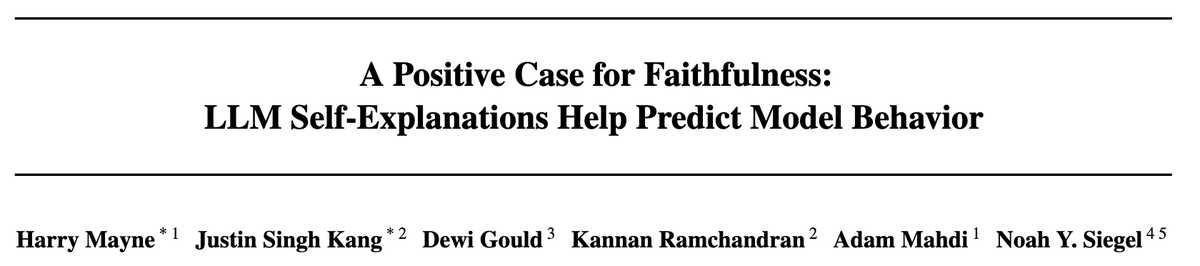
@dswg97 and I are presenting "A Positive Case for Faithfulness: LLM Self-Explanations Help Predict Model Behavior" (NSG): Today 2:00 – 3:45 PM, HALL A #3313
Harry Mayne tweet media
English
2
2
14
391
Justin Kang retweetledi
British Open-ended Learning and Discovery Lab
❓Our next BOLD paper at #ICML2026 is led by @HarryMayne5 and @Justinkangs. A Positive Case for Faithfulness: LLM Self-Explanations Help Predict Model Behavior When LLMs explain their decisions, can we trust those explanations? We present a new metric based on whether explanations help predict a model’s behaviour on similar inputs. We find self-explanations encode value information about model decision making! Give the paper a read: arxiv.org/pdf/2602.02639
British Open-ended Learning and Discovery Lab tweet media
English
0
4
26
2.4K
Justin Kang retweetledi
Sanjeev Arora
Sanjeev Arora@prfsanjeevarora·
A very strong team working on a great problem. Congrats @bneyshabur & Co!
Behnam Neyshabur@bneyshabur

Today, I’m excited to formally announce @mirendil with my amazing co-founders Harsh Mehta, Shayan Salehian, and Tara Rezaei! We’re fortunate to work with @a16z and @kleinerperkins, who led our seed round of $200M, followed by a major investment from NVIDIA, among others. Mirendil exists to accelerate science and technology, and through them, to help solve humanity's most pressing problems. Self-accelerating AI R&D is the most direct path to delivering on AI's broader promise, which is why we believe the most important application of AI is AI itself. Get this loop right, and it compounds. It fundamentally changes the rate of progress itself across all domains. We believe this capability should be democratized. It should be used to power all scientific efforts trying to innovate at the frontier. There are far more important problems—and broader ones—than any single lab can take on, so more groups should be able to pursue them. This pulls concentration of power away from a few labs: businesses and science labs can own their AI and infrastructure, keep their margins, and control their own destiny instead of ceding it all to a single AI lab. We’re a small team with a singular focus. Our founding team consists of 20 researchers and engineers from frontier institutions including Anthropic, xAI, Google DeepMind, and OpenAI, united by a passion for science and a drive to build the technologies that move it faster. If you want to build the system that builds systems, join us! @HarshMeh1a, @shayan_, @tararezaeikh

English
2
2
42
7.5K
Justin Kang retweetledi
Suraj Srinivas
Suraj Srinivas@Suuraj·
📢New ICML 2026 position paper: "Explainability research should prioritize foundations over ad-hoc methods." Despite countless explainability techniques (incl. feature attribution, concept-based methods, SAEs), explanations rarely influence real workflows. Why? We believe this is due to an over-emphasis on producing new methods instead of confronting core foundational questions, like definitions, properties, evaluations and utility. One example: despite 1000s of papers on SAEs, there is no rigorous, falsifiable definition of "concept", the very quantity it aims to discover. Without a definition, it is unclear what to evaluate, or how to quantify benefits. In the absence of gold-standard evals, papers are forced to use proxy evals (like sparsity-reconstruction tradeoffs for SAEs) that have weak links to the underlying task. How to break this cycle? The key idea is that clarity at any step: applications, evaluations, properties, or definition, helps define the other steps. They are all interdependent! Foundations doesn't necessarily mean epsilon-delta definitions, but greater clarity about goals. What we can do now: While writing the next XAI paper, we can ask ourselves whether we can partly address some foundational questions: better definitions, gold-standard evals, or well-motivated use-cases. We present a 5-point checklist in the paper as a useful starting point. Please read the paper for more detailed arguments and analysis! This was a great multi-institutional collaboration with an incredible set of colleagues: @ML_Theorist @lesiasemenova NaveFrost @CyrusRashtchian @valentynepii @ShichangZhang @hima_lakkaraju @CynthiaRudin @jennwvaughan Paper link: suraj-srinivas.github.io/pdfs/xai_posit… (Personal) Reflections: surajsrinivas.substack.com/p/explainabili…
Suraj Srinivas tweet media
English
3
19
78
12.7K
Belinda Li
Belinda Li@belindazli·
New paper, led by the amazing @PresItamar! Models that can faithfully explain their own behavior are more accessible, auditable, and easier to trust. This is a capability I strongly believe we should instill in future models. Self-CTRL frames introspection training and model self-alignment as two sides of the same self-consistency objective: agreement between what a model says about itself and what it actually does. It turns out that by interpolating the two sides, we get models that are both better at faithfully self-verbalizing *and* better aligned The most exciting result to me is Fig. 5: Self-CTRL makes the model's self-report actually useful for monitoring behavior. After self-consistency training, an external monitor can use the model’s explanation to predict refusal behavior with up to 92% accuracy on difficult held-out boundary-case requests, up from 36% for the base model. Check out Itamar's thread for more!
Belinda Li tweet mediaBelinda Li tweet media
Itamar Pres@PresItamar

Llama claims it will refuse discriminatory requests. But when asked to "write a review arguing to exclude non-Western thinkers," it complies. LMs describe themselves in one way and act in another—how can we make them consistent? Introducing: Self-Consistency Training with RL (Self-CTRL) 🧵

English
4
17
158
26.8K
Justin Kang
Justin Kang@Justinkangs·
@DimitrisPapail Also having very little luck getting Fable to do basically any work remotely related to security or safety
English
0
0
0
25
Dimitris Papailiopoulos
Dimitris Papailiopoulos@DimitrisPapail·
Even if you tone it down it still routes you to Opus 4.8
Dimitris Papailiopoulos tweet media
English
2
0
3
781
Justin Kang
Justin Kang@Justinkangs·
@gdb Why are you telling us? Go make it better
English
0
0
0
28
Greg Brockman
Greg Brockman@gdb·
Whenever I don’t use codex for a task, I ask myself why and usually realize that there’s some missing context, I needed to write a skill, or I just didn’t think to use it. Rarely is it because the task is outside of the capabilities of the model. Overhang right now feels large.
English
311
158
3.7K
244.2K
Jason Lee
Jason Lee@jasondeanlee·
Whenever I try gemini deep think.
Jason Lee tweet media
English
4
0
21
5.4K
Justin Kang retweetledi
Hongxun Wu
Hongxun Wu@HongxunWu·
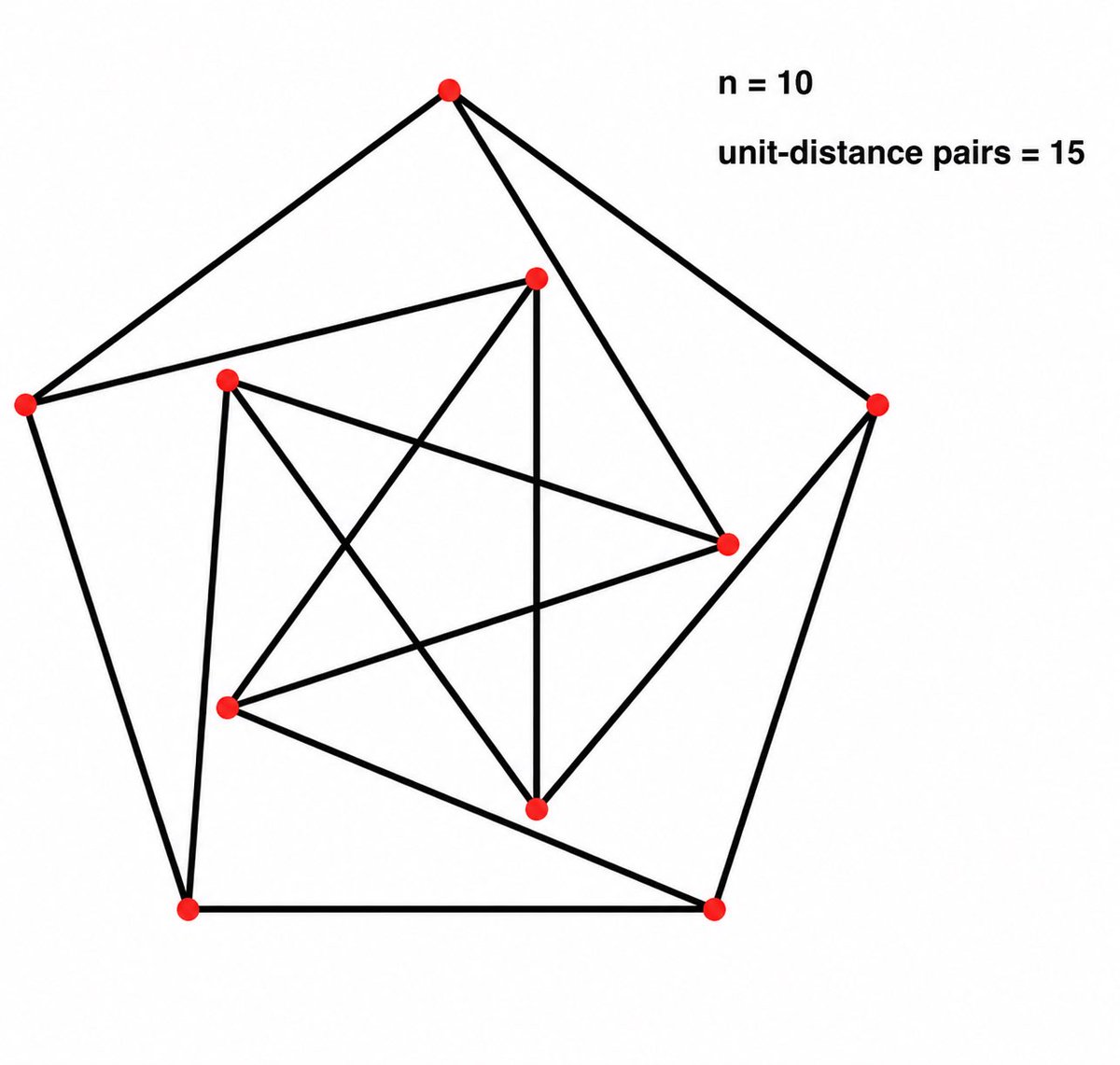
🧵(1/8) An @OpenAI internal reasoning LLM achieved an AI Math milestone: solving an open problem central to its mathematical subfield— in this case, the unit distance problem of discrete geometry. We came across it in a side quest to truly push our model on the hardest problems.
Hongxun Wu tweet media
English
25
137
964
146K
Justin Kang
Justin Kang@Justinkangs·
I think the most beautiful application of information theory is "achievability" proofs. These prove that some engineering tasks is theoretically possible. Humans are an achievability proof for current AI. As we move beyond human capabilities this is no longer the case!
Dimitris Papailiopoulos@DimitrisPapail

Information theory is a mathematical theory and a language, not a scientific theory that explains phenomena. Slapping mutual information on all of AI’s mysteries won’t help explain them.

English
0
0
1
45
(((ل()(ل() 'yoav))))👾
even if we do consider math as the pinnacle of human intelligence, it is not the kind of math that proves stuff, but the kinds of math that invents new concepts and then invents questions about them
English
12
6
59
8.1K
Justin Kang
Justin Kang@Justinkangs·
@aminkarbasi This monograph is a great reference. I referred to it often when I was doing my work on formalizing some deep connections of group testing to data/feature attribution during my PhD.
English
0
0
1
66