

LayerVAI
15 posts
LayerVAI
@LayerVai
Invisible By Design. Secure By Default.
Katılım Ekim 2025
26 Takip Edilen240 Takipçiler
@FBICyberDiv LayerV makes OT/PLC infrastructure invisible by default (OpenNHP/QURL). No discoverable attack surface until authenticated -- directly blocks the scanning & targeting described here. Details: layerv.ai
FBI Cyber Division@FBICyberDiv
Iran-affiliated cyber actors are targeting operational technology devices across US critical infrastructure, including programmable logic controllers (PLCs). These attacks have led to diminished PLC functionality, manipulation of display data and, in some cases, operational disruption and financial loss. The @FBI, @CISAGov, @NSAgov, @EPA, @ENERGY and @US_CYBERCOM are urging US organizations—especially municipalities and those in the water and energy sectors—to review the tactics, techniques, and procedures (TTPs) and indicators of compromise (IOCs) detailed in this advisory. Applying the recommended mitigations will reduce the risk of compromise: ic3.gov/CSA/2026/26040…
English
The @WhiteHouse just made initial access denial national cybersecurity policy.
We've been building this for two years.
Our CEO @ReelLifeJustin breaks down what matters and what doesn't.
layerv.ai/blog/white-hou…
English
🚨 BREAKING: Sophisticated hackers just got BUSTED hiding command & control servers INSIDE innocent-looking CS essays on Pastebin using STEGANOGRAPHY! 😲 They snuck it into 26 fake npm packages mimicking big names like Express & Lodash to steal dev creds.
Shoutout to @feross & @SocketSecurity for spotting this in MINUTES! But in the AI era, detection isn't enough -- prevention is key.
At LayerV, we make your infrastructure INVISIBLE to attackers before they even scan. You can't hack what you can't see! 👻🔒
Dev community, time to level up your security game. Check out how we cloak your assets: layerv.ai
Feross@feross
You don’t see this every day: attackers hiding C2 infrastructure inside computer science essays on Pastebin using character-level steganography, then wiring it into 26 typosquatted npm packages impersonating some of the ecosystem’s most widely-used libraries. Socket detected the cluster within minutes of publication, uncovering a disciplined, multi-stage operation linked to the Contagious Interview campaign that delivers a full infostealer and RAT stack built to harvest developer credentials. socket.dev/blog/stegabin-…
English
Great question, and the distinction is important -- LayerV doesn't absorb attacks. It eliminates the attack surface entirely.
Think of it this way: traditional security puts a guard in front of a visible building. Attackers can still see the building, probe it, and try to get past the guard. LayerV makes the building invisible. There's nothing to attack -- no ports to scan, no services to fingerprint, no infrastructure to target. From an attacker's perspective, it simply doesn't exist.
When a legitimate user needs access, they go through our "authenticate before connect" process -- which is your "special knock" analogy. Their identity and device posture are cryptographically verified before any network connection is established. Only after that verification does the infrastructure become visible and accessible to that specific user, for that specific session. Everyone else still sees nothing.
So the key shift is from defending visible infrastructure to making infrastructure invisible by default. You can't attack what you can't see.
English

@LayerVai So does LayerV absorb all the attacks and protects the resource? Once a customer comes by with the special knock are they allowed a secure connection to the resource?
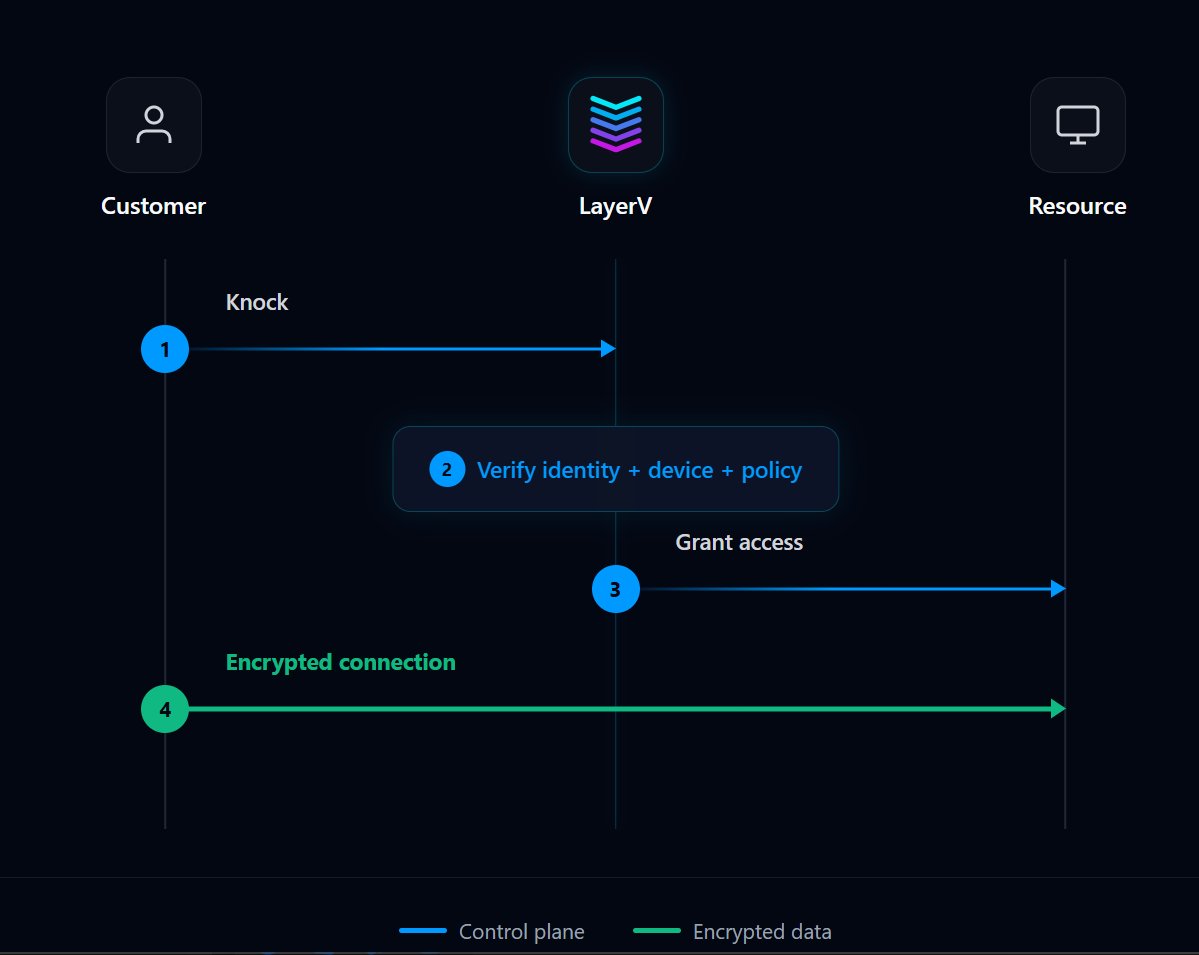
English
The security industry built a trillion-dollar stack around one assumption nobody questions:
It's fine for attackers to see your infrastructure. We'll deal with them after.
LayerV, built on NHP, kills that assumption at the root.
No authentication = no visibility. No visibility = no attack surface.
Full breakdown 👇
English
Clawdbot is the first viral stress-test of agentic security at the consumer layer -- and it's failing in public. Hundreds of exposed instances. Private keys extracted in five minutes via prompt injection. Google's VP of Security Engineering telling people point-blank: "Don't run Clawdbot."
But the real story isn't misconfigured proxies or leaked API keys. It's proof-of-concept for cognitive context theft: attackers don't need your password when they can read your AI's MEMORY.md and map your psychology, workflows, and trust graph.
Worse -- poison SOUL.md, inject false context, and you've turned someone's assistant into a persistent insider threat. This isn't credential theft. It's identity infrastructure compromise.
The root failure? These gateways were visible. Shodan indexed them in seconds. The "local-first = private" model assumes obscurity, but TCP/IP doesn't hide anything by default.
The fix isn't better configs -- it's architectural. Agent infrastructure needs to be invisible until authenticated. That's the premise behind standards like OpenNHP and implementations like LayerV.ai: default-deny at the network layer, not the application layer. You can't exploit what you can't find.
English
LayerVAI retweetledi

Today, @nodejs published a security release for Node.js that fixes a critical bug affecting virtually every production Node.js app.
If you use React Server Components, Next.js, or ANY APM tool (Datadog, New Relic, OpenTelemetry), your app could be vulnerable to DoS attacks.
👇
English
You can't attack what you can't see.
OpenNHP makes servers invisible. Port scans return nothing. You don't exist until you authenticate.
Just launched the Discord for people done stacking firewalls on a broken model.
discord.gg/CpyVmspx5x
English
@CodeGlitch0 @ReelLifeJustin For scale, gateways scale horizontally and can be deployed regionally for geo-redundancy. We designed it so you're not introducing new infrastructure that needs to be visible to work -- the HA layer itself stays dark.
English

The @LayerVai infrastructure looks pretty solid, but what happens when the authentication server / gateway needs a reboot? What does scalability/clustering look like? @ReelLifeJustin
English
@CodeGlitch0 @ReelLifeJustin The architecture is HA from the ground up -- no single points of failure. Gateways run in active clusters, so a reboot just means traffic routes to other nodes. Authenticated sessions persist cryptographically rather than depending on sticky connections to any single server.
English

@ChangeFatigued Everyone's building better locks (that's your IDP). We make the entire building disappear from the map until you've already proven you belong there.
Dark to scans. Silent to probes. No ports, no response, no proof of existence. Attackers can't recon what doesn't answer.
English

@LayerVai Curiouser and curiouser. I've been wondering: what metaphor would you utilize to describe this? Like an invisibility cloak over a system? A decreased surface area to score a goal? ...? Tech change mgmt transformations always start with a mic drop metaphor ✨
English