MLabs
1.5K posts

MLabs
@MLabs10
Blockchain and AI consultancy working across industries, including fintech and blockchain. 🙏 Support us in Project Catalyst 🔗 https://t.co/MjWDX8Q7bZ


SEND IN THE AUDITOOOOOOOORS to be very specific, a back of the envelope wishlist: 1. prior to intersect budget season kicking off, teams should voluntarily provide an update on ALL their treasury funded proposals (direct TW, thru catalyst, builder DAO, etc). You got money to do X, did you really do it? 2. Previous and current delivery history for ALL treasury funded proposals should be accounted for and communicated as an appendix to new budget proposals. You got money to do X in Y time. Did you successfully deliver X during or before Y time? This ecosystem is too comfortable with delayed implementation…we need expediency if we’re to be competitive. 3. the next budget cycle should fund an independent firm providing Monitoring, Evaluation, Accountability and Learning function. Standard in any publicly funded programme. What is MEAL? Track progress, assess impact in the context of Cardano 2030, ensure transparency to stakeholders, and use data for continuous program improvement and adaptation, integrating systematic data collection, analysis, feedback, and learning into project management to achieve better, evidence-based outcomes.

there are only 2 jobs left in this economy: – Idea Guy ($1M / yr) – Execution Guy ($500k / yr)


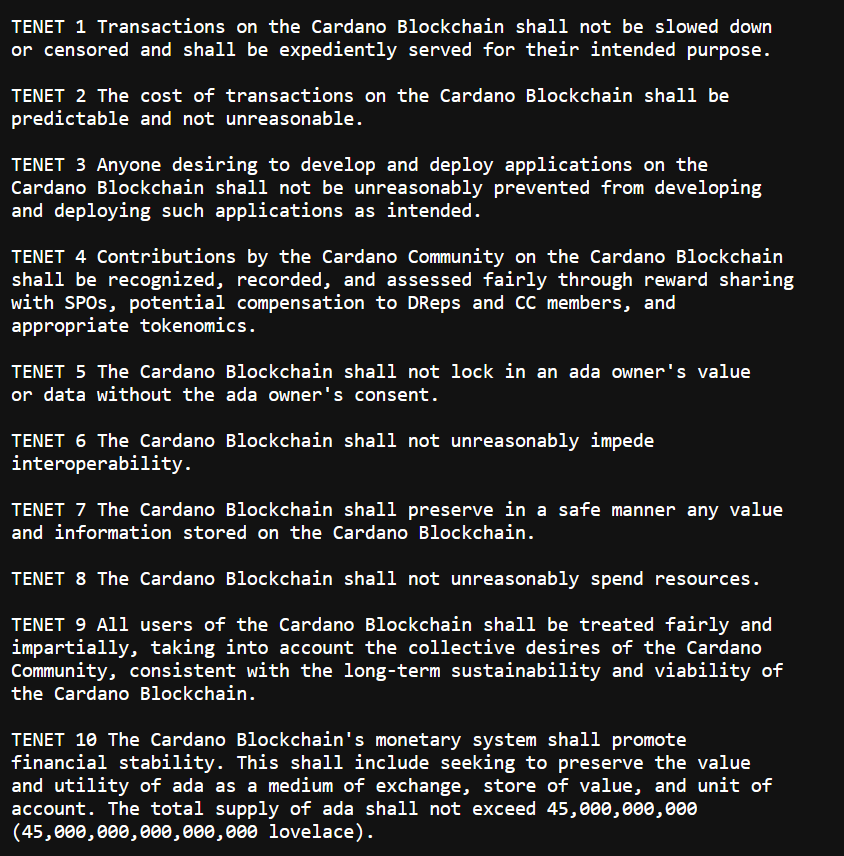
Thank you for sharing your view and for the effort you’ve clearly put into articulating it. I appreciate the seriousness with which you are engaging in this discussion. That said, I believe the argument as presented contains several methodological issues that are significant in the context of constitutional and governance design. I will focus strictly on the structure of the reasoning itself. 1. Reduction of institutional analysis to inferred motivations The core issue under discussion is the scope, limits, and institutional role of the Constitutional Committee (CC) within the Cardano Constitution. However, the argument reframes this issue primarily in terms of inferred personal motivations—namely, that certain positions are driven by a desire to weaken checks and balances against individual voting power. Institutional design should be evaluated based on its structural effects and systemic outcomes, not on speculative assumptions about individual intent. Arguments grounded in inferred motivation are inherently unfalsifiable and weaken the analytical rigor of constitutional debate. 2. Aggregation of quotations without contextual distinction The cited statements span different contexts, timeframes, and specific concerns regarding CC authority. Treating them collectively as evidence of a single, unified intention risks conflating distinct arguments into a retrospective narrative. Concerns about excessive discretion or arbitrariness in CC decision-making do not, in themselves, amount to opposition to checks and balances. When quotations are removed from their original context and aggregated, institutional critique is replaced by intent attribution. 3. Construction of a false dichotomy The framing suggests a binary opposition between: •those who seek to limit or clarify CC authority, and •those who support strong checks and balances. This dichotomy is misleading. It is entirely coherent to support robust constitutional review while also advocating for clearer constraints to prevent subjective or arbitrary exercise of power. Excluding this middle, institutionally grounded position unnecessarily narrows the scope of the debate. 4. Trivialization of constitutional design as “preferences” Questions of constitutional authority, separation of powers, and governance legitimacy cannot be reduced to mere differences in preference. These design choices have concrete, long-term implications for power concentration, institutional stability, and accountability. Characterizing the disagreement as a “basic and predictable difference in preferences” risks bypassing substantive evaluation of those consequences. 5. Toward a more rigorous discussion A productive constitutional debate should focus on textual interpretation, institutional structure, and foreseeable systemic effects—rather than on who is presumed to want what. I believe the discussion would benefit from returning to these foundations and engaging directly with the design trade-offs involved.

The discussion around the Constitution boils down to a simple difference in preferences. The largest single individual DRep is likely to desire a weaker Constitutional Committee to weaken the checks and balances against his voting power. This is obvious from past actions and statements: --literally deleted the phrase "checks and balances" from the Constitution; --"[CC] already holds enormous power"; --"CC holds even greater default power"; --"the Cardano Constitution places constraints on the CC’s excessive authority"; --"the Cardano Constitution exists to constrain the CC’s excessive power"; --"Cardano Constitution is is not a weapon for the CC—it is a restraint on the CC"; --"DReps (and SPOs) bear the responsibility of monitoring both the inherently powerful CC and the Constitution that binds it"; --"[i]f the CC were free to invoke the Tenets loosely or expansively, it would open the door to highly subjective, and potentially authoritarian, decision-making"; and --"judgments of the form 'this proposal violates the Tenets, in my personal view' must be exercised with extreme restraint". On the other end of the spectrum, many others will want strong checks and balances against undue concentration in voting power. Basic and predictable difference in preferences.

Protect the Cardano Treasury. For-profit companies seeking grants: the era of free money is over. Prove your impact with clear ROI, transaction volume, and active users.


Here’s the current status update across all zkFold projects. TL;DR, all initiatives are either completed or progressing on schedule. 1. zkFold ZK Rollup We have completed and submitted every milestone in line with the agreed and communicated schedule, despite the decline in ADA’s price. We have also shared a summary update with the community: x.com/zkFold/status/… Screenshot attached 2. Project Catalyst initiatives: zkFold Symbolic - completed. milestones.projectcatalyst.io/projects/11002… zkFold: Smart Contract Wallet Backend - completed milestones.projectcatalyst.io/projects/12002… zkFold: Zero-Knowledge Prover Backend - completed. milestones.projectcatalyst.io/projects/11002… zkFold: UPLC Converter - completed. milestones.projectcatalyst.io/projects/12002… zkFold x zkPass - completed. milestones.projectcatalyst.io/projects/12002… zkFold x Asterizm - on schedule. milestones.projectcatalyst.io/projects/13001… zkFold x Defy - completed. milestones.projectcatalyst.io/projects/12002… P2P Fiat-to-Crypto On-Ramp for Cardano - completed. milestones.projectcatalyst.io/projects/11001… Bitcoin <> Cardano Atomic Swaps - the project has been completed ahead of schedule. We plan to submit the milestones later this week milestones.projectcatalyst.io/projects/14000… In addition, we have released a Smart Wallet product (x.com/zkFold/status/…) that enables existing Cardano projects to onboard new users more easily. Users can create a wallet using Gmail and send ADA to anyone via email.