Marathon Resource Advisors

1.9K posts

Marathon Resource Advisors banner
Marathon Resource Advisors

Marathon Resource Advisors

@MRAfunds

Asset Manager focusing on publicly traded global natural resource equities. Tweets are not investment advice.

San Francisco, CA Katılım Ağustos 2020
697 Takip Edilen5K Takipçiler
Sabitlenmiş Tweet
Marathon Resource Advisors
So, how big an 🫏-kicking did the rest of the world receive over the last couple of months as all U.S. asset classes and the US$ got simultaneously, unceremoniously pummeled? We think a good term is EPIC. Quantifying the Tariff Shock Impact on Foreign holders of U.S. assets: a 🧵 Given the newfound correlation (in a bad way) of US equity and fixed income markets with the US$ during the recent drawdown, we undertook a project to try and compare the MTM losses suffered by foreign holders of U.S. assets relative to those sustained during the GFC of 2007-2009. Despite having to make some significant assumptions and generalizations, we feel like the following conclusions are, at the very least, “in the ballpark.” 1) The percentage drawdown for foreign holders of U.S. assets in the 6 weeks ending April 8th 2025 was roughly ~19%, which is 2X the percentage losses they sustained during the 18 months of the GFC from Q4 2007 through Q1 2009. 2) The total amount of MTM losses in local currency terms, given the rapid growth of U.S. equity, treasury, corporate and agency debt holdings in the intervening years, over those 6 weeks was roughly 9X those suffered over the 18 months of the GFC. Conclusion: A shock of this magnitude over such a short period of time, coupled with increasingly confrontational U.S. economic and political policy, may well lead to a reversal of decades of the “virtuous cycle” of asset flows from the Rest of World (RoW) into U.S. securities. In particular, we see the potential for U.S. equities and corporate bonds to be sources of funds for foreign holders looking to reduce their outsized positions in US$ assets as the current market instability may well be a feature, and not a bug, of the current administration.
GIF
English
7
8
61
40.9K
Marathon Resource Advisors
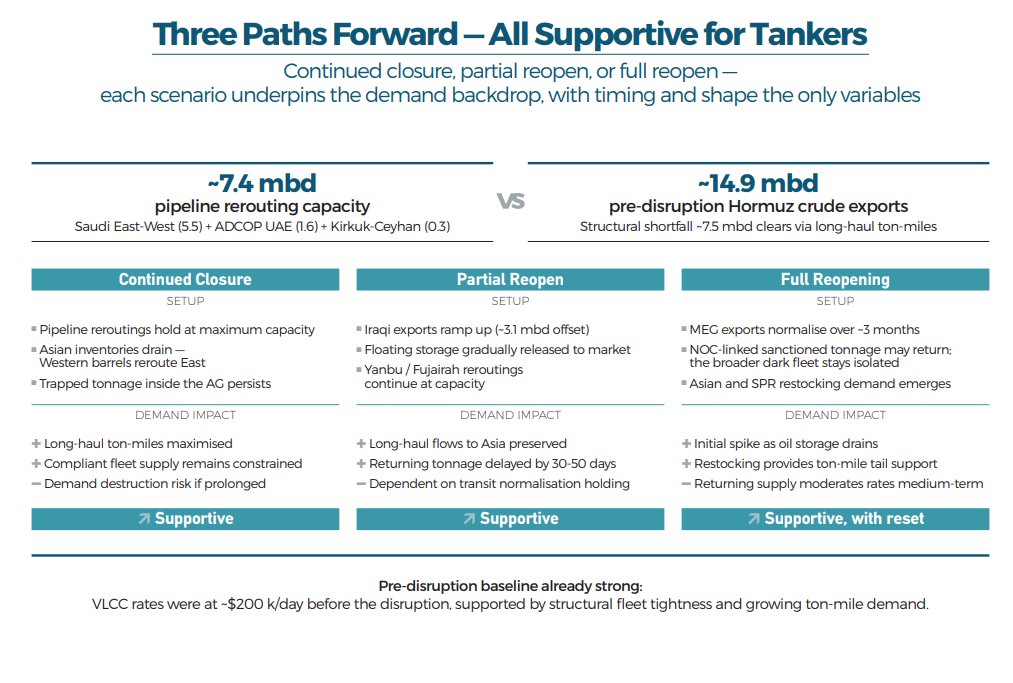
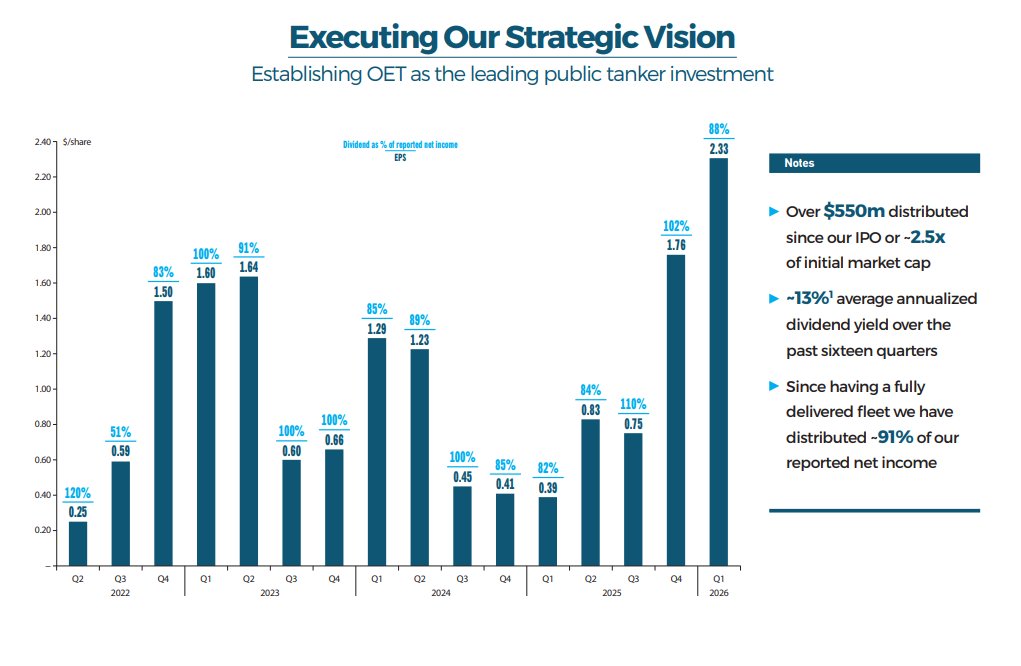
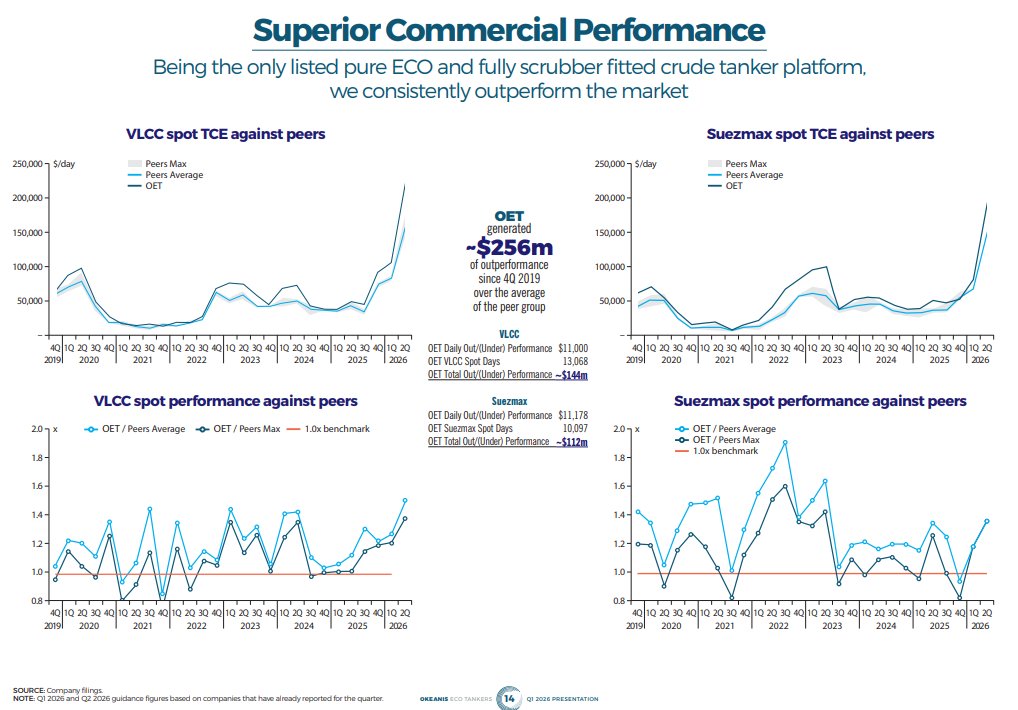
An observation: investor enthusiasm for tech earnings vs. commodity/resource sector earnings. Nice quarter from $CSCO. Revs of $15.8B beat by 1.2%, EPS of $1.06 also beats by ~2%. Guide for next quarter +6% sequentially on revs ($16.8B) and +10% on EPS to $1.17. Dividend of $1.6B, for quarterly yield of 0.4%. Stock trading up 15% aftermarket. What if $CSCO’s guidance for next quarter suggested sales +44% and earnings +110%? And then declared that their Q1 dividend, instead of $1.6B (1.6% annualized yield), would be $15B (15% annualized yield)? And that next quarter’s dividend was tracking towards $35B (35% annualized)? Note: Those dividends would be rather hard to achieve for $CSCO, as it would require them to pay out 95% of current Q REVENUES as a dividend, and 208% of next Qs REVENUES as a dividend. That’s what $OET $ECO just did. Stock is trading flat/+2%. Not a recommendation. Just an observation. Do your own DD.
Marathon Resource Advisors tweet mediaMarathon Resource Advisors tweet mediaMarathon Resource Advisors tweet media
English
0
1
2
1.5K
Le Shrub🌳
Le Shrub🌳@agnostoxxx·
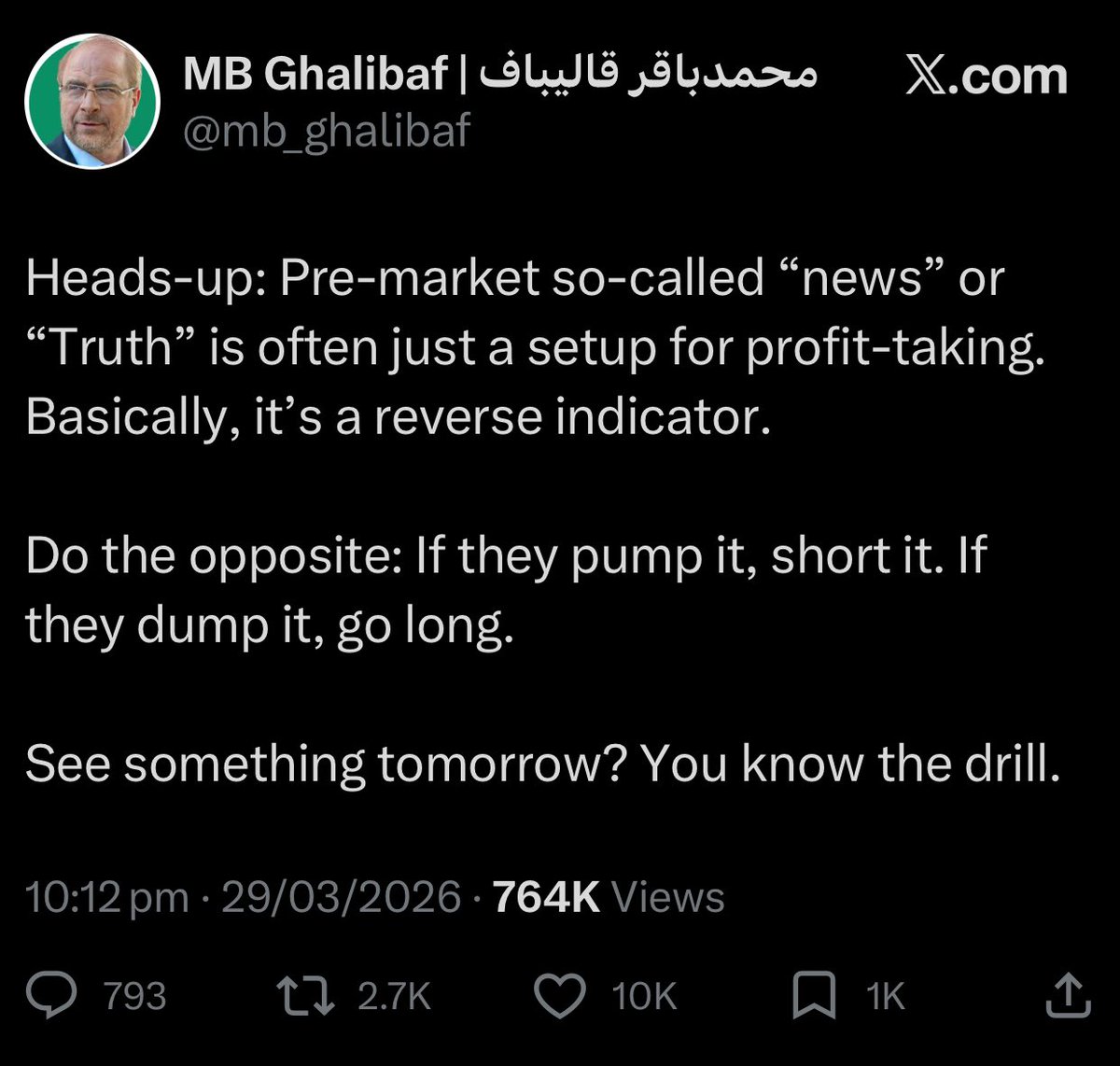
First, Iran competed with me in Memes. Now they are stealing my trading strategy. IS NOTHING SACRED ANYMORE?!😭
Le Shrub🌳 tweet media
English
37
29
641
34K
Marathon Resource Advisors
As usual, wise words from @johnarnold I won't hold my breath for a collective "thank you" from U.S. consumers and industry - in fact, am waiting for screams about price gouging and export restrictions in 3...2...1... - but there is no better example of American Exceptionalism despite persistent regulatory and social headwinds than what the U.S. oil patch has delivered over the last 20 years. Gratitude 🙏
John Arnold@johnarnold

Hard to overstate the role shale gas has played in lowering inflation and spurring American industry. Were we a net importer today as forecast in the 2000s, domestic nat gas & power would be at multiples of current pricing, serving as a huge tax on individuals and companies. 1/5

English
0
2
7
1.3K
Marathon Resource Advisors
As usual, @RealRickRule is on to something here. Taking it a step further, for those entities who hold large illiquid private credit stakes, what if they try and hedge those holdings by buying puts on public credit ETFs? Gamma squeezes work both ways kids....
GIF
Rick Rule@RealRickRule

What if: the credit contagion around private equity causes retail holders of high yield, below investment grade ETF bond funds, to liquidate. The ETF's are very liquid, the assets they hold are very illiquid. Ouch

English
0
0
5
1.2K
Marathon Resource Advisors
What a concept…. I will be speaking at @gnoble79 investor event today with an idea to capitalize on what I hope is a move away from energy idiocy towards pragmatism in a part of the world that desperately needs it.
Andrew Griffith MP@griffitha

There’s been talk of releasing strategic oil and gas reserves around the world to bring down prices. But why do we have to rely on the reserves of others? We have vast reserves at our fingertips which we could extract to lower prices for Britain every day of the year 👇

English
0
3
16
7.4K
Marathon Resource Advisors
Another banger note from @ces921
Craig Shapiro@ces921

US-Iran War/Energy Crisis vs Covid 2019 The current 2026 energy crisis from the war and COVID-19 share the same institutional failure DNA. Both began with confident containment declarations overtaken by events within days. Both produced calibration lag: each policy instrument designed for last week's problem, deployed against this week's. Both generated political denial phases where the cost of acknowledging true scale exceeded the perceived cost of denial. And both are producing second-order damage that will outlast and exceed the primary shock.   The analogy is precise for institutional psychology. However, it requires three corrections for market dynamics. 1) Price-signal demand destruction is a functioning mechanism in 2026 that COVID's administrative shutdown was not. The price is the lockdown, and it works, brutally. 2) Russia's shadow fleet provides an unofficial emergency circulatory system that has no COVID equivalent. The adversary's sanctions-evasion architecture became the system's emergency backup, a circular stability COVID never produced. 3) US military capacity provides a transit antibody that no vaccine ever offered against a virus.   Against those stabilizers, I do believe that 2026 is unambiguously more severe on several dimensions. The adversaries (Russia, China, Iran) have strategic agency and financial incentives to prolong the crisis. Russia is earning $30-50 million per day in additional revenue from prolonged disruption. China is building its position as indispensable energy mediator. Iran demonstrated that Hormuz is more powerful than any weapon in its arsenal. The mutation speed exceeds COVID at its peak: various distinct escalation events over the last 7 days, each requiring a categorically different response instrument. The resolution mechanism requires political decisions from actors who benefit financially from no resolution. The tail risk distribution includes NATO Article 5 triggers, reserve currency transition, and great power confrontation that dwarf anything COVID threatened. And the petrodollar security guarantee (military protection in exchange for dollar-denominated oil flows) has failed its most visible real-world test in fifty years.   The dimension COVID did not face and 2026 cannot escape is the policy response constraint. COVID arrived into a fully loaded policy environment: the Fed cut to zero, expanded its balance sheet from $4 trillion to $9 trillion, and Treasury deployed $5 trillion in fiscal stimulus into a deflationary shock with no inflation ceiling and a bond market absorbing everything at 0.5% on the 10-year. That response worked. It also consumed the ammunition. The 2026 energy crisis arrives with the Fed carrying a $7 trillion balance sheet, a policy rate that cannot be cut into an inflationary oil shock without risking expectations unanchoring, federal debt at $35 trillion versus $23 trillion in 2020, and a 10-year yield already at 4.14% and rising on oil-driven inflation fears. Every fiscal stimulus instrument available (energy subsidies, consumer relief, defense spending) is inflationary. The cure and the disease are the same instrument. COVID was fought with a fully loaded bazooka into a deflationary shock. The 2026 energy crisis must be managed with a partially spent bazooka into a stagflationary one. The treatment is better than aspirin. The disease can think. The pharmacy has fewer options. And the timeline between the fix that works and the deadline the politics permit is the shortest it has been since 1979, the last time a central bank faced this specific combination of oil shock, partially unanchored expectations, and political pressure on an electoral timeline. Volcker chose credibility over growth. This Fed is changing leadership in 3 months with midterms coming in 7 months. This time may be different.


English
0
0
3
1.5K
The Long View
The Long View@HayekAndKeynes·
China has over 1bn barrels of oil in their SPR
English
35
10
211
88.9K
Tracy Shuchart (𝒞𝒽𝒾 )
Once again A geopolitical price spike to $90, does nothing for shale producers 2026 CAPEX plans.
English
12
18
270
34.5K