Devansh: chocolate milk cult leader

5.4K posts

Devansh: chocolate milk cult leader banner
Devansh: chocolate milk cult leader

Devansh: chocolate milk cult leader

@Machine01776819

Breaking down ideas in AI, Software, and Tech as an industry. Chocolate Milk Cult Leader reaching 1M+ people monthly. The best meme maker in all of tech

United States of America Katılım Ekim 2020
340 Takip Edilen2.1K Takipçiler
Ray Wang
Ray Wang@rwang07·
@OpenAI Greg: "gpt-5.4 has ramped faster than any other model we've launched in the API: within a week of launch, 5T tokens per day, handling more volume than our entire API one year ago, and reaching an ARR of $1B in net-new revenue."
Greg Brockman@gdb

gpt-5.4 has ramped faster than any other model we've launched in the API: within a week of launch, 5T tokens per day, handling more volume than our entire API one year ago, and reaching an annualized run rate of $1B in net-new revenue. it's a good model, try it out!

English
3
1
15
2.6K
Devansh: chocolate milk cult leader retweetledi
Ollie Forsyth
Ollie Forsyth@ollieforsyth·
Keeping up with AI is REALLY hard (Who to trust, which information is accurate, and what is actually happening etc). So, if you are new to AI or thinking about it every day, here's my go-to list of people to learn from, outside of the usual names we hear about: Venture Capital: AI Investing: @vkhosla & @JoshuaKushner AI Apps Investing: @illscience (and the wider @a16z team) White House AI: @DavidSacks Startups at @ycombinator Tech News: Stay at the edge: @danshipper How I AI: @clairevo How To AI: @rubenhassid Practical AI Tutorials: @petergyang AI News & Strategy Daily: @natebjones Emerging AI Tech News: @ReadFuturist Ideas: @Machine01776819 TBPN: @johncoogan and @jordihays ACCESS / Sources: @hamburger and @alexeheath People working for AI companies: CEO of Applications, OpenAI: @fidjissimo OpenClaw: @steipete Co-Founder @huggingface: @ClementDelangue Founder @midjourney: @DavidSHolz Co-Founder @ElevenLabs: @matiii There are so many others! Add your favorites below! Let's continue building the future together!
English
6
3
35
1.9K
Devansh: chocolate milk cult leader
@Zoe_ZouYi A lot of the times that startups were doomed from the start. Started by founders that wanted the aesthetic of being a founder but no deep planning on what they would actually build.
English
0
0
1
34
Devansh: chocolate milk cult leader
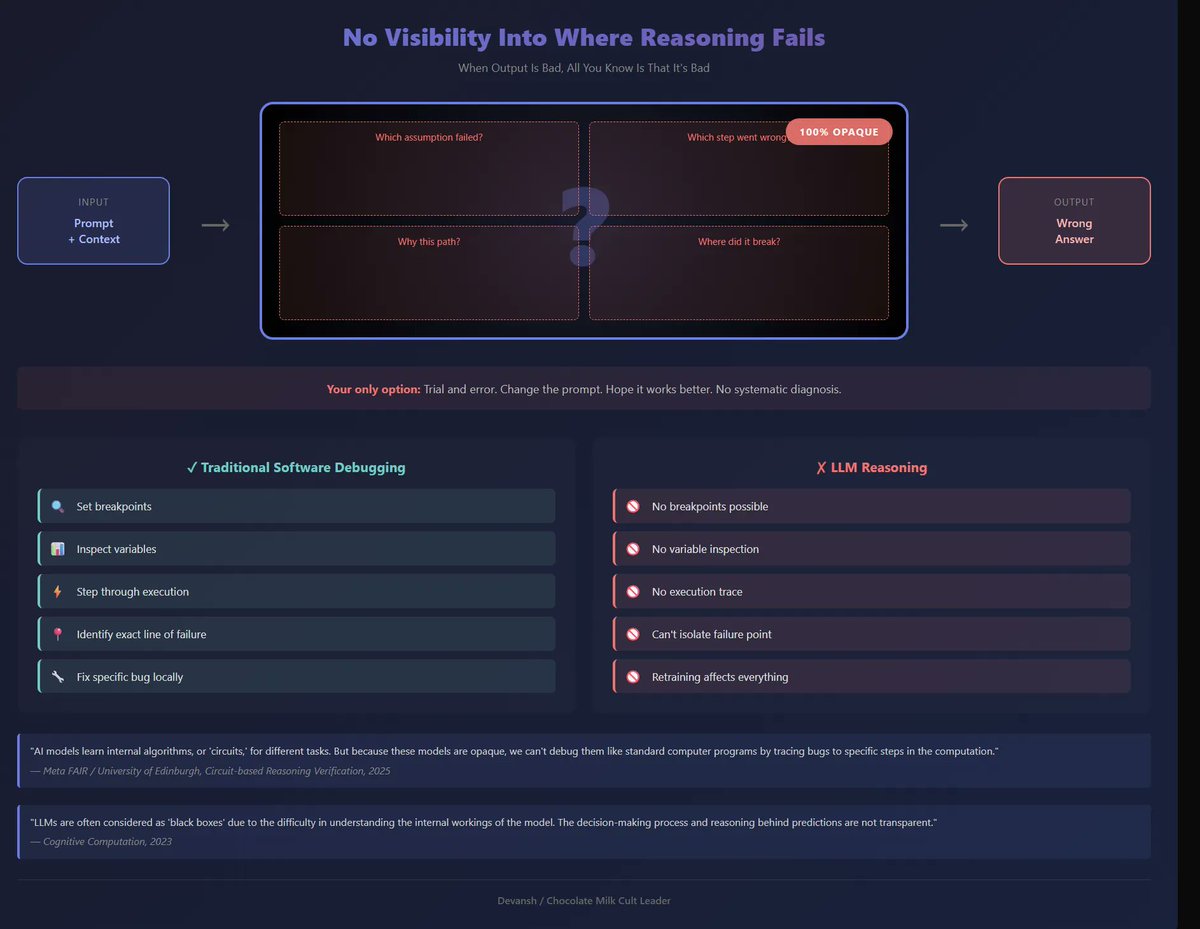
AI Models don't need to be more intelligent. We just need to understand them better. When an output is bad, all you know is that it’s bad. There Is No Visibility Into Where Reasoning Fails or how we could have done better. You don’t know which assumption failed. You don’t know which step went wrong. You don’t know whether the issue was factual, strategic, preference-related, structural, or simply a bad roll by your presiding RnG god. You can prompt the model again, but that’s not a diagnosis; it’s trial and error. This opacity isn’t limited to users. Model providers face the same problem. When a model succeeds or fails, the internal process is effectively a black box. Improvements require retraining. Retraining introduces new failures. The cycle repeats. As a result, reliability becomes extremely expensive. Not because models are weak, but because there’s no way to intervene locally. Everything is global. Everything is destructive. Imagine having to relearn the entire language everytime you want to add a new skill/analysis technique to your toolbelt. That is effetively what we do when we try to train better models: update their neurons and pray to Cthulu that it won't ruin the learnings that are already backed into our models. That’s one of the biggest reasons why training costs and inference keep going up and up and up. To deal with the overly complex demands imposed on a very fragile information LLM ecosystem, we have to rely on bigger and bigger models to fit all the interactions. Mo’ params, mo’ problems. This is clearly a structural issue with how we represent and navigate the information in our models. It won't be fixed by doing more of the same. This requires a ground-up rebuild of how we see represent intelligence digitally. If you're interested in learning how we handle this at Irys, Legal AI (formerly Iqidis) to build the best legal reasoning system on the planet, check out resources GitHub -- github.com/dl1683/Latent-… Original Article--artificialintelligencemadesimple.com/p/how-to-teach…
Devansh: chocolate milk cult leader tweet media
English
0
0
0
53
Devansh: chocolate milk cult leader
Devansh: chocolate milk cult leader@Machine01776819·
The AI Industry is all in on reasoning models. I think this is a suckers bet. Reason 1 for it-- Training reasoning into model weights does not compound. The current approach ensures that every advance in reasoning is a dead end. Say Irys, Legal AI (formerly Iqidis) develops a model with sophisticated legal reasoning capabilities. Under the current paradigm, that work lives and dies inside our system. Google can’t use our insights about legal argumentation structure. Anthropic can’t benefit from what we learned about precedent analysis. A medical AI startup can’t adapt our approach to clinical reasoning. The knowledge is locked in weights, and weights don’t compose. This is the opposite of how technological progress usually works. When someone invents a better compiler, everyone’s code gets faster. When someone develops a better database, every application can use it. Infrastructure improvements compound across the ecosystem. There’s no way to patch this stupdity since it is a consequence of embedding reasoning into weights. Weights are not modular. They do not expose interfaces. They do not separate concerns. Once “reasoning” is fused into a model, it becomes inseparable from everything else the model knows — language patterns, stylistic biases, safety constraints, latent correlations from training data. Improving one aspect requires retraining the whole. The result is an ecosystem where: -Every lab re-solves the same problem independently -Every improvement requires fresh compute -Every domain rebuilds its own reasoning stack from scratch The compute cost is staggering. But the opportunity cost is worse. All those resources spent duplicating solved problems are resources not spent on unsolved ones. The tech industry grew by building shared platforms that allowed us to reduce redundant work and build on each other's iterations. Reasoning models are a step back from that. Instead, we should be working on shared reasoning infrastructure that will enalbe the testing and development of intelligence at scale. Read more-- artificialintelligencemadesimple.com/p/reasoning-mo…
English
0
0
0
115
Kat ⊷ the Poet Engineer
Kat ⊷ the Poet Engineer@poetengineer__·
the feature ive been working on: cross-pollination of ideas. ✦ particles drift between plants: when one touches two, it generates a brand new idea from both. a garden that doesn't just show your thinking - it extends it. releasing to x subscribers today <3
Kat ⊷ the Poet Engineer@poetengineer__

all my obsidian notes are now a living, digital garden 🌿🌸 each plant is a notes from a tag: older ones on the trunk, newer ones as leaves. i wanted to create a sense of tending your garden, so scrubbing the timeline lets you watch your notes grow chronologically.

English
56
181
2.2K
105.6K
Devansh: chocolate milk cult leader
Devansh: chocolate milk cult leader@Machine01776819·
Everyone wants a 1M-token context window. Very few want to talk about the invoice. The popular story is that long-context inference is a compute problem, but that’s only half true. A lot of the pain shows up as memory bandwidth, KV cache growth, and expensive GPUs spending their time hauling bytes around instead of doing useful work. Silicon has a nasty sense of humor like that: the smarter the model gets, the more easily it can be humbled by memory. That’s why the future of transformers is getting strange. FlashAttention matters, but it does not repeal the laws of physics. KV compression helps, but it trades memory savings against fidelity. Mamba and linear attention offer a different scaling story, but they bring their own recall, training, and deployment tradeoffs. Hybrid models are interesting for a simpler reason: they’re less ideological. Keep attention where it matters, use cheaper mechanisms where the memory bill becomes absurd, and try not to torch the stack while you’re at it. I wrote a new piece on where this is heading: FlashAttention, KV compression, Mamba, linear attention, hybrid models, context parallelism, and the economics of serving long-context AI without lighting your margins on fire. My bet, at least for the near term, is that the winners won’t be the prettiest ideas. They’ll be the ones that survive contact with production. That probably means hybrids and KV compression first, with more radical architecture shifts earning their place later. It's linked below Curious where you land: does the future belong to better attention, less attention, or just more infrastructure pain? artificialintelligencemadesimple.com/p/how-long-con…
English
1
0
0
87
Devansh: chocolate milk cult leader
There is some irony with all the tech VCs/startup bros that say things like "money isn't real; you can keep creating infinite wealth" to gaslight people into shitty working conditions. These are the same people that fight hard to avoid paying even the tiniest bit of taxes. If unchecked capitalism lets you create infinite wealth why waste your time fighting taxes instead of creating more?
English
0
0
0
54
Devansh: chocolate milk cult leader
@loganthorneloe This seems like a bad idea from a product perspective. Learning to work within usage limits is a very important signal for the teams so they can find the breaking points/high roi angles.
English
1
0
1
460
Devansh: chocolate milk cult leader retweetledi
AC
AC@lc_fund·
Neoclouds $NBIS $CRWV ROIC ~4-6x+ with "storage-as-memory tier" AI infra startups (WEKA, VAST Data/DASE, DDN ExaScaler/Lustre, PureStorage) that move KV cache to NVMe/SSD fading the recompute cost for stateful AI.
English
1
1
3
323
Bryce Roberts
Bryce Roberts@bryce·
Feels like the AI legal tech crowd is about to get a big wake up call. Selling a wrapper for less than you’re paying for the underlying models is a crazy shaky proposition for the Harveys and Legoras of the world that’s getting weaker by the day.
English
43
13
468
240.2K
Devansh: chocolate milk cult leader
Not to mention all model improvements are horizontal-- they apply to all industries and capabilities. Legal work is complex and needs specialization (some of which directly contradicts with their default training). That's why you can't rent intelligence from models, you have to build your own. Like the one shown here. artificialintelligencemadesimple.com/p/how-to-teach…
English
0
0
0
531
Devansh: chocolate milk cult leader
Devansh: chocolate milk cult leader@Machine01776819·
@ihtesham2005 Very cool share. I wonder how it navigates specific chunk related inoformation (what does this entity say about X). Imo that has been a big blocker for KGs
English
0
0
0
26
Ihtesham Ali
Ihtesham Ali@ihtesham2005·
🚨 Someone just built a tool that turns any GitHub repo into an interactive knowledge graph and open sourced it for free. It's called GitNexus. Think of it as a visual X-ray of your codebase but with an AI agent you can actually talk to. Here's what it does inside your browser: → Parses your entire GitHub repo or ZIP file in seconds → Builds a live interactive knowledge graph with D3.js → Maps every function, class, import, and call relationship → Runs a 4-pass AST pipeline: structure → parsing → imports → call graph → Stores everything in an embedded KuzuDB graph database → Lets you query your codebase in plain English with an AI agent Here's the wildest part: It uses Web Workers to parallelize parsing across threads so a massive monorepo doesn't freeze your tab. The Graph RAG agent traverses real graph relationships using Cypher queries not embeddings, not vector search. Actual graph logic. Ask it things like "What functions call this module?" or "Find all classes that inherit from X" and it traces the answer through the graph. This is the kind of code intelligence tool enterprise teams pay thousands per month for. It runs entirely in your browser. Zero server. Zero cost. Works with TypeScript, JavaScript, and Python. 100% Open Source. MIT License.
English
101
441
3.3K
220.6K