Marcus Painter

878 posts

Marcus Painter banner
Marcus Painter

Marcus Painter

@MarcusOwen5

Associate professor of finance @SLU_Official alumni of @universityofky and @mizzou

St Louis, MO Katılım Eylül 2012
576 Takip Edilen909 Takipçiler
Sabitlenmiş Tweet
Marcus Painter
Marcus Painter@MarcusOwen5·
Ever wonder what happens behind the scenes when the SEC investigates firms? My co-authors and I did, so we built a database tracking SEC-associated smartphones to study how they monitor firms. A key finding: firm insiders that sell around a visit avoid large losses thread...
Marcus Painter tweet media
English
16
81
481
138K
Marcus Painter retweetledi
John Henry
John Henry@johnhenrystl·
"Lightning City Blues" drops tomorrow! Cinematic, bluesy alt-rock track by John Henry from St. Louis, USA.
English

0
1
1
80
Orin Kerr
Orin Kerr@OrinKerr·
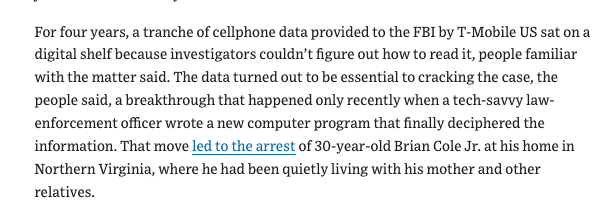
Wait, the FBI was able to solve the 1/6 pipe bomb case because an agent finally figured out how to read the data they had sitting around for years? Curious what "deciphered" means here. wsj.com/politics/natio…
Orin Kerr tweet media
English
33
78
981
193K
Marcus Painter retweetledi
Jesús Fernández-Villaverde
Jesús Fernández-Villaverde@JesusFerna7026·
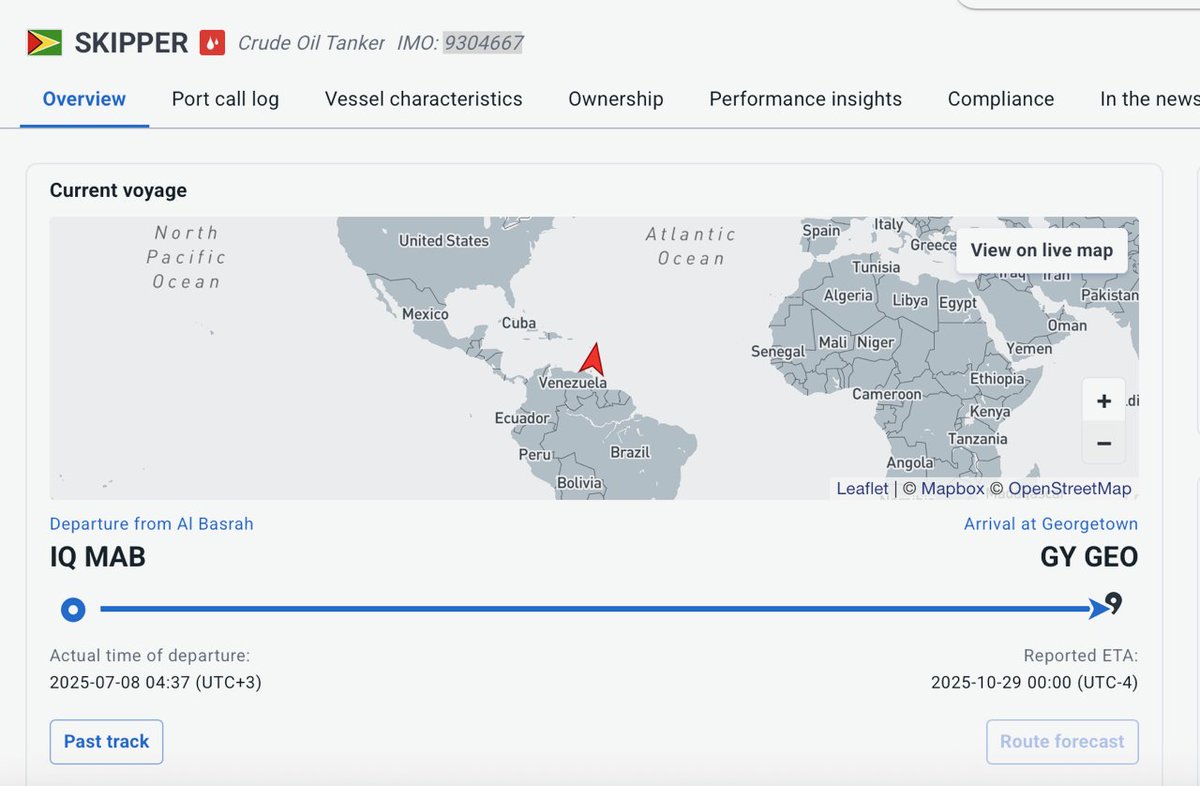
Yesterday, the U.S. seized the oil tanker Skipper off the coast of Venezuela (included pic). This seizure highlights the key role that the dark fleet plays in the global oil market. Together with @YiliangLi_, Le Xu, and @FZanettiOxford, I have spent much of the last year thinking about this market: sas.upenn.edu/~jesusfv/Dark_… While I have posted about this work before, given the recent discussion on X about modern economics, data, and artificial intelligence, I want to revisit it, as I believe it is also a perfect example of the marvelous findings that can be documented using machine learning in economics and how the future of economics goes, to a large extent, through artificial intelligence. Our punchline is that we designed a novel, powerful machine learning algorithm to show that dark oil tankers transported an estimated 9.3 million metric tons of crude oil per month between 2017 and 2023 (right now, before sending the paper back to the journal, we are extending the database to 2025). Let that sink in: nearly 10 million tons of crude every month off the books, outside official trade flows. And the economic impact? Surprisingly large for output and inflation in the U.S., the EU, and China. Let’s start today with how we gather the data. When oil sanctions hit, exporters don’t stop. They go dark: — Disable AIS transponders — Transfer oil ship-to-ship in open waters — Reflag vessels under shady jurisdictions — Use forged paperwork to mask identities And here’s the twist: Many of these tactics are quietly tolerated (sometimes even facilitated) by countries that don’t want to see tight energy markets or higher inflation. Nobody wants to rock the boat. So, we built the most comprehensive dataset to track this: ✅ Over 2,150 oil tankers, essentially the entire global crude fleet. ✅ Trips tracked from 2017 to 2023. ✅ Satellite AIS data + metadata (vessel age, flag, etc.). ✅ ~330 million observations. We then trained a machine learning model that detects sanction-busting trips with very high accuracy: — Patterns in AIS gaps. — Origins and destinations. — Temporal clues like navigation anomalies. — Vessel profiles. This isn’t sample data — it’s population-level tracking. We audited and validated the model using satellite images and independent checks. For instance, the oil tanker Roma (IMO: 9182291) was classified as “dark” by the algorithm, and sure enough, we found imagery of Roma loading oil at Kharg Island (Iran) on August 20, 2022 (see second included pic). You can’t argue with a photo. This process gives us confidence in the entire classification and enables us to identify every trip that violates sanctions. So what do we do with all these dark voyages? We construct time series of: 📈 Oil exports that violate sanctions. 📉 Oil imports that violate sanctions. 🌐 Their origin and destination. See the third and fourth included pics. Tomorrow, I will discuss these results and how we use them in what I think is a rather creative econometric exercise. P.d. By the way. Have you seen any “heterodox economist” doing anything like that? Of course not. The “heterodoxs” sit down and talk about the ontology of the oil markets, or what Sraffa would have said about the oil market, or even better, that mainstream economists do not look at the data (and write a whole book about that). Can you be any more empirical than this paper, where we actually look at every single oil tanker in the planet in real-time? Let’s be honest: “heterodox economics” is just an excuse to be a low performer and not having to face your own shortcomings as as a researcher.
Jesús Fernández-Villaverde tweet mediaJesús Fernández-Villaverde tweet mediaJesús Fernández-Villaverde tweet mediaJesús Fernández-Villaverde tweet media
English
59
162
801
176.6K
Marcus Painter retweetledi
Marcel Caesmann
Marcel Caesmann@MarcelCaesmann·
In 1550, naming your son "Matthias" in Germany meant nothing. By 1650, it marked you as Catholic. How do arbitrary symbols become identity markers—common knowledge that organizes group boundaries? My JMP studies this in the Protestant Reformation. 🧵
Marcel Caesmann tweet media
English

1
23
65
12.3K
Marcus Painter
Marcus Painter@MarcusOwen5·
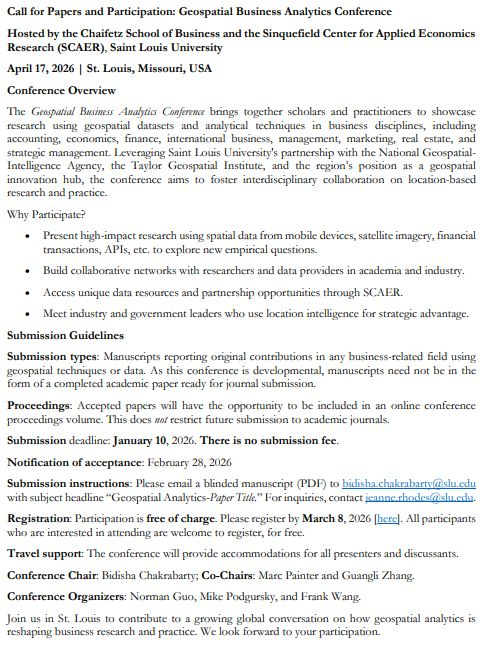
Submission deadline: January 10, 2026. Submit blinded manuscripts to the email in the image below. There is no submission fee. You can also register to the conference for free at this link: eventbrite.com/e/geospatial-b…
Marcus Painter tweet media
English
0
0
1
52
Marcus Painter
Marcus Painter@MarcusOwen5·
We welcome submission of working papers for consideration from accounting, economics, finance, international business, management, marketing, real estate, strategic management, and beyond. Send us your best stuff!
English
1
0
1
53
Marcus Painter
Marcus Painter@MarcusOwen5·
We at @SLUChaifetzBiz are hosting a first of its kind interdisciplinary research conference focused on the use of geospatial data and techniques in business research, broadly defined. The conference will take place on April 17, 2026. 🧵
Marcus Painter tweet media
English
1
1
4
65
Marcus Painter retweetledi
John Arnold
John Arnold@johnarnold·
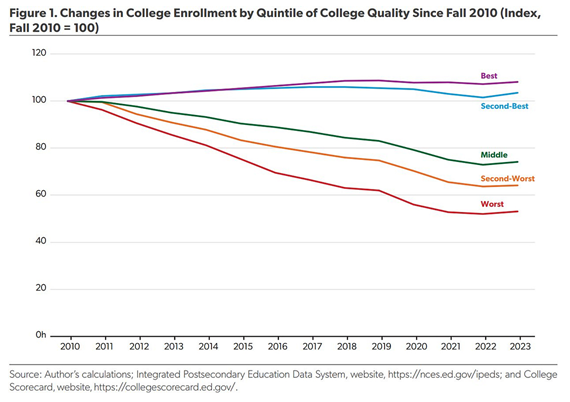
The ongoing decline in college enrollment since 2010 has been healthy, falling entirely on the lowest quality institutions like U of Phoenix (-77%) & ITT (-100%). Meanwhile, the top 40% of colleges ranked by student outcomes have seen enrollment increases. via @PrestonCooper93
John Arnold tweet media
English
24
110
850
85K
Marcus Painter
Marcus Painter@MarcusOwen5·
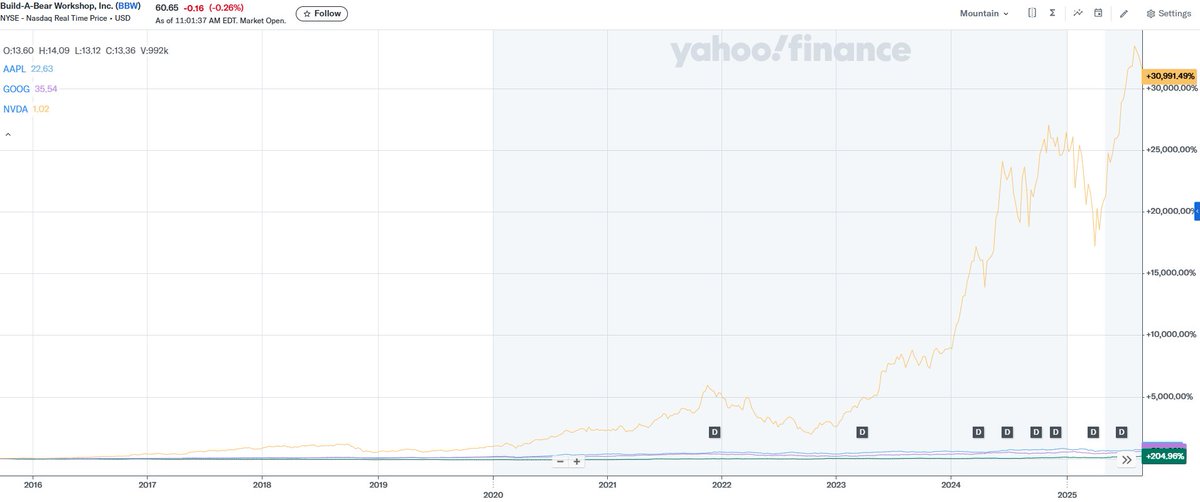
@auren starting the chart at the peak of the dot-com boom is choice. here's what it looks like starting in '92
Marcus Painter tweet media
English
0
0
2
36
Auren Hoffman
Auren Hoffman@auren·
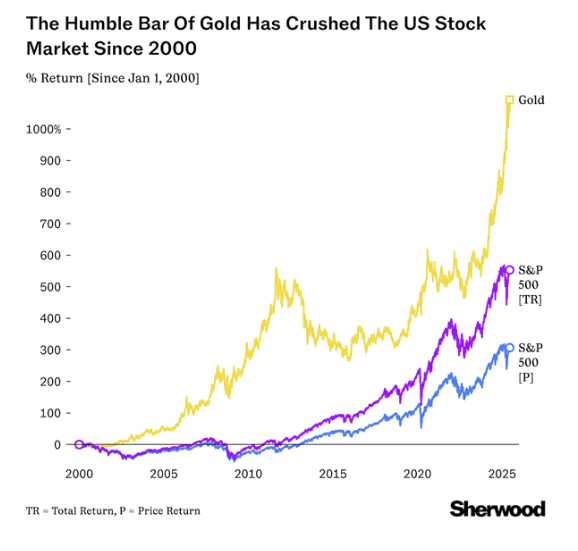
this is not a good sign. betting on gold is essentially a short on progress.
Auren Hoffman tweet media
English
3
0
4
1.2K
Kevin A. Bryan
Kevin A. Bryan@Afinetheorem·
I know this is @Chris_arnade's schtick, but just stopped by a McDs because I was running late; must be most cross-class, cross-ethnicity possible institution in modern society. Would be better to have even more of this (and yes, this is also a Housing Theory of Everything tweet).
English
8
4
101
49.1K
Marcus Painter retweetledi
Tony Cookson
Tony Cookson@prof_cookson·
New Working Paper with @gk_ben and @w_mullins_ "Immigration and Credit in America" SSRN link: papers.ssrn.com/sol3/papers.cf… Using SSN assignment rules before 2012, we identify immigrants in a 10% TransUnion sample. Our paper presents new facts about US immigrant consumer credit.
Tony Cookson tweet media
English
1
12
26
1.9K
Marcus Painter retweetledi
Journal of Financial and Quantitative Analysis
Firms outsource the burden of filing with the SEC to third-party filing agents in 80% of 8-Ks. Leakage of private information is greater when firms outsource versus self-file. Leakage differentials are higher when private information is more valuable. jfqa.org/wp-content/upl…
Journal of Financial and Quantitative Analysis tweet media
English
0
4
23
3.5K
Marcus Painter retweetledi
Dan Garrett
Dan Garrett@DangGarrett·
The Virtual Municipal Finance Workshop starts this Wednesday, 2/19, at 11am EST! Our first presentations will be by Delphine Samuels (UChicago) and Gustavo Cortes (UFlorida) on information creation and distribution Papers and Zoom: muni-workshop.com
Dan Garrett tweet mediaDan Garrett tweet media
English
0
1
9
296
Marcus Painter retweetledi
Michael Varley
Michael Varley@varley_ma·
🚨New Working Paper 🚨 How does Federal Reserve policy impact the real economy? With Igor Cunha, we reveal a key but overlooked player in this transmission: municipal bond issuers. Our findings show how financial flexibility in public finance amplifies monetary policy. (1/N)
English
2
9
34
5.7K