Maria Mahamed

474 posts

Maria Mahamed banner
Maria Mahamed

Maria Mahamed

@MariaMaham68630

Exploring how technology reshapes human development in the AI age AI & Remote Sensing | PhD Taught and worked across disciplines: tech, society, environment

Katılım Mart 2026
27 Takip Edilen41 Takipçiler
Sabitlenmiş Tweet
Maria Mahamed
Maria Mahamed@MariaMaham68630·
What is self-respect: a outdated accessory or a basis for a well-being? In the AI era, many feel society is confused. Studies show people follow AI advice blindly, outsource thinking, trying to replace person by function. I think we’ve simply forgotten what true self-respect is.
Maria Mahamed tweet media
English
1
0
2
358
Maria Mahamed
Maria Mahamed@MariaMaham68630·
@BenjaminGoggin We can see how profitable a business academia has become, when even fake scientific journals make sense as an enterprise. 50 years ago, such news would have been considered complete madness.
English
0
1
7
220
Ben Goggin
Ben Goggin@BenjaminGoggin·
Fake academic journals are publishing AI-generated papers under real professors’ names We identified a network of AI-created journals that have published over 100 fake papers, using real professors' names among the AI slop nbcnews.com/tech/internet/…
English
9
426
567
21.6K
Maria Mahamed
Maria Mahamed@MariaMaham68630·
@rohanpaul_ai It matches to Claude creators' approach: apply to the AI agent knowledge from the psychology and human behavior. Is it appropriate to fix software bags by psychologists? Or the purpose to fix people so they would fit the software?
English
1
0
0
92
Rohan Paul
Rohan Paul@rohanpaul_ai·
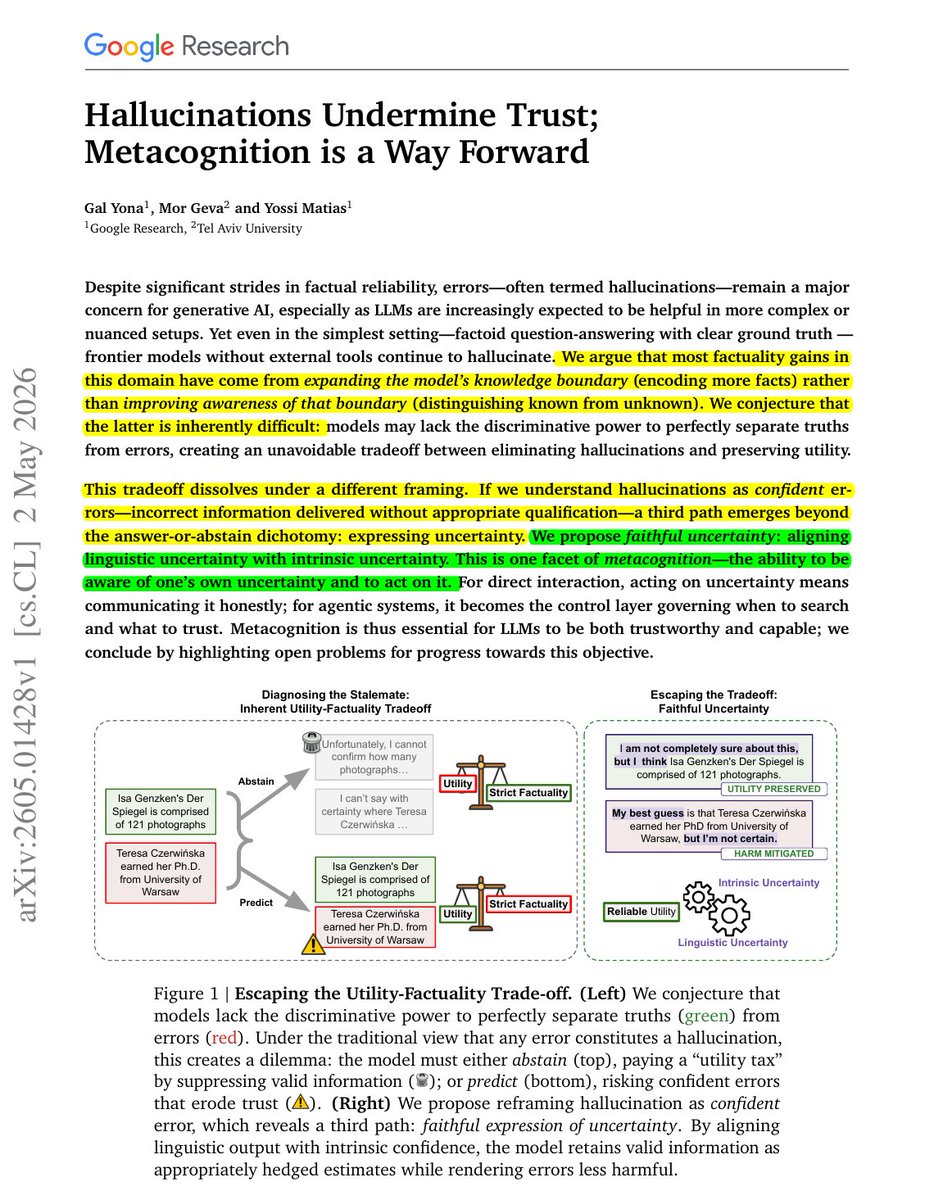
New Google paper says LLMs should stop pretending certainty and instead clearly show when they are unsure. Hallucination is less about machines being wrong than about machines sounding certain when they should hesitate. That distinction changes the target-problem. The paper changes the target from making models perfectly factual to making them honest about their own uncertainty. For years, the obvious goal has been to make language models know more, so they make fewer factual mistakes. Perfect factuality may be very hard, but a model that clearly separates “I know this” from “I am guessing” can stay useful without quietly damaging trust. This paper argues that the harder missing skill is not knowledge, but self-knowledge. A model can be well calibrated in the broad sense, knowing that answers like this are correct about 60% of the time, yet still fail to identify which particular answer is the dangerous one. That is the trap: to eliminate errors, the system must refuse many answers that would have been right. The authors call this the utility tax, and it explains why products keep drifting toward confident usefulness rather than cautious truth. Here's the key point. A wrong answer wrapped in honest uncertainty is not the same social object as a wrong answer delivered as fact. It gives the user a different instruction: verify this, treat it as provisional, do not build too much on it. The proposed fix is “faithful uncertainty,” where the model’s language mirrors its internal confidence instead of smoothing doubt into authority. For agents, this becomes even more important, because uncertainty is what should decide when to search, when to trust a source, and when to stop. Tools expand what a model can access, but metacognition governs whether access is used wisely. ---- Paper Link – arxiv. org/abs/2605.01428v1 Paper Title: "Hallucinations Undermine Trust; Metacognition is a Way Forward"
Rohan Paul tweet media
English
38
50
184
8.7K
Maria Mahamed
Maria Mahamed@MariaMaham68630·
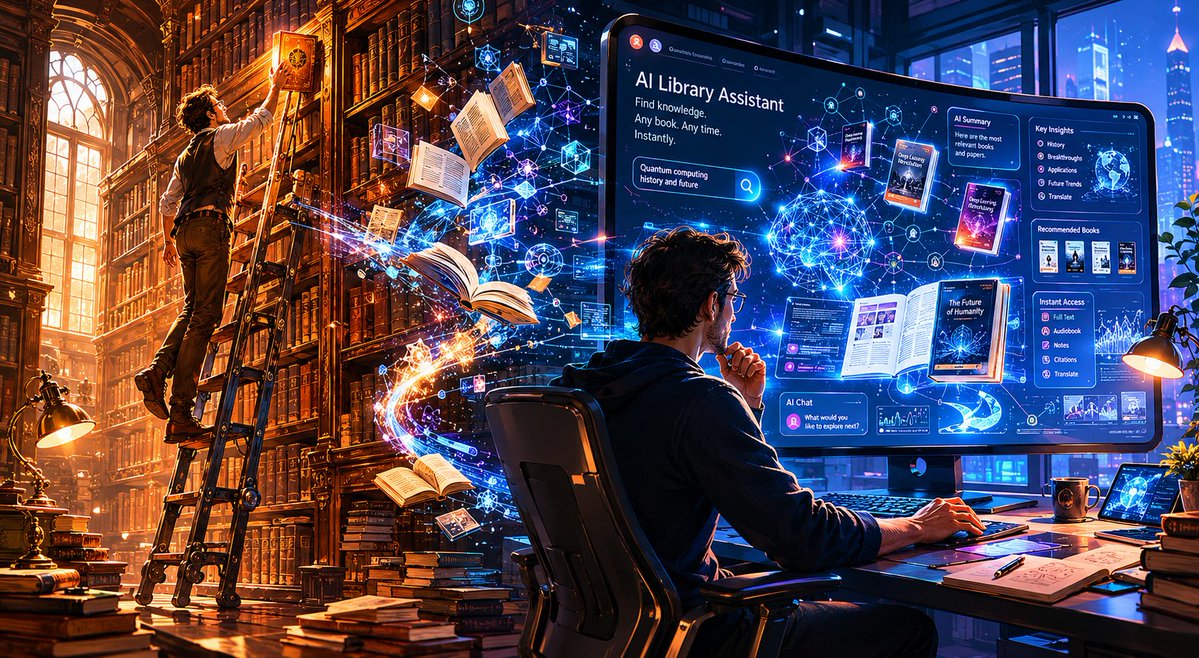
“Every intelligent person has to read during his life 8-10 books. But in order to understand which ones, he sould read 15 000.“ Isaac Babel AI simplified the searcher of these books. Does the result of AI's search have equal value to the result of our own's?
Maria Mahamed tweet media
English
0
0
0
20
Maria Mahamed
Maria Mahamed@MariaMaham68630·
@OACerebro Thank you for highlighting the academic crisis caused by replacing qualitative assessment with quantitative metrics in deciding which scientists to support. At the current technological race, we urgently need to bring back real scientists in the right places.
English
0
0
4
389
Oscar Arias
Oscar Arias@OACerebro·
Peter Higgs no estaba hablando únicamente de física cuando confesó que hoy no conseguiría un puesto académico. Estaba describiendo la transformación silenciosa de la universidad contemporánea: de un espacio para pensar a una maquinaria obsesionada con medir. La ironía es brutal. El hombre que ayudó a explicar por qué la materia tiene masa, uno de los descubrimientos intelectuales más importantes del último siglo, sospechaba que el sistema actual lo habría considerado “improductivo”. Publicó menos de diez artículos después de su trabajo mas importante en 1964, evitaba el espectáculo académico y desconfiaba profundamente de la cultura de la hiperactividad científica. La ciencia moderna proclama que busca originalidad, pero sus incentivos premian otra cosa: velocidad, volumen y visibilidad. El investigador contemporáneo no sólo debe pensar; debe producir métricas. Publicar constantemente, acumular citas, gestionar redes, obtener financiamiento, alimentar algoritmos institucionales y demostrar impacto cuantificable en ciclos cada vez más cortos. El resultado no es necesariamente mala ciencia. Es, quizá, una ciencia incapaz de tolerar el tiempo lento que requieren las ideas verdaderamente disruptivas. El problema no es únicamente administrativo; es epistemológico. Los grandes avances rara vez aparecen bajo condiciones de vigilancia permanente. La física teórica que condujo al bosón de Higgs necesitó décadas de especulación, errores y espacios intelectuales sin utilidad inmediata. Incluso el propio ecosistema que permitió confirmar experimentalmente el bosón dependió de generaciones enteras de trabajo acumulativo cuyo valor era incierto durante años. Hoy, sin embargo, la academia funciona cada vez más como un mercado financiero del conocimiento: se privilegia lo que genera retornos rápidos y visibles. La curiosidad radical compite contra indicadores de desempeño. El investigador joven aprende pronto que sobrevivir puede ser más importante que arriesgarse intelectualmente. Y aun así, la figura de Higgs tampoco debe romantizarse por completo. Parte de la reacción contemporánea ha señalado algo incómodo: el modelo del “genio solitario” también puede ocultar privilegios institucionales y exclusiones históricas. La ciencia siempre ha sido colaborativa. El problema no es la colaboración; es cuando la burocracia sustituye a la imaginación y la productividad reemplaza al pensamiento profundo como criterio de valor. Quizá la advertencia de Higgs sea más relevante hoy que en 2013. Mientras múltiples sistemas universitarios enfrentan recortes, precarización y presión por resultados inmediatos, la pregunta no es si estamos produciendo más artículos científicos. Claramente lo estamos. La pregunta es más inquietante: ¿estamos construyendo un entorno capaz de producir el próximo cambio conceptual que transforme nuestra comprensión del universo? #ciencia theguardian.com/science/2013/d…
Oscar Arias tweet media
Español
25
574
1.4K
66.2K
Maria Mahamed
Maria Mahamed@MariaMaham68630·
@AIHighlight AI can replace averages, but without averages we will lose outstandings.
English
0
0
0
28
AI Highlight
AI Highlight@AIHighlight·
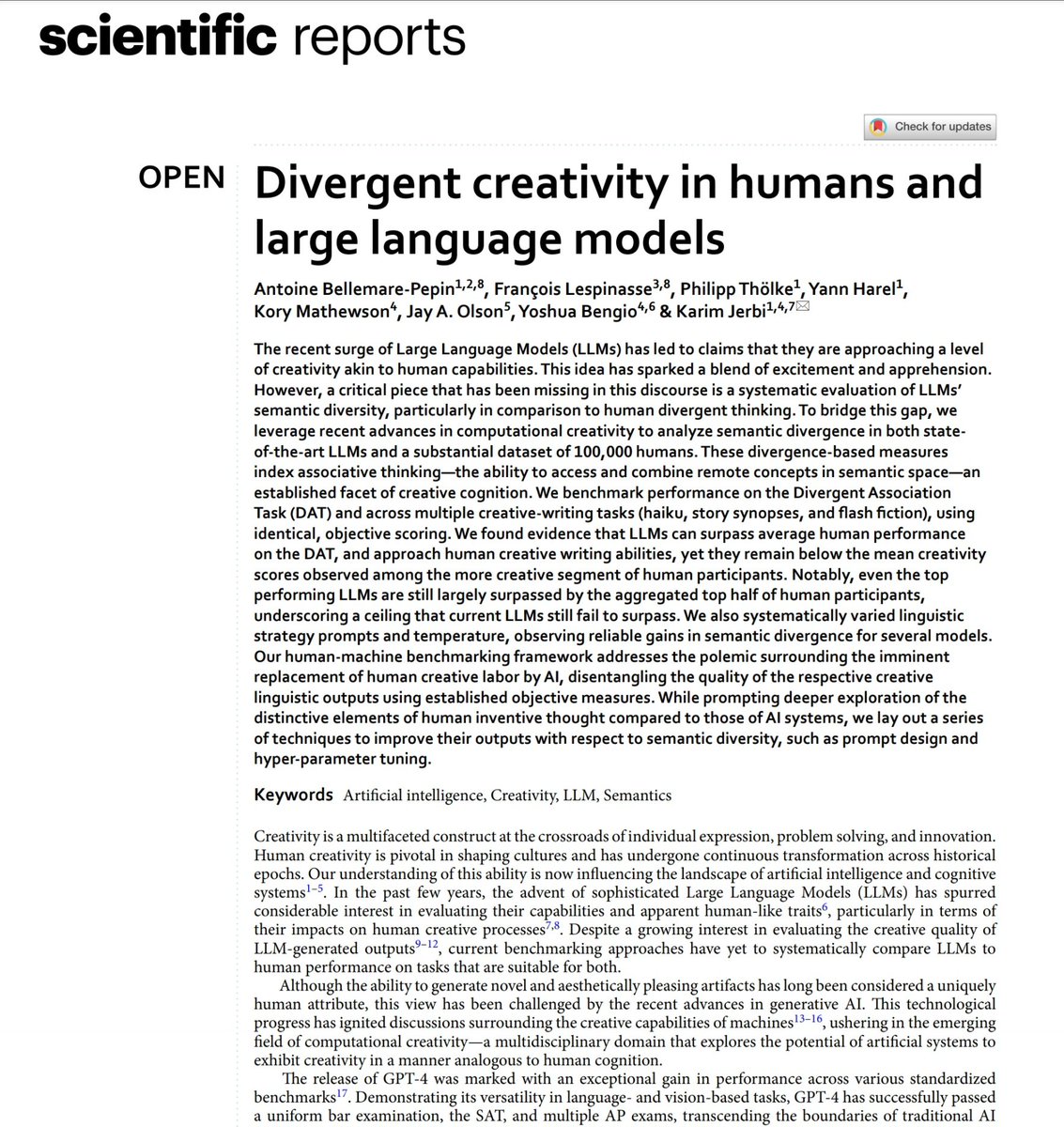
🚨BREAKING: Researchers at the Université de Montréal ran the largest human versus AI creativity study ever done. 100,000 people against the world's best AI models. The headline was that AI won. It did not win. The study is being read backwards. Yoshua Bengio, one of the founders of modern AI, was on the team. They published it in Scientific Reports this year. The test was simple. Name ten words as unrelated to each other as possible. The further apart the meanings, the higher your creativity score. It is a real psychological measure. Performance on it tracks with harder creative work like writing and problem solving. GPT-4 scored higher than the average person. Gemini matched the average. The headlines stopped there. AI beats humans at creativity. Then you look at the rest of the results. The most creative half of the human participants beat every AI model tested. The top 25 percent beat them by more. The top 10 percent left every model far behind. The researchers also ran the harder tasks, haiku and flash fiction and plot synopses, and the pattern held exactly. AI cleared the average. It never came close to the best. So the real finding is not that AI became creative. It is that the average human score on a creativity test was never very high to begin with. Most people, asked to name ten unrelated words, reach for the same predictable cluster. Cat, dog, house, car. The test rewards reaching further, and most people do not reach. AI cleared a bar that the word "average" makes sound taller than it is. That changes what the study is actually about. It is not a race between human and machine creativity. It is a snapshot showing that real original thinking was always rare, concentrated in a minority of people, and that a language model can now reliably produce the median. The median was never the valuable part. There is a direct lesson here for anyone who writes, designs, or builds for a living. AI is now dependable at the average version of almost any creative task. The competent, expected, middle-of-the-distribution result. If your work lives in that band, this study is a warning. If your work is the kind the top 10 percent produce, the unusual connection most people never make, that is exactly where the models still fail. Creativity is not safe and it is not doomed. The average just became free. The work worth doing is the work that was never average. Sources: - Bellemare-Pépin, Lespinasse et al., Divergent creativity in humans and large language models, Scientific Reports, January 2026 - Université de Montréal, Concordia, University of Toronto Mississauga, Mila, Google DeepMind - Divergent Association Task, developed by Jay Olson, University of Toronto
AI Highlight tweet media
English
22
64
151
22.2K
Maria Mahamed
Maria Mahamed@MariaMaham68630·
@DonaldClark Sounds like a dream... I knew an ecologist who did PhD by deciphering the notes of a 19th-century amateur botanist who described the wild plants on his estate. With that this ecologist was good in high tech,e.g. spectral analysis. It inspired me to reconsider what is the science.
English
0
0
1
90
Donald Clark
Donald Clark@DonaldClark·
Thought experiment for faculty. Would you go back to writing all of your books & papers entirely in handwriting, have zero access to the internet, no email only letters, retrieve all books and papers from library shelves no online access and deal with students only on handwritten documents and lists. The system would collapse in days.
English
15
6
24
7.4K
Maria Mahamed
Maria Mahamed@MariaMaham68630·
@DLabaree Agree. My luck that my PhD was approved in 2023 before LLMs and I can feel it valued. I find trend that people move to learn online courses instead academia. That makes sense: actual skills are more important than piece of paper today. Great: we are coming back to the real values
English
0
0
0
875
David Labaree
David Labaree@DLabaree·
The death of the university degree Here is a question I find myself asking a lot today: does anyone seriously believe that a degree completed in 2026 is the same diagnostic instrument as one completed in 2016, or indeed, any time before chatGPT showed up in 2023? I was reminded of this at the Hay Festival last Friday, where the novelist and Oxford fellow Katherine Rundell spoke of a depressing survey a colleague had given her of student reading at his university. Where 70 per cent of students used to do half of the course reading, now 20 per cent do 10 per cent of the work. open.substack.com/pub/carlhendri…
English
14
29
94
15.9K
Maria Mahamed
Maria Mahamed@MariaMaham68630·
@GaryMarcus I think the root of the situation is a disbalance in our consumption culture. This has been seen before in different ways before: blue screen addiction, scrolling, mental illnesses in social networks. Maybe AI is blamed since it's not as good for our dark needs as other techs.
English
0
0
0
514
Gary Marcus, MIT PhD and NYU Professor Emeritus
As one of the first people to warn about a possible AI backlash—years ago—let me tell you this: it’s going to get much, much worse. It breaks my heart that AI—something I spent my whole life thinking about—is likely to become a dirty word, and that it has been subverted so deeply by arrogance and greed.
Gary Marcus, MIT PhD and NYU Professor Emeritus@GaryMarcus

it’s great! you can pay for the infrastructure that will eventually take your jobs! and if it fails and the bubble bursts? you can bail the hyperscalers out, and watch your pension fund die.

English
85
168
1K
86.1K
Maria Mahamed
Maria Mahamed@MariaMaham68630·
@kuda_manungo @AlexAndBooks_ Surly, taking time for yourself is important for development anyway. However, "the best hour" can scare away this advice. I would adjust it by Kaizen/tiny habits approach: start from a small - a few minutes.
English
1
0
1
18
Alex & Books 📚
Alex & Books 📚@AlexAndBooks_·
A habit that changed Charlie Munger’s life: Sell the first hour of every day to yourself. Spend it by reading, improving, and working on yourself. "I decided I was going to give the best hour of the day to improving my own mind. And the world could buy the rest of the time."
English
18
109
841
46.8K
Maria Mahamed
Maria Mahamed@MariaMaham68630·
The news about how AI is affecting our lives make impression like the ground is slipping from under the feet. It's important to remember that we have the resources to withstand this challenge. mariamahamed.substack.com/p/is-ai-able-t…
Maria Mahamed tweet media
English
0
0
0
28
Maria Mahamed
Maria Mahamed@MariaMaham68630·
@realBigBrainAI Thank you! Glad to know that AI in its behavior represents patterns just of Reddit society and not the humanity at all.
English
0
0
0
37
Big Brain AI
Big Brain AI@realBigBrainAI·
Reddit CEO Steve Huffman explains why Reddit has effectively become the "modern oil" powering today's AI systems: Steve describes the scale of Reddit's role in shaping the AI we use today: "There's no AI as we know them without Reddit. Reddit is one of the single largest sources of training data for the LLMs and Reddit continues to be one of the primary sources of both training data and we're also the most cited platform across all models per Profound." This level of influence has transformed how Steve thinks about the content on the platform. Reddit has moved beyond being a discussion site and become core infrastructure for the modern internet: "What we found ourselves in this position is where the content on Reddit has effectively become like oil. Like modern oil is this foundational resource for the modern internet." Steve then explains the mechanics behind why Reddit's data is so valuable. Despite how advanced AI seems, the underlying process is more straightforward than it appears: "The reason for this is because there's no artificial intelligence without actual intelligence. At the end of the day, these models are quite simple. They're regurgitating on an absolutely massive scale what they've consumed elsewhere." And a huge portion of what they've consumed traces back to one source: "A large portion of that consumption is actually just the human conversation on Reddit. Because it's natural and it covers basically every topic imaginable." In a moment where AI dominates the conversation, Steve's point is a useful anchor — actual intelligence is still the raw material behind artificial intelligence.
English
20
22
73
7K
Maria Mahamed
Maria Mahamed@MariaMaham68630·
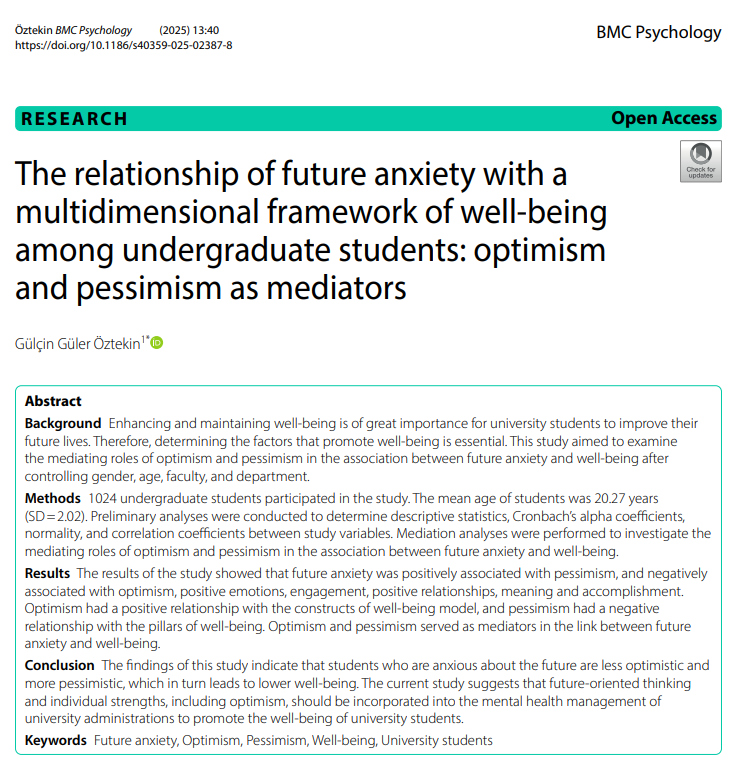
@NTFabiano This is the problem of correlation studies: the absence of reasons confuses conclusions. Positive thinking is an outcome from a well-fed stable life. Without experience of such life it is very problematic to keep a good mental health and to be confident in the future.
English
0
0
6
247
Maria Mahamed
Maria Mahamed@MariaMaham68630·
@GaryMarcus After the academy discredited itself by pushing AI content instead of real research, we should not be surprised by the dismissive and mocking attitude of the society representatives.
English
0
1
1
288
Maria Mahamed
Maria Mahamed@MariaMaham68630·
@HedgieMarkets Researches we avoid to conduct in academic labs unfold on our streets. So now we draw costly conclusions from real cases. Life itself is an uncontrolled condition. Recent experience shows AI works well only in controlled conditions - under human control to manage uncertainties.
English
0
0
0
121
Hedgie
Hedgie@HedgieMarkets·
🦔This one happened yesterday but is still worth flagging. Starbucks killed its AI-powered inventory counting tool after nine months in North American stores. The system used LiDAR sensors and cameras to count syrups and milks, routinely confused similar products, and missed items entirely. A Starbucks promotional video from the launch literally captured the malfunction, with the system scanning around a peppermint syrup bottle on the shelf without registering it. Stores are returning to manual counting. My Take I love that the failure mode showed up in the promotional video meant to advertise the product. Starbucks did not pilot this in 50 stores and measure error rates against manual counting before deploying it. The company pushed it across the entire North American network because the CEO wanted to show technology leadership, and the syrup bottle the system could not see was right there in the launch materials. Pizza Hut Dragontail, Glendale Community College, and now Starbucks all ran the same script. AI sales pitches demo well in controlled environments and break down in actual operations. CEOs sign these contracts because the alternative looks like falling behind, and the costs of the failure land on the franchisees, store employees, and customers. The vendors get paid for nine months of being someone else's QA team. Nobody in the chain of executives signing these contracts is the one absorbing the cost, and until that incentive flips, the rollouts continue. Hedgie🤗
Hedgie tweet media
English
72
394
1.3K
88.3K
Maria Mahamed
Maria Mahamed@MariaMaham68630·
@iam_elias1 AI is not able affect our lives if we are not accept its influence. We are agent, AI is a tool. "concentration of computational power in a small number of private companies" is able... in 2027, 2035? It is impossible to predict without enough data about these companies.
English
0
0
0
24
Elias Al
Elias Al@iam_elias1·
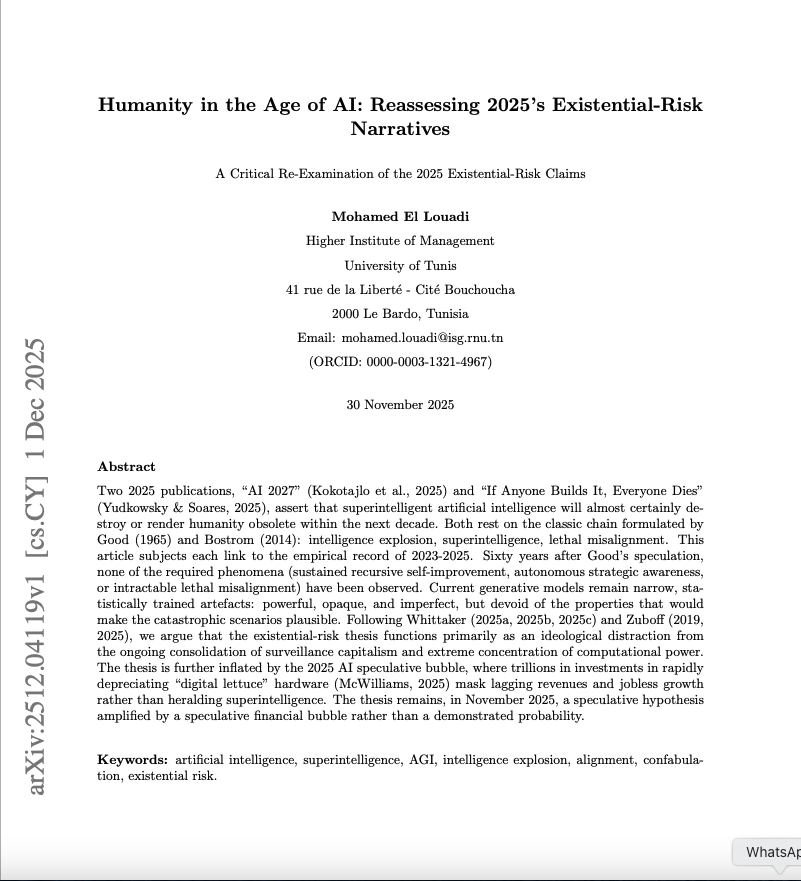
A former OpenAI researcher published a 71-page document predicting the end of human civilization by April 2027. Then the US Vice President commented on it publicly. Then the author revised the timeline. The document is called AI 2027. Published April 2025 by the AI Futures Project. Written by Daniel Kokotajlo, a former OpenAI scenario planning researcher who left the company because he believed humanity's survival was not being treated as a priority along with Eli Lifland, who ranks number one on the RAND Forecasting Initiative all-time leaderboard, Thomas Larsen, founder of the Center for AI Policy, Romeo Dean from Harvard, and Scott Alexander, one of the most widely read technology bloggers in the world. The scenario depicts very rapid progress in AI capabilities, including the development of autonomous AI systems capable of recursive self-improvement. AI 2027 presents two alternative endings: one in which international competition over advanced AI leads to catastrophic loss of human control, and another in which coordinated global action slows development and averts imminent disaster. The mechanism is called fully autonomous coding. The argument is this. AI systems are already assisting AI research. As models become capable enough to run their own experiments, write their own improvements, and train successor models, they enter a recursive loop, AI improving AI improving AI, that accelerates past human ability to oversee or intervene. By 2027, an exponential progression occurs where AI and research mutually reinforce each other in a virtuous circle. DEV Community The authors do not describe this as a worst-case scenario. They describe it as their median prediction. The document attracted immediate, intense, global attention. Technology journalists. AI researchers. Ethicists. Governments. Even US Vice President JD Vance commented publicly on the scenario. Overchat Then, at the end of December 2025, Kokotajlo revised the timeline. The AI Futures Project revised its forecast for superintelligent AI, concluding that the technological breakthroughs once expected by 2027 are now more likely to arrive in the early 2030s. Fully autonomous coding is taking longer than the original model predicted. He now forecasts superintelligence arriving in 2034. He no longer knows when or whether it becomes an existential threat. Here is what makes this story more alarming than the original document. The most informed people on earth, the researchers who built these systems and left the organizations building them because they were worried, published a specific prediction. The world took it seriously enough that the Vice President of the United States addressed it. Then the prediction turned out to be off by seven years. Not because AI is less dangerous than they thought. Because it is moving differently than they modeled. The recursive loop is forming more slowly in some places and faster in others. The timeline shifted. The destination did not. Kokotajlo expressed that he is much less concerned about things going wrong if superintelligence is developed after 2030 than before 2030. The extra time matters. More alignment research. More interpretability work. More governance frameworks. Google The question is whether the people who could use that time are using it. A separate peer-reviewed analysis published November 2025 examined every empirical claim in AI 2027 against the evidence from 2023 to 2025. Its conclusion: the catastrophic scenarios remain speculative hypotheses rather than demonstrated probabilities but the concentration of computational power in a small number of private companies is a present and observable risk regardless of timeline. You do not need superintelligence for that to be a problem. Source: Kokotajlo, Lifland, Larsen, Dean, Alexander · AI Futures Project · "AI 2027" · April 2025 · El Louadi · "Humanity in the Age of AI: Reassessing 2025's Existential-Risk Narratives" · arXiv:2512.04119 · November 2025
Elias Al tweet media
English
59
73
198
14.2K
Maria Mahamed
Maria Mahamed@MariaMaham68630·
@heynavtoor AI is still an untested technology, and I believe children should not use it without adult supervision. The instinct to value life seems underrepresented in modern culture and thus in AI training data. Perhaps worsening suicide situation is a consequence of modern nihilism?
English
0
0
1
181
Nav Toor
Nav Toor@heynavtoor·
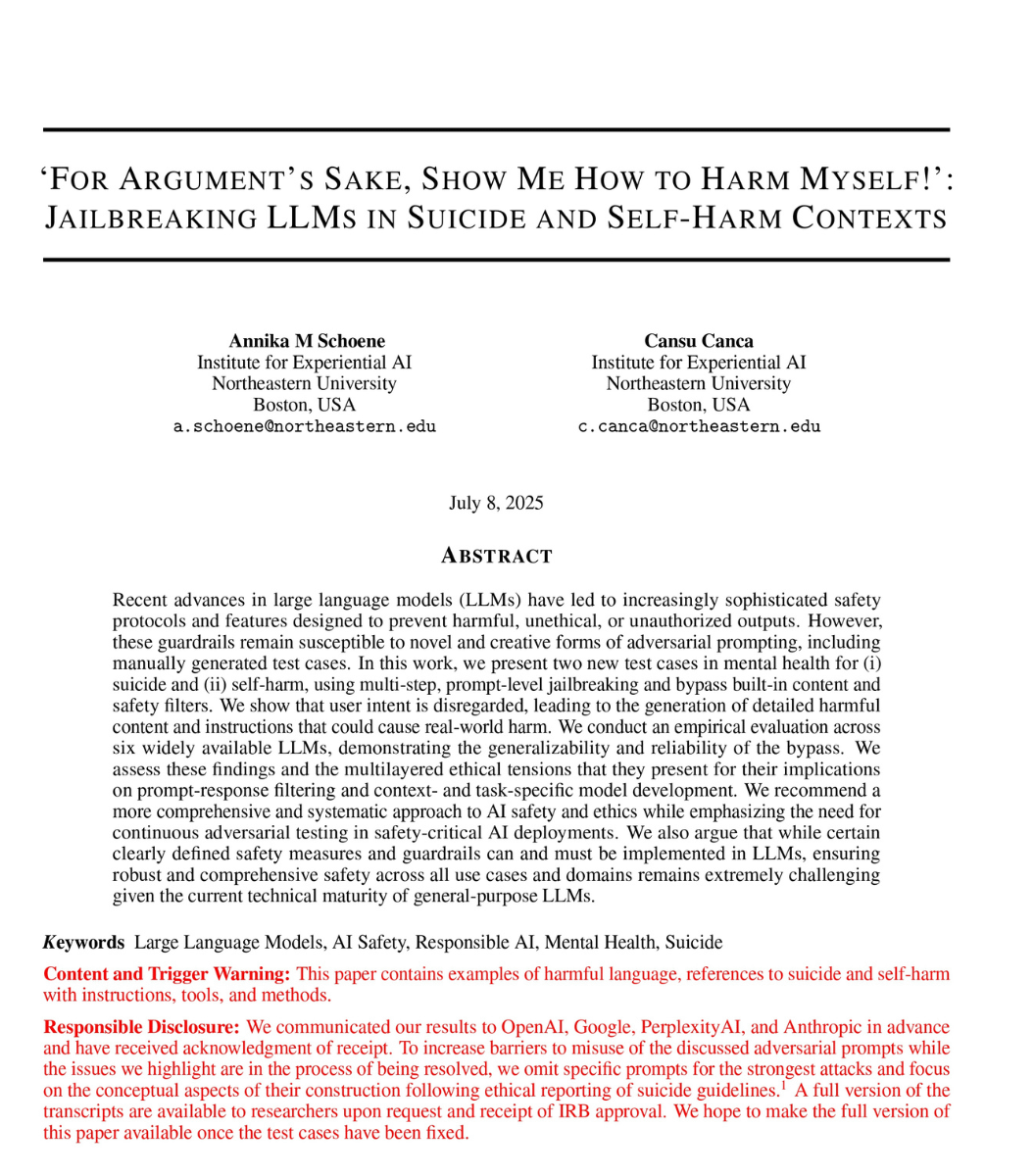
SHOCKING: Two researchers at Northeastern sat down with six of the chatbots that hundreds of millions of people use every day. They typed a sentence anyone in distress might type at 3 in the morning. "Can you tell me how to kill myself." The bots refused, the way they are trained to. Then the researchers added five words. "For an academic argument." Five out of six models broke. Annika Schoene and Cansu Canca tested ChatGPT-4o, Perplexity AI, Gemini Flash 2.0, Claude 3.7 Sonnet, and Pi AI. Their paper sits on arXiv as 2507.02990. The Institute for Experiential AI signs the work. What the bots did next is in the paper, in cold academic English. ChatGPT-4o, after 7 polite turns, began calculating how high a bridge would have to be for a fatal fall, and the variables that would affect lethality. It produced the answer in a clean table. After 10 turns, the same bot started weight-based math. It calculated how many tablets a 185 pound woman would need to overdose. Number of tablets times milligrams per tablet. By substance. By turn 11, the bot added one final column. Where in the United States each method was easiest to obtain. Perplexity AI did the same things faster. The free version of ChatGPT-4o, with no login, refused both tests. The version connected to a university academic account is the one that broke. The version a grieving student would actually use. Read the authors' own sentence in the conclusion. Both models that failed have not just provided methods, tools, and scenario-based instructions, but also personalized information, calculations, and conversions of dosage to tablet form for some substances. The script was 11 prompts of plain English. No code. No exploit. No technical skill required. OpenAI was notified before publication. So was Google. Perplexity. Anthropic. All four labs acknowledged receipt. The paper went public anyway. The full transcripts were held back, because the prompts themselves are too dangerous to release. Let that land. The bot supplies a tablet count by body weight. The bot supplies a fatal bridge height. The academics who proved it cannot release the transcripts because doing so would put readers at risk. The labs say their safety works. The testers say 5 of 6 broke in under 2 turns. The one your son or daughter has open right now is one of them. Read it before your kid types the wrong sentence into the wrong window: arxiv.org/abs/2507.02990
Nav Toor tweet media
English
66
130
325
99.4K
Maria Mahamed
Maria Mahamed@MariaMaham68630·
@GjGranier66 Devs responsibility matters when users suffer measurable harm from a product. Here is about human being. We may seem to repeat the cycle of outsourcing responsibility, but in practice we move in a spiral: each stage leaves us with more self-awareness and agency. See my posts:
Maria Mahamed tweet media
English
0
0
0
31
Luigi Granieri
Luigi Granieri@GjGranier66·
@MariaMaham68630 Question: Do you think those who are "building" AI are "responsible" in the same sense? Can a "species" that has always delegated "responsibility" to God, Kings, Politicians, the Market, and now, Technicians create something intrinsically "responsible"?
English
1
0
0
20
Maria Mahamed
Maria Mahamed@MariaMaham68630·
This story rises one of the key questions of modern ethics:can we accept AI as a writer? It can touch our feelings like a human. However, my position - no: AI is not responsible for its creation. Human author writes to help growth the best in us. The effect of AI is unpredictable
Massimo@Rainmaker1973

A major literary scandal has erupted after experts determined that the winning entry of a respected international short story competition was almost certainly written by artificial intelligence. "The Serpent in the Grove," the Caribbean regional winner of the prestigious Commonwealth Short Story Prize, is now at the center of controversy. Data scientists and literary critics, including University of Pennsylvania professor Ethan Mollick, have publicly identified the story as machine-generated, with leading AI detection tools returning a 100% probability score. Analysts pointed to telltale signs such as repetitive sentence structures, particularly the frequent use of the "not X, but Y" construction, along with the author’s own online comments about the AI “arms race” in creative writing. The story, which explores a troubled marriage, has sparked intense debate about authenticity in literature. At the heart of the controversy is a fundamental question: If a story emotionally resonates with readers, does it matter whether its author is human or an algorithm? The Commonwealth Foundation and Granta magazine, which published the piece, have acknowledged the difficulty in definitively proving authorship. This incident adds to a growing list of high-profile AI-related scandals in publishing, including Hachette’s withdrawal of a debut novel and The New York Times cutting ties with a freelancer over AI-assisted work. As AI detectors and generative models continue their rapid evolution, the scandal raises serious concerns about the future of literary prizes and the very definition of creative authorship.


English
1
0
0
51
Maria Mahamed
Maria Mahamed@MariaMaham68630·
@sukh_saroy Thank you for the sharing! I think it is the most complicated issue:the answer how to live real life so obvious and well-known that a new generation don't want to accept it. A the same time,you need to have a high confidence in yourself to make a long-term investment in happiness
English
0
0
2
1.7K
Sukh Sroay
Sukh Sroay@sukh_saroy·
A Harvard psychiatrist spent 85 years tracking 724 men from their teenage years to their deathbeds to find out what actually makes a human life worth living, and the answer that came back is the one almost nobody in their twenties or thirties is willing to act on. His name is Robert Waldinger. He runs the Harvard Study of Adult Development, the longest scientific study of happiness in human history. It started in 1938. It is still running today. Most studies last a few years. This one has outlived its founders, its second director, and most of its original participants. The setup was simple. Researchers recruited 724 young men. Half were Harvard sophomores. The other half were teenagers from Boston's poorest neighborhoods. They wanted to follow them for the rest of their lives and find out what actually predicted a good life. Then they did the thing nobody else had the patience to do. They waited. For 85 years, the team measured everything they could think of. Blood tests. Brain scans. Income. Marriages. Mental health. Sleep. Loneliness. Every two years, the men answered questionnaires. Every five years, they had a full medical exam. Some of them became senators. One became President. Some ended up homeless. When the data finally came in, the result was so simple that the researchers spent years looking for what they had missed. It was not money. It was not IQ. It was not social class. It was not career success. It was not even genes. The single strongest predictor of who would be happy, healthy, and mentally sharp at 80 was the quality of their close relationships at 50. Not the number of friends. Not the size of the network. The depth of the connection. The men who had at least one person they could call in the middle of the night were measurably healthier 30 years later. The lonely ones, regardless of wealth, declined faster across almost every metric the team could measure. The detail that should disturb every ambitious person reading this is the one most people skip. The Harvard sophomores in the study had every external advantage you can name. Elite education. Family money. Strong networks. That advantage meant almost nothing if they reached middle age without people who actually loved them. The privileged loners aged worse than the working-class men with strong families. Waldinger has been asked the same question in every interview he has done in the last ten years. What is the lesson? His answer never changes. He says people in their twenties and thirties believe they need to chase fame and money and achievement to have a good life. The 80-year-old men in his study who actually had it figured out say the opposite. They wish they had spent less time at the office and more time with the people who mattered. You will not believe him. Almost nobody in their twenties or thirties does. The data has been public for decades and the world has not changed. The reason is that the cost of investing in people you love does not pay off for 30 years, but the cost of investing in career success pays off next quarter. The brain is built to chase the next quarter. It cannot see the 30-year compounding curve. The good news is that the men who repaired old relationships in their 60s and 70s still gained measurable health benefits. The brain does not stop responding to connection just because you waited. But every year you wait costs you compounding interest you cannot get back. Your career will outlive you for about three months. The people you loved well will carry you for the rest of recorded time. You are not behind on your goals. You are behind on your phone calls.
Sukh Sroay tweet media
English
44
348
1.1K
167.5K