Mark Stephany
10K posts

Mark Stephany
@Mark_MNLocal
Husband, father, physician, cyclist, btc - If you risk nothing, then you risk everything. President @BTCPhysicians 501c6 🟠 Advisor @SOUND_HSA


zcash is literally the highest expression of crypto technology and ppl are asking “why the hype” are you fucking retarded or something?


Minnesota Governor Tim Walz signed H.F. 3709 into law last week, making Minnesota one of the latest states to explicitly authorize banks and credit unions to offer cryptocurrency custody services. The law, which takes effect August 1, 2026, allows state-chartered banks and credit unions to hold digital assets on behalf of customers in both fiduciary and nonfiduciary capacities. Institutions must maintain written policies covering risk management, cybersecurity, and business continuity, and are required to give the state banking commissioner 60 days' notice before launching custody services. Customer digital assets must be segregated from the institution's own holdings. The bill passed with overwhelming bipartisan support. The House approved it 130-4 before the Senate passed it 51-16. After reconciling amendments, the House repassed it 119-6. Minnesota joins Wyoming, Texas, and a growing list of states building legal frameworks for digital asset custody at the state level. The law also allows banks to use qualified third-party service providers to facilitate custody, as long as the bank retains oversight and compliance responsibility. The state banking commissioner retains authority to limit or condition any bank's custody activities if they're determined to be unsafe or unsound.

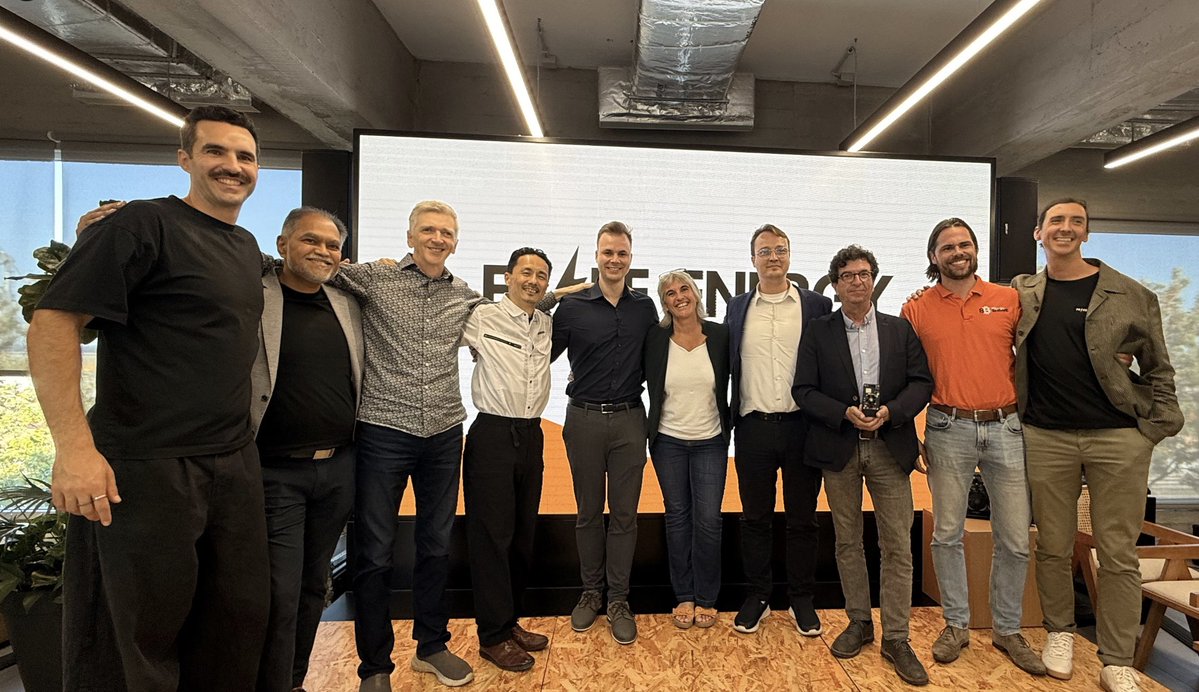
I just got back from the Bitcoin Energy Summit in Lisbon and I have a question that won't leave me alone. First some context: Bitcoin mining is now stabilizing the grids of 7 nations, 4 agencies (including the Spanish Govt and the World's largest energy policy association) just called for more flexible demand being critical to the resilience of the grids of the future - and Bitcoin mining is the world's most flexible load resource by an order of magnitude. So in light of this my question is this: why is 95% of the Bitcoin adoption conversation about Bitcoin-as-money when Bitcoin-as-energy is already deployed on grids across 3 continents? Is it possible that energy is the Bitcoin usecase that paves the road for mainstream acceptance of Bitcoin in the West? I've been in this space for four years now. When I started, the conversation was "bitcoin mining wastes energy." A group of Bitcoiners including @thetrocro, @jyn_urso and others changed that. Then it became "ok maybe it doesn't waste energy, but it's not useful." @gladstein, @jack and others changed that too. But here's what I noticed in Lisbon. Three separate European organisations - the European Bitcoin Energy Association, Free Madeira, and the Institut National de Bitcoin in France - are all independently converging on the same conclusion. @geyer_rachel, Chair of EBEA said energy is what will move the needle for Bitcoin in Europe. @andreloja at @FREEMadeiraOrg said energy is the most topical issue in Europe right now. Bastien Desteuque (@Proxy18387764), directeur général at @BitcoinPolicyFr said they're focusing on mining because France has spare nuclear capacity and that's where the biggest opportunity is. Three organisations. Same conclusion. And that's before you get to what's actually being built. In Sweden, a man I coach runs ASIC hardware that earns almost two-thirds of its revenue from frequency regulation - keeping the lights on, responding in seconds to the need of the grid operator, and helping to stabilize the grid an incredible 11,247 times last year alone. (Yes, you read that sentence right). In Lisbon, I watched Kenji Tateiwa present a circular economy where bitcoin mining heat grows tropical fish and the CO2 gets converted to charcoal and micro diamonds. Bastian outlined how France's surplus nuclear energy could be absorbed by bitcoin mining by 2027. And outside the West, from stabilizing the economy of Bhutan post-covid to helping save Virunga National Park in Africa - Bitcoin mining was behind both events and many more. This phenomenon is a global one. The conversation has quietly moved from "does bitcoin mining help grids?" to "how many services can one machine provide?" We've been thinking about this like monoculture - one machine, one function. What I saw in Lisbon is permaculture. The same hardware doing frequency regulation, heat capture, Sats-minting ... and potentially in the near future - voltage regulation (something that would have prevented the 28 April 2025 Iberian Peninsular Blackout). I talked to Bitcoin founders after the keynote who told me the energy thesis had opened their eyes. These are people who worked to advance Bitcoin payment infrastructure, and they hadn't fully grasped this. Bitcoin solves a monetary problem the world is only beginning to understand. I'm more convinced of that than ever. And ... as we wait for that revolution to be fully grasped, the energy revolution is already here - deployed, generating revenue, stabilizing grids. It might just be the thing that opens the door for everything else. What other Bitcoin use case is this far along ... at least in the West?


Bitcoin is not a hedge. Bitcoin is a speculative new system. Many are confused by this.


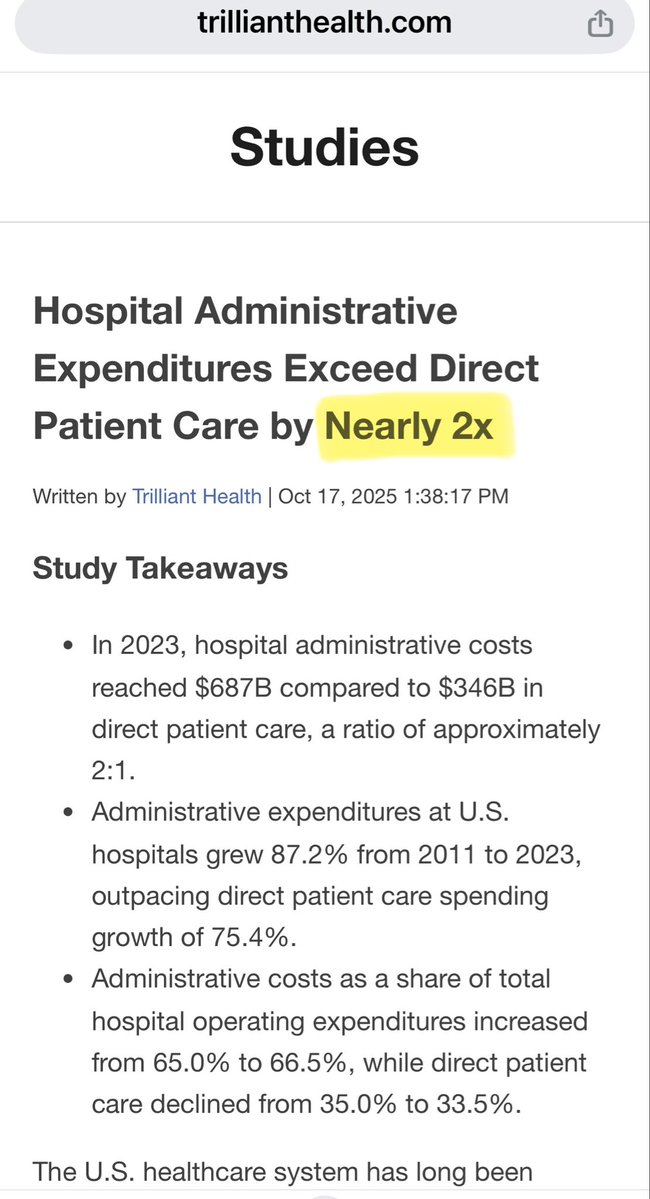
if every doctor in the US worked for free, healthcare costs would go down ~8% meanwhile: MSOs take ~20–30% of practice revenue TPA/ASOs take ~10% of insurance premiums the US has built an enormous economy around healthcare without adding much more care


Hospitals have dramatically failed to improve labor productivity the way other sectors of the market economy have. Over the last three decades, labor productivity in the private nonfarm business sector increased 78%. Hospital labor productivity was essentially flat. Paragon’s new paper explains how government policies contribute to hospital inefficiency. t2m.io/wYsYB3T


Sen. Lummis' remarks on Sen. Kim's amendment are true: There is so much new BSA authority in this bill. There will be so much more collection of intimate data about innocent Americans as a result. That this still is not acceptable to surveillance hawks is disappointing.

HUGE. Looks like we got a non-partisan vote out of Senate Banking with the BRCA still intact. I'm thrilled. The last minute compromise reflects Coin Center's analysis from last January, there were some steps forward since then and then back but we are feeling very comfortable.