

Markus Covert Lab
71 posts
Markus Covert Lab
@MarkusCovertLab
Building computer models of cellular systems to predict complex behaviors. And having fun doing it! Also department chair and #1 fan, @bioe_stanford ❤️
Stanford University Katılım Haziran 2024
362 Takip Edilen505 Takipçiler

“We’re living in the best time in the history of the world for solving unsolvable problems”
Well said @MarkusCovertLab!
English
How would we go about spearheading a Human Cell Project? By request I’ll post some thoughts on this topic over the next few weeks.
First, we need a clear idea of what the goals are. For the sake of discussion, let me suggest two: (1) we want at least one *strong* annotation for 95% of the known functional (coding and non-coding) regions of the genome, and (2) the totality of this information needs to be made openly available, machine readable and encoded in a computational model that can make actionable predictions about cell behavior, including in response to different environmental or genomic conditions. As in the Human Genome Project, it makes sense to start with simpler (microbial) cells to develop the tech and intuition, and keep moving forward in complexity.
Today I’ll offer some thoughts on annotation and the data challenge, which is a huge effort that I think is sometimes misdirected. Specifically, a unified experimental effort would need to be more specifically directed to what is unknown – that’s where the uncharacterized functional regions lie.
For example, we and others have shown that a large fraction of the unknown genes in bacterial cells are related to interactions with other biological entities. Viruses, other microbes and mammalian cells or factors – adding any of these to the culture media will cause a number of uncharacterized genes to be upregulated and expressed. In order to characterize and annotate this large set of genes, we need new, more complex means of recreating the full spectrum of what cells experience in the wild!
This will help us to annotate, even across species -- for example, a few years ago we reported a system in which we prompted mammalian macrophages (part of the immune system) to swallow bacteria which were themselves harboring a virus called lambda phage. Around a quarter of the bacteria in your gut right now contain viruses like this.
The mammalian cells didn’t kill the bacteria directly. Instead, they released a peptide that activated the lambda phage, which then went on a rampage and killed all of the engulfed bacteria (as they say, "the enemy of my enemy is my friend"). This unexpected finding led to a number of novel annotations that you would never find in experimental data derived using simple media conditions, or interpolate from a model generated from such data.
So one thing we need to think about is how to systematically capture these interactions, ideally at scale but definitely quantitatively and over time. Innovators wanted, we need ideas here!
Maybe in the future I can talk more about dynamics, quantification, causality, curation and a detailed strategy for annotating those 95% of genes in future posts if people are interested.
sciencedirect.com/science/articl…
English
@robziman Thanks for the question! I'll share some thoughts on this in a subsequent post (maybe a week or so).
English

@MarkusCovertLab Thanks for the QT—curious: are you familiar with the work of Robert Rosen and others who have proven mathematically that some aspects of biology cannot be exactly replicated by computers even in principle?
Robert Ziman@robziman
@BoWang87 "One of his main results, as explained in his book Life Itself (1991), was the unexpected conclusion that (M,R) systems cannot be simulated by Turing machines" en.wikipedia.org/wiki/Robert_Ro…
English
Very true - it's time to call for a Human Cell Project, analogous to the Human Genome Project, to systematically and comprehensively characterize and model first the simplest and then the most complex cells. A moonshot to catapult biology to the next era🦠🚀💪 - let's go!!
Bo Wang@BoWang87
Really enjoyed @NatureBiotech's new commentary "Minimal life by computer": the road to a true virtual cell is not just bigger AI models. It’s AI + mechanistic biology. Pattern recognition can get you far. But if we want to simulate life, predict interventions, and actually understand cells, we need models with causal structure beyond just correlations. paper: nature.com/articles/s4158…
English
@OmicsOmicsBlog As a starting point, how about "95% of the coding regions in the cell have at least one defined functional/mechanistic annotation?" We could ramp up in complexity from there.
English
It’s worth noting the Human Gene be Project had a somewhat fuzzy actual goal (sequence all euchromatin) that could almost be objectively defined
It took two decades more to truly sequence a human reference genome
This idea, while interesting, has no objective finish line
Markus Covert Lab@MarkusCovertLab
Very true - it's time to call for a Human Cell Project, analogous to the Human Genome Project, to systematically and comprehensively characterize and model first the simplest and then the most complex cells. A moonshot to catapult biology to the next era🦠🚀💪 - let's go!!
English
Seung Kim is one of my favorite people on campus, a brilliant scientist and outstanding mentor. Lots of inspiration, wisdom and humor here! 🧪🌲❤️
Stanford Medicine@StanfordMed
Walk With Me: Seung Kim studies pancreatic biology and insulin-producing cells to advance regenerative approaches for diabetes. Hear what still inspires him about science -- and why Elvis Presley is on his lab walls. stan.md/walkwithme
English
A terrific article -- this one takes it even further, applying neuroscientist wet-lab techniques to try and understand the microprocessor "brain" of an old Atari game console. (Spoiler: they fail) Fun to think about in the context of AI and simulation! journals.plos.org/ploscompbiol/a…
Michael Koeris@mkoeris
Re-read it every few years. This however now needs to substitute to „how AI will understand biology“
English
@annewoj23 I remember when you showed us your orange hands in bio class and we all freaked out 🥕🖐️🤣
English
Back in the late 90s I had a job where I could get free carrot juice. 32 ounces a day. I learned the hard way that yes in fact you can turn orange!! I do not recommend it!!
yahoo.com/health/wellnes…
English
Great take from @NikoMcCarty on a terrific cell modeling study that came out in Cell this week. I was asked to comment for a news piece about it in Nature; here's the full text of what I wrote (with thoughts on AI-driven models vs more mechanistic models) in case it sparks further discussion:
Dear Ewen, thanks for reaching out and very exciting to see Zan and Zane's newest work! This work is a significant advance - the key part is including the kinetics, which most of the all-molecule simulations are not able to do. With regard to AI virtual cells, so far they are mostly promise and very little actual product, so it's hard to go into too much detail.
That said, one way to think about Zan's accomplishment is in the context of artificial life, or AL. Her lab and mine, and others, are focused on actually trying to build detailed representations of a living cell in silico. They are dynamic, holistic, and mechanistic, all of which adds many distinct advantages in contrast to what is being considered with AI.
For example, AL model simulations are explainable (that is, the simulated behaviors can be explained in terms of their mechanistic underpinnings), they actually require less data (but well-targeted, and of several different kinds), they are better suited to extrapolation, and interestingly, transfer learning is achieved through evolutionary theory (matching E. coli to a mycoplasma, for example), instead of (or in addition to) the traditional transfer learning methods that would be used for AI.
I anticipate that in the future, some of the best things we learn from AI and this next generation AL (first generation would be Conway's Game of Life, and stuff like that - but these new models move far beyond that) will be integrated, and that is an interesting future to consider. As my lab is currently demonstrating (to appear soon), these models can lead us to scientific questions that were never considered before, and making an impact in basic as well as applied science. Very exciting times!
* Note that several of these ideas came up in discussions with my lab members, they didn't all originate with me. Lucky to have a great team❤️
Niko McCarty.@NikoMcCarty
If you like this, then you may like my blog about biology: nikomc.com.
English
Count me in here - other seminal mathematical and statistical approaches have been invented while pursuing large-scale modeling goals (ie chaos theory and data assimilation in predicting weather) but biology has the most potential. What will we discover, and what will it enable?
The Atlantic@TheAtlantic
Many physicists have come to believe that a mystery is unfolding in every microbe, animal, and human—one that could redefine the field for the next generation, @AdamFrank4 writes. theatlantic.com/science/2025/1…
English
So honored to receive this award, can't wait to visit @UniMelb! And thanks a million to my incredible lab, a brilliant and wonderful group of people who inspire me every day ❤️🦠💻
Stanford Bioengineering@bioe_stanford
Markus Covert has been awarded the University of Melbourne’s 2025 Grimwade Medal! 🌟 The honor recognizes his pioneering work for constructing the first "whole-cell" computational model. @MarkusCovertLab @UniMelb biomedicalsciences.unimelb.edu.au/news-and-event…
English
QME

@MarkusCovertLab @AdamArkinLab @Tomita_M_Keio @ucsd_sbrg And Lattice Microbes by Zan Luthey-Schulten at Uiuc.
Deutsch
Somehow the term "virtual cell" has been co-opted to mean only AI-driven or foundation models, but the OG "Virtual Cell Project" was an ambitious effort by @lesloew and @jcschaff to facilitate building mechanistic models of cells. 1/2 sciencedirect.com/science/articl…
English
@anshulkundaje We ran a virtual cell challenge 10 years ago, exciting idea and outstanding teams - but again, participants found a workaround. As they say in experimental biology, "you get what you screen for" 🙃 Agreed @anshulkundaje, we need to more focus on design! journals.plos.org/ploscompbiol/a…
English

I've run challenges before and I came to the conclusion that they are extremely hard to get right especially for biological problems that simply cannot be distilled to a few metrics. They just get gamed. 1/
dalloliogm@dalloliogm
My second post on the Arc Virtual Cell Challenge. The challenge’s Discord forums are in turmoil. Some participants have discovered a trick to get to the top of the leaderboard. gmdbioinformatics.substack.com/p/arc-virtual-… #arc_virtual_cell_challenge #foundation_models
English
@ElowitzLab @NikoMcCarty Wait... "intrinsically" more interesting? Or do you mean "extrinsically"? 🤣 but in all seriousness, an awesome paper - catalyzed lots of great follow-on work as well @ElowitzLab
English
This experiment came to life when I realized the negative control (two genes, same regulation) was intrinsically more interesting—and easier!—than the "real" experiment I had been planning... Thanks
@NikoMcCarty!
Niko McCarty.@NikoMcCarty
Take two cells and place them side by side. Both cells have the same genome. And yet, oddly enough, they behave in different ways. They divide at different times and their RNA levels are distinct. Now let’s go one step further. Take those same two cells. But this time, imagine that they have not only the same genome, but completely identical molecules at identical concentrations. Will these two cells behave in the same way? The answer is no. This is because there are two types of "noise" inside of living cells; intrinsic and extrinsic. In the first example, the two cells act differently because of subtle differences in their gene levels. Not all genes are expressed at the same time or in the same amount, and this leads to slight differences. This is extrinsic noise, because it is “global to a single cell” but varies “from one cell to another.” In the second example, which is so statistically unlikely as to be basically impossible, the two cells would still have different gene expression patterns “because of the random microscopic events that govern which reactions occur and in what order.” This is intrinsic noise or stochasticity; it is an inalienable part of biology. I’m pulling these quotes from one of my all-time favorite papers, called “Stochastic Gene Expression in a Single Cell.” The first author is @ElowitzLab (of synthetic biology fame) and it was published in August 2022. It’s worth reading. For this paper, Elowitz & co. designed a simple experiment to separate intrinsic and extrinsic noise in a cell. Their goal was measure each source of noise to figure out which one dominates in different scenarios, like exposure to IPTG or the addition of a plasmid. So here’s what they did: First, they took E. coli cells and inserted two genes into the genome; one encoding a fluorescent cyan protein, and another encoding a fluorescent yellow protein. Each gene had the same promoter, and was placed equidistant from the genome’s origin of replication (but on opposite sides.) Next, they grew these cells in LB broth and photographed them using a microscope with color filters. The brightness of each color, in each cell, was quantified. If the variability between different E. coli cells stems from shared cellular conditions (like ribosome levels or extrinsic noise), then both colors in a single cell would fluctuate together. If the variability instead arises from random molecular events (intrinsic noise), then even within the same cell, the cyan and yellow levels would differ. If you plot these changes out on a scatterplot, then you can literally decode which “signals” or “triggers” are dominated by intrinsic or extrinsic noise, and by how much. This is a “beautiful experiment” because the experiment is so simple, yet it retrieves a huge amount of information. All they did was put two genes into an E. coli cell at symmetrical locations in the genome! And from that alone, they deconvoluted noise and its origins.
English
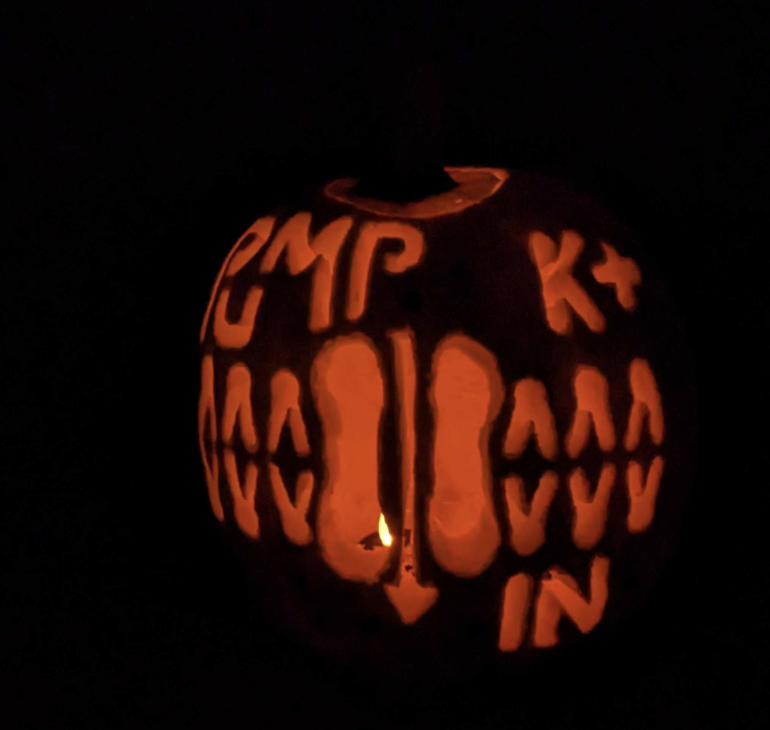
@NikoMcCarty Great article @NikoMcCarty! Since it's apropos and Halloween is coming up, I'll share my lab's amazing jack o'lantern, carved in the shape of a potassium channel, or "PUMP K+ IN." Aren't they the best?!? 🧡🎃🧡
English

My new essay is about atomic-scale protein filters.
Briefly: Cells are crowded and frenzied places.
Molecular machines convert raw inputs into highly ordered structures; DNA coils into chromosomes and proteins fold into precise three-dimensional shapes.
Outside the cell, by contrast, ions drift without gradients, and DNA and proteins exist mostly as scattered building blocks. Only a thin membrane separates the managed chaos inside from the high entropy outside.
If a cell’s membrane is punctured, the fluid within — made mostly of water — drains away, and the cell swiftly dies. And yet, the membrane must let molecules in (food, nutrients, ions) and out (waste, toxins, messages) for the cell to survive. The membrane does so by means of hyperspecific proteins that allow only particular molecules to pass. It is thanks to these atomic-scale filters that life can exist at all.
Two types of protein filters, aquaporin and the potassium ion channel, offer particularly elegant examples. Aquaporins let billions of water molecules pass in and out each second in a single file line, while blocking protons. Potassium channels conduct about 100 million K⁺ ions per second yet decisively reject Na⁺, a slightly smaller ion with the same charge.
Both of these proteins rely on geometry alone (namely, the precise placement of amino acids) to achieve their selectivity. And both demonstrate how seemingly complex problems are often solved in biology simply by positioning the correct atom, with the appropriate charge, at the perfect place.
GIFs by Ella Watkins-Dulaney for @AsimovPress
GIF
GIF
English

@MarkusCovertLab @eperlste Thanks! I started a section on your work, but I removed it because it was just getting way too long. Always been a big fan! Still in Memphis these days but hoping to get back late fall. Would love to take you up on the offer sometime.
English
OK. I posted a first attempt at spelling out some of my thoughts on the new race for virtual cell models. Overall, I'm excited, but also wary that we might repeat some of the same mistakes of the past.
English
@UriAlonWeizmann so glad you are okay, and so sorry to hear about the lab - you are a priceless treasure! 🎶❤️
Uri Alon@UriAlonWeizmann
When we came to see our destroyed labs hit by an Iranian missile, we found that a piano had survived @WeizmannScience
English