Matt

1.8K posts

Matt banner
Matt

Matt

@Matt_M_M

Austin, TX Katılım Nisan 2009
1.7K Takip Edilen247 Takipçiler
Matt
Matt@Matt_M_M·
@doodlestein Wow this looks cool. I was going to take the night off, but...
English
1
0
1
268
Jeffrey Emanuel
Jeffrey Emanuel@doodlestein·
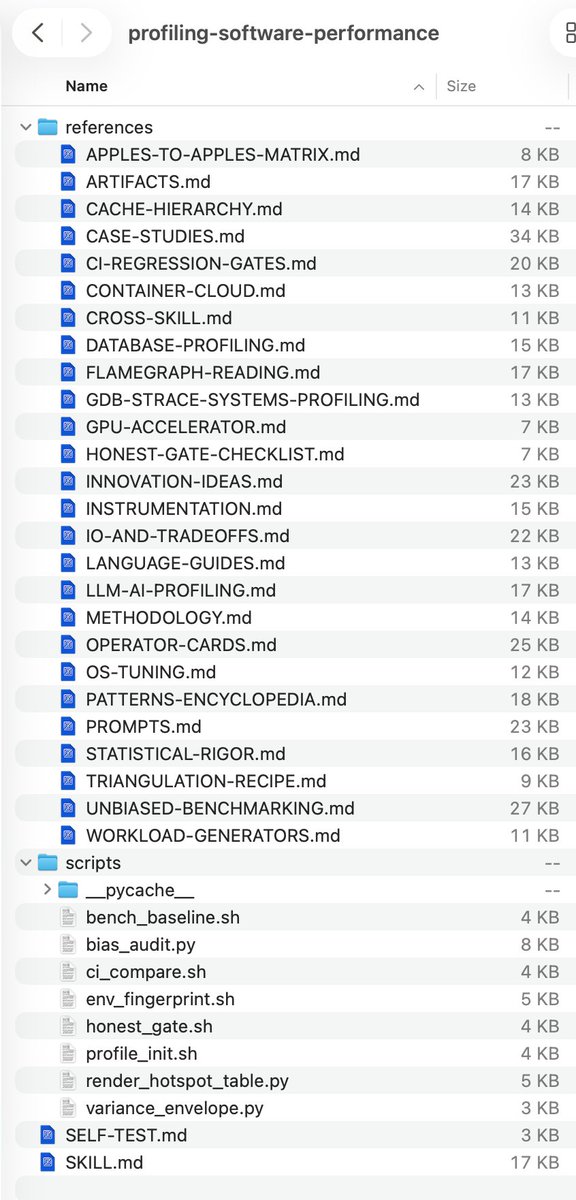
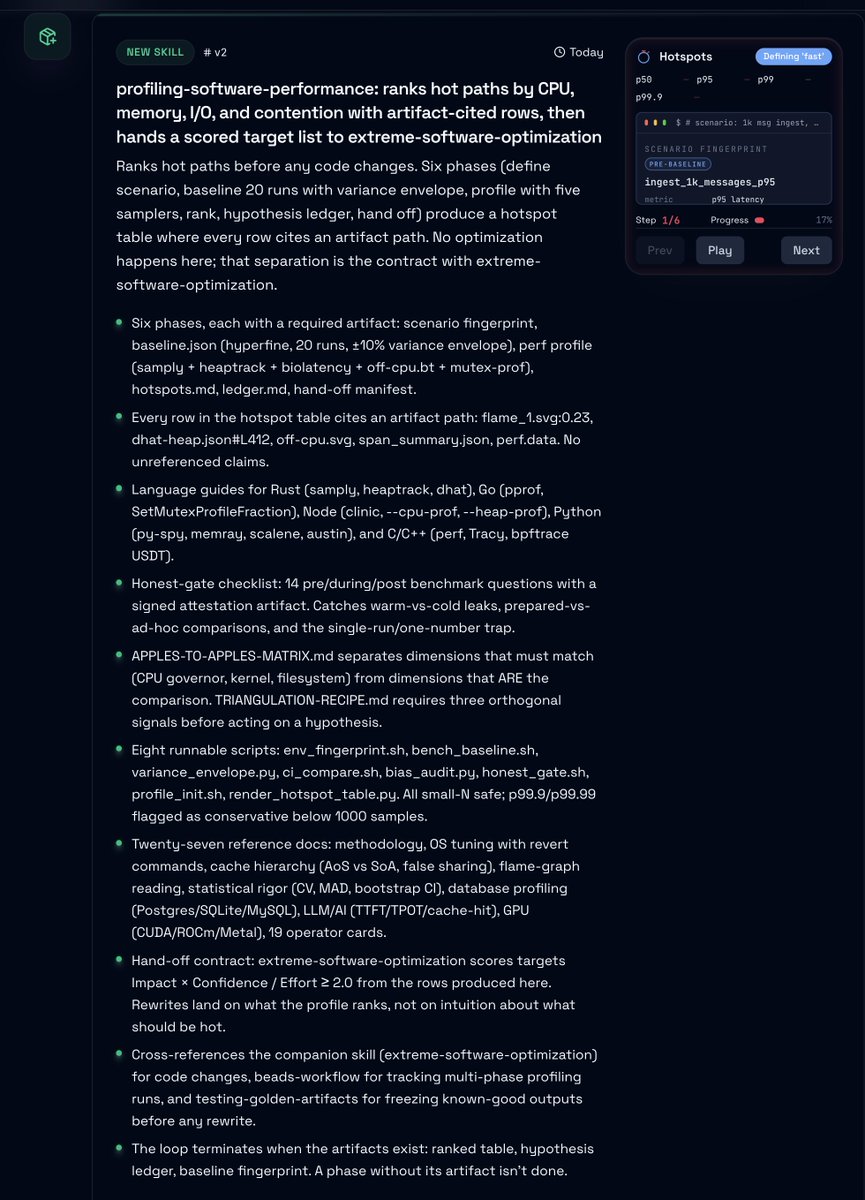
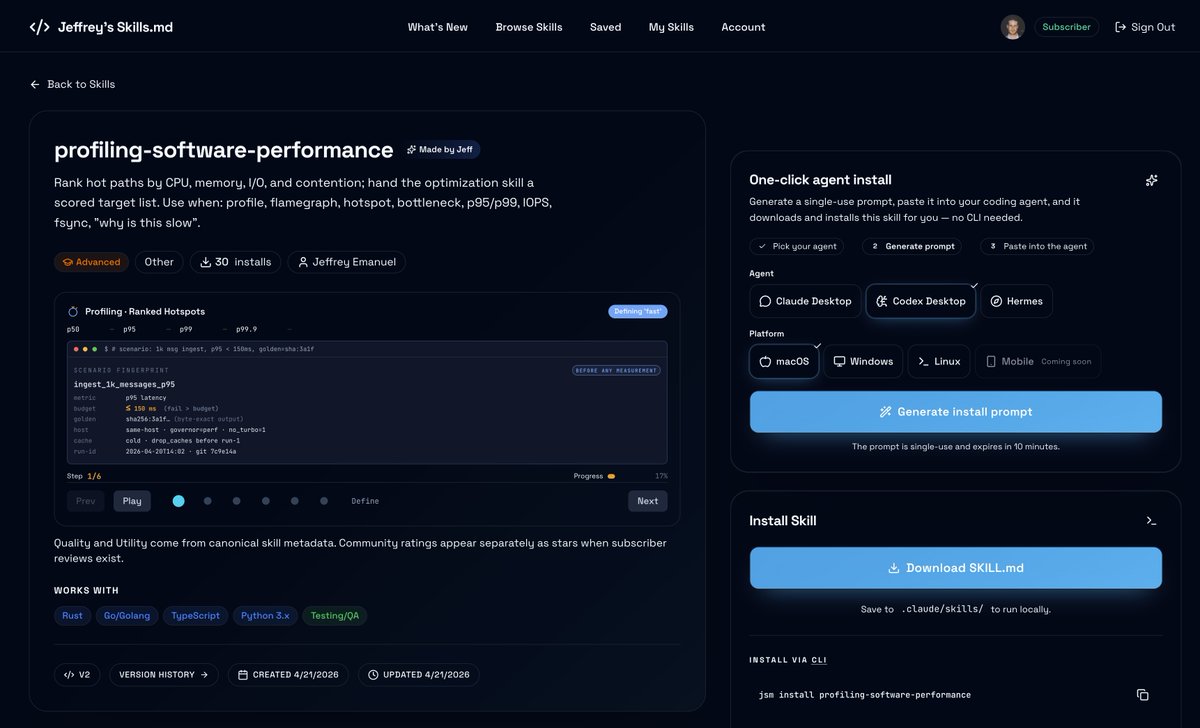
As many of you know, I'm currently working on dozens of complex open-source projects at the same time now, including things like FrankenTUI, asupersync, FrankenSQLite, and many others that I've posted about. As part of that work, I've had to do countless rounds of performance optimizations, which includes careful instrumentation, profiling, and benchmarking to determine the key hotspots in the project and where to focus attention to get the biggest benefit. Once you know where the problem areas are, you can then apply various strategies, including my /extreme-software-optimization skill, to carefully optimize performance while ensuring that all changes are isomorphic and carefully benchmarked and tested. But it's often not at all obvious where to look, and static code analysis can be very misleading, particularly when projects get more complicated, and you can get complex interactions between single/multi-threaded operations, I/O thrashing, caching, etc. And if you pick the wrong thing to focus on, it doesn't matter how clever you are or how many rounds of optimization you do: you're not going to move the needle much on what actually matters to bottom-line performance. To help with this issue, I developed my latest skill (available on jeffreys-skills.md), called /profiling-software-performance. It's based on thousands of my actual coding agent sessions across dozens of projects, which I trawled through using cass to find the "inner threads" and patterns that kept recurring so we could draw general lessons from them. It works for most common programming languages like Rust, Golang, TypeScript, Python, etc. and introduces an extremely sophisticated and powerful framework for handling this problem end-to-end in an automated, repeatable way. The skill spans 36 files, including 8 scripts, and totals 476kb of text, all of which has been heavily optimized for progressive disclosure to be as efficient and agent-intuitive as possible. I’ve now applied it over the past few days to many of my gnarliest projects, and it has really helped cut through the haze and focus attention on the key levers that actually matter. Once you know the real bottlenecks, you can attack them directly instead of guessing. That’s why it works so well together with the /extreme-software-optimization skill, which contains a huge range of concrete optimization strategies for addressing common performance issues and more specialized ones too. And once the objective is clear, the latest frontier models are shockingly good at helping drive that optimization work forward. So how does it work and why is it effective? Here's what GPT-5.4 has to say about what makes it special and useful: --- Its core value is simple: it forces ranked evidence before optimization. That is more important than it sounds. Most performance work fails because people jump from “this feels slow” to “let’s rewrite/cache/parallelize this.” This skill interrupts that reflex and turns performance work into a clean pipeline: DEFINE -> ENVIRONMENT -> BASELINE -> INSTRUMENT -> PROFILE -> INTERPRET -> HAND OFF What makes it useful is that it produces the artifacts an optimizer actually needs: a baseline fingerprint, a ranked hotspot table, and a hypothesis ledger. That means the next step is not “try ideas,” but “attack the highest-confidence, highest-impact target with evidence behind it.” Why It’s Compelling It turns profiling into an operator-grade workflow instead of a bag of tools. The skill does not just say “run flamegraph.” It asks: - What exact scenario are we measuring? - What metric matters: p95, throughput, RSS, IOPS, lock wait? - Is the binary actually profilable, with symbols and frame pointers? - Are we comparing on the same host, same power profile, same cache state? - Do we have at least 20 baseline runs? - Are CPU, allocation, I/O, off-CPU, and contention all considered? - Does every hotspot cite an artifact? That prevents the classic fake win: one lucky benchmark, one misleading flamegraph, one optimized function that was never the real bottleneck. Why It’s Accretive The biggest strength is that every run leaves reusable evidence. A good profiling session under this skill creates tests/artifacts/perf// with comparable fingerprints, baselines, profiler outputs, span summaries, hotspot rankings, and hypothesis outcomes. That compounds across agents and across time. A future agent can look at the artifact trail and know: - what was measured, - under what machine/toolchain/kernel/build conditions, - which explanations were supported, - which explanations were rejected, - what remains worth optimizing. That is enormously valuable in multi-agent work. It prevents six agents from rediscovering the same “maybe it’s fsync” theory. The hypothesis ledger is especially strong because rejected ideas become durable knowledge, not just forgotten chat context. Why It’s Innovative The innovative part is the strict boundary between profiling and optimization. The skill explicitly stops before changing performance behavior. It hands the ranked target list to extreme-software-optimization, which can then score candidates by impact, confidence, and effort. That separation is clean engineering: measurement first, intervention second. It also treats performance as multidimensional. CPU flamegraphs alone are not enough. The skill covers: - tail latency, not just mean runtime, - allocator pressure and heap high-watermark, - peak RSS and PSS, - I/O wait and fsync behavior, - off-CPU time, - lock contention, - scaling behavior across workload sizes, - benchmark fairness and variance envelopes. That makes it harder to optimize the wrong thing. A function that dominates CPU might not matter if p99 is actually caused by disk syncs or lock waits. A cache might look attractive until the RAM-for-speed tradeoff table exposes bad invalidation or poor hit rate. The Killer Feature The killer feature is this contract: > No hotspot list -> no change. That one rule changes agent behavior. It blocks premature cleverness. It makes performance work auditable. It creates handoff artifacts. It lets multiple agents collaborate without cargo-culting benchmark numbers. And it turns optimization from vibes into a ranked decision problem.
Jeffrey Emanuel tweet mediaJeffrey Emanuel tweet mediaJeffrey Emanuel tweet media
English
8
1
117
23.9K
Fallacy Hunter D
Fallacy Hunter D@CChef1980·
- death of parents - burden on work, family and responsibilities - future becomes predictable and certain vs full of opportunities and adventures - realizing how fucked the world is - realizing your kids will grow up in that world - realizing how fake the world is - realizing that Santa Claus was just an euphemism for most of things in life - start of chronic disease, pain, etc - reduced energy, and other capacities. - facing your own mortality - many face divorce and severe loss of jobs families and belonging. Which also comes with financial destruction... There are plenty more... Even for those that are financially successful... most of the above are still present, and while financial success.
English
7
0
86
3.5K
Anthony Bradley
Anthony Bradley@drantbradley·
Men are extremely vulnerable to suicide between the ages of 45-54. A deep hopelessness sets in when they realize that they checked all of the so-called fulfillment boxes and life still feels empty. Why is that? Why are married men in their 40s so hopeless, depressed, and lonely?
Anthony Bradley tweet media
English
1K
240
4K
898.2K
Matt
Matt@Matt_M_M·
@doodlestein I would love to nope out on Salesforce and Slack. Their sales tactics are up there with Oracle. Very entitled people. Can't wait to try.
English
1
0
1
99
Jeffrey Emanuel
Jeffrey Emanuel@doodlestein·
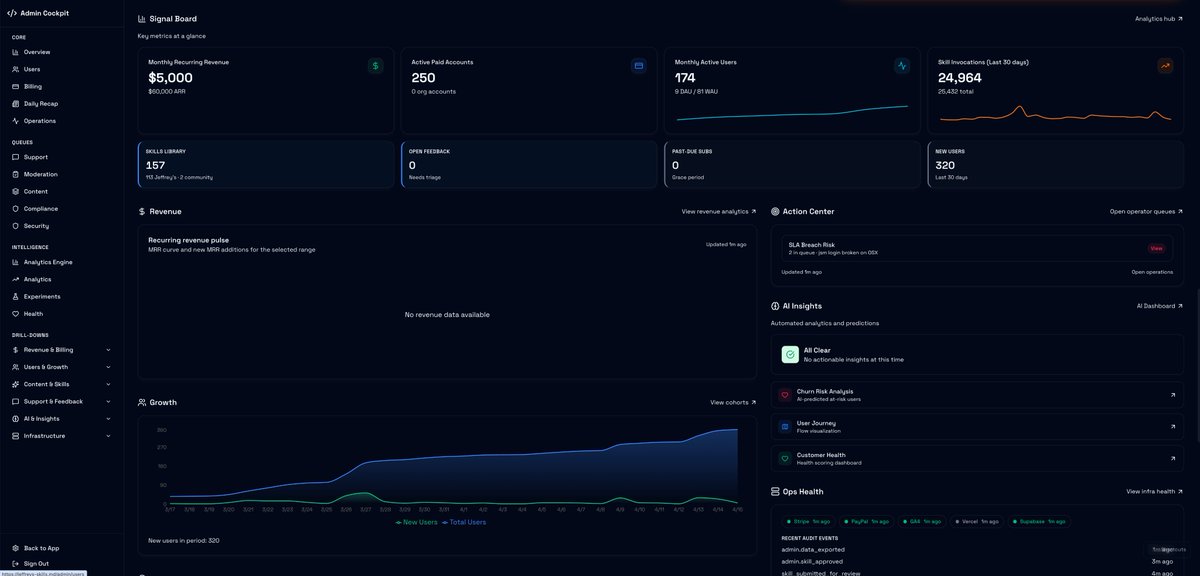
I’m pleased to introduce my latest set of 3 skills that automate the process of migrating your business from Slack to self-hosted Mattermost, an open-source alternative that costs 96% to 99% less. Keep all your message history and say no to Salesforce: jeffreyemanuel.com/writing/slack-…
Jeffrey Emanuel tweet media
English
6
3
53
11.8K
Matt
Matt@Matt_M_M·
@doodlestein I think I was close to #1! I am happy to support you. I get more than the sub price in free knowledge and the skills are next level. I have easily learned more from you than any other source. Thank you! 🙏🏻
English
0
0
0
19
Jeffrey Emanuel
Jeffrey Emanuel@doodlestein·
Just hit 250 subscribers on jeffreys-skills.md ! Feels good. It's hard to convey how much more satisfying it is than doing consulting work, even though the numbers are still pretty small. I think it's because I can feel that it's so scalable. I could easily handle 10k subs!
Jeffrey Emanuel tweet mediaJeffrey Emanuel tweet media
English
17
2
95
5.4K
Matt
Matt@Matt_M_M·
@doodlestein In Jeffrey we trust! Glad to hear this. I had a good day with it too.
English
0
0
2
47
Jeffrey Emanuel
Jeffrey Emanuel@doodlestein·
Clearly my sentiments about Opus 4.7 aren’t universal. But I suggest people wait a day or two before passing judgement, since these could easily be deployment bugs common to new model launches in this new era of heterogeneous inference hardware: x.com/doodlestein/st…
Jeffrey Emanuel@doodlestein

@benhylak You must be seeing a different model than me. I wonder if it depends on your location and which server you get directed to. They could have some requests being handled with GPUs, some with TPUs, some with Amazon silicon, etc. Could even vary between GPU models. Teething pains.

English
5
1
31
5.4K
Jeffrey Emanuel
Jeffrey Emanuel@doodlestein·
OK, I can now report after several hours of use across a bunch of different projects and workflows, Opus 4.7 is really freaking good. I'm using xhigh thinking. Very glad they added a permanent higher-effort setting, since "max" is temporary. I ❤︎ free-market competition!
Claude@claudeai

Introducing Claude Opus 4.7, our most capable Opus model yet. It handles long-running tasks with more rigor, follows instructions more precisely, and verifies its own outputs before reporting back. You can hand off your hardest work with less supervision.

English
37
8
193
15.8K
Matt
Matt@Matt_M_M·
@neogoose_btw NVIm is noyce and MCP is sweet. I know it's all a gift and love what I see. Wondering if you have anything against clis though? Like I want to use it too! 😂
English
0
0
0
435
Dmitriy Kovalenko
Dmitriy Kovalenko@neogoose_btw·
My dear software engineers, I am excited to present you my latest achievement in the code search area that I've been trying to tackle for the last months: ACTUALLY WORKING real-time approximate typo-resistant code search. What does it mean? you: can search any code with any typos you agent: for every search of UserController with 0 results will automatically suggest UserAuthController without additional cost It's already live github.com/dmtrKovalenko/… you can try it right now as MCP for file search
English
98
287
4.4K
435.9K
Jeffrey Emanuel
Jeffrey Emanuel@doodlestein·
You don’t need permission, just a smartphone. I made this a couple years ago (source code on my GitHub) and it does the same thing: alzheimersbuddy.com
Paul White Gold Eagle@PaulGoldEagle

In 2011, a neuroscientist at MIT named Dr. Li-Huei Tsai made a discovery that should have been on the front page of every newspaper on Earth. She exposed mice with advanced Alzheimer's disease to a flickering light pulsing at exactly 40 Hz — forty flashes per second. Nothing else. No drugs. No surgery. Just light at a specific frequency. Within one hour, the amyloid-beta plaques in their brains — the protein deposits that define Alzheimer's — began to dissolve. Not slow. Not gradually. Within sixty minutes. After seven days of daily 40 Hz exposure, plaque levels dropped by 50%. The mice regained memory function. Their neurons began firing in synchrony again. The brain's immune cells — microglia — activated and started clearing the toxic buildup like a cleaning crew that had been asleep for years. The study was published in Nature. The most prestigious scientific journal on the planet. Peer-reviewed. Replicated. Confirmed. That was 2016. It is now 2026. 40 million people worldwide have Alzheimer's. The pharmaceutical industry generates $13 billion per year from Alzheimer's drugs that do not reverse the disease. Not one of them. They slow it. Maybe. Temporarily. At $26,000 per year per patient. A 40 Hz light costs less than a dollar to produce. Dr. Tsai is still at MIT. Her research continues. Phase III human trials are underway. But you will not see this on the evening news. You will not hear your doctor mention it. You will not find it in any pharmacy. Because a frequency that costs nothing cannot sustain a $13 billion industry. The light is 40 Hz. The frequency is real. The science is published. And 40 million people are still waiting for permission to use it.

English
24
93
1.4K
181.3K
Matt
Matt@Matt_M_M·
@Saboo_Shubham_ Config advice is awesome. I started using dot files. I can't believe I didn't think of this. Thanks! 🙏🏻
English
0
0
0
18
Jeffrey Emanuel
Jeffrey Emanuel@doodlestein·
@joshpuckett @asallen Zojirushi Neuro Fuzzy Rice Cooker. This thing works so well. I guess it does two things because you can also make oatmeal with it.
Jeffrey Emanuel tweet media
English
3
0
14
1.2K
joshpuckett
joshpuckett@joshpuckett·
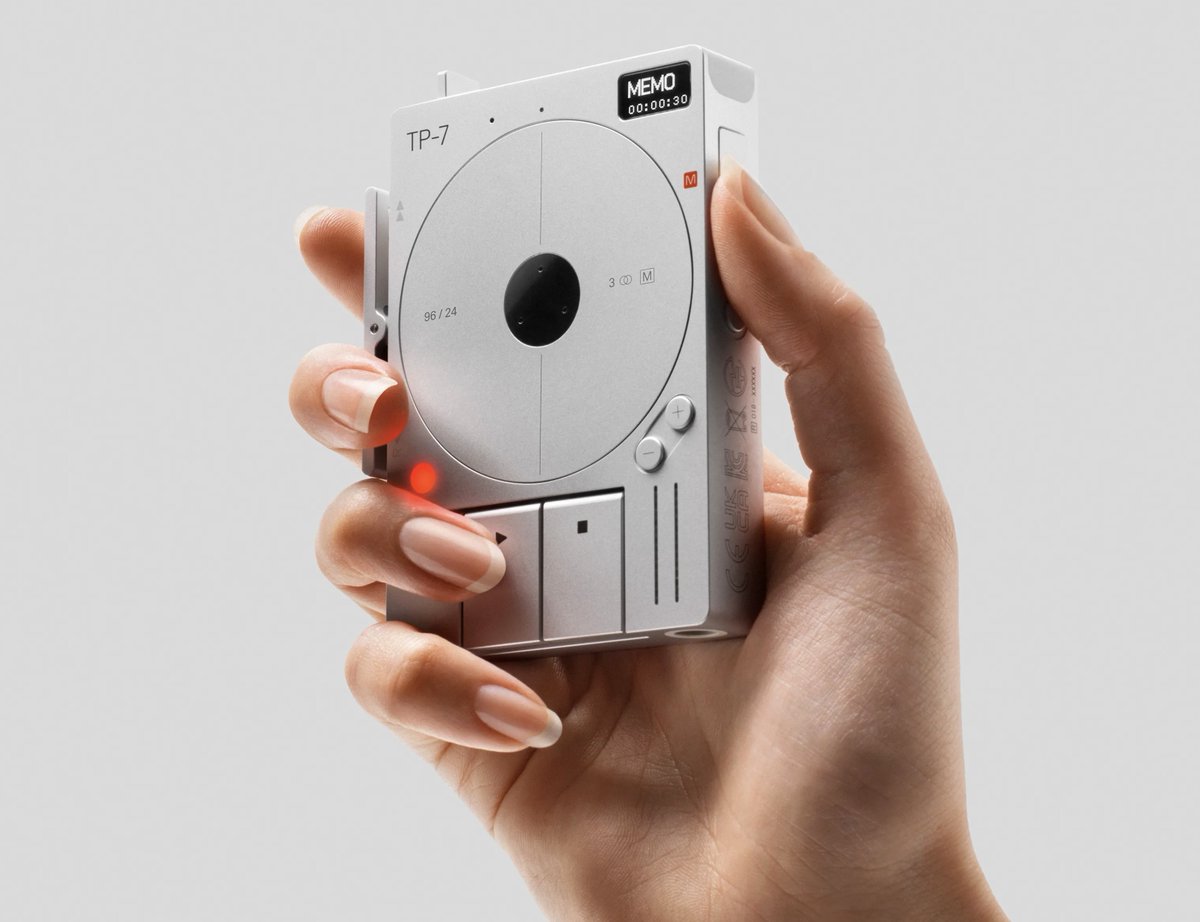
What are your favorite examples of what I call ritual instruments — single purpose objects where the design and execution is simply uncompromising? Like the TP-7 recorder from Teenage Engineering, The Toaster from Balmuda, or !Boring apps from @asallen.
joshpuckett tweet mediajoshpuckett tweet mediajoshpuckett tweet media
English
68
12
470
143.5K
Matt
Matt@Matt_M_M·
@dhh Meh I had WTF moment at 48 and just went for 4. Best decision I EVER made. I love my 4th more than any thing.
English
0
0
0
64
DHH
DHH@dhh·
"Moral of the story? Get married. Stay married. Have kids. Raise them together... You’ll be happier... The data says so." And might I add: Don't wait too long. We started in our early 30s and ended up with three. If we had started in late 20s, we might have gone for four.
Josh Wood@J_K_Wood

“Children don’t make you happy” - The Daily Mail I'm no researcher, but I downloaded the dataset and looked for myself. The study's numbers say the EXACT OPPOSITE of the headline 👇🏻

English
112
85
2.2K
195.6K
Karim C
Karim C@BrandGrowthOS·
what's your current agent tech stack for production workflows? browser automation, api calls, or are you building something completely different?
English
2
0
0
54
Anthropic
Anthropic@AnthropicAI·
New on the Anthropic Engineering Blog: How we use a multi-agent harness to push Claude further in frontend design and long-running autonomous software engineering. Read more: anthropic.com/engineering/ha…
English
320
922
6.7K
1.8M
Matt
Matt@Matt_M_M·
@doodlestein Love 'jsm' and the new prompts!
English
1
0
1
126
Jeffrey Emanuel
Jeffrey Emanuel@doodlestein·
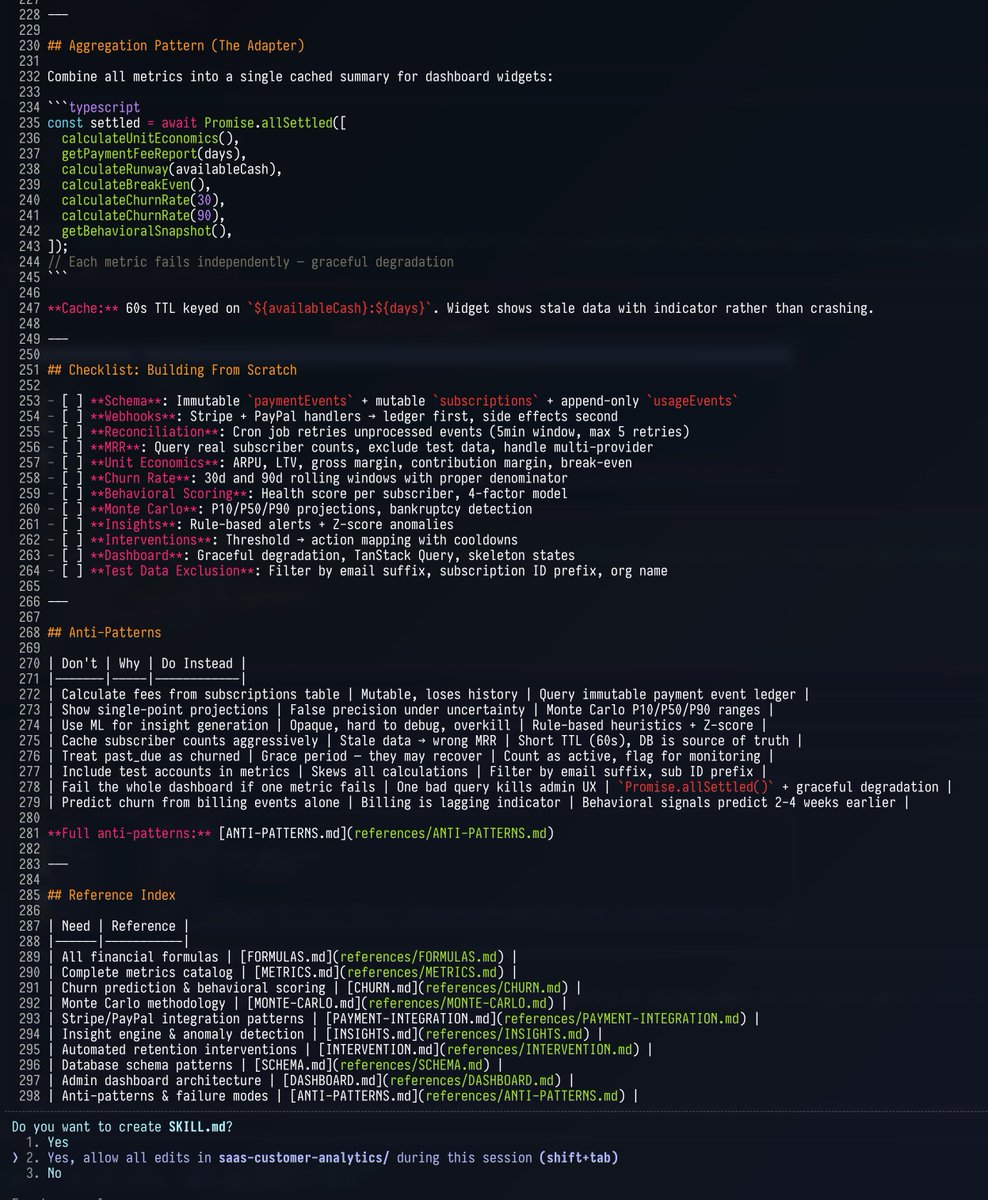
Skills and custom tooling just change everything about how quickly you can communicate extremely complex instructions to agents. I'm now able to operate at such a refined level of economy of expression, and it's all so wonderfully self-referential and self-reinforcing. What am I even talking about? See this prompt I just used in the project folder for my jeffreys-skills.md site; this approach lets me turn all the work I would do anyway for the site into "teachable moments" for other agents: --- ❯ Reread AGENTS .md so it's still fresh in your mind. I want you to use your /cass and /sc skills to read about what we did in this project over the last two days to create an elaborate analytics system for projecting user behavior, churn, billing, etc. for this SaaS product; I want you to use /sw and /operationalizing-expertise to generalize from these specifics to create within the /cs location a new skill called saas-customer-analytics that operationalizes all this in a general, detailed way. The new skill should be super elaborate and in-depth, just like existing sophisticated skills like the ones I asked you to use in here (you can also consult /extreme-software-optimization for another solid example). Really take the time to fully understand what we did and why, and the inner, abstract principles at work so that the skill is more universally applicable to various kinds of SaaS business ventures that also connect to Stripe and PayPal for billing. --- Once this initial version is done, I will do several rounds of refinement and optimization using another skill writing meta skill of mine (one of a small handful I've kept private, even from my website-- sorry!). The goal there is to make the skill maximally agent-intuitive and agent-ergonomic by using progressive disclosure in the optimal way possible, making the top level skill file as clear and direct as can be, etc. Finally, I'll onboard it to my site using my /onboarding-new-skills-to-jeffreys-skills-md skill, which in turn will do things like create a slick interactive visualization for the new skill using my /interactive-visualization-creator (this one IS included in the site!). Starting to get the idea? Skills are a LOT more than just markdown files. The fact that you can use the same skills with Claude, Codex, and Gemini is also so incredibly useful and powerful. The same skill, when wielded by different agent harnesses and different frontier models, leads to very different outcomes! Iterative refinement from applying the same skill using multiple agent types is another big unlock. And I'm not just saying all this stuff to promote my site. I literally use all of these skills, all day, every day, across all of my projects. The thought of managing an agent swarm using my ntm tool without my /ntm and /vibing-with-ntm skills is enough to make me shudder at all the extra, annoying typing and explaining I would need to do to get anything close to the same results. Same goes for my /cass skill and all the rest. And btw, the agent sessions from the last two days that I'm mining with /cass to build that new SaaS analytics skill? All that stuff was built using an array of other skills, including my (non-public) alien artifact skills and idea wizard skill and many more. If you're already using my Agent Flywheel tools, having easy access to these skills is an enormous force multiplier. And I basically shovel every new skill and improvement to existing skills that I make out to users on a daily basis now.
Jeffrey Emanuel tweet media
English
9
6
106
7.1K
Matt
Matt@Matt_M_M·
@LLMJunky Key here is materialized data with time grains and metrics optimized for a job - ads, keywords, replenishing, issue detection - no derivatives. The psychosis part is, it meta prompts a generated ADK agent to operate using its own data and tools it made for the jd.
English
0
0
1
22
Matt
Matt@Matt_M_M·
@LLMJunky Currently an agent factory. I give it a jd/sops of how to manage a $3M Amazon Seller biz. and Fivetran sync in bq. It makes dbt materializations and evaluates 42 known metrics at 93% then deploys a domain agent on ADK with tools, memory, cron, email, Slack.
English
1
0
0
26
am.will
am.will@LLMJunky·
What are your favorite AI agent orchestration tools or strategies that you use? Can be anything. Gas town, agent flywheel, ralph loops, symphony, skills. I want to know, what are you using, and why?
English
35
1
35
6.3K
Matt
Matt@Matt_M_M·
@MatthewBerman Get a DWD service account (if you are on Google Workspace) and read any email on your domain. Systems@ finance@ purchasing@ etc
English
0
0
0
18
Matt
Matt@Matt_M_M·
@MatthewBerman I did it for AP this week. I use watermark syncs to read accounting@ I used auto research to perfect Gemini data extraction to get invoice/PO from attachments. They go to BQ where I have a view that joins on billing webhooks and show invoices received not in billing system
English
1
0
0
83
Matthew Berman
Matthew Berman@MatthewBerman·
If you’ve successfully setup an AI system to triage email (labeling and drafting replies) using full relationship history as context, I want to talk to you.
English
59
7
163
21.7K
Matt
Matt@Matt_M_M·
@bdainton FS is all you need. I have this overwhelming urge to build this for business but I don't think it scales, but I can't shake it. I works well for my 6 person family with horses, dogs, cats, etc.
English
0
0
1
20