Meg
45 posts

Meg retweetledi

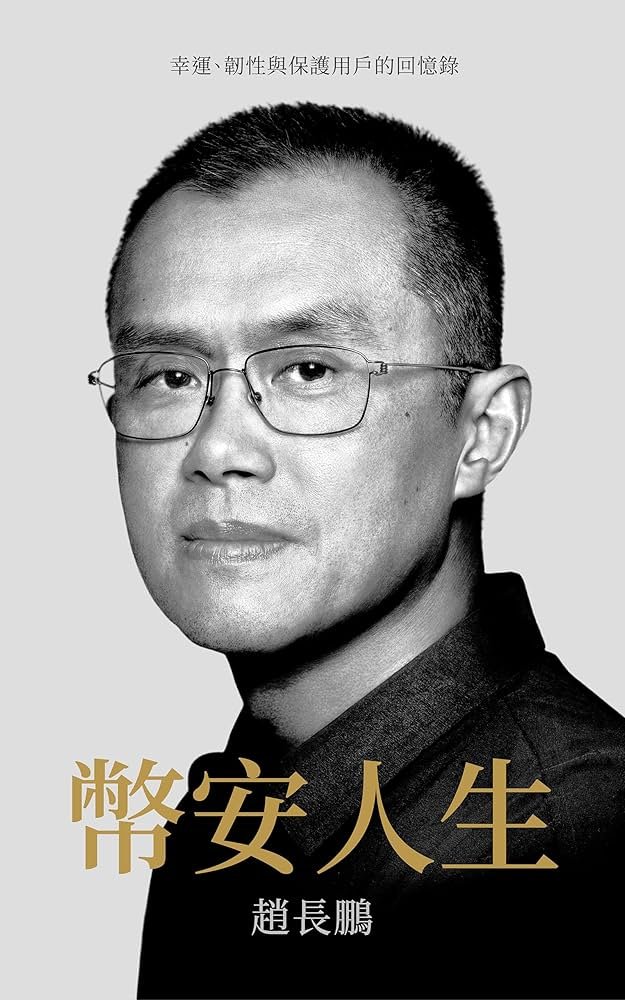
Update on my book Freedom of Money.
The launch is set for next week. Unless the editors pull me in for one more round 😂
E-books are now available for pre-order.
English 👉 a.co/d/08NMxBOH
Traditional Chinese 👉 a.co/d/01f7iQTn
The English physical book will also launch next week. Regional language editions will follow in the coming months — taking a bit longer, but we’re on it.

English
Meg retweetledi
Forgot mention, all proceeds from the book sales will go to Charity. Not trying to make money from the book. 🤣
CZ 🔶 BNB@cz_binance
Update on my book Freedom of Money. The launch is set for next week. Unless the editors pull me in for one more round 😂 E-books are now available for pre-order. English 👉 a.co/d/08NMxBOH Traditional Chinese 👉 a.co/d/01f7iQTn The English physical book will also launch next week. Regional language editions will follow in the coming months — taking a bit longer, but we’re on it.
English
Meg retweetledi


Meg retweetledi



Meg retweetledi

Is quantum computing a risk to Bitcoin?
@dpuellARK and @Unchained's @dhruvbansal and @tom_honzik dive into this question in a brand new white paper. Read here.
ark-invest.com/white-papers/b…
English
Meg retweetledi

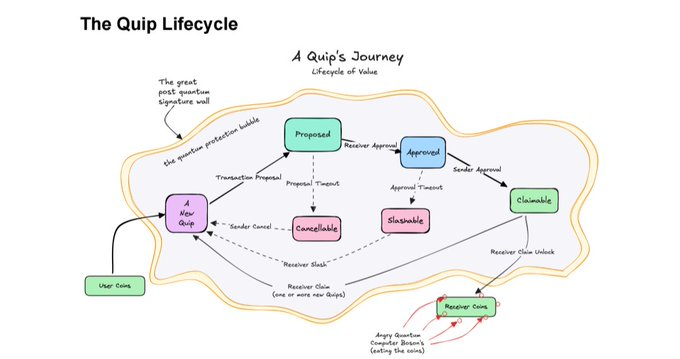
The Quantum Doomsday Clock is ticking for Bitcoin's encryption. How long do we have before quantum computers could potentially break it? Insights from @quipnetwork founders.
English
Meg retweetledi

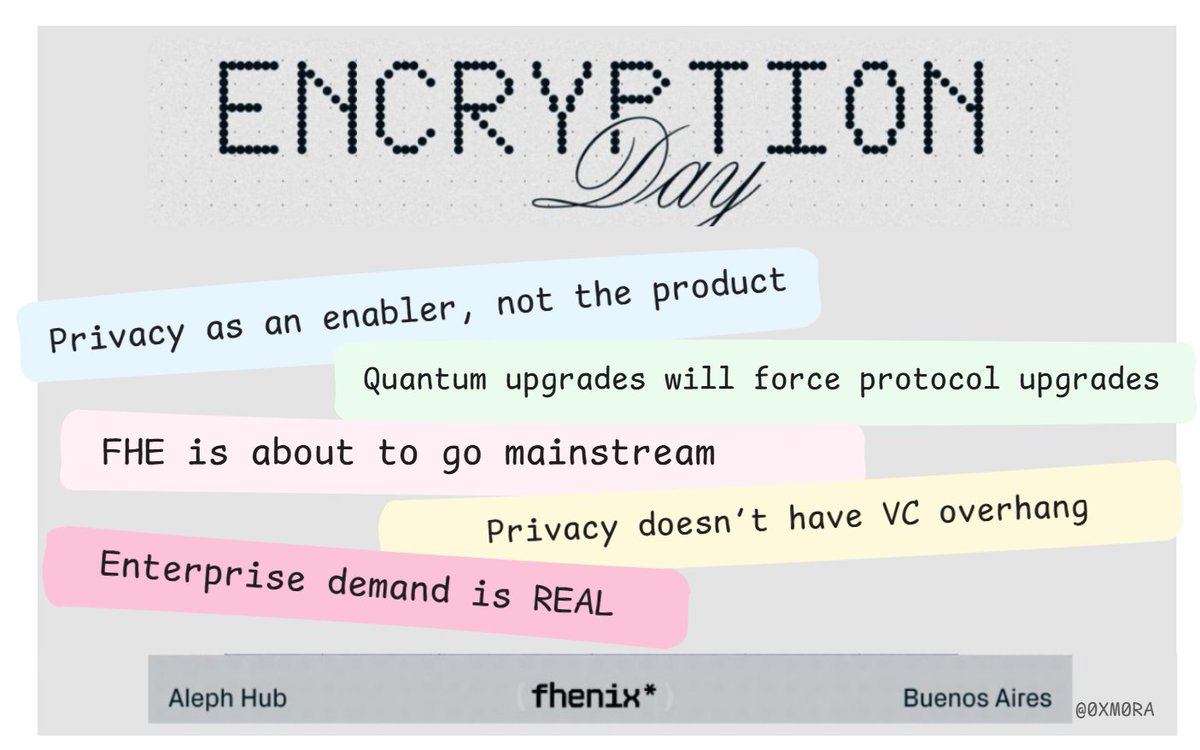
> privacy shouldn't be a product, it should be a L0 infra.
today i missed about half of the @fhenix livestream,
but i caught the rest.
will share a recap of a few of the panels with you.
one of them was about why privacy is becoming a serious topic in web3, what's blocking adoption,
and how we should even define the ethics and boundaries around it.
@rcarback, @furkanakal, @yonatanerez and others spoke.
⇾ why privacy matters now?
- privacy has turned from an extra feature into a basic user need.
- as institutions move onchain, confidential transactions become a practical requirement.
- security means privacy; data in web3 is money.
- users increasingly recognize that full onchain transparency creates real usability and safety problems
----------------------------------------------------
⇾ the role of quantum
- a real threat but not an apocalypse.
- it just means FHE and zk will migrate to quantum resistant versions.
- computational cost goes up, the system doesn't collapse.
----------------------------------------------------
⇾ the core problem of privacy
- terrible ux: users need 10+ wallets just to hide things.
- privacy must be integrated into the background so users don’t need extra steps to achieve it.
- there's also a mental barrier: people think privacy means complexity.
----------------------------------------------------
⇾ the big adoption blocker
- compliance is still unsolved.
- web2 and web3 need shared kyc/aml models using zk.
- without this alignment, enterprise privacy won't scale.
----------------------------------------------------
⇾ why privacy isn't a hype trend?
- doesn’t produce fast profit like nfts.
- it's infra not a product.
- its success is in enabling apps, not making noise.
----------------------------------------------------
⇾ the right way forward
- add privacy to the applications people already use, and make it default rather than optional.
- products should embed privacy as an infrastructure layer.
----------------------------------------------------
⇾ who sets the ethical rules?
- full digital sovereignty (user-controlled),
- context dependent privacy,
- collaborative ethical standards set by builder
the whole panel agreed that privacy is not a trend
it's a necessity, and the ecosystem is finally getting close to making it real.
English
Meg retweetledi

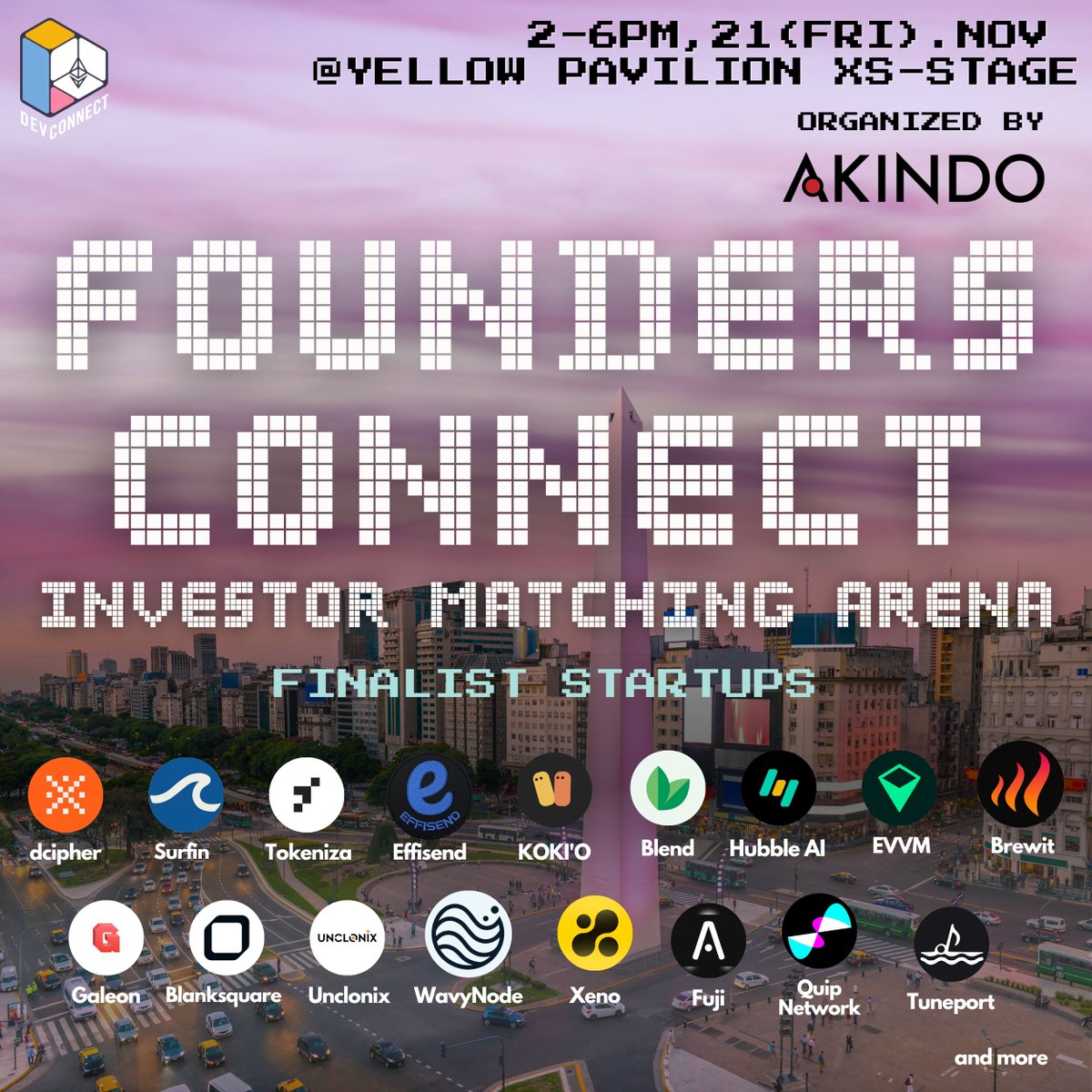
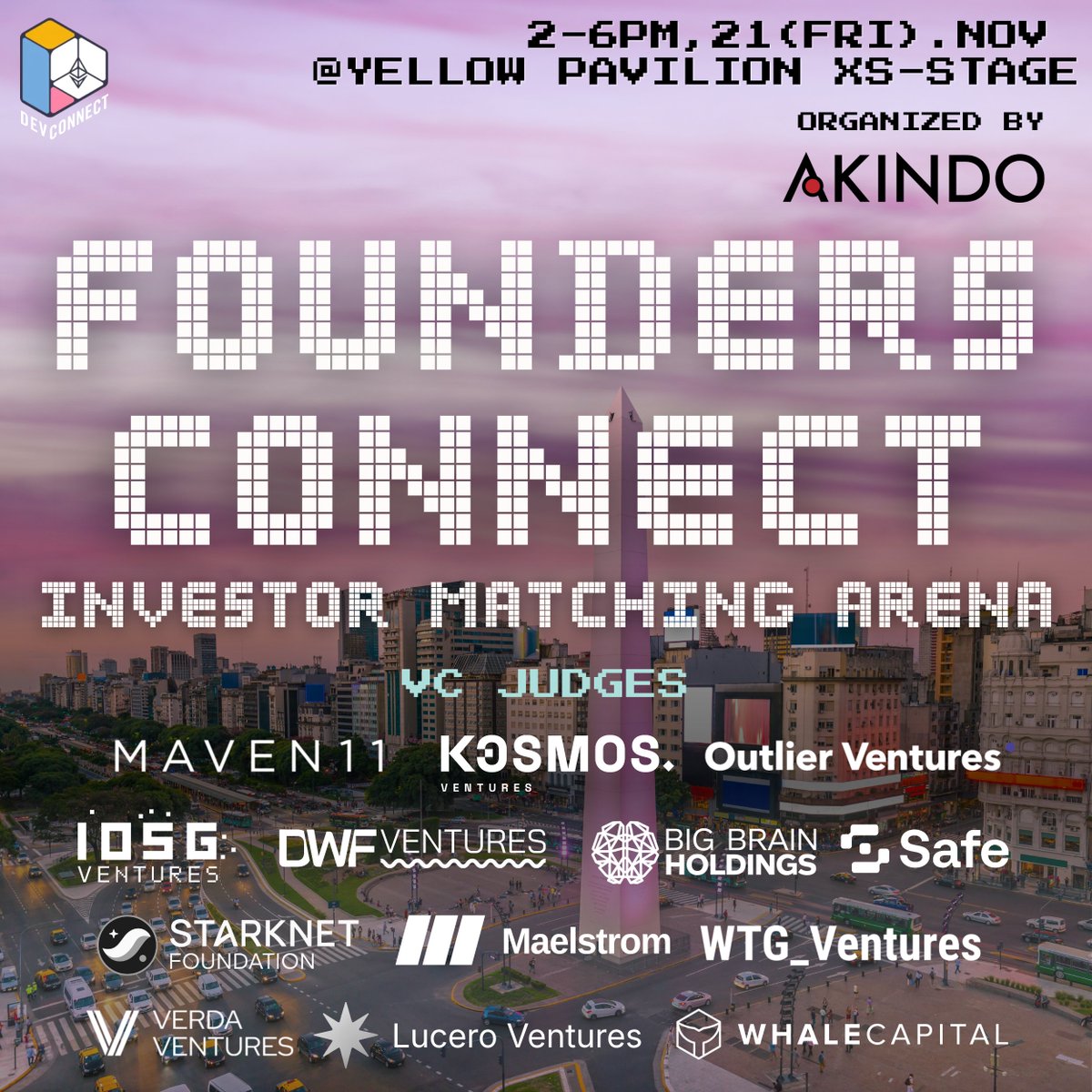
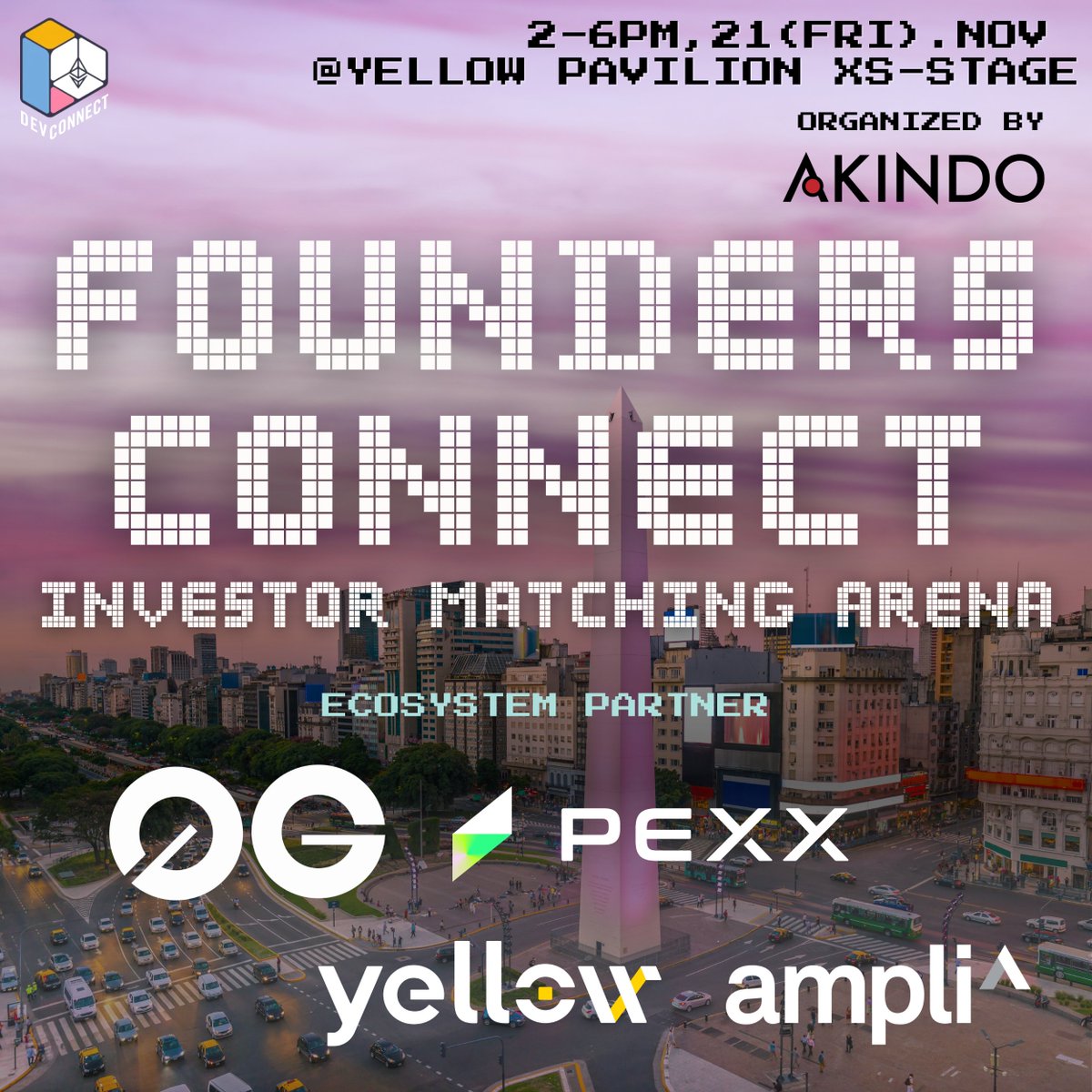
📣📣📣FINALISTS ANNOUNCED: @EFDevcon Founders + VC Connect: Investor Matching Arena is officially locked in💥And it will be one of the top founder–investor events of Devconnect Week.
📍On Nov 21 (Fri), 2–6PM @ Yellow Pavilion XS-Stage,
20_ selected founders will pitch live on stage, in person, in front of 15+ global VCs, followed by deep networking, food, and drinks.
This is where real dealflow happens.
Today, we’re proud to introduce: Ecosystem Partners, Community Partners, VC Partners, and the 20 Finalist Startups.
📌 Ecosystem Partners
@0g_labs @PEXX_Official @yellow__capital @ampli_inc
🌐 Community Partners
@Crecimientolab @supafundxyz @ethereumfndn @EFetheverywhere @buidlguidl @Coiniseasy @mpost_io @odisealabs
💼 VC Judge Partners
@Maven11Capital @outlierventures @IOSGVC @DWFVentures @BigBrainVC @safe @MaelstromFund @WTGVentures @VerdaVentures @LuceroVentures @StarknetFndn @KosmosVC WhaleCapital + More
🔥 Finalist Startups
@dciphernetwork
@surfinswipe
@Tokeniza_tknz
@Effisend_
@kokiodotapp
@blend_money
@meethubble
@AlphixFi
@RollAMate
@brewitmoney
@tuneportxyz_en
@HelloGaleon
@Blanksquare_io
@unclonix
@WavyNode
@fuji_trade_app
@quipnetwork
+ More
These incredible founders will pitch across AI, DeFi, infra, identity, creator tools, and next-gen financem, directly in front of the investors shaping onchain’s future.
💬 Everything happens on-site:
✅ Live pitches (no online)
✅ Real-time VC feedback
✅1:1 matchmaking rounds
✅ Dedicated networking session
✅Food & drinks for all participants
If you're at Devconnect, don’t miss this arena.
This is where founders meet investors, and where long-term partnerships begin.
📍 2–6PM, Nov 21 (Fri)
Yellow Pavilion XS-Stage
🔗 luma.com/devconnect-sho…
🎯 Who Should Come?
👥 Founders: Network with VCs and ecosystem leaders in person
💼 Investors : Meet the most promising builders in one curated session
🏗️ Ecosystem Partners : Connect directly with builders and backers
The best part? Full networking time with food & drinks, so you can build real relationships beyond the stage.
🛠️ Organized by
AKINDO, the world’s largest Buildathon platform powering real ecosystem growth.

English
Meg retweetledi

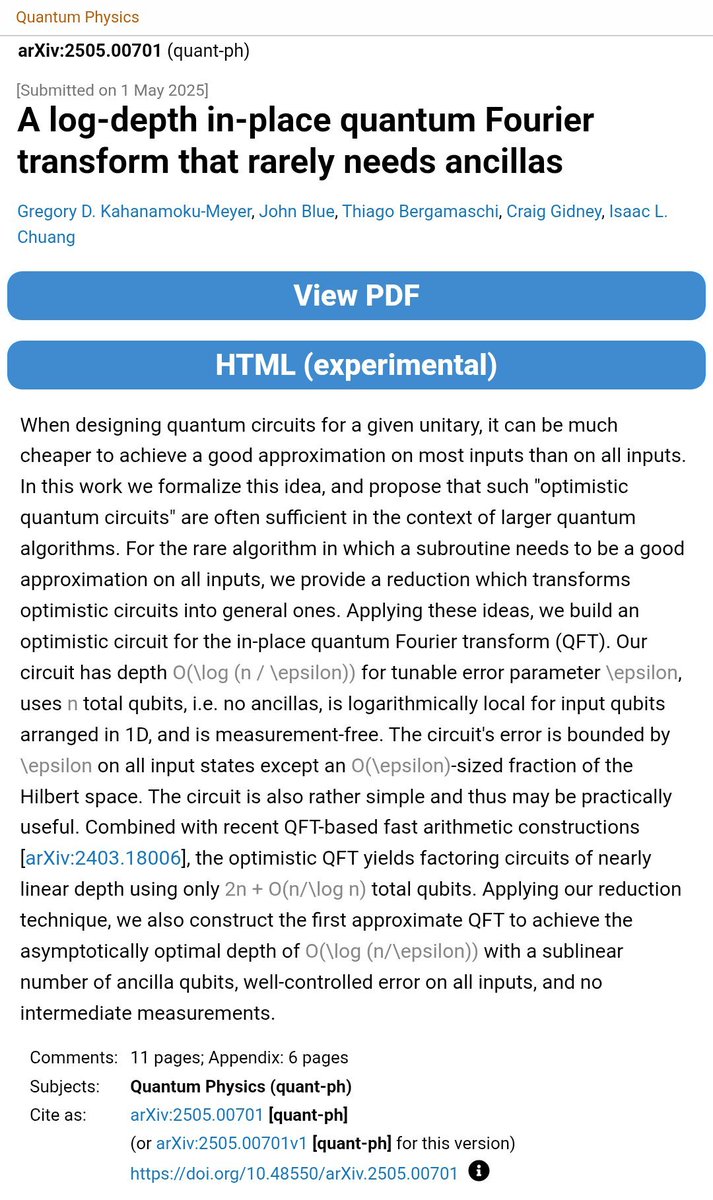
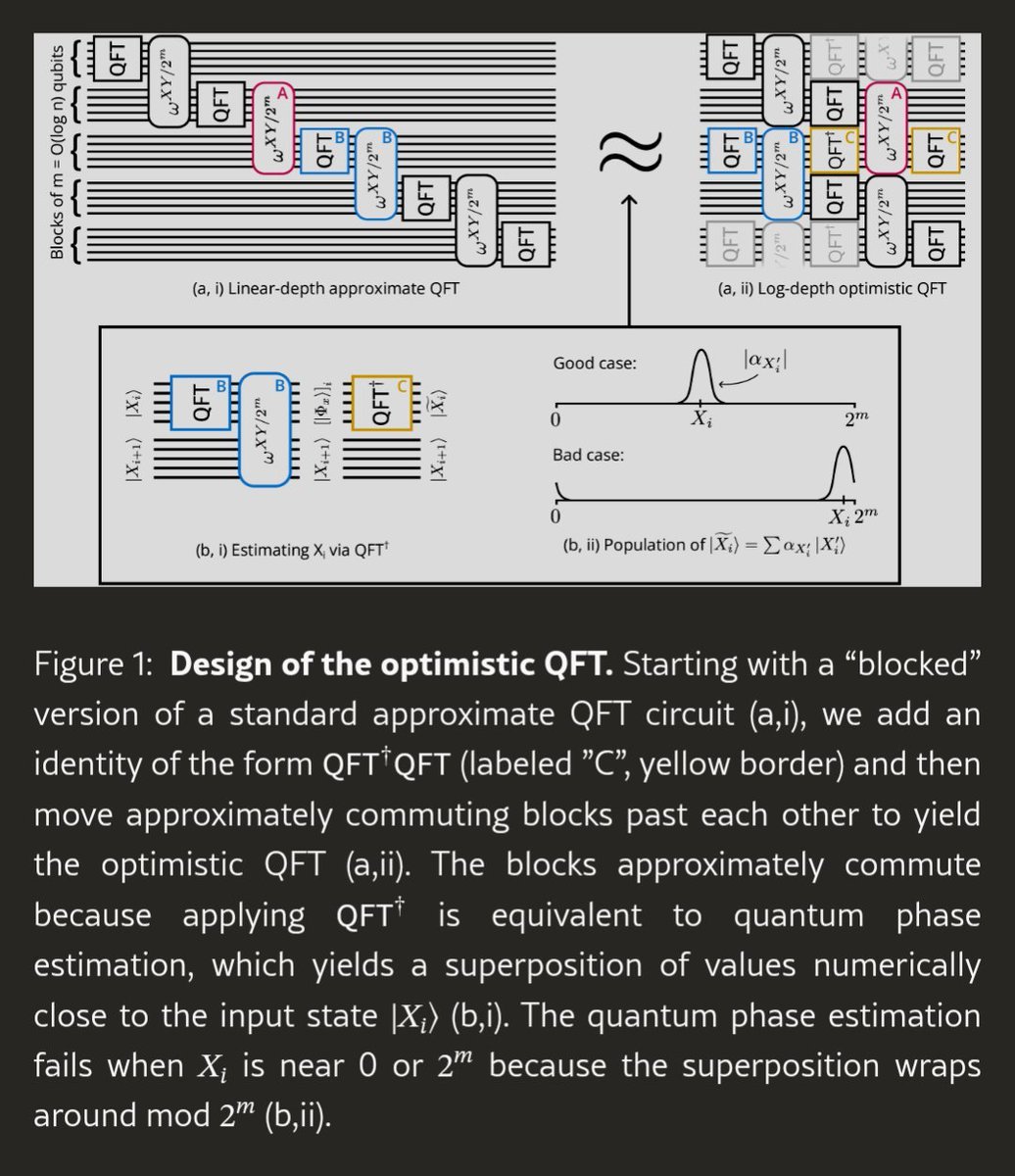
Today is a monumentous day for quantum computing and cryptography. Two breakthrough papers just landed (links in next tweet). Both papers improve Shor's algorithm, infamous for cracking RSA and elliptic curve cryptography. The two results compound, optimising separate layers of the quantum stack. The results are shocking. I expect a narrative shift and a further R&D boost toward post-quantum cryptography.
The first paper is by Google Quantum AI. They tackle the (logical) Shor algorithm, tailoring it to crack Bitcoin and Ethereum signatures. The algorithm runs on ~1K logical qubits for the 256-bit elliptic curve secp256k1. Due to the low circuit depth, a fast superconducting computer would recover private keys in minutes. I'm grateful to have joined as a late paper co-author, in large part for the chance to interact with experts and the alpha gleaned from internal discussions.
The second paper is by a stealthy startup called Oratomic, with ex-Google and prominent Caltech faculty. Their starting point is Google's improvements to the logical quantum circuit. They then apply improvements at the physical layer, with tricks specific to neutral atom quantum computers. The result estimates that 26,000 atomic qubits are sufficient to break 256-bit elliptic curve signatures. This would be roughly a 40x improvement in physical qubit count over previous state-of-the-art. On the flip side, a single Shor run would take ~10 days due to the relatively slow speed of neutral atoms.
Below are my key takeaways. As a disclaimer, I am not a quantum expert. Time is needed for the results to be properly vetted. Based on my interactions with the team, I have faith the Google Quantum AI results are conservative. The Oratomic paper is much harder for me to assess, especially because of the use of more exotic qLDPC codes. I will take it with a grain of salt until the dust settles.
→ q-day: My confidence in q-day by 2032 has shot up significantly. IMO there's at least a 10% chance that by 2032 a quantum computer recovers a secp256k1 ECDSA private key from an exposed public key. While a cryptographically-relevant quantum computer (CRQC) before 2030 still feels unlikely, now is undoubtedly the time to start preparing.
→ censorship: The Google paper uses a zero-knowledge (ZK) proof to demonstrate the algorithm's existence without leaking actual optimisations. From now on, assume state-of-the-art algorithms will be censored. There may be self-censorship for moral or commercial reasons, or because of government pressure. A blackout in academic publications would be a tell-tale sign.
→ cracking time: A superconducting quantum computer, the type Google is building, could crack keys in minutes. This is because the optimised quantum circuit is just 100M Toffoli gates, which is surprisingly shallow. (Toffoli gates are hard because they require production of so-called "magic states".) Toffoli gates would consume ~10 microseconds on a superconducting platform, totalling ~1,000 sec of Shor runtime.
→ latency optimisations: Two latency optimisations bring key cracking time to single-digit minutes. The first parallelises computation across quantum devices. The second involves feeding the pubkey to the quantum computer mid-flight, after a generic setup phase.
→ fast- and slow-clock: At first approximation there are two families of quantum computers. The fast-clock flavour, which includes superconducting and photonic architectures, runs at roughly 100 kHz. The slow-clock flavour, which includes trapped ion and neutral atom architectures, runs roughly 1,000x slower (~100 Hz, or ~1 week to crack a single key).
→ qubit count: The size-optimised variant of the algorithm runs on 1,200 logical qubits. On a superconducting computer with surface code error correction that's roughly 500K physical qubits, a 400:1 physical-to-logical ratio. The surface code is conservative, assuming only four-way nearest-neighbour grid connectivity. It was demonstrated last year by Google on a real quantum computer.
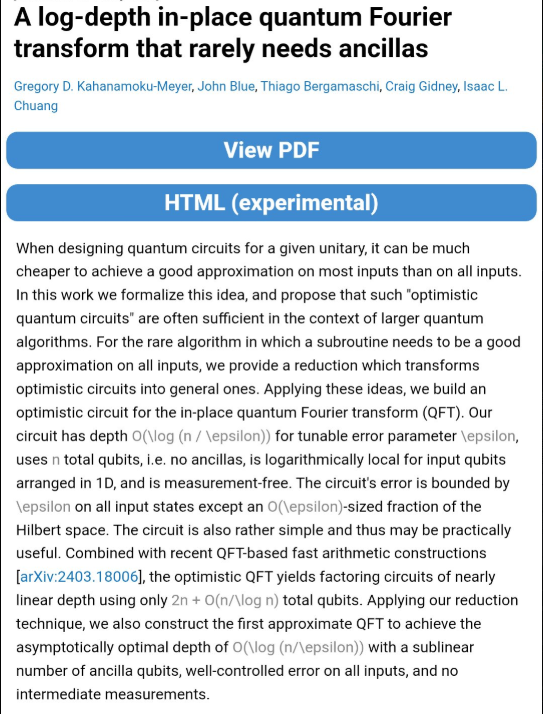
→ future gains: Low-hanging fruit is still being picked, with at least one of the Google optimisations resulting from a surprisingly simple observation. Interestingly, AI was not (yet!) tasked to find optimisations. This was also the first time authors such as Craig Gidney attacked elliptic curves (as opposed to RSA). Shor logical qubit count could plausibly go under 1K soonish.
→ error correction: The physical-to-logical ratio for superconducting computers could go under 100:1. For superconducting computers that would be mean ~100K physical qubits for a CRQC, two orders of magnitude away from state of the art. Neutral atoms quantum computers are amenable to error correcting codes other than the surface code. While much slower to run, they can bring down the physical to logical qubit ratio closer to 10:1.
→ Bitcoin PoW: Commercially-viable Bitcoin PoW via Grover's algorithm is not happening any time soon. We're talking decades, possibly centuries away. This observation should help focus the discussion on ECDSA and Schnorr. (Side note: as unofficial Bitcoin security researcher, I still believe Bitcoin PoW is cooked due to the dwindling security budget.)
→ team quality: The folks at Google Quantum AI are the real deal. Craig Gidney (@CraigGidney) is arguably the world's top quantum circuit optimisooor. Just last year he squeezed 10x out of Shor for RSA, bringing the physical qubit count down from 10M to 1M. Special thanks to the Google team for patiently answering all my newb questions with detailed, fact-based answers. I was expecting some hype, but found none.
English
Looks like @MarioNawfal has caught on, keep an eye on this space because we're making verifiable quantum supremacy available to the masses along with the tools to protect against it
Mario Nawfal@MarioNawfal
🚨 QUANTUM COMPUTING: THE NEXT TECH GOLD RUSH Quantum computing (QC) is about to blow up the tech world. Think of it as AI on steroids—but here’s the kicker: the entire U.S. quantum sector is worth less than Dogecoin. Imagine buying Bitcoin at $500. That’s where QC is today. Regular computers process in 1s and 0s. QCs use qubits, which can be 1, 0, or both at the same time (superposition). Translation? They solve ridiculously complex problems insanely fast. Google recently ran a calculation on its quantum chip in 5 minutes that would take the world’s fastest supercomputer 10 septillion years to complete. Yes, that’s older than the universe. Why it matters: QC isn’t just a cool science project—it’s a game-changer: Medicine: Design drugs in weeks, not years. Finance: Smarter investments, faster decisions. AI: Supercharges AI, making today’s breakthroughs look tiny. McKinsey predicts QC will add trillions to the economy in the next decade. Entire industries will be rewritten. We are closer than most people think. Quantum startups are already hitting 10 qubits, aiming for 100 in 2 years and thousands in 5 years. QC is already solving real problems in medicine, defense, and finance, and platforms like AWS and Google let you rent quantum power right now. Here’s the wild part: the entire U.S. quantum sector is trading for less than a meme coin. Meanwhile, China is outspending the U.S. 5 to 1 in quantum development. Legislation like the Quantum Leadership Act is injecting billions into R&D, but QC’s “ChatGPT moment”—where its potential becomes undeniable—is just 2-3 years away. The upside here is massive. QC isn’t just going to change industries—it’s going to flip them on their heads. When its moment comes, the repricing will be fast and brutal. The clock is ticking. Source: @caprioleio
English